Free CXC Agricultural Science Paper 1 May/June 2019 past paper from 2019. Open the PDF, take a timed test, and study with AI on Caribbean AI.
Answer keys are free on Caribbean AI. View the answers to every past-paper question at no cost - no payment needed - with step-by-step worked solutions and instant AI marking available on Premium.
CSEC Agricultural Science Paper 1 May/June 2019 - Free CXC Past Paper with Answers
Free CXC Agricultural Science Paper 1 May/June 2019 past paper from 2019. Open the PDF, take a timed test, and study with AI on Caribbean AI.
Opening the interactive papers…
Every question from this paper as text. Questions are the property of the Caribbean Examinations Council; Caribbean AI is not affiliated with CXC.
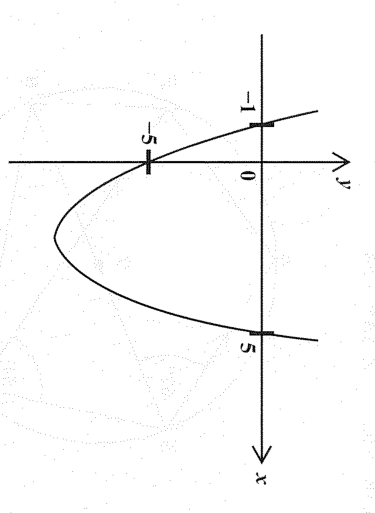
The diagram below shows a sketch of the quadratic function , where b and c are constants.
State the roots of the equation .
For the function a) determine the value of c
b) show that .
State the coordinates of the MINIMUM point on the graph of the function .
The diagram below is an accurate plan of the floor of a room. All the corners are right angles. All measures shown on the diagram are recorded to the nearest metre. (i) State, in terms of x, the length l of the floor. (ii) The perimeter of the floor is 56 metres. a) Determine the value of x. b) Calculate the area of the floor.
State, in terms of x, the length l of the floor.
The perimeter of the floor is 56 metres.
Determine the value of x.
Calculate the area of the floor.
The diagram shows a region S bounded by three lines.
The diagram shows a region S bounded by three lines.
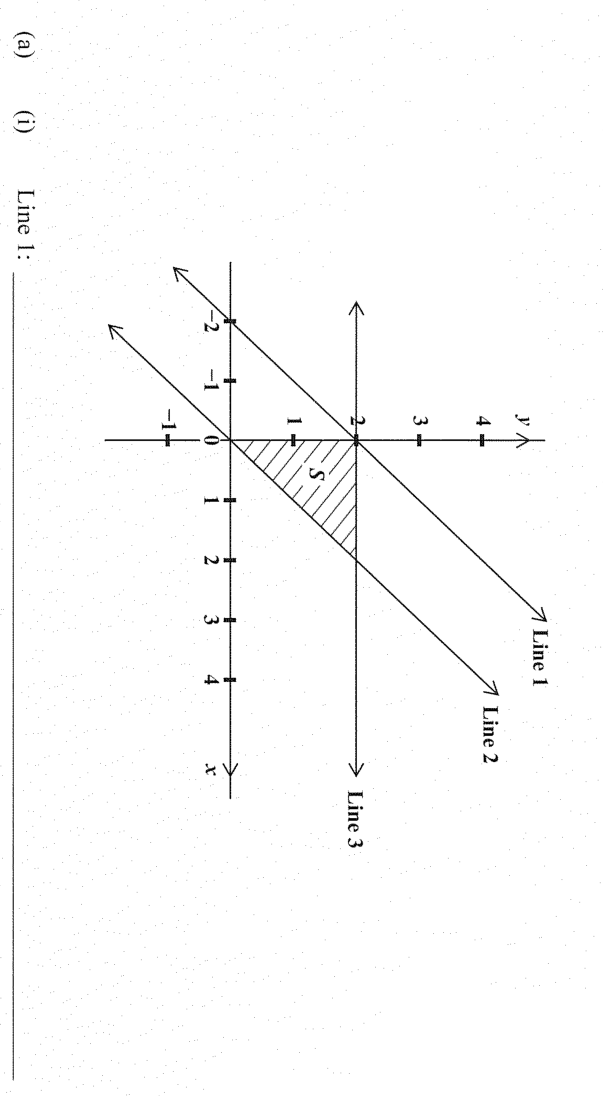
Line 1:
Line 2:
Line 3:
Inequalities that define S:
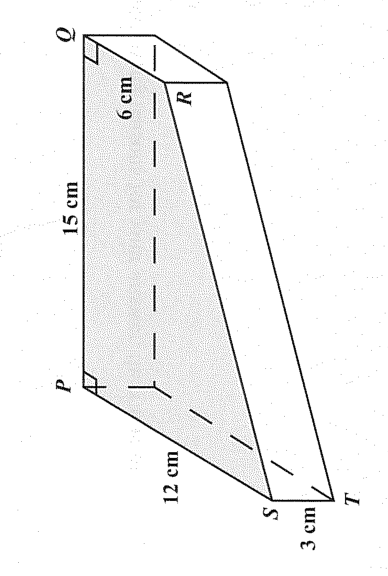
The block of metal has a mass of 1.5 kg. Calculate, in grams, the mass of ONE cubic centimetre of metal.
0.011 g
0.022 g
0.033 g
0.044 g
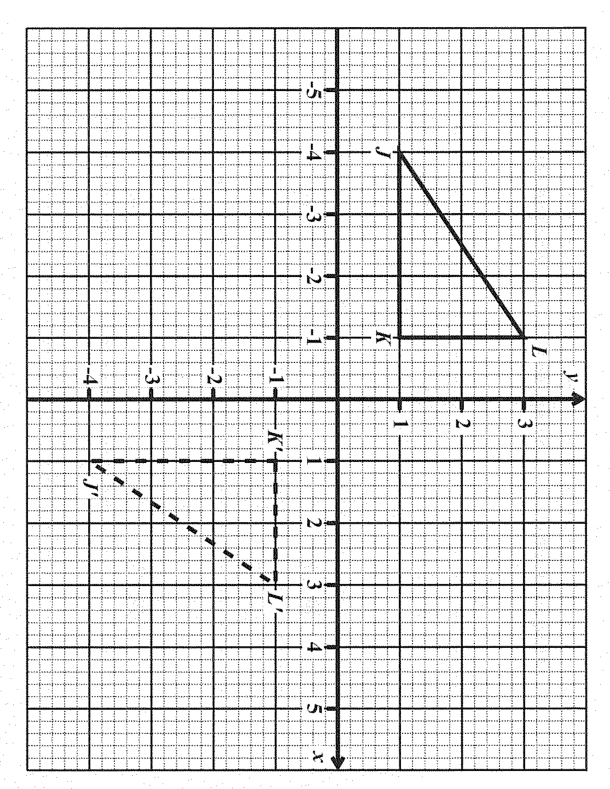
(iv) State the coordinates of triangle J" K" L", the image of triangle JKL, under the translation by the vector (5 -3)
(2 marks)
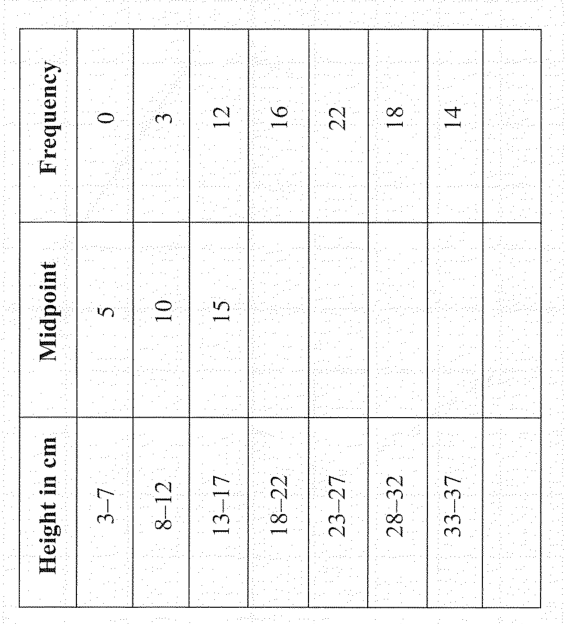
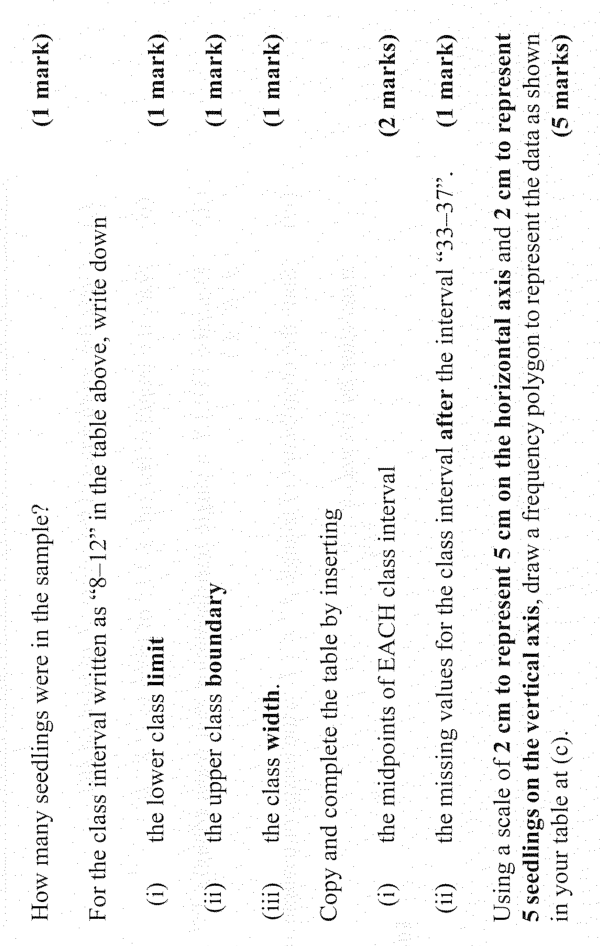
Using a scale of 2 cm to represent 5 cm on the horizontal axis and 2 cm to represent 5 seedlings on the vertical axis, draw a frequency polygon to represent the data as shown in your table at (c).
The frequency polygon is drawn correctly.
The frequency polygon is drawn correctly.
The frequency polygon is drawn correctly.
The frequency polygon is drawn correctly.
The number of dots is .
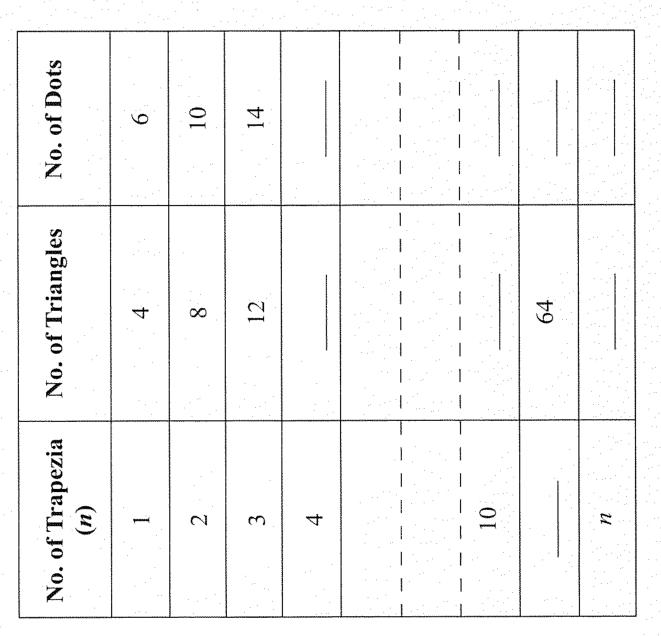
The number of dots is .
The number of dots is .
The number of dots is .
The number of dots is .
(d) The lines whose equations are 3x + y = 2 and 4x - 2y = 6 intersect at (x, y). Show that the point of intersection is (1, -1).
3x + y = 2
4x - 2y = 6
3x + y = 2 and 4x - 2y = 6
The point of intersection is (1, -1).
In the diagram below, not drawn to scale, O is the centre of the circle. The lines SK and AF are parallel.
Calculate, giving reasons for your answer, the measure of: (i) ∠ FAW (ii) ∠ SKF (iii) ∠ ASW
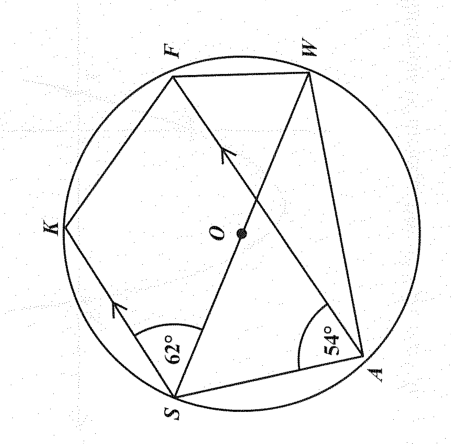
(i) 62° (angle in the same segment) (ii) 116° (opposite angles of a cyclic quadrilateral) (iii) 54° (alternate segment theorem)
(i) 116° (angle in the same segment) (ii) 62° (opposite angles of a cyclic quadrilateral) (iii) 116° (alternate segment theorem)
(i) 54° (angle in the same segment) (ii) 116° (opposite angles of a cyclic quadrilateral) (iii) 62° (alternate segment theorem)
(i) 62° (angle in the same segment) (ii) 54° (opposite angles of a cyclic quadrilateral) (iii) 116° (alternate segment theorem)
If and , determine the position vector of L.
(3 marks)
The bearing of P from Q is 252°. Calculate the bearing of R from P.
(4 marks)