Free CXC Information Technology Paper 2 May/June 2009 past paper from 2009. Includes a worked answer key. Open the PDF, take a timed test, and study with AI on Caribbean AI.
Answer keys are free on Caribbean AI. View the answers to every past-paper question at no cost - no payment needed - with step-by-step worked solutions and instant AI marking available on Premium.
CSEC Information Technology Paper 2 May/June 2009 - Free CXC Past Paper with Answers
Free CXC Information Technology Paper 2 May/June 2009 past paper from 2009. Includes a worked answer key. Open the PDF, take a timed test, and study with AI on Caribbean AI.
Opening the interactive papers…
Every question from this paper as text. See the answers and worked solutions. Questions are the property of the Caribbean Examinations Council; Caribbean AI is not affiliated with CXC.
Answer Question 1 and any TWO other questions from this section.
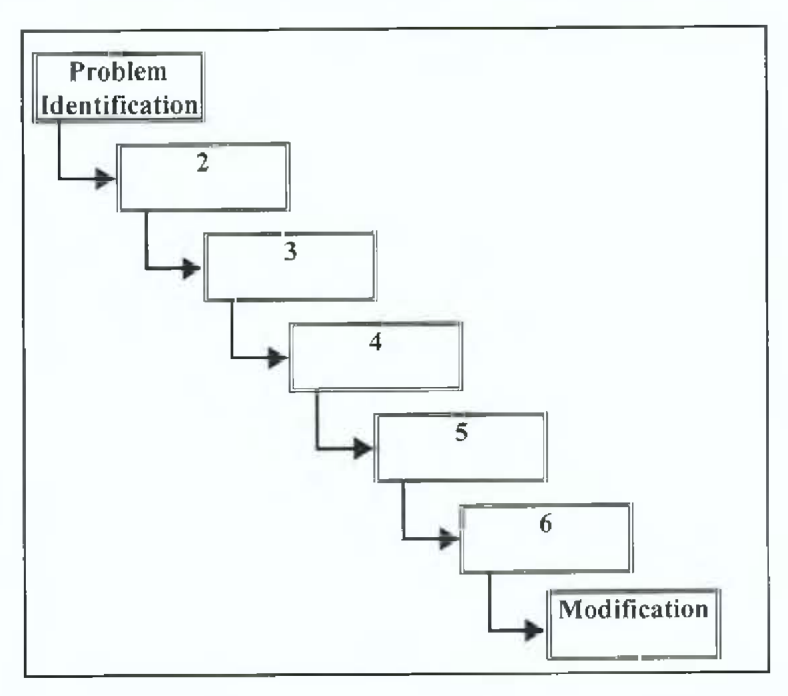
(a) The following diagram illustrates the stages in the Systems Development Life Cycle. Write the numbers 2, 3, 4, 5 and 6 on separate lines in your answer book. Using the phases listed below, match a phase to the number that corresponds to the order in the diagram shown below, and write that phase next to the number in your answer booklet.
Phases: Design Post-implementation review Feasibility study Analysis Implementation
[27 marks]
The Systems Development Life Cycle includes activities such as:
Activity 1: Developing a sound insight into the requirements for the new systems as well as a sound grasp of what the issues are with the old system Activity 2: Producing a descriptive representation (in a diagram) of what the new system could become Activity 3: Installing a new system or converting an old system to a new one
For EACH of the activities listed above, state the phase in the Systems Development Life Cycle where the activity occurs.
[3 marks]
Why is the Post Implementation Review stage important to the Systems Development Life Cycle?
[2 marks]
Often a new system requires new hardware. Give ONE advantage and ONE disadvantage of acquiring and installing new hardware.
[2 marks]
Explain the difference between the following methods of converting from an old system to a new one using:
[3 marks]
List ONE advantage of the phased implementation and ONE advantage of the parallel running methods.
[2 marks]
What is the difference between a 'data flow diagram' and a 'data dictionary'?
[3 marks]
Create a decision table to represent the following scenario:
If a client has enough money in his account and the item is available, then the sale is made. If the item is not available, no sale can be made. If the client does not have sufficient funds then even if the item is available, the sale is not made.
[7 marks]
Meter readers visit EACH house to check the electricity used. The current readings are recorded directly into a device. At the end of the day, all the data are transferred directly into the computer system to avoid transcription errors.
(a) (i) State TWO relevant items of data that should be printed on the data capture document.
[24 marks]
Describe TWO validation checks that should be performed when the data are read into the computer system.
[4 marks]
Explain how it might still be possible for incorrect data to be stored in the computer system.
[2 marks]
Since the company has a large number of accounts, the billing process is run overnight at regular times.
(a) State the type of processing that would be MOST appropriate in this case.
State THREE functions of an operating system.
[3 marks]
Which type of processing mode that would be BEST suited for EACH of the following applications:
Monthly payroll?
[1 mark]
Transactions at an automatic teller machine?
[1 mark]
Processing electricity bills?
[1 mark]
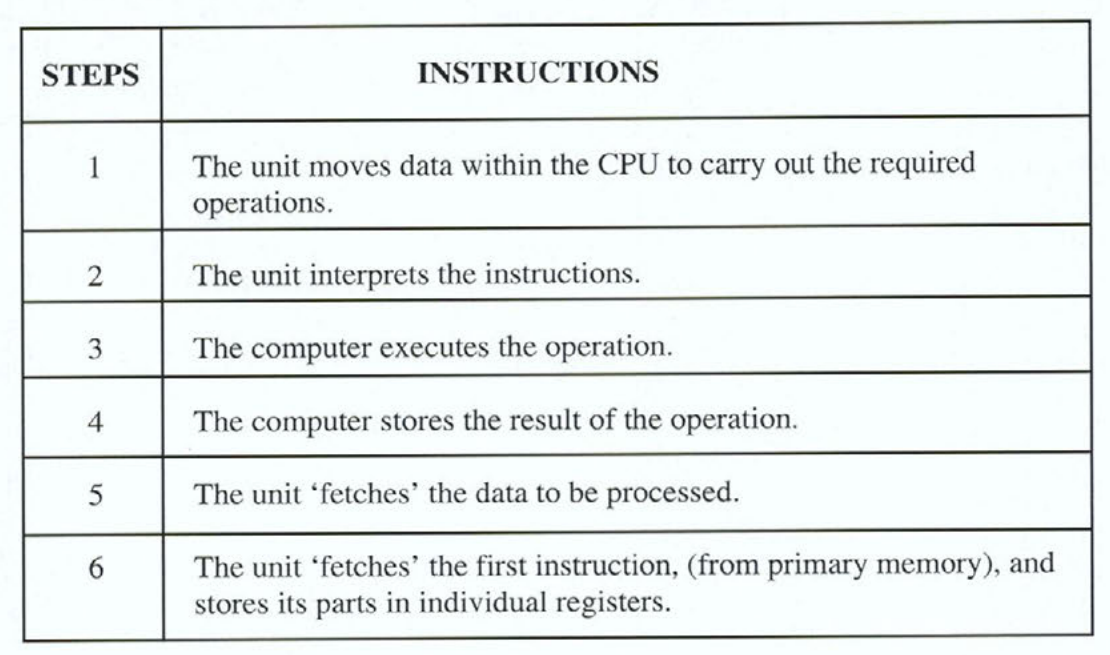
Table 1 below shows the steps to be taken by the Central Processing Unit (CPU) in the execution of instructions.
| STEPS | INSTRUCTIONS |
|---|---|
| 1 | The unit moves data within the CPU to carry out the required operations. |
| 2 | The unit interprets the instructions. |
| 3 | The computer executes the operation. |
| 4 | The computer stores the result of the operation. |
| 5 | The unit 'fetches' the data to be processed. |
| 6 | The unit 'fetches' the first instruction, (from primary memory), and stores its parts in individual registers. |
Table 1
Name the part of the CPU that performs the execution of these instructions.
[1 mark]
State the general function of this part.
[1 mark]
Use the table above to write the sequence of numbers that shows the correct order of the steps for executing the instructions.
[3 marks]
Identify ONE of the steps used in the instruction cycle.
[1 mark]
Identify ONE of the steps used in the execution cycle.
[1 mark]
Explain EACH of the following terms:
Sequential file
[2 marks]
Master file
[2 marks]
Transaction file
[2 marks]
Key field
[2 marks]
A local vendor wants to keep records of the merchandise that he sells and the customers who buy the merchandise. He needs at least two files – the merchandise file that stores the items sold and the customer file that stores data on customers.
(i) For EACH of the files mentioned in (b) suggest an appropriate data field that can be used as a primary key.
Suggest THREE additional fields that are appropriate for EACH file mentioned at (b).
[6 marks]
Explain how the purchase information is used to update the merchandise file immediately, when an item is sold to a customer.
[4 marks]
Explain how the updating process works if the merchandise file is a sequential file on disk. (Assume one transaction per merchandise.) Note that the purchase information is stored in a transaction file on disk and the merchandise file is updated at the end of EACH day.
[4 marks]
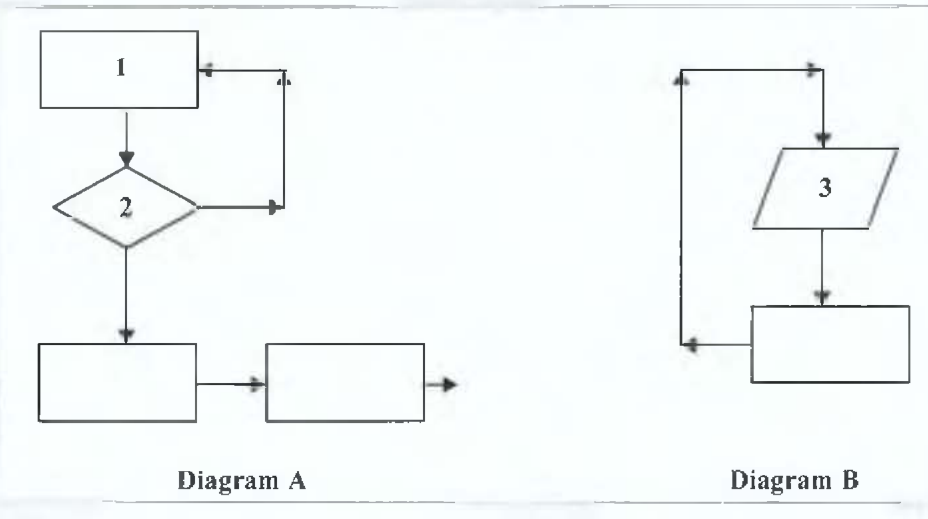
Diagram A and Diagram B below, show TWO types of loops used in programming.
(i) Identify the type of loop that is being used in EACH diagram.
Identify the three flowcharting symbols labelled 1, 2 and 3 in diagrams A and B below.
[3 marks]
Give ONE example EACH, of a statement that can be used to replace symbols 2 and 3 respectively, when translating into code.
[2 marks]
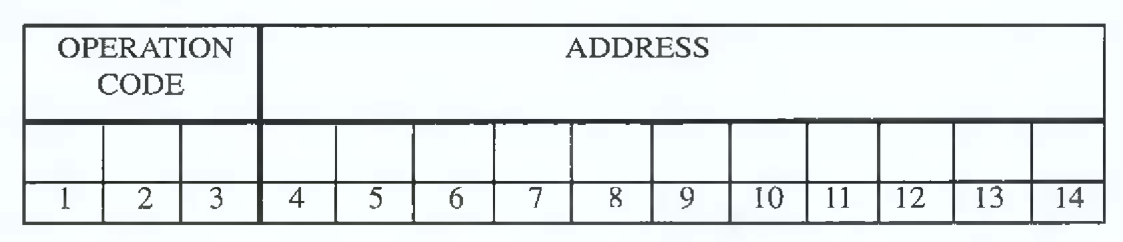
Diagram C below, shows a program instruction for a simple computer that is designed with a fixed word length of 14 bits.
(i) Calculate the number of different operation codes that this computer is capable of using.
Calculate the MAXIMUM number of directly addressable locations available.
[2 marks]
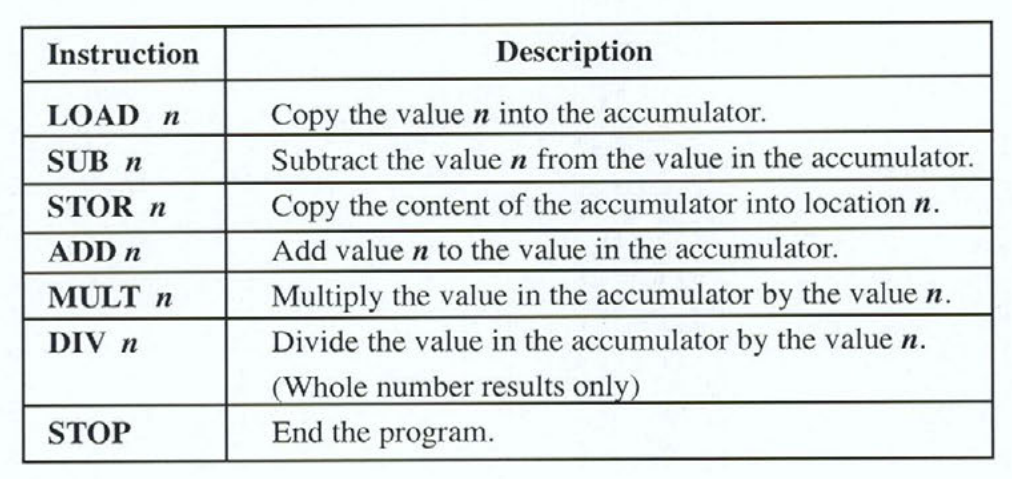
A certain assembly language contains the following instructions:
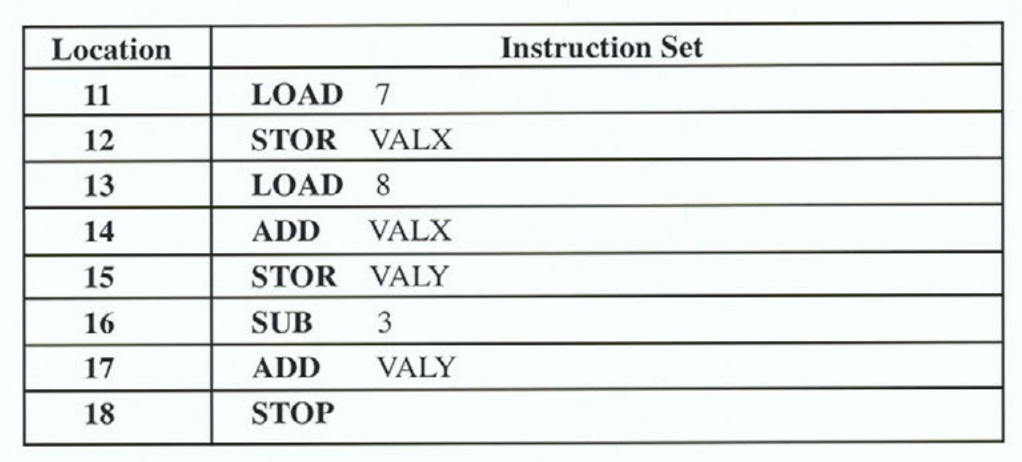
Consider the following instruction set.
(i) What would be the values in VALX, VALY and the accumulator at the end of the execution of this instruction set? (ii) Write THREE more lines of code in this Assembly Language, by adjusting the program you now have so that:
[13 marks]
What would be the values in VALX, VALY and the accumulator at the end of the execution of this instruction set?
[3 marks]
Write THREE more lines of code in this Assembly Language, by adjusting the program you now have so that:
[6 marks]
Rewrite this program in a structured programming language (like Pascal) so that the SAME outcome is achieved.
[4 marks]
SECTION II PROGRAMMING
Answer Question 5 and any TWO other questions in this section.
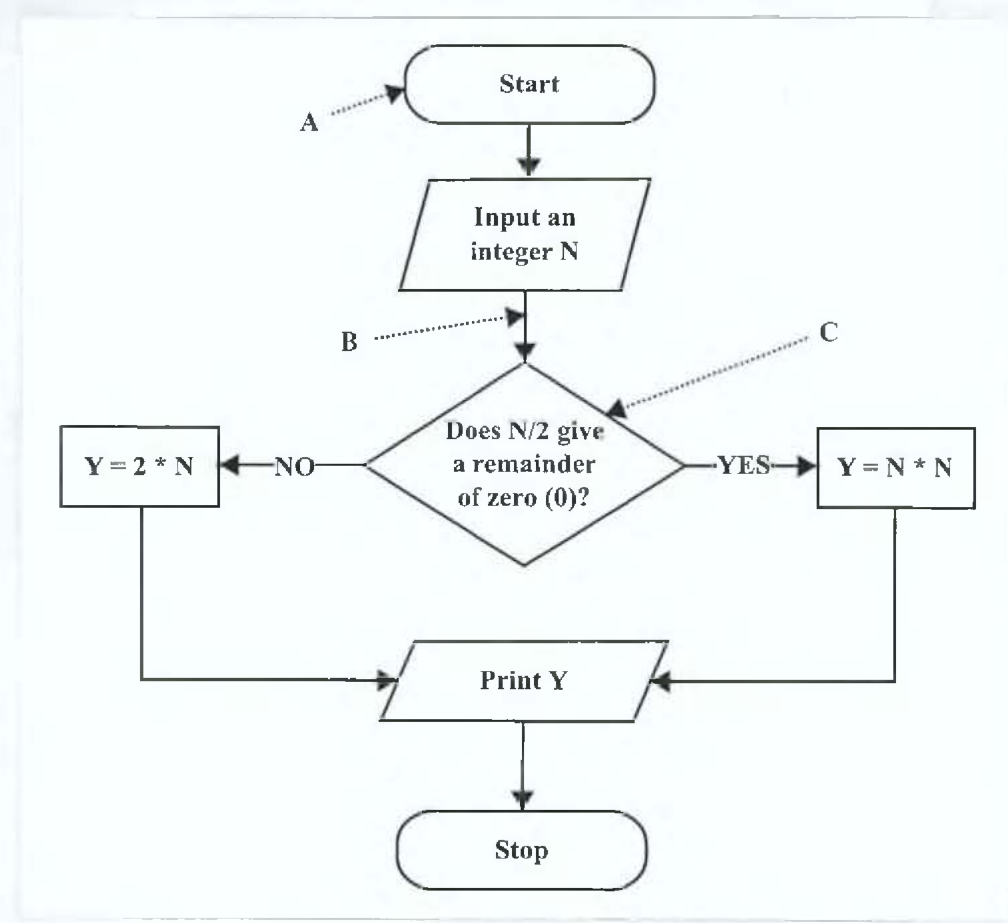
The following questions (a), (b), (c) are based on the flowchart below:
[27 marks]
Name the symbols labelled A and B and give the function of EACH symbol named.
[4 marks]
State what would happen if the question in the box (C) read "Does N/1 give a remainder of zero (0)?".
[1 mark]
Determine the output of the flowchart when the following input values are used as test data:
(i) 13 (ii) 36
[4 marks]
13
[2 marks]
36
[2 marks]
Write a structured program that (i) prompts the user for an even integer (ii) accepts the input (iii) determines if ( MOD 2) is not zero (iv) prints the message "Only even numbers accepted", if the result is not zero (v) otherwise program prints the message "This is an even number", and the number .
[10 marks]
prompts the user for an even integer
[1 mark]
accepts the input
[1 mark]
determines if ( MOD 2) is not zero
[2 marks]
prints the message "Only even numbers accepted", if the result is not zero
[2 marks]
otherwise program prints the message "This is an even number", and the number .
[4 marks]
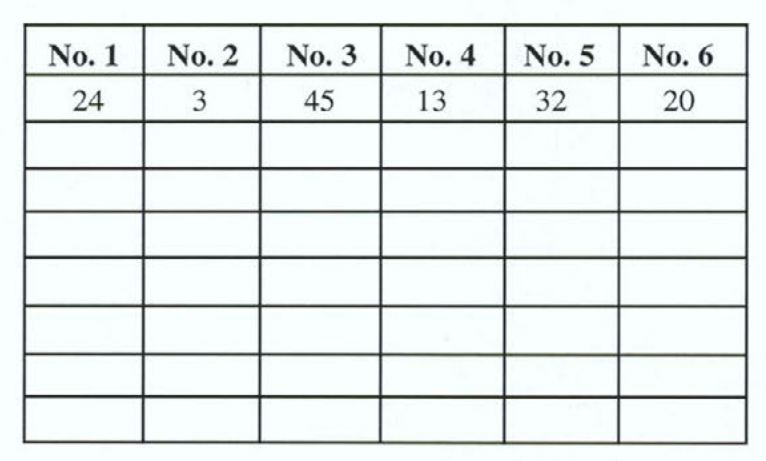
The following algorithm is used to manipulate a list of numbers.
Step 1: Compare the first two numbers in the list. Step 2: If the first number is smaller than the second number then compare the second number with the third number. Step 3: If the first number is larger than the second number then swap them so that the number originally in the first place will now be in the second place, while the number originally in the second place would now be in the first place. Step 4: Now compare the numbers in positions two and three and repeat Steps 2 and 3. Move to the next pair of numbers until the full list is completed then start again until no swaps are registered. Step 5: Write out the sorted list.
Copy and complete the trace table using the list of numbers given and the algorithm provided above.
[8 marks]
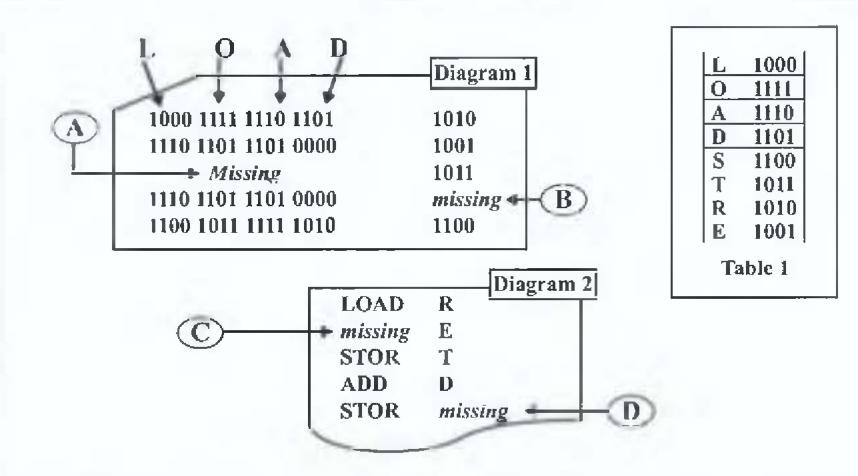
The TWO sets of codes below represent the same algorithm written using two different levels of programming languages. (i) What level of programming languages does the code in Diagram 1 represent? (1 mark) (ii) What level of programming languages does the code in Diagram 2 represent? (1 mark) (iii) Name ONE programming language that is NOT represented in the diagrams shown. (1 mark) (iv) Pieces of code are missing from EACH of the diagrams. Using the key in the table (Table 1), and the corresponding lines in the programs, write the missing pieces of code, A, B, C, and D. (4 marks) (v) Write a piece of code (in a language different from those shown) that will accomplish the same task. (5 marks)
[25 marks]
Six bits are being used to store positive and negative integers in a computer using the two's complement representation method. (i) Determine, in binary and in decimal, the LARGEST integer that can be stored. (2 marks) (ii) Two binary numbers, 10111 and 11001 are added together using the six bit machine. Explain the result of the computation. (2 marks) (iii) Determine the binary representation of -1. (2 marks) (iv) Determine the binary representation of -23. (2 marks) (v) Determine the decimal value represented by 110010. (2 marks) (vi) Determine the decimal equivalent of the binary fraction 0.0111. (3 marks)
[13 marks]
The following algorithm manipulates an array of eight (8) integers. The array is denoted as NUMB(j), where j is the index of the array.
for j = 1 to 4 do
begin
temp = NUMB(j)
NUMB(j) = NUMB (9 - j)
NUMB (9 - j) = temp
end
(i) Using the array of integers (25, 20, 38, 23, 17, 33, 30, 21) develop a trace table to show the results of running the algorithm on the values provided. (8 marks) (ii) Develop a program flowchart, using the appropriate symbols, to correspond to this algorithm. (8 marks)
[16 marks]
There are 16 insurance agents at Called N Covered insurance agency. For EACH agent TWO items of data are available to the supervisor, the salesperson's name and the monthly sales for each month.
Write an algorithm to perform EACH of the following: (i) Read these data and print the name and monthly sales for EACH agent. (3 marks) (ii) Calculate and print the average sales for ALL salespersons. (5 marks)
[8 marks]
Explain the difference between (i) testing a program and debugging a program (2 marks) (ii) a real number and an integer (2 marks) (iii) a 'dry run' and 'program trace'. (2 marks)
[6 marks]
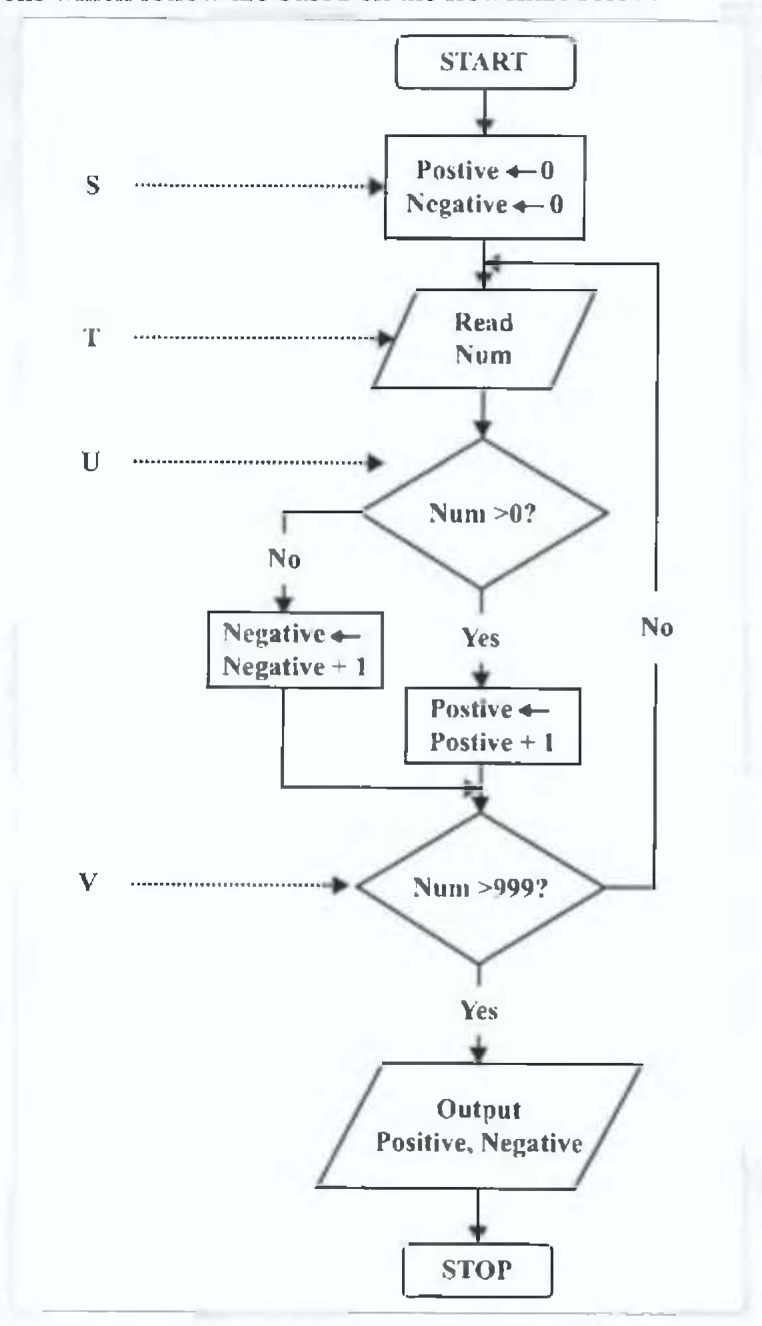
The questions which follow are based on the flowchart below. (i) In the flowchart above, THREE variables are used. Identify the variables. (3 marks) (ii) Step V stops the loop from continuing (loop terminator). What are the functions of the steps S, T, and U? (3 marks)
[6 marks]
Write an algorithm to correspond to this flowchart.
[5 marks]
Calculate the output, if the input values are $12, -45, 20, 78, -9, 36, 44$.
[2 marks]
Write a short programming routine in a structured language, that will take as its input, a number representing the quantity of tourists, and then calculate the number of canoes needed, and print that number. If the number of remaining tourists is less than THREE, print "The remaining visitors will not be able to see this site today".
[5 marks]