9.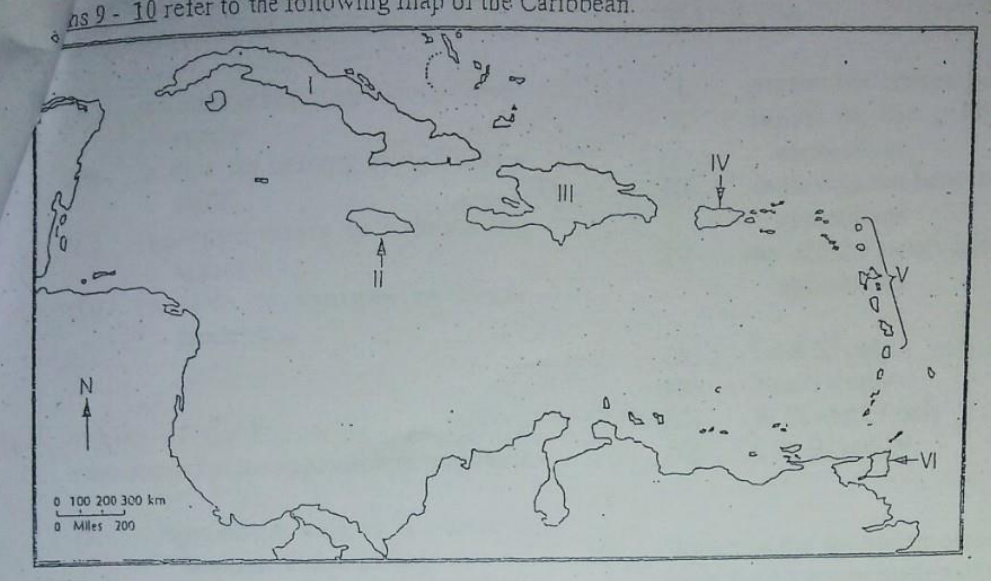
On which of the following islands was the first Spanish settlement established?
- (A)
I
- (B)
II
- (C)
III
- (D)
IV
Free CXC Caribbean History Paper 1 May/June 2011 past paper from 2011. Includes a worked answer key. Open the PDF, take a timed test, and study with AI on Caribbean AI.
Answer keys are free on Caribbean AI. View the answers to every past-paper question at no cost - no payment needed - with step-by-step worked solutions and instant AI marking available on Premium.
CSEC Caribbean History Paper 1 May/June 2011 - Free CXC Past Paper with Answers
Free CXC Caribbean History Paper 1 May/June 2011 past paper from 2011. Includes a worked answer key. Open the PDF, take a timed test, and study with AI on Caribbean AI.
Opening the interactive papers…
Every question from this paper as text. See the answers and worked solutions. Questions are the property of the Caribbean Examinations Council; Caribbean AI is not affiliated with CXC.
In which of the following areas were the Maya LEAST renowned?
Farming
Fishing
Astronomy
Architecture
Which of the following statements are TRUE of the Kalinago?
I. They settled mainly in Cuba. II. They adopted many Taino customs. III. They were skilled sailors and fishermen. IV. They fiercely resisted the Spanish invaders.
I and II only
I and III only
II, III and IV only
I, II, III and IV
Ornaments worn by the Taino leaders were often made of
gold
bronze
leather
diamonds
Which of the following activities was MOST closely associated with the Taino practice of religion?
Fishing for turtles
Smoking of tobacco
Building of new huts
Hunting water fowl
In which island of the Greater Antilles were BOTH Kalinagos and Tainos found at the end of the fifteenth century?
Cuba
Jamaica
Hispaniola
Puerto Rico
Which of the following islands was the FIRST to be settled by the English?
St. Kitts
Barbados
Antigua
Grenada
In the period , Dutch islands in the West Indies were used MAINLY as
fishing ports
military bases
trading stations
plantation colonies
The duty of the encomendero towards the Indigenous People was to
protect and christianize them
free them from enslavement
keep records of their punishment
ensure that they worked in the mines
On which of the following islands was the first Spanish settlement established?
I
II
III
IV
On which of the following islands were Spanish settlements found by the mid-sixteenth century?
I, II, III and IV only
I, II, IV and V only
I, II, V and VI only
I, IV, V and VI only
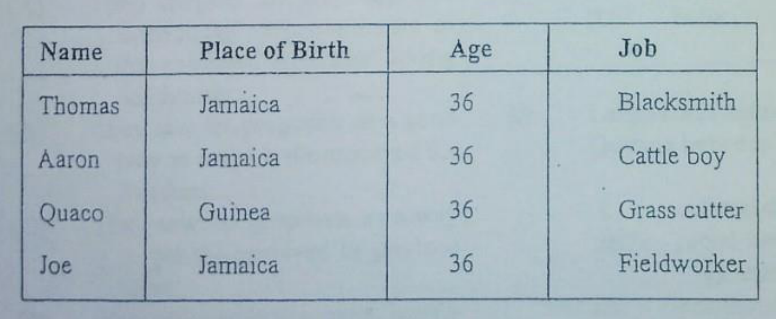
Item 11 refers to the table below.
ENSLAVED ON A BRITISH CARIBBEAN ESTATE IN 1830
| Name | Place of Birth | Age | Job |
|---|---|---|---|
| Thomas | Jamaica | 36 | Blacksmith |
| Aaron | Jamaica | 36 | Cattle boy |
| Quaco | Guinea | 36 | Grass cutter |
| Joe | Jamaica | 36 | Fieldworker |
Which of the enslaved Africans above would have experienced the horrors of the Middle Passage?
Joe
Aaron
Quaco
Thomas
Which of the following resulted from the Sugar Revolution in the Caribbean? I. The mulatto population declined. II. The black population increased. III. The number of land owners declined. IV. The number of land owners increased.
I and III only
II and III only
I, II and III only
I, II and IV only
Which of the following was NOT a port of call in the triangular trade?
Bristol
Bombay
Liverpool
Bridgetown
Which of the following means of protest were used by enslaved Africans during The Atlantic Crossing (Middle Passage)? I. Refusing to eat II. Attacking the crew III. Committing suicide IV. Complaining to the captain
I and II only
II and III only
I, II and III only
I, II, III and IV
Which of the following statements BEST describes the 'Sugar Revolution' of the seventeenth century?
The early experiments in sugar production
The growth in the number of sugar plantations
The changes resulting from the large-scale production of sugar
The increased consumption of sugar in Europe
Which of the following groups of European countries sent troops to St. Domingue during the 1791 revolt?
France, Holland, England
England, France, Spain
France, Portugal, Spain
Portugal, Holland, England
Which of the following conditions did NOT result from the Haitian Revolution?
The economy of the island was almost destroyed.
The pattern of land ownership changed.
The mulattoes were wiped out.
The country became independent from France.
The expedition sent by Napoleon to St. Domingue in 1801 under the leadership of Le Clerc was intended MAINLY to
abolish slavery
expel the British
punish the colonists
restore French control
In 1763, a major slave uprising took place in the Dutch colony of
Berbice
Curaçao
Suriname
St. Eustatius
In which Caribbean territory was there a rebellion in 1831?
Barbados
Guyana
Jamaica
Trinidad
Most West Indian planters saw the period of apprenticeship MAINLY as
a means of ensuring a steady labour supply
a time for training slaves in new skills
an opportunity to educate the apprentice
a time to reorganize sugar production
Which of the following was NOT a requirement of the apprenticeship system?
Apprentices were to be trained to become skilled labourers.
Praedials were to continue working for their former masters for six years.
Apprentices were to work the first forty hours of the week for no wages.
The planters were to provide food and clothing for the apprentices.
Which of the following describes how MOST planters and colonial assemblies reacted to amelioration?
They adopted the proposals and introduced improvements to the enslaved Africans' living conditions.
They saw the proposals as a good way to prepare the enslaved for freedom.
They saw the proposals as a way to get the enslaved to produce more.
They completely rejected or largely ignored the proposals.
Stipendiary Magistrates were appointed MAINLY to I. protect the interest of the planters II. report on the problems of the apprentices III. settle disputes between planter and apprentices IV. try all the court cases involving apprentices
I and III only
I and IV only
II, III and IV only
I, II, III and IV
The acts referred to in the information above were the
Navigation Acts
Sugar and Stamp Acts
Declaratory and Townshend Acts
Intolerable and Quebec Acts
The colonists' resentment of the acts led to
the American Revolution
the French Revolution
the Haitian Revolution
the Cuban Revolution
The acts were passed mainly to
raise revenue for the British government
punish the colonists for their rebellious behaviour
ensure that the colonies remained dependent on Britain
protect British merchants from foreign competition
Items 28-29 refer to the following information.
"The French Revolution was a period of far-reaching social and political upheaval in France that lasted from 1789 until 1799. It was partially carried forward by Napoleon during the later expansion of the French Empire."
Which of the following was a major cause of the French Revolution?
The rise of the bourgeoisie
The influence of the American Revolution
The economic crisis and social inequality
The desire for a constitutional monarchy
The French Revolution had a significant impact on the Caribbean because it
led to the abolition of slavery in the French colonies
inspired slave revolts and demands for freedom
resulted in the transfer of French colonies to Britain
encouraged the development of new economic systems
Items 30-32 refer to the following information.
"The Haitian Revolution was a successful anti-slavery and anti-colonial insurrection by self-liberated slaves against French colonial rule in Saint-Domingue, now the sovereign nation of Haiti. It lasted from 1791 until 1804."
The Haitian Revolution is considered unique because it was the only slave revolt that
involved a large number of slaves
led to the establishment of an independent state
was supported by a European power
resulted in the complete abolition of slavery
A key leader of the Haitian Revolution was
Jean-Jacques Dessalines
Henri Christophe
Toussaint Louverture
Alexandre Pétion
The Haitian Revolution had a profound impact on the Caribbean by
encouraging other slave revolts
leading to increased repression of slaves
demonstrating the possibility of black self-governance
all of the above
"William Knibb foresaw that planters would try to force extra work from their free labourers by increasing rents on homes on the estate."
To which territory was Knibb referring?
Guyana
Jamaica
Barbados
Trinidad
What action did Knibb take to address the situation of formerly enslaved persons acquiring land?
Warn the labourers
Plead with the planters
Establish free villages
Report to the Governor
Which of the following Caribbean territories was NOT occupied by the United States' military forces in the early 1900s?
Cuba
Haiti
Jamaica
Dominican Republic
Which of the following was the IMMEDIATE cause of the war of 1898 between Spain and the United States?
The United States took over Panama.
The USS Maine was blown up in Havana harbour.
The United States was angered by General Weyler's atrocities.
Spanish troops invaded the island of Cuba.
Fidel Castro overthrew the government of Fulgencio Batista by
using American financial help
joining forces with foreign powers
making use of Russian warships
organizing armed internal uprisings
By which agreement did the USA make Cuba "... gravitate only toward the North American Union?"
The Platt Amendment
The Teller Amendment
The Hay-Pauncefote Treaty
The Clayton-Bulwer Treaty
"The adherence of the United States to the Monroe Doctrine may force the United States, however reluctantly, in cases of wrong doing or impotence, to the exercise of the international police force."
The above statement is associated with President
Ulysses S. Grant
John Fitzgerald Kennedy
Woodrow Wilson
Theodore Roosevelt
Which of the following was NOT associated with the riots of the 1930s?
Uriah Butler of Trinidad
George Price of Belize
Robert Bradshaw of St. Kitts
Alexander Bustamante of Jamaica
Which of the following statements BEST describes the focus of the Moyne Commission?
To end the unrest in the British Caribbean immediately
To identify the persons causing the unrest and recommend penalties for them
To investigate ethnic conflict between indentured immigrants and freed persons in the British Caribbean
To investigate the economic, social and political situation in the colonies and to make recommendations
In many British Caribbean territories during the 1930s, there was a strong link between political parties and
trade unions
plantation owners
stipendiary magistrates
the established church
Marcus Garvey is BEST remembered for his
participation in the 1937 riots
teachings on black nationalism
deportation from the United States
association with the trade union movement
Most of the Caribbean political leaders in the 1930s advocated constitutional changes MAINLY in order to
obtain self-government
promote the two party system
promote social revolution
develop the colonies economically
The first Caribbean country to gain its independence was
Cuba
Haiti
Grenada
Jamaica
The British West Indies Federation of 1958 was established because
French West Indian colonies had begun to federate
the old representative system proved to be useless
the Crown Colony government had given West Indians experience in running their affairs
West Indian leaders felt that independence would be achieved faster through federation
The Federation of the British West Indies broke up in 1962 MAINLY because
Grantley Adams was a very weak leader
Jamaica decided to withdraw from the federation
Britain refused to make an adequate grant in aid
the smaller territories were not interested in federation
Which of the following Caribbean countries became the first free and associated state of the USA?
Cuba
Margarita
Puerto Rico
Hispaniola
Universal Adult Suffrage can be defined as the right of
all citizens of a specified age to vote
educated people to govern a country
people with a given amount of property to run for elections
blacks and non-blacks to share political power
In which of the following British colonies was sugarcane cultivation of LEAST importance during the days of enslavement?
Belize
Guyana
Jamaica
Barbados
In which chronological order did the British Caribbean planters face competition from the following? I. French beet sugar II. Virginian tobacco III. Cuban slave grown sugar IV. Sugar from St. Domingue
I, II, III, IV
II, IV, III, I
III, IV, II, I
IV, II, III, I
In which order did the following stages in the movement towards Independence in British Caribbean territories take place? I. Introduction of the party system II. Election of a Prime Minister or Premier III. Achievement of universal adult suffrage IV. Full internal self-government
I, II, III, IV
I, III, II, IV
II, IV, III, I
IV, II, III, I
Which of the persons named below was an important trade union leader in Guyana?
Grantley Adams
Robert Bradshaw
Hubert Nathaniel Critchlow
Clement Payne
What was the CORRECT order of the abolition process?
Apprenticeship, emancipation, amelioration, abolition of slave trade
Emancipation, apprenticeship, abolition of slave trade, amelioration
Amelioration, emancipation, abolition of slave trade, apprenticeship
Abolition of slave trade, amelioration, emancipation, apprenticeship