Free CXC Caribbean History Paper 1 May/June 2017 past paper from 2017. Includes a worked answer key. Open the PDF, take a timed test, and study with AI on Caribbean AI.
Answer keys are free on Caribbean AI. View the answers to every past-paper question at no cost - no payment needed - with step-by-step worked solutions and instant AI marking available on Premium.
CSEC Caribbean History Paper 1 May/June 2017 - Free CXC Past Paper with Answers
Free CXC Caribbean History Paper 1 May/June 2017 past paper from 2017. Includes a worked answer key. Open the PDF, take a timed test, and study with AI on Caribbean AI.
Opening the interactive papers…
Every question from this paper as text. See the answers and worked solutions. Questions are the property of the Caribbean Examinations Council; Caribbean AI is not affiliated with CXC.
Which of the following statements is true of BOTH Jamaica and Cuba at the time of Columbus' arrival in the Caribbean?
They were not inhabited.
They were inhabited by Tainos.
They were inhabited by Mayas.
They were inhabited by Kalinagos.
Which of the following was NOT an activity in which the Maya engaged?
Growing corn
Making quipus
Building temples
Playing ball games
Which of the following statements are TRUE of the Kalinagos? I. They adopted many Taino customs. II. They were skilled sailors and fishermen. III. They fiercely resisted the Spanish invaders.
I and II only
I and III only
II and III only
I, II and III
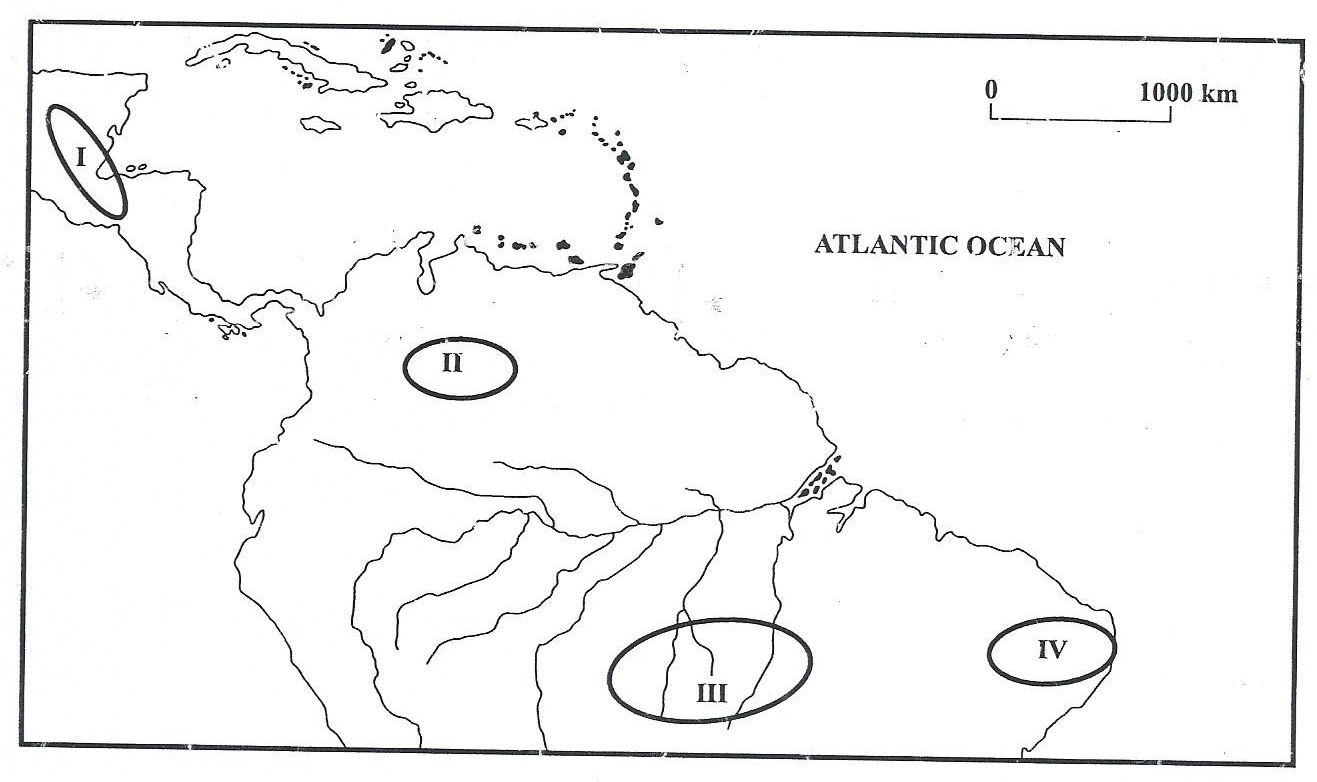
The area where the Kalinagos lived before they migrated to the Caribbean islands is labelled
I
II
III
IV
Which of the following BEST explains why many Kalinago women spoke the Tainos' language?
They worked in the fields with the Taino women.
Kalinago women often traded with the Taino women.
Taino women were often captured by Kalinago warriors.
Kalinago girls were taught the language of the Taino by their elders.
Which TWO European countries were arch rivals in the setting up of colonies in the Americas in the early 16th century?
Portugal and Spain
England and Spain
France and Portugal
England and France
Which is the correct order, from MOST to LEAST powerful, of European social groups in the 1400s?
Merchants, priests, peasants, kings
Kings, priests, peasants, merchants
Priests, kings, merchants, peasants
Kings, priests, merchants, peasants
The MAIN reason why the English attempted to break the Spanish monopoly in the New World was to
obtain new trade routes to the East
obtain a share of the wealth of the New World
supply captive Africans to the Spanish colonies
gain a base from which to attack the native peoples
The 'practice' referred to in the statement was known as the
asiento
audiencia
residencia
encomienda
The Dutch may be called the 'foster fathers' of French and British settlers in the Caribbean in the 1600s MAINLY because of their
skills in tobacco growing which they shared with the settlers
naval strength which protected the settlers from pirates attacks
military which conquered the indigenous people and made settlement safe
traders who kept the settlers supplied with foodstuff and other essential goods
Which of the following resulted from the change over from tobacco to sugar cane cultivation in the Caribbean?
I. The mulatto population declined. II. The black population increased. III. The number of land owners declined.
I and II only
I and III only
II and III only
I, II and III
Which of the following ports were British slave ships MOST likely to visit during the 1700s?
Havana
Kingston
Rio de Janeiro
Port-au-Prince
The term 'barracoon' is BEST associated with the
cultivation by captive persons in Africa
trade of enslaved persons in the Caribbean
housing of captive persons on the African coast
punishment of enslaved persons in the Caribbean
It is TRUE to say the enslaved Africans in the British Caribbean were
encouraged by their owners to educate themselves
allowed to raise a family without their owners' permission
allowed to own small properties without their owners' permission
encouraged by their owners to farm on small provision grounds
The large importation of enslaved Africans into the Caribbean during the 1600s and 1700s was due MAINLY to
the heavy debts owed by estate owners
improved technology being used on the estates
the expansion and profitability of the sugar industry
promotion of the slave trade by the Royal African Company
An enslaved African in the British Caribbean who stole from the plantation owner was LEAST likely to be
whipped
mutilated
charged a fine
placed in the stockade
Which of the following was NOT a similarity between the Maroons of Jamaica and those of Suriname?
They both signed peace treaties with the British.
They both planted, hunted and fished for a living.
They both waged guerilla warfare on white plantations.
They were runaway slaves who escaped into the forested interior.
Toussaint L'Ouverture contributed to the success of the Haitian Revolution MAINLY by
setting up a system of fortification
developing a revolutionary ideology
organizing the enslaved into a formidable fighting force
dividing the country between the blacks and the mulattos
In 1763, a major uprising of enslaved Africans took place in the Dutch colony of
Berbice
Curaçao
Suriname
Sint Eustatius
Which of the following were consequences of the Haitian Revolution? I. All the mulattos left the island. II. All enslaved Africans were freed. III. The colony gained political independence.
I and II only
I and III only
II and III only
I, II and III
Which of the following was the MAIN purpose of the policy of amelioration?
To maintain the established system of enslavement
To put an end to enslavement in the British Caribbean
To introduce a new supply of cheap labour to the British Caribbean
To improve the conditions of the enslaved in the British Caribbean
Lord Mansfield is MOST closely associated with the declaration that
the slave trade was unlawful
the enslaved are our brothers
slavery was not legal in England
slavery was legal in the crown colonies
Which of the following duties was NOT performed by stipendiary magistrates?
Visiting the estates in their district
Teaching the apprentices new trades
Hearing complaints in Saturday courts
Sending reports to the Colonial Office
Which of the following did the Amelioration measures of 1823 propose? I. No enslaved woman should be flogged. II. Enslaved families should not be divided. III. Enslaved persons should not be sold as payment for debt.
I and II only
I and III only
II and III only
I, II and III
The British government was reluctant to authorize African immigration after the abolition of slavery MAINLY because
the planters were opposed to the scheme
Africans were too numerous in the colonies
the scheme could lead to a new form of slavery
immigration from Africa was too expensive to operate
Most of the immigrant workers used in the Cuban sugar industry in the 19th century were
Indians
Chinese
Africans
Europeans
Which factor BEST explains why East Indians did not return home after the period of indentureship was over?
Some of them accepted grants of money or land.
Bounties were offered to induce them to renew their contracts.
Many of them did not know of the offer of a free passage home.
Planters did not want them to return to the low standard of life in India.
Which cultural elements did indentured workers from Madeira bring to the British Caribbean?
Indian
African
Chinese
Portuguese
Which of the following did NOT result from immigration of indentured labourers to the Caribbean after emancipation?
The expansion of rice cultivation in Guyana
The expansion of sugar production in Barbados
The introduction of new religions in the Caribbean
The introduction of a variety of ethnic groups in Trinidad
The majority of immigrants brought to work in the British Caribbean in the years between emancipation and the First World War were employed as
shopkeepers
factory hands
small farmers
unskilled labourers
Which of the following groups helped in the formation of free villages in Jamaica?
Planters
Missionaries
Local assemblies
Stipendiary magistrates
There were more free villages in Jamaica than there were in Barbados MAINLY because
in Jamaica more land was available for settlement
in Barbados the freed Africans did not want to leave the plantations
the Jamaican planters encouraged the freed Africans to set up free villages
freed Africans in Jamaica had more money to buy land than freed Africans in Barbados
Which group of territories contained the MOST crown land?
Antigua, Guyana, Jamaica
Antigua, Grenada, Guyana
Guyana, Jamaica, Trinidad
Barbados, Grenada, Trinidad
Which of the following was NOT a means by which freed Africans acquired land after emancipation?
Renting estate land
Buying old estate land
Squatting on crown land
Receiving free crown land
Which of the following was NOT a result of the development of the peasantry in the British Caribbean after 1838?
Diversification of the economy
Legal recognition of the practice of obeah
Greater expansion of the non-conformist churches
A growing sense of independence among freed Africans
The policy by which the United States government was actively involved in directing the financial affairs of the Caribbean between 1905 and 1930 was known as
Dollar Diplomacy
the Big Stick Policy
Operation Bootstrap
the Good Neighbour Policy
Which of the following was the IMMEDIATE cause of the United States' declaration of war against Spain in 1898?
The United States took over Panama.
The U.S.S. Maine was blown up in Havana harbour.
The United States was angered by Spanish invasion of Cuba.
The United States was angered by General Weyler's atrocities.
Which of the following was intended MAINLY to prevent further extension of European influence in the 'New World'?
Monroe Doctrine
Platt Amendment
Dollar Diplomacy
Clayton-Bulwer Treaty
"The adherence of the United States to the Monroe Doctrine may force the United States, however reluctantly, in cases of wrong doing or impotence, to the exercise of an international police power."
The statement above is associated with President
Ulysses S. Grant
Woodrow Wilson
Theodore Roosevelt
John Fitzgerald Kennedy
Which of the following Caribbean territories was NOT occupied by US military forces in the early 1900s?
Cuba
Haiti
Jamaica
Dominican Republic
Which of the following personalities was NOT directly associated with the riots of the 1930s in the British Caribbean?
George Price of Belize
Robert Bradshaw of St Kitts
Clement Payne of Barbados
Alexander Bustamante of Jamaica
Which commission was sent to investigate conditions in the Caribbean as a result of the 1930s disturbances?
Deane Commission
Foster Commission
Moyne Commission
Norman Commission
Which of the following contributed strongly to the protests of the 1930s in the British Caribbean?
I. Low levels of wages II. High rates of unemployment III. Strength of trade unions
I only
I and II only
II and III only
I, II and III
Most of the Caribbean political leaders in the 1930s advocated constitutional changes MAINLY to
obtain self-government
promote social evolution
promote the two-party system
develop the colonies economically
Marcus Garvey is BEST remembered for his
participation in the 1937 riots
teachings on black nationalism
visit to Central America in 1909
association with the trade union movement
Which of the following considerations MOST influenced the decision to form the British West Indies Federation of 1958?
All territories would participate on an equal basis.
Federation would help the independence movement.
Inter-island communication would be more economical.
Citizens would be able to move more freely in the various territories.
By the referendum of 1961, Jamaica decided to
withdraw from the federation
change its federal representative
change the site of the federal capital
reduce its financial contribution to the federation
One feature of the 1958 Federation was that the government of each territory would
cease to exist
continue as before
share power with the federal government
hand over its power to the federal government
Which Caribbean territories were assimilated by France in 1946?
Haiti, Martinique, Guadeloupe
Marie Galante, Haiti, Dominica
Saint Barthelemy, Trinidad, Martinique
Guadeloupe, French Guiana, Martinique
In what order did the following countries gain political independence? I. Guyana II. Jamaica III. Grenada
I, II, III
II, I, III
II, III, I
III, II, I
José Martí is associated with the struggle for independence in
Cuba
Haiti
Puerto Rico
the Dominican Republic
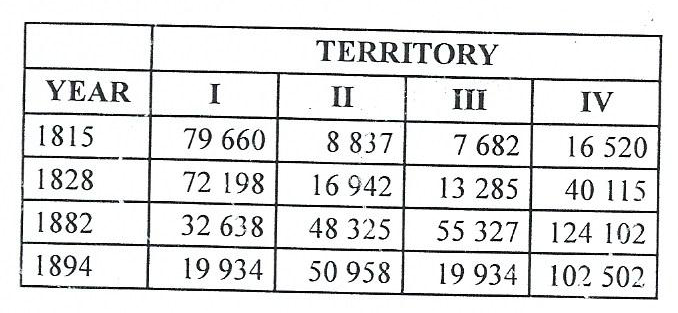
In which territory did sugar production experience a steady decline?
I
II
III
IV
The Cuban sugar industry in the 1800s received most of its capital from
Spain
the USA
England
Germany
Which of the following British Caribbean territories was FIRST granted adult suffrage?
Jamaica
Guyana
Trinidad
Barbados
Universal Adult Suffrage is BEST described as the right of
citizens of a specified age to vote
educated people to govern a country
Blacks and Non-Blacks to share political power
people with a given amount of property to run for elections
What is the correct order of the abolition process?
Apprenticeship, emancipation, amelioration, abolition of slave trade
Emancipation, apprenticeship, abolition of slave trade, amelioration
Amelioration, emancipation, abolition of slave trade, apprenticeship
Abolition of slave trade, amelioration, emancipation, apprenticeship
Which of the following statements is TRUE of Cuba in the 1800s?
It had become a major sugar producing territory.
Logwood production had become a major industry.
Tobacco had replaced sugar as the leading product.
Indigenous Indians were the major source of agricultural labour.
In which of the following territories was Elma François an active trade unionist?
Belize
Grenada
Trinidad
Barbados
Which of the following persons was an important trade union leader in Guyana?
Vere Bird
Clement Payne
Robert Bradshaw
Hubert Nathaniel Critchlow
Which of the following persons was the Prime Minister of the West Indies Federation?
Eric Williams
Grantley Adams
Alexander Bustamante
Hubert Nathaniel Critchlow