Free CXC Physics Paper 3 May/June 2005 past paper from 2005. Includes a worked answer key. Open the PDF, take a timed test, and study with AI on Caribbean AI.
Answer keys are free on Caribbean AI. View the answers to every past-paper question at no cost - no payment needed - with step-by-step worked solutions and instant AI marking available on Premium.
CSEC Physics Paper 3 May/June 2005 - Free CXC Past Paper with Answers
Free CXC Physics Paper 3 May/June 2005 past paper from 2005. Includes a worked answer key. Open the PDF, take a timed test, and study with AI on Caribbean AI.
Opening the interactive papers…
Every question from this paper as text. See the answers and worked solutions. Questions are the property of the Caribbean Examinations Council; Caribbean AI is not affiliated with CXC.
An acetate rod may be charged positively by rubbing it with a dry cloth, whereas a polyethylene rod will be negatively charged if similarly rubbed. Explain why this occurs. Explain, with the aid of diagrams if necessary, why it is possible to pick up small bits of paper with either of these charged rods.
[8 marks]
The positively charged acetate rod and the negatively charged polyethylene rod are made to touch each other, causing of current to flow from one rod to the other for a period of $4 ms$.
Calculate
[6 marks]
the amount of charge which flows through the rod
the number of electrons involved in this current flow.
(Charge of electron = )
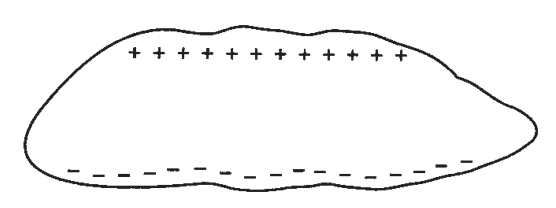
A cloud has the charge distribution shown in Figure 1 below.
(i) In your answer booklet sketch the electric field pattern inside the cloud, treating the charge distribution as that for TWO parallel plates. (ii) If this cloud is directly over a tall building, explain how the distribution of charges in the building's structure will be affected. (iii) The air between the cloud and the building breaks down and there is a flash of lightning. Deduce the direction in which the electrons will flow in this lightning bolt.
[6 marks]
An investor is interested in a nuclear power station project. He has the option of using natural or artificial radioactive decay processes to obtain energy. In helping him to decide, he consults an engineer who compares the energy obtained from the following TWO nuclear reactions:
natural: artificial:
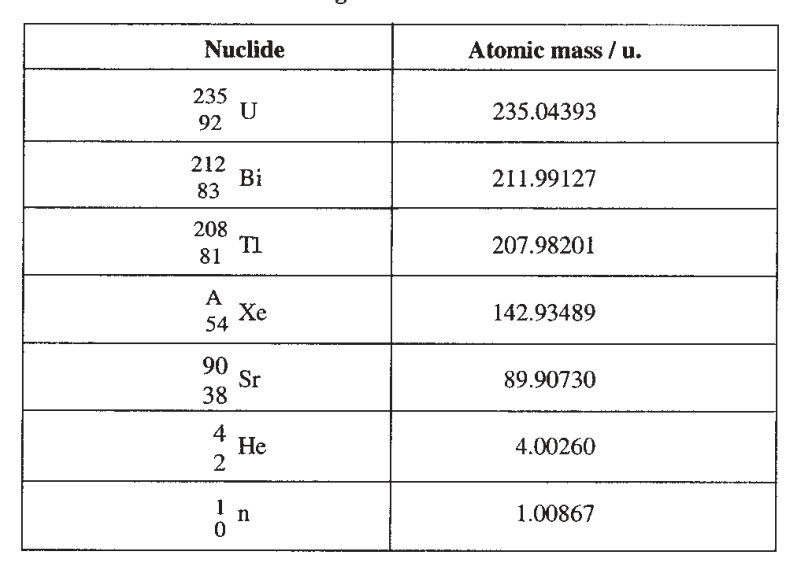
Table 1 below gives the data for these nuclides where .
| Nuclide | Atomic mass / u. |
|---|---|
| 235.04393 | |
(i) Calculate the number of neutrons in Bismuth (Bi). (3 marks) (ii) Determine the atomic mass number of Xenon (Xe). (2 marks) (iii) Calculate the energy released in EACH nuclear reaction and the ratio of the larger to the smaller. Deduce the recommendation that the engineer will give to the investor. (7 marks)
Calculate the number of neutrons in Bismuth (Bi).
[3 marks]
Determine the atomic mass number of Xenon (Xe).
[2 marks]
Calculate the energy released in EACH nuclear reaction and the ratio of the larger to the smaller. Deduce the recommendation that the engineer will give to the investor.
[7 marks]
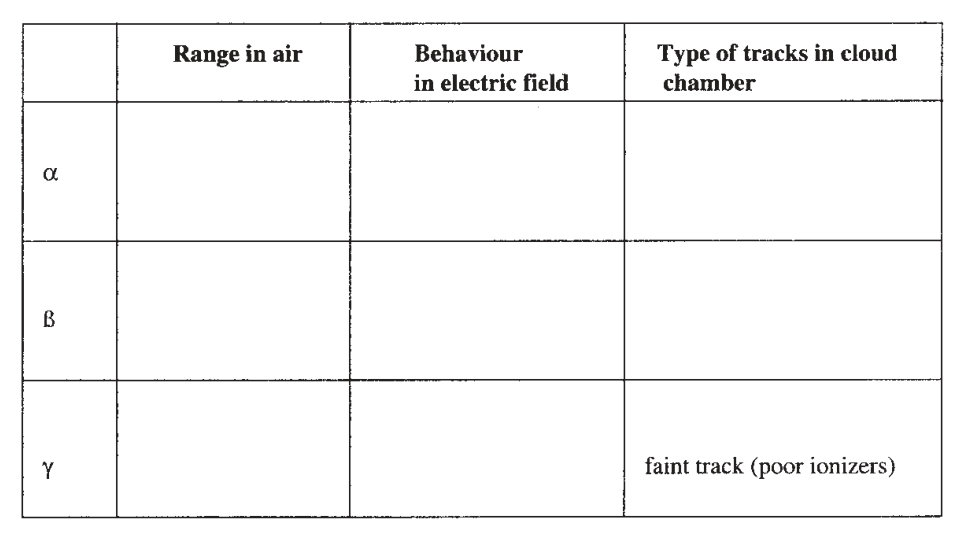
Radioactive materials emit alpha (), beta () and gamma () radiation. Table 2 summarises some of the properties of these types of radiation. Copy the table in your answer booklet and complete the missing entries.
With the aid of a neat, clearly labelled diagram, describe an experiment to prove the relationship between the angle of incidence, , and the angle of reflection, , for a ray of light incident on a plane mirror.
[8 marks]
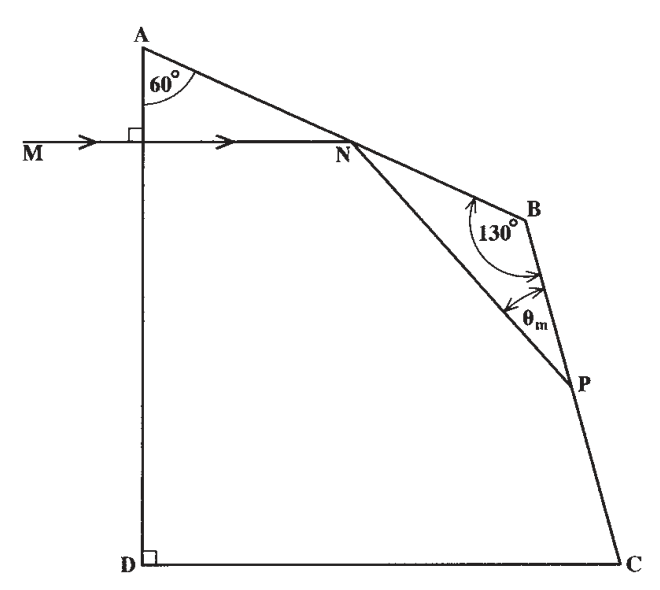
Figure 2 is a side view of ABCD, a prism made from fused quartz (a type of glass) of refractive index 1.46.
The ray MN is incident on face AD as shown.
(i) Show that MN will be totally internally reflected from the face AB. (7 marks) Redraw the diagram in your answer book. (ii) Determine, , the angle which the reflected ray makes with the face BC at point P. (iii) Sketch on your diagram the ray from point P, showing clearly the path from P through to its emergence from the prism.
Indicate any refraction. (5 marks)
[12 marks]
Show that MN will be totally internally reflected from the face AB. Redraw the diagram in your answer book.
[7 marks]
Determine, , the angle which the reflected ray makes with the face BC at point P.
Sketch on your diagram the ray from point P, showing clearly the path from P through to its emergence from the prism.
Indicate any refraction.
[5 marks]
With the aid of a labelled diagram describe an experiment to determine the centre of gravity of an irregularly shaped sheet of cardboard.
[8 marks]
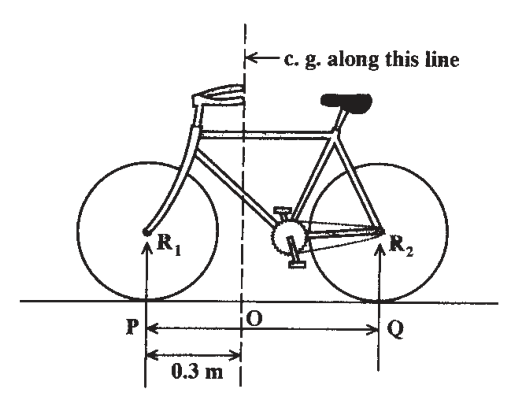
Figure 3 shows a bicycle of mass $15 kg$ resting in a vertical position, with the front and back wheels touching the horizontal ground at points P and Q respectively, where PQ = $1 m$. The centre of gravity of the bicycle is vertically above O, a point on PQ where PO = $30 cm$.
Given that the normal reactions of the ground on the front and rear wheels are and respectively, write TWO equations, in and , which satisfy the conditions of equilibrium.
[4 marks]
Kenny and Candy decided to sit on a see-saw while visiting a local play park. Candy, of mass $50 kg$, sat $250 cm$ from the pivot of the seesaw.
(i) Where should Kenny, of $60 kg$ mass, sit so that a state of stable equilibrium exists? (5 marks) (ii) What should Kenny do if he wanted to elevate Candy? (3 marks)
(Acceleration due to gravity = )
[8 marks]
Where should Kenny, of $60 kg$ mass, sit so that a state of stable equilibrium exists?
[5 marks]
What should Kenny do if he wanted to elevate Candy? (Acceleration due to gravity = )
[3 marks]
Distinguish between EACH of the following pairs of terms:
[4 marks]
'Condensation' and 'vaporisation'
[2 marks]
Describe FULLY the process of sublimation.
[2 marks]
For the changes of state mentioned in a) and b) above to take place energy must be added to or removed from a substance. Give the general name for this type of energy and state what happens to the temperature during these processes.
[2 marks]
A student placed 700 g of water at in a freezer. After 6 minutes and 15 seconds the water was transformed to ice. Calculate (i) the heat energy transferred from the water during the temperature change
[4 marks]
the latent heat of solidification, given that of heat energy was transferred during the change of state
[3 marks]
the rate of heat energy transfer for the entire process. (Specific heat capacity of water = )
[5 marks]
| 211.99127 |
| 207.98201 |
| 142.93489 |
| 89.90730 |
| 4.00260 |
| 1.00867 |
| Range in air | Behaviour in electric field | Type of tracks in cloud chamber | |
|---|---|---|---|
| faint track (poor ionizers) |
[8 marks]