CSEC Physics Paper 3 May/June 2011 - Free CXC Past Paper with Answers
Free CXC Physics Paper 3 May/June 2011 past paper from 2011. Includes a worked answer key. Open the PDF, take a timed test, and study with AI on Caribbean AI.
Answer keys are free on Caribbean AI. View the answers to every past-paper question at no cost - no payment needed - with step-by-step worked solutions and instant AI marking available on Premium.
- All CSEC Past Papers
- CSEC Physics Past Papers
- CSEC Physics Paper 3 May/June 2025
- CSEC Physics Paper 3 January 2017
- CSEC Physics Paper 3 May/June 2017
- CSEC Physics Paper 3 May/June 2014
- CSEC Physics Paper 3 May/June 2013
- CSEC Physics Paper 3 May/June 2012
- CSEC Physics Paper 3 May/June 2010
- CSEC Physics Paper 3 May/June 2007
- CSEC Physics Paper 3 May/June 2006
- CSEC Physics Paper 3 May/June 2005
CSEC Physics Paper 3 May/June 2011 - Free CXC Past Paper with Answers
Free CXC Physics Paper 3 May/June 2011 past paper from 2011. Includes a worked answer key. Open the PDF, take a timed test, and study with AI on Caribbean AI.
Opening the interactive papers…
- All CSEC Past Papers
- CSEC Physics Past Papers
- CSEC Physics Paper 3 May/June 2025
- CSEC Physics Paper 3 January 2017
- CSEC Physics Paper 3 May/June 2017
- CSEC Physics Paper 3 May/June 2014
- CSEC Physics Paper 3 May/June 2013
- CSEC Physics Paper 3 May/June 2012
- CSEC Physics Paper 3 May/June 2010
- CSEC Physics Paper 3 May/June 2007
- CSEC Physics Paper 3 May/June 2006
- CSEC Physics Paper 3 May/June 2005
CSEC Physics Paper 3 May/June 2011 Questions
Every question from this paper as text. See the answers and worked solutions. Questions are the property of the Caribbean Examinations Council; Caribbean AI is not affiliated with CXC.
Question 1 (20 marks)
The arrangement in Figure 1 was set up to find out how the image distance and object distance were related for a convex lens.
Record the positions of the object, lens and screen.
Object position _________________________________________________________________ Lens position _________________________________________________________________ Screen position _________________________________________________________________

[3 marks]
State ONE precaution to be taken when reading the scale.
[1 mark]
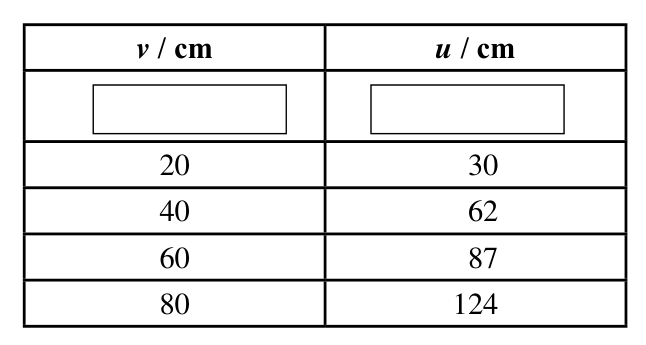
Calculate the image distance , and object distance , for the arrangement in Figure 1 and enter these values in the appropriate spaces in Table 1 below.