Free CXC Physics Paper 3 May/June 2007 past paper from 2007. Includes a worked answer key. Open the PDF, take a timed test, and study with AI on Caribbean AI.
Answer keys are free on Caribbean AI. View the answers to every past-paper question at no cost - no payment needed - with step-by-step worked solutions and instant AI marking available on Premium.
CSEC Physics Paper 3 May/June 2007 - Free CXC Past Paper with Answers
Free CXC Physics Paper 3 May/June 2007 past paper from 2007. Includes a worked answer key. Open the PDF, take a timed test, and study with AI on Caribbean AI.
Opening the interactive papers…
Every question from this paper as text. See the answers and worked solutions. Questions are the property of the Caribbean Examinations Council; Caribbean AI is not affiliated with CXC.
State Newton's first and second laws of motion. Use these laws to explain how a satellite remains in orbit around the earth.
[8 marks]
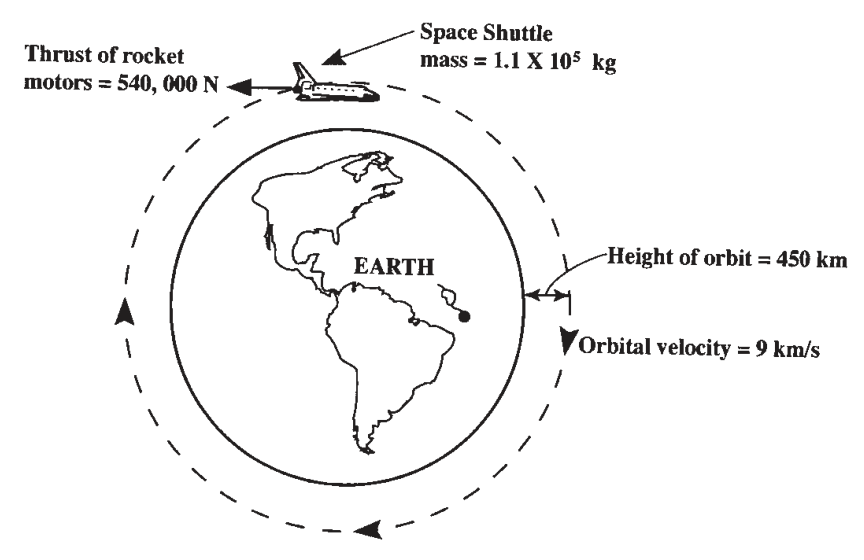
The mass of a space shuttle is tonnes ( kg). It orbits the earth at a height of km, with a speed of km s. Calculate the kinetic energy of the shuttle in this orbit.
The shuttle also possesses gravitational potential energy. Assuming that the gravitational field strength () is the same at all heights up to km, calculate the total energy of the shuttle as it orbits the earth at this height.
The mass of a space shuttle is tonnes ( kg). It orbits the earth at a height of km, with a speed of km s. Calculate the kinetic energy of the shuttle in this orbit.
The shuttle also possesses gravitational potential energy. Assuming that the gravitational field strength () is the same at all heights up to km, calculate the total energy of the shuttle as it orbits the earth at this height.
[7 marks]
When the space shuttle is to return to Earth, it fires its rockets in order to slow down. The total thrust of the rocket motors is $540 \ 000$ N and the rockets are fired for s.
Calculate the (i) deceleration of the space craft while the rockets are firing (ii) reduction in speed during the s.
( N kg)
[5 marks]
deceleration of the space craft while the rockets are firing
reduction in speed during the s.
Sound is a longitudinal wave that is produced by vibrating sources. Sound waves emitted from two sources are found to be vibrating in phase. Explain what is meant by the terms underlined.
[3 marks]
Pitch and loudness are terms used to describe sound. How are the frequency, wavelength and amplitude of a sound wave affected by an increase in the a) pitch of the sound? b) loudness of the sound?
The note, middle C, played first on a piano and then on a violin sounds different on the two instruments. The notes are said to have a different quality. Explain this observation.
[5 marks]
Pitch and loudness are terms used to describe sound. How are the frequency, wavelength and amplitude of a sound wave affected by an increase in the a) pitch of the sound? b) loudness of the sound?
The note, middle C, played first on a piano and then on a violin sounds different on the two instruments. The notes are said to have a different quality. Explain this observation.
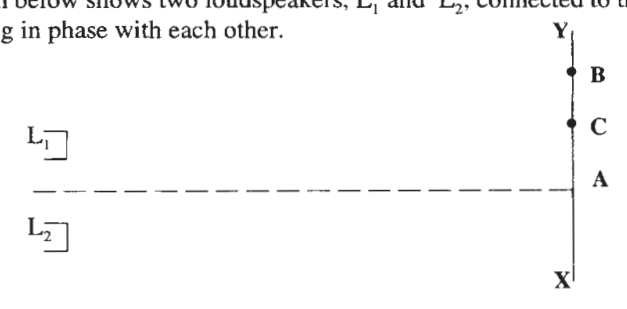
The diagram below shows two loudspeakers, and , connected to the same source and vibrating in phase with each other.
(i) The loudspeakers produce notes of frequency Hz. If the speed of sound is m s, what is the wavelength of the notes? (ii) Consider, at any instant, a sound wave starting at and proceeding in the direction of A. Sketch a graph of displacement (of the air molecules) against position for the first m of this wave. (iii) A student walks along the line XY. At both A and B the sound is loud whereas at C the sound is quite faint. Explain these observations. With the frequency of the notes still Hz, the loudspeakers are moved closer together. What will be the effect on the observations at A, B and C? (iv) The frequency of the sound is now changed to Hz with the loudspeakers returned to the original positions. Will the wavelength now be larger or smaller than before? What will be the effect on the observations at A, B and C?
[12 marks]
The loudspeakers produce notes of frequency Hz. If the speed of sound is m s, what is the wavelength of the notes?
Consider, at any instant, a sound wave starting at and proceeding in the direction of A. Sketch a graph of displacement (of the air molecules) against position for the first m of this wave.
A student walks along the line XY. At both A and B the sound is loud whereas at C the sound is quite faint. Explain these observations. With the frequency of the notes still Hz, the loudspeakers are moved closer together. What will be the effect on the observations at A, B and C?
The frequency of the sound is now changed to Hz with the loudspeakers returned to the original positions. Will the wavelength now be larger or smaller than before? What will be the effect on the observations at A, B and C?
Answer the following questions using the kinetic theory of matter.
Answer the following questions using the kinetic theory of matter. (i) Explain why thermal energy has to be supplied to a liquid at its boiling point to be changed into gas, without any change in temperature, and why the volume of the gas produced is much greater than the original volume of the liquid. State the energy change that occurs during the phase change from liquid to gas. (ii) A gas exerts a pressure on the walls of its container. What causes this pressure? If the temperature of a gas in a container is reduced, the pressure in the container falls. Why does this occur?
[8 marks]
Explain why thermal energy has to be supplied to a liquid at its boiling point to be changed into gas, without any change in temperature, and why the volume of the gas produced is much greater than the original volume of the liquid. State the energy change that occurs during the phase change from liquid to gas.
A gas exerts a pressure on the walls of its container. What causes this pressure? If the temperature of a gas in a container is reduced, the pressure in the container falls. Why does this occur?
At standard temperature and pressure, that is, C and Pa pressure, the density of oxygen is kg m. Oxygen is stored in a container of volume m, at a pressure of Pa and at a temperature of C.
(i) What volume would the same mass of oxygen occupy at 'standard temperature and pressure'? Calculate the mass of oxygen in the container. (ii) The container is now heated to C. What will be the new pressure? Assume the container does not expand. (iii) Sketch a graph of pressure against KELVIN temperature for the gas. Indicate on the graph the original temperature and pressure.
[12 marks]
What volume would the same mass of oxygen occupy at 'standard temperature and pressure'? Calculate the mass of oxygen in the container.
The container is now heated to C. What will be the new pressure? Assume the container does not expand.
Sketch a graph of pressure against KELVIN temperature for the gas. Indicate on the graph the original temperature and pressure.
Describe the procedure used in the Geiger-Marsden experiment. State the results of the experiment and outline what these results suggested about the structure of atoms.
[8 marks]
The common isotope of sodium, Na, is stable, while the sodium isotope, with a mass number of , sodium-, is radioactive. Sodium- decays into an isotope of magnesium (Mg) by the emission of a -particle.
Write a nuclear equation to represent the decay of sodium-. How many (i) neutrons and (ii) protons are in the nucleus of magnesium which is formed and how many electrons are there in a neutral atom of magnesium?
[6 marks]
A radioactive source is found to be emitting, on average, particles per second. If the source has a half life of minutes, how much time will elapse before the average emission rate becomes per second?
Explain why the measured count rate of in one second is unlikely to be exactly . What will be the effect on the count rate of (i) gently heating the radioactive sample and (ii) heating the sample to a very high temperature?
[6 marks]
Draw a diagram of a simple moving-coil loudspeaker.
Explain how a changing voltage applied to the loudspeaker results in sound being emitted from it.
[8 marks]
A loudspeaker is usually enclosed in a box to improve its efficiency of converting electrical energy into sound. The loudspeaker is then connected to the output of an amplifier. A certain loudspeaker has a resistance of and operates at an efficiency of $15%$. It is connected to an amplifier which provides voltage of V to the loudspeaker. Calculate: (i) The current flowing in the loudspeaker (ii) The electrical power being delivered by the amplifier (iii) The sound energy per second being emitted.
[7 marks]
The current flowing in the loudspeaker
The electrical power being delivered by the amplifier
The sound energy per second being emitted.
A second identical loudspeaker is now connected in parallel with the first loudspeaker across the output of the same amplifier which still provides an output voltage of V. Determine: (i) The combined resistance of the two loudspeakers (ii) The total sound energy per second being emitted
[5 marks]
The combined resistance of the two loudspeakers
The total sound energy per second being emitted