CSEC Biology Paper 3 January 2020 - Free CXC Past Paper with Answers
Free CXC Biology Paper 3 January 2020 past paper from 2020. Includes a worked answer key. Open the PDF, take a timed test, and study with AI on Caribbean AI.
Answer keys are free on Caribbean AI. View the answers to every past-paper question at no cost - no payment needed - with step-by-step worked solutions and instant AI marking available on Premium.
- All CSEC Past Papers
- CSEC Biology Past Papers
- CSEC Biology Paper 3 May/June 2018
- CSEC Biology Paper 3 May/June 2017
- CSEC Biology Paper 3 May/June 2014
- CSEC Biology Paper 3 May/June 2013
- CSEC Biology Paper 3 May/June 2012
- CSEC Biology Paper 3 May/June 2007
- CSEC Biology Paper 3 January 2007
- CSEC Biology Paper 3 May/June 2006
- CSEC Biology Paper 3 May/June 2005
- CSEC Biology Paper 3 January 2005
CSEC Biology Paper 3 January 2020 - Free CXC Past Paper with Answers
Free CXC Biology Paper 3 January 2020 past paper from 2020. Includes a worked answer key. Open the PDF, take a timed test, and study with AI on Caribbean AI.
Opening the interactive papers…
- All CSEC Past Papers
- CSEC Biology Past Papers
- CSEC Biology Paper 3 May/June 2018
- CSEC Biology Paper 3 May/June 2017
- CSEC Biology Paper 3 May/June 2014
- CSEC Biology Paper 3 May/June 2013
- CSEC Biology Paper 3 May/June 2012
- CSEC Biology Paper 3 May/June 2007
- CSEC Biology Paper 3 January 2007
- CSEC Biology Paper 3 May/June 2006
- CSEC Biology Paper 3 May/June 2005
- CSEC Biology Paper 3 January 2005
CSEC Biology Paper 3 January 2020 Questions
Every question from this paper as text. See the answers and worked solutions. Questions are the property of the Caribbean Examinations Council; Caribbean AI is not affiliated with CXC.
Question 1 (20 marks)
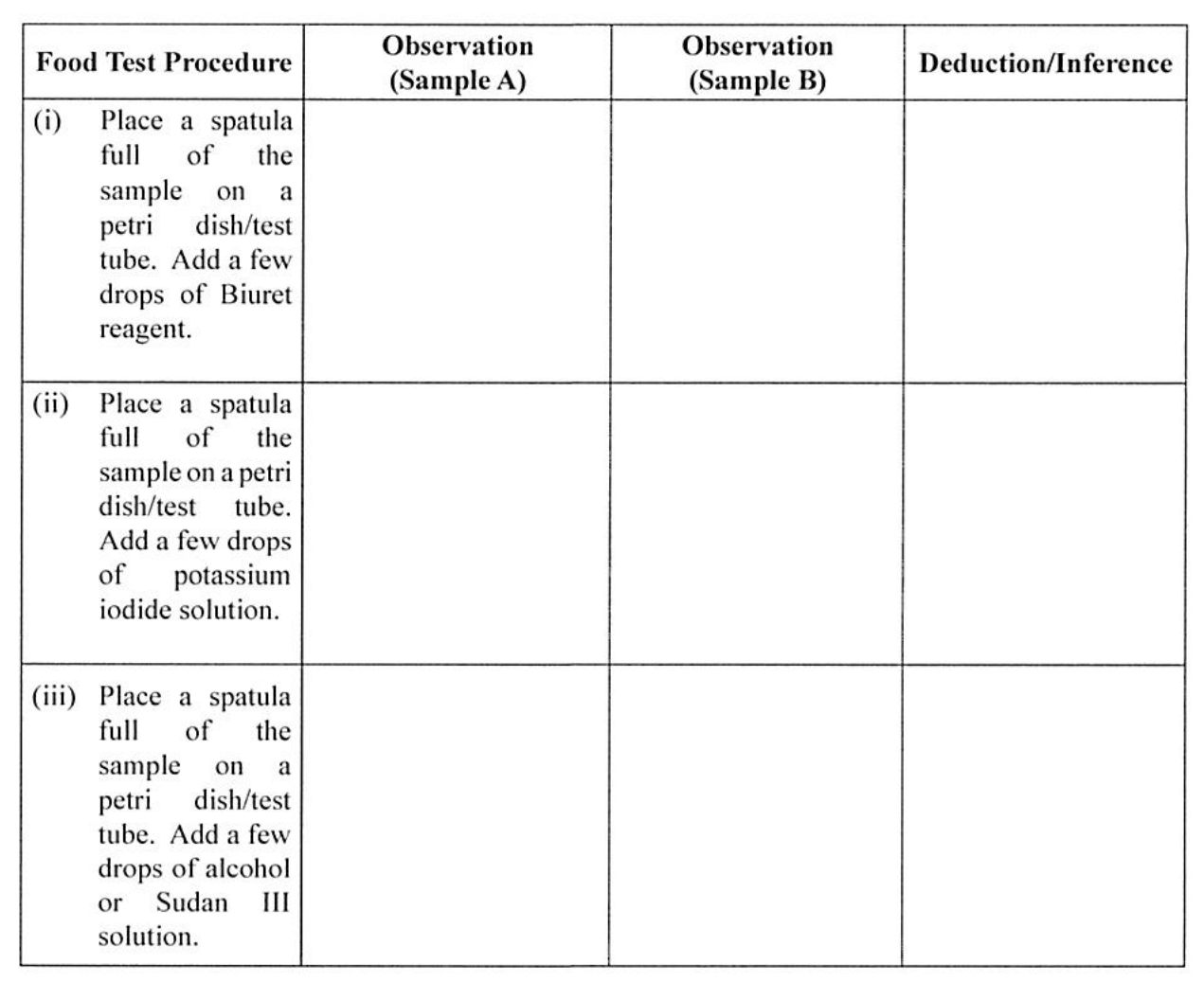
You are provided with the following:
- A sample of (mashed, crushed or blended) cooked potatoes labelled A
- A sample of powdered full cream milk labelled B
- 8–10 ml of the test reagents: Biuret reagent, potassium iodide solution, alcohol or Sudan III solution
Using the THREE testing reagents provided, conduct food tests on both food samples. Complete Table 1 by:
- describing the observations for Sample A in Column 2
- describing the observations for Sample B in Column 3
- stating the deductions/inferences in Column 4
TABLE 1: RESULTS OF FOOD TESTS
| Food Test Procedure | Observation (Sample A) | Observation (Sample B) | Deduction/Inference |
|---|---|---|---|
| (i) Place a spatula full of the sample on a petri dish/test tube. Add a few drops of Biuret reagent. | |||
| (ii) Place a spatula full of the sample on a petri dish/test tube. Add a few drops of potassium iodide solution. | |||
| (iii) Place a spatula full of the sample on a petri dish/test tube. Add a few drops of alcohol or Sudan III solution. |