CSEC Integrated Science Paper 3 May/June 2008 - Free CXC Past Paper with Answers
Free CXC Integrated Science Paper 3 May/June 2008 past paper from 2008. Includes a worked answer key. Open the PDF, take a timed test, and study with AI on Caribbean AI.
Answer keys are free on Caribbean AI. View the answers to every past-paper question at no cost - no payment needed - with step-by-step worked solutions and instant AI marking available on Premium.
- All CSEC Past Papers
- CSEC Integrated Science Past Papers
- CSEC Integrated Science Paper 3 May/June 2014
- CSEC Integrated Science Paper 3 May/June 2013
- CSEC Integrated Science Paper 3 May/June 2012
- CSEC Integrated Science Paper 3 May/June 2011
- CSEC Integrated Science Paper 3 May/June 2010
- CSEC Integrated Science Paper 3 May/June 2009
- CSEC Integrated Science Paper 3 May/June 2007
- CSEC Integrated Science Paper 3 May/June 2006
- CSEC Integrated Science Paper 3 May/June 2005
CSEC Integrated Science Paper 3 May/June 2008 - Free CXC Past Paper with Answers
Free CXC Integrated Science Paper 3 May/June 2008 past paper from 2008. Includes a worked answer key. Open the PDF, take a timed test, and study with AI on Caribbean AI.
Opening the interactive papers…
- All CSEC Past Papers
- CSEC Integrated Science Past Papers
- CSEC Integrated Science Paper 3 May/June 2014
- CSEC Integrated Science Paper 3 May/June 2013
- CSEC Integrated Science Paper 3 May/June 2012
- CSEC Integrated Science Paper 3 May/June 2011
- CSEC Integrated Science Paper 3 May/June 2010
- CSEC Integrated Science Paper 3 May/June 2009
- CSEC Integrated Science Paper 3 May/June 2007
- CSEC Integrated Science Paper 3 May/June 2006
- CSEC Integrated Science Paper 3 May/June 2005
CSEC Integrated Science Paper 3 May/June 2008 Questions
Every question from this paper as text. See the answers and worked solutions. Questions are the property of the Caribbean Examinations Council; Caribbean AI is not affiliated with CXC.
Question 1 (17 marks)
Two pieces of apparatus are provided, one as shown in Figure 1 and the second is similar with a rubber band instead of the spring. You will also be provided with a series of masses (weights): 10 g, 20 g, 30 g ... to 100 g. The elasticity of two materials, a spring and a rubber band are to be compared.
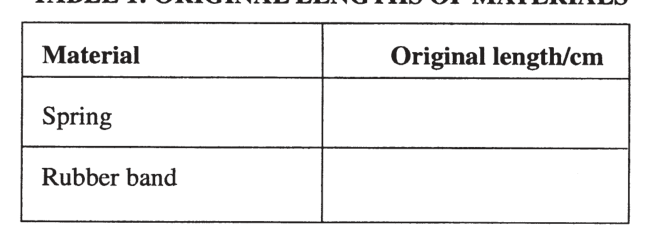
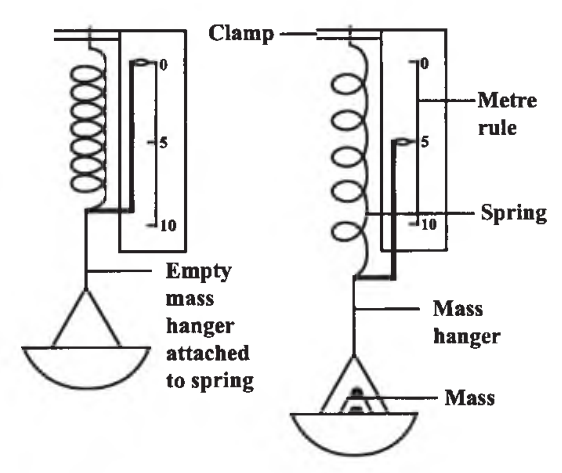
Complete Table 1 by measuring the original length of EACH material, that is, the length without any load attached.
The spring
The rubber band
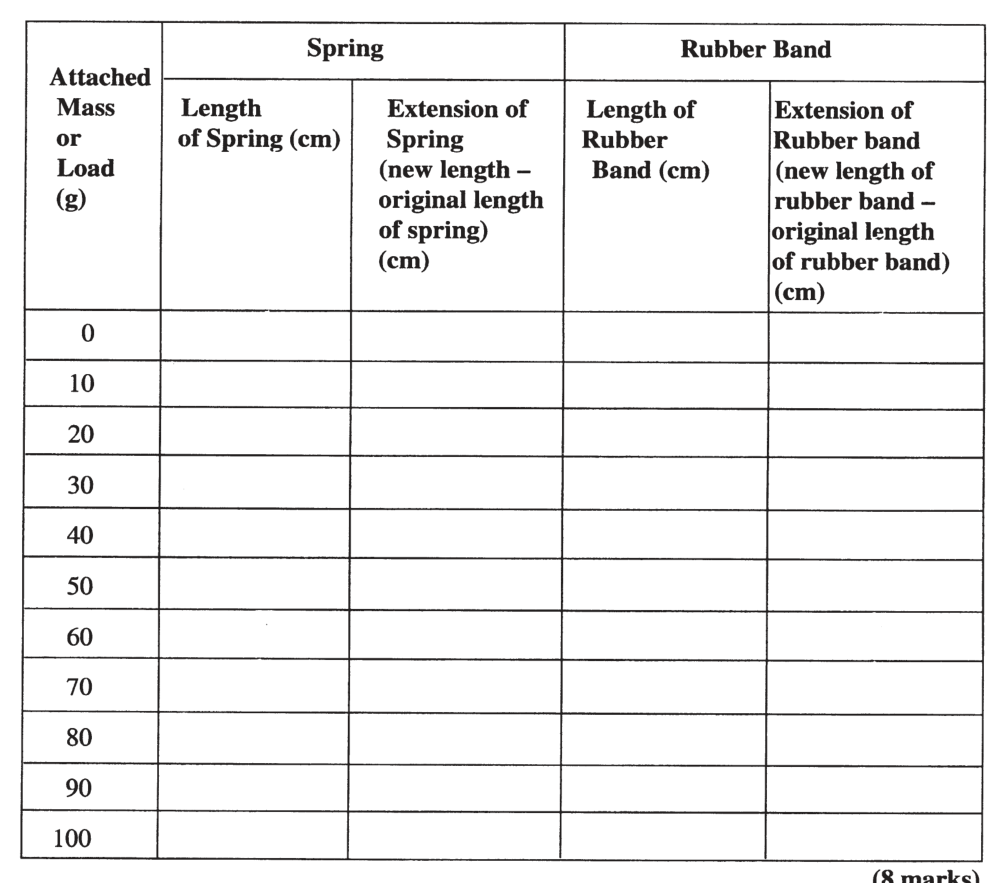
Assume that the mass of each material without any load is zero grams (0 g). Complete Table 2 by performing the steps below. (i) Record the original length of the spring. (ii) Attach a 10 g mass (weight) to (or place it in) the hanger that is attached to the spring. (iii) Measure the new length of the spring and record this. (iv) Calculate the extension of the spring for this 10 g mass (weight) (new length – previous length) and record this. (v) Remove this mass (weight). Attach the next mass (weight) in the series to (or place it in) the hanger. (vi) Repeat steps from (ii) to (iv) until all the masses (weights) in the series have been used. (vii) Repeat the steps from (i) to (vi) for the hanger attached to the rubber band.