Free CXC Mathematics Paper 2 May/June 1985 past paper from 1985. Includes a worked answer key. Open the PDF, take a timed test, and study with AI on Caribbean AI.
Answer keys are free on Caribbean AI. View the answers to every past-paper question at no cost - no payment needed - with step-by-step worked solutions and instant AI marking available on Premium.
CSEC Mathematics Paper 2 May/June 1985 - Free CXC Past Paper with Answers
Free CXC Mathematics Paper 2 May/June 1985 past paper from 1985. Includes a worked answer key. Open the PDF, take a timed test, and study with AI on Caribbean AI.
Opening the interactive papers…
Every question from this paper as text. See the answers and worked solutions. Questions are the property of the Caribbean Examinations Council; Caribbean AI is not affiliated with CXC.
Answer ALL the questions in this section.
Without using tables, calculate the exact value of
[5 marks]
A car left Mandeville at 16:00 hrs and arrived in Kingston at 17:30 hrs. It travelled at an average speed of 60 kilometres per hour. Calculate the distance from Kingston to Mandeville.
The car then left Kingston at 18:20 hrs and arrived in Montego Bay at 22:05 hrs. If Montego Bay is 210 kilometres from Kingston, calculate the average speed of the car on the journey from Kingston to Montego Bay.
[6 marks]
Given that , determine the values of and .
[5 marks]
Find the values of to 2 significant figures in the equation .
[6 marks]
$5 000 was put in a fixed deposit account on 1st January, 1984 for 6 months. The rate of interest was 12.5% per annum. On 1st July, 1984 the total amount received was reinvested for a further 6 months at 12.0% per annum. Calculate the final amount received at the end of the year.
[5 marks]
Of the 100 candidates who wrote the examinations in Computer Science, Statistics and Accounts, 48 candidates passed Computer Science, 14 passed Computer Science and Accounts only, and 14 passed Statistics and Accounts only.
Three times as many passed in both Statistics and Computer Science as passed all three subjects.
Assume that:
Represent the information given above on a suitable Venn diagram and hence write down TWO equations in and which can be used to solve for and .
[8 marks]
ABCDE is a regular pentagon inscribed in a circle centre O, radius 12 cm, as shown in the diagram above. M is the mid-point of DC.
(i) Calculate the angle DOC (in degrees). (ii) Calculate DM. (iii) Hence, find the perimeter of the pentagon.
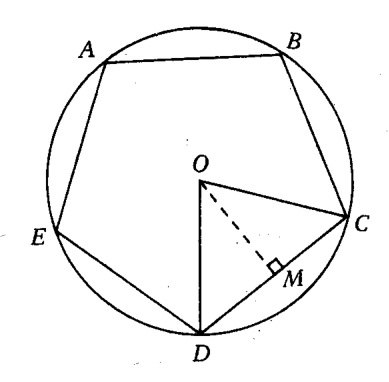
ABCDE is a regular pentagon inscribed in a circle centre O, radius 12 cm, as shown in the diagram above. M is the mid-point of DC.
(i) Calculate the angle DOC (in degrees). (ii) Calculate DM. (iii) Hence, find the perimeter of the pentagon.
[10 marks]
In the diagram above the triangle ABC undergoes a shear so that A is mapped onto D and DC is parallel to AB, B and C remaining fixed. EF is the image of DC under translation and DE is equal to BC.
Describe (i) a single transformation that will map triangle EFC onto triangle DAB. (ii) a single transformation that will map triangle BMC onto triangle BDF.
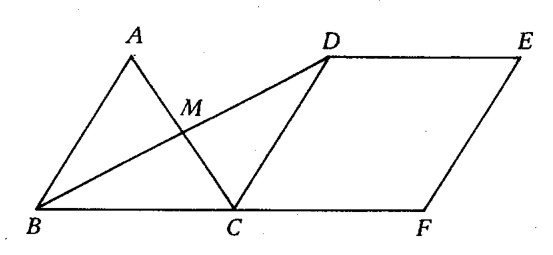
a single transformation that will map triangle EFC onto triangle DAB.
[2 marks]
a single transformation that will map triangle BMC onto triangle BDF.
[2 marks]
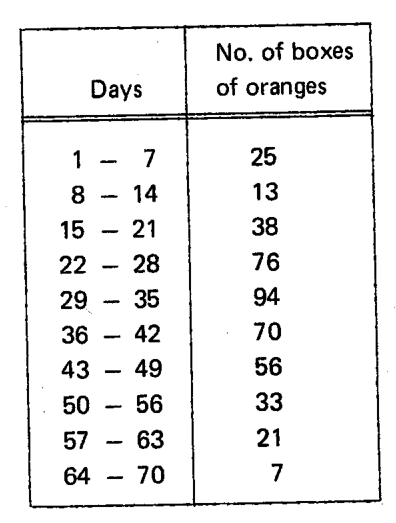
A farmer kept the following record for his orange crop over ten weeks.
| Days | No. of boxes of oranges |
|---|---|
| 1 – 7 | 25 |
| 8 – 14 | 13 |
| 15 – 21 | 36 |
| 22 – 28 | 76 |
| 29 – 35 | 94 |
| 36 – 42 | 70 |
| 43 – 49 | 56 |
| 50 – 56 | 33 |
| 57 – 63 | 21 |
| 64 – 70 | 7 |
(a) Complete the column for the cumulative frequency on the answer sheet provided. (b) Using a scale of 1 cm to represent 7 days on the -axis and 1 cm to represent 20 boxes on the -axis, draw a cumulative frequency curve. (c) Use the curve to determine (i) the number of boxes of oranges collected in the last 30 days (ii) the number of days before a target of 360 boxes was reached. (d) A box contains 10 similar balls, 4 of which are yellow. The first ball taken out at random is yellow. It is not replaced. Calculate the probability that a second ball taken out at random is yellow.
Complete the column for the cumulative frequency on the answer sheet provided.
Using a scale of 1 cm to represent 7 days on the -axis and 1 cm to represent 20 boxes on the -axis, draw a cumulative frequency curve.
Use the curve to determine (i) the number of boxes of oranges collected in the last 30 days (ii) the number of days before a target of 360 boxes was reached.
the number of boxes of oranges collected in the last 30 days
the number of days before a target of 360 boxes was reached.
A box contains 10 similar balls, 4 of which are yellow. The first ball taken out at random is yellow. It is not replaced. Calculate the probability that a second ball taken out at random is yellow.
[14 marks]
A cylindrical object of height 21 cm has an outer diameter of 28 cm and an inner diameter of 24 cm. The material of which it is made has a density of 6 g/cm. Calculate, to the nearest kilogram, the mass of the object.
[7 marks]
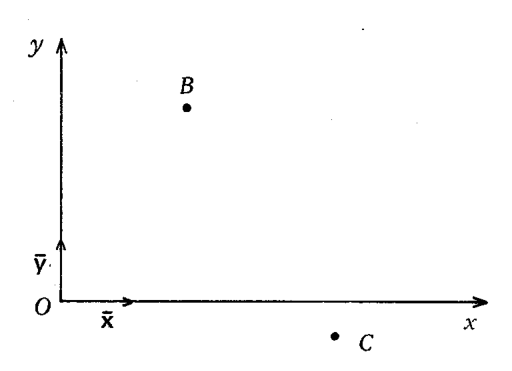
The points A, B, and C have position vectors , and respectively where and are unit vectors along $Ox$ and $Oy$ as shown in the diagram above.
(i) Find the length of vector . (ii) Find the values of and if is a parallelogram.
Find the length of vector .
Find the values of and if is a parallelogram.
[8 marks]
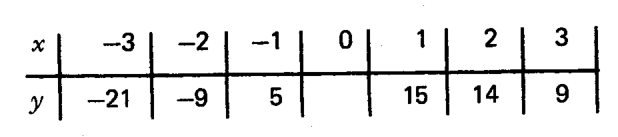
The path of a missile was tracked by an observer. The missile travelled according to the formula where $x, y$ represents its coordinates at any time .
The table below shows the observer's record in which he incorrectly wrote one of the values.
| -3 | -2 | -1 | 0 | 1 | 2 | 3 | |
|---|---|---|---|---|---|---|---|
| -21 | -9 | 5 | 15 | 14 | 9 |
(a) Calculate the value of when . (b) Draw a graph of the recorded observations using a scale of 2 cm to 1 unit on the -axis and 1 cm to 2 units on the -axis, clearly indicating the incorrect value. (c) Estimate the correct value of for the incorrect one given. (d) Find the values of and in the formula.
[12 marks]
Calculate the value of when .
Draw a graph of the recorded observations using a scale of 2 cm to 1 unit on the -axis and 1 cm to 2 units on the -axis, clearly indicating the incorrect value.
Estimate the correct value of for the incorrect one given.
Find the values of and in the formula.
An object moves from a point A in such a way that its distance metres after seconds is given by the relation:
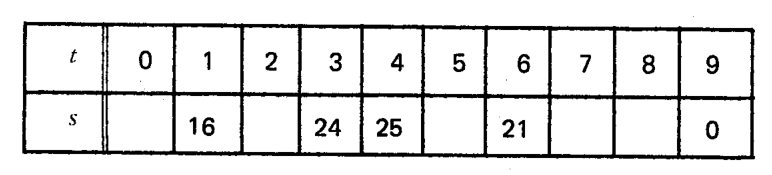
(a) Copy and complete the table below for values of and for .
| 0 | 1 | 2 | 3 | 4 | 5 | 6 | 7 | 8 | 9 | |
|---|---|---|---|---|---|---|---|---|---|---|
| 16 | 24 | 25 | 21 |
(b) Draw the graph of the relation using a scale of 2 cm to represent 1 second and 2 cm to represent 10 metres. (c) Using the graph, find (i) the greatest distance of the object from A (ii) the time when the object returns to A (iii) the speed after it has travelled 5 seconds.
[10 marks]
Copy and complete the table below for values of and for .
| 0 | 1 | 2 | 3 | 4 | 5 | 6 | 7 | 8 |
|---|
Draw the graph of the relation using a scale of 2 cm to represent 1 second and 2 cm to represent 10 metres.
Using the graph, find (i) the greatest distance of the object from A (ii) the time when the object returns to A (iii) the speed after it has travelled 5 seconds.
the greatest distance of the object from A
the time when the object returns to A
the speed after it has travelled 5 seconds.
Two rectangular plots are equal in area. The length of the first plot is one and a half times its width. The length of the second plot is 7 metres less than three times its width.
(a) Denoting the width of the first plot by metres and the width of the second plot by metres, derive a relation between and . (b) If , calculate the values of and .
[10 marks]
Denoting the width of the first plot by metres and the width of the second plot by metres, derive a relation between and .
If , calculate the values of and .
A quadrilateral ABCD is formed by joining the points whose co-ordinates are A(-2, 0), B(0, 4), C(7, 3) and D(3, -5).
(a) Calculate the length of AC. (b) Show that BD is perpendicular to AC. (c) Prove that ABCD is a trapezium.
[10 marks]
Calculate the length of AC.
Show that BD is perpendicular to AC.
Prove that ABCD is a trapezium.
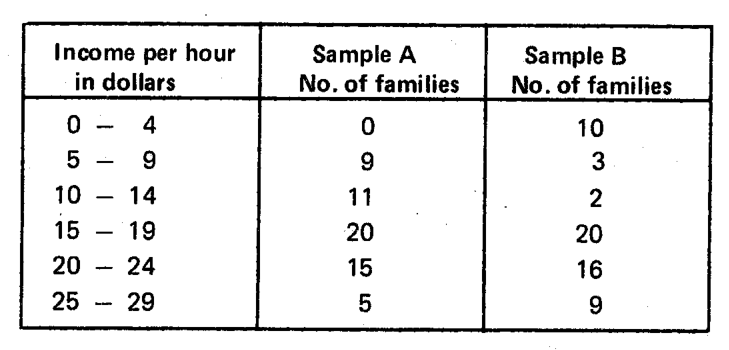
The result of a survey of the income earned per hour for 2 samples of 60 families is given in the table below:
| Income per hour in dollars | Sample A No. of families | Sample B No. of families |
|---|---|---|
| 0 – 4 | 9 | 10 |
| 5 – 9 | 9 | 3 |
| 10 – 14 | 11 | 2 |
| 15 – 19 | 20 | 20 |
| 20 – 24 | 15 | 16 |
| 25 – 29 | 5 | 9 |
(a) Estimate the mean income per hour of the families in Sample A. (b) Using a scale of 2 cm to represent $5 and 2 cm to represent 5 families draw a frequency polygon to illustrate the incomes of the families in Sample B. (c) How would you determine which sample had a more equitable distribution of income? Give reasons to support any statements you make.
[10 marks]
Estimate the mean income per hour of the families in Sample A.
Using a scale of 2 cm to represent $5 and 2 cm to represent 5 families draw a frequency polygon to illustrate the incomes of the families in Sample B.
How would you determine which sample had a more equitable distribution of income? Give reasons to support any statements you make.
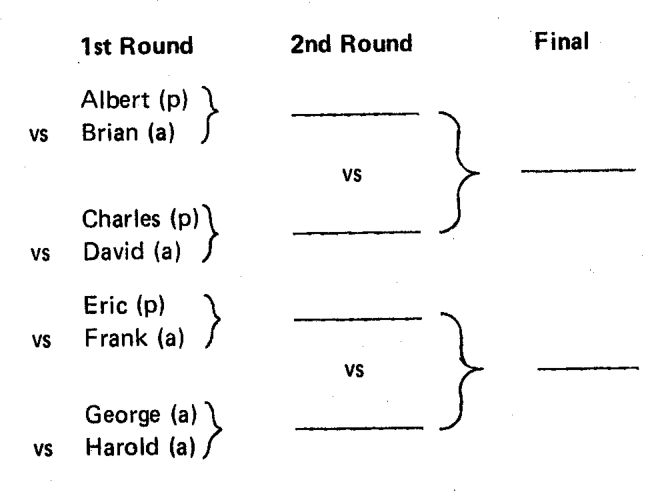
The draw for a tennis tournament involving three professional and five amateur players is made as follows:
1st Round Albert (p) vs Brian (a) Charles (p) vs David (a) Eric (p) vs Frank (a) George (a) vs Harold (a)
The letters (p) and (a) after each name denote the status (professional or amateur) of the player. The probability that a professional beats an amateur is and players of the same status have the same chance of winning.
Calculate the probability that
[10 marks]
Brian and David play each other in the 2nd Round.
[5 marks]
Either Frank or George (or both) will reach the 2nd Round.
[5 marks]
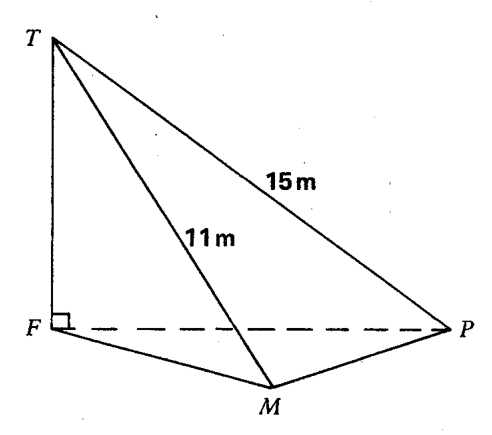
TF is a vertical flagpole. , and are points on the same horizontal plane. Two ropes TP and TM are attached to the top of the pole. The angles of depression of M and of P from T are and respectively. m, and m. .
Calculate the length of
[10 marks]
PF
[5 marks]
MP.
[5 marks]
In a triangle PQR the position vectors of the vertices P, Q and R relative to O are , and respectively. M is a point on PQ such that . N is a point on PR such that . Using vector algebra, show that
[10 marks]
.
MN is parallel to QR.
[5 marks]
Consider the following TWO arguments: (i) All regular polygons may be inscribed in a circle. Therefore an equilateral triangle is a regular polygon.
(ii) For each of the TWO arguments state whether or not the conclusion necessarily follows from the premises. Give reasons for your answer in each case.
[10 marks]
Copy and complete the truth table below for the compound statement .
| p | q | ||
|---|---|---|---|
| T | T | ||
| T | F | ||
| F | T | ||
| F | F |
If p represents the statement "I like cricket", and q represents the statement "I play basketball well", what conclusion can be drawn from the statement ?
[5 marks]
Consider the following TWO arguments: (i) Therefore
[5 marks]
Given that , that is ,
[10 marks]
Prove that the sum of any three consecutive integers is divisible by 3.
[3 marks]
Any even number may be written as where can be a negative or positive integer or zero.
Prove that
If the product of any two integers is odd then the sum of the integers is even.
[3 marks]
Prove that .
| 9 |
|---|
| 16 | 24 | 25 | 21 |
[5 marks]
[4 marks]