Free CXC Mathematics Paper 2 May/June 2000 past paper from 2000. Includes a worked answer key. Open the PDF, take a timed test, and study with AI on Caribbean AI.
Answer keys are free on Caribbean AI. View the answers to every past-paper question at no cost - no payment needed - with step-by-step worked solutions and instant AI marking available on Premium.
CSEC Mathematics Paper 2 May/June 2000 - Free CXC Past Paper with Answers
Free CXC Mathematics Paper 2 May/June 2000 past paper from 2000. Includes a worked answer key. Open the PDF, take a timed test, and study with AI on Caribbean AI.
Opening the interactive papers…
Every question from this paper as text. See the answers and worked solutions. Questions are the property of the Caribbean Examinations Council; Caribbean AI is not affiliated with CXC.
Calculate the exact value of
[4 marks]
Write the value of (i) exactly in decimal form (ii) to two decimal places (iii) to two significant figures.
[3 marks]
A company sells its printers to customers in order to make a profit of 25%. Calculate (i) the price a customer pays for a printer which the company bought for $1 700 (ii) the price the company paid for a printer which was sold to a customer for $2 500.
[5 marks]
Factorize completely: (i) (ii) (iii)
[5 marks]
The floor of a room is in the shape of a rectangle. The floor is metres long. The width of the floor is 2 metres less than its length. (i) State, in terms of (a) the width of the floor (b) the area of the floor. (ii) If the area of the floor is , write down an equation in to show this information. (iii) Use the equation to determine the width of the floor.
[7 marks]
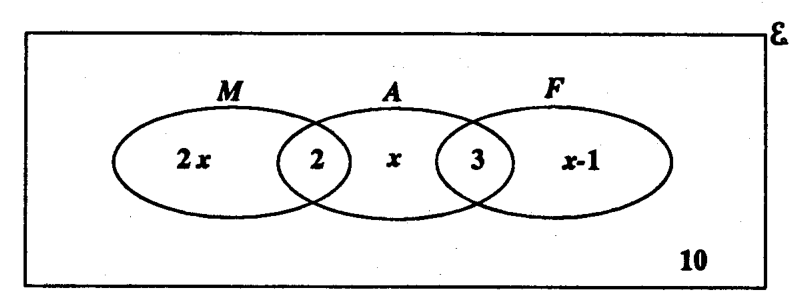
The Venn diagram below shows the number of students doing Mathematics (), Accounts () and French () in a class of 50.
(i) Write down an expression, in terms of , for the number of students who do Accounts. (ii) Write down an equation, in terms of , which shows the information in the Venn diagram. (iii) Determine the number of students who do Mathematics only. (iv) Determine the number of students who do French.
[8 marks]
Solve the simultaneous equations
[4 marks]
Using ruler and compasses only: (i) Construct such that , angle . (ii) Construct which is perpendicular to and which intersects at . (iii) Complete the quadrilateral such that . (iv) Measure and write down the length of . (v) Name the type of quadrilateral you have drawn. [All construction lines must be clearly shown.]
[7 marks]
Write your answer to this question on the answer sheet provided. The diagram on the answer sheet shows triangle . is a translation given by the vector . is a rotation of about the origin . (i) Draw and label triangle , the image of triangle under . (ii) Under the rotation , triangle is mapped onto triangle . Draw and label triangle .
Given that Calculate .
[2 marks]
State the value of for which is not defined.
[1 mark]
Derive an expression for .
[3 marks]
Calculate the value of .
[4 marks]
An aircraft left Jamaica at 13:55 hrs and travelled to Barbados via Antigua. The average speed of the aircraft was 420 km per hour. It arrived in Antigua at 16:45 hrs local time.
Given that Antigua is ONE hour AHEAD of Jamaica, calculate the distance between Jamaica and Antigua.
[4 marks]
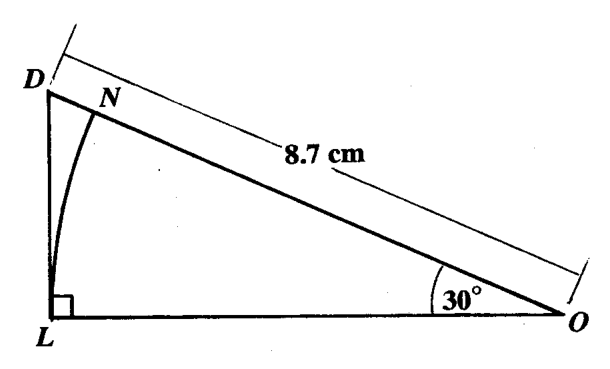
[Take ] In the diagram above, not drawn to scale, is a sector of a circle, centre and is produced to . Angle , angle and . Calculate (i) the length, in cm, of (ii) the radius of the sector (iii) the area of the sector .
[7 marks]
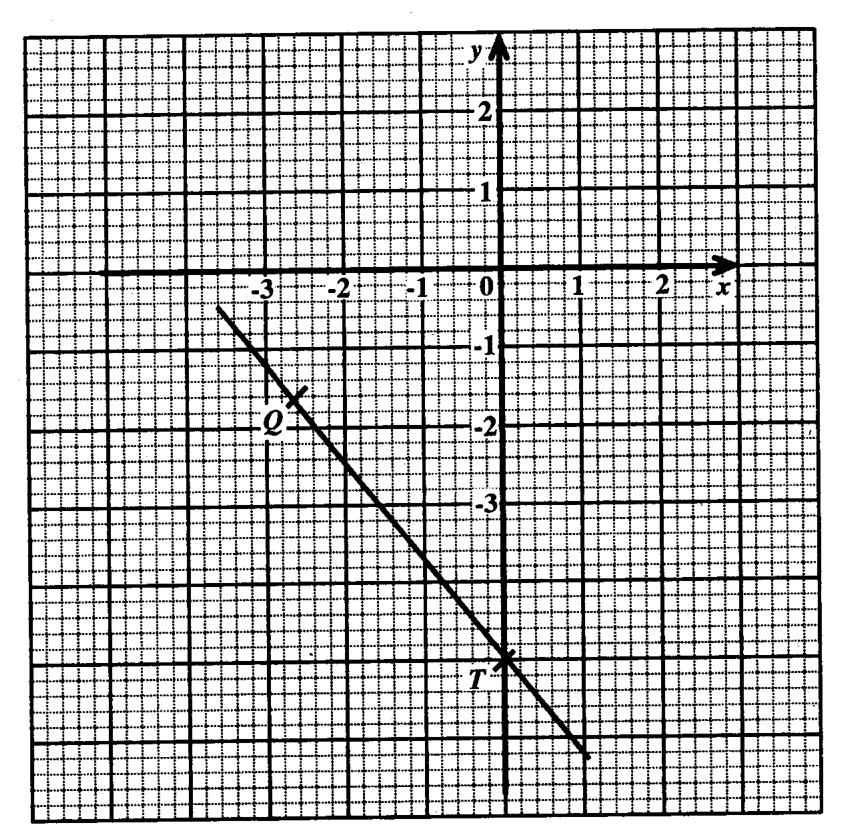
The graph above shows a straight line intersecting the -axis at . (i) State the coordinates of . (ii) Calculate the gradient of . (iii) Determine the equation of .
[5 marks]
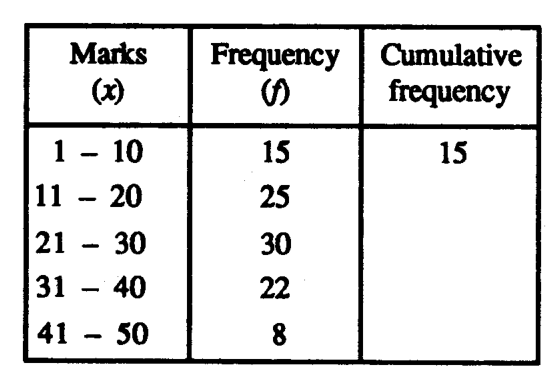
The table below gives the marks of 100 students in an examination. Copy and complete the table in your answer booklet.
| Marks $(x)$ | Frequency $(f)$ | Cumulative frequency |
|---|---|---|
| 1 - 10 | 15 | |
| 11 - 20 | 25 | |
| 21 - 30 | 30 | |
| 31 - 40 | 22 | |
| 41 - 50 | 8 |
[2 marks]
Plot a cumulative frequency curve to show this information using a scale of 1 cm to represent 5 marks on the horizontal axis and 1 cm to represent 10 students on the vertical axis.
[6 marks]
Show on your graph how to estimate (i) the lower quartile (ii) the upper quartile.
[2 marks]
Use your estimates to calculate the interquartile range.
[1 mark]
Given that 20% of the students passed the examination, determine the pass mark.
[1 mark]
Solve
[15 marks]
Solve
Write the expression in the form , where , and are real numbers. (ii) Hence, state whether the function has a maximum or minimum value. (iii) State the value of at which this maximum or minimum value occurs.
Write the expression in the form , where , and are real numbers.
Hence, state whether the function has a maximum or minimum value.
[2 marks]
State the value of at which this maximum or minimum value occurs.
[2 marks]
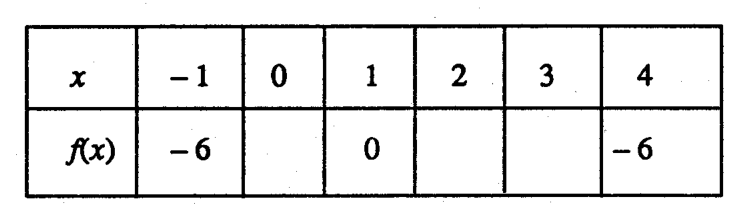
Copy and complete the table below for the function .
| -1 | 0 | 1 | 2 | 3 | 4 | |
|---|---|---|---|---|---|---|
| -6 | 0 | -6 |
[3 marks]
Using 2 cm to represent 1 unit on the -axis and 1 cm to represent 10 students on the -axis, draw the graph of for .
Using the graph, determine: (i) the maximum value of (ii) The value of for which is maximum (iii) The values of for which .
the maximum value of
[1 mark]
The value of for which is maximum
[1 mark]
The values of for which .
[2 marks]
Using the same scale and the same axes, draw the line . (ii) Use the graphs of and to find the roots of the equation .
Using the same scale and the same axes, draw the line .
[1 mark]
Use the graphs of and to find the roots of the equation .
The base, , of an antenna rests on horizontal ground. The angle of elevation of the top , from a point on the ground is .
The angle of elevation of from a second point , 6 m closer to than , is .
[15 marks]
Draw a diagram to show the information above, labelling all given points, distances and angles.
[4 marks]
Calculate, to 3 significant figures (i) the length (ii) the height , of the antenna.
[7 marks]
the length
[3 marks]
the height , of the antenna.
[4 marks]
A third point, , lies on the ground 5.4 m from . The angle of depression of from is degrees.
Calculate, to the nearest degree, the value of .
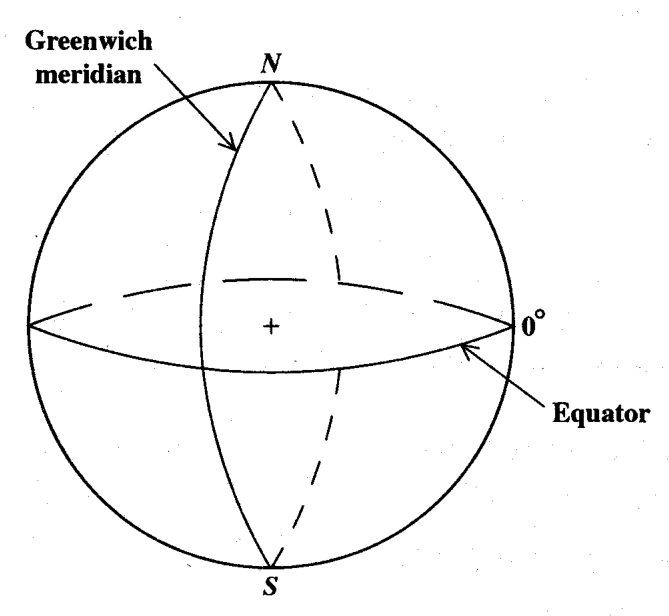
[Take the radius of the earth to be 6400 km and use ] The diagram above represents the earth and shows the equator and the Greenwich meridian. Town is situated at Town is situated at
[9 marks]
Copy and complete the diagram and show the positions of Town and Town . (ii) Calculate the radius of the circle of latitude on which Towns and are situated. (iii) Calculate the shortest distance, measured along the earth's surface, between the two towns.
[9 marks]
Copy and complete the diagram and show the positions of Town and Town .
[3 marks]
Calculate the radius of the circle of latitude on which Towns and are situated.
[3 marks]
Calculate the shortest distance, measured along the earth's surface, between the two towns.
[3 marks]
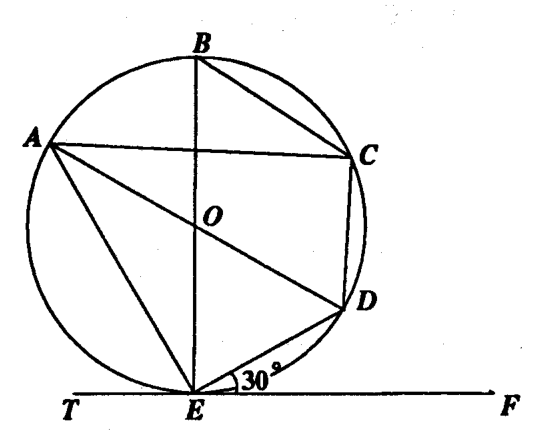
In the figure above, not drawn to scale, is the centre of the circle and is a tangent to the circle at .
Given that , calculate, giving reasons to support your answer, the sizes of the angle (i) (ii) (iii) (iv) .
[1 mark]
[1 mark]
[2 marks]
.
[2 marks]
The position vectors of the points , and relative to an origin are , and . (i) Express, in the form , the vectors and . (ii) Show, by calculation, that makes an angle of with the -axis.
[5 marks]
Express, in the form , the vectors and .
Show, by calculation, that makes an angle of with the -axis.
[2 marks]
Given that (a) (i) Evaluate the inverse, , of . (ii) Use a matrix method to solve (7 marks) (b) is mapped onto under a reflection in the y-axis. (i) Write down the matrix, , associated with this transformation. (ii) is mapped onto by a reflection in the line . Write down the matrix, , associated with this transformation. (iii) Determine the single matrix, , which represents the transformation followed by . (iv) Describe fully the single transformation represented by . (8 marks)
[15 marks]
[4 marks]
[8 marks]
[7 marks]
[3 marks]
[4 marks]
[4 marks]
[4 marks]
[3 marks]
[4 marks]
[6 marks]
[3 marks]