Free CXC Biology Paper 1 May/June 2005 past paper from 2005. Includes a worked answer key. Open the PDF, take a timed test, and study with AI on Caribbean AI.
Answer keys are free on Caribbean AI. View the answers to every past-paper question at no cost - no payment needed - with step-by-step worked solutions and instant AI marking available on Premium.
CSEC Biology Paper 1 May/June 2005 - Free CXC Past Paper with Answers
Free CXC Biology Paper 1 May/June 2005 past paper from 2005. Includes a worked answer key. Open the PDF, take a timed test, and study with AI on Caribbean AI.
Opening the interactive papers…
Every question from this paper as text. See the answers and worked solutions. Questions are the property of the Caribbean Examinations Council; Caribbean AI is not affiliated with CXC.
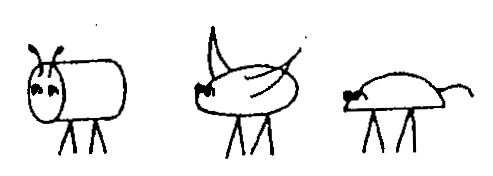
What other visible characteristic could be used for classification purposes?
Size
Weight
Tail
Fur
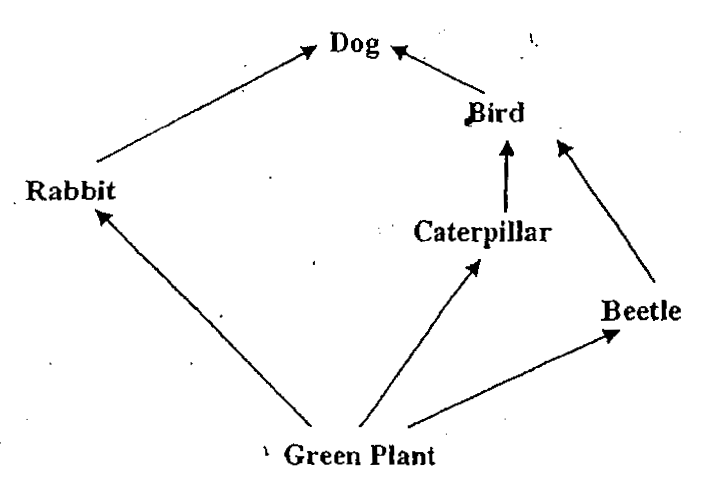
The carnivores in the food web are the
bird and caterpillar
dog and rabbit
beetle and caterpillar
bird and dog
When does respiration occur in plants?
All the time
Only at night
When photosynthesis stops
Only while photosynthesis is taking place
Which of the following is NOT indicated by the direction of the arrows in a food chain?
The direction of the flow of energy
The amount of food each animal eats
That plants start every food chain.
The animals that are predators
Which of the following situations BEST exemplifies an ecological community?
A colony of termites
A flock of migrating birds
Flies on a piece of rotting meat
The organisms in a fresh water pond
The sites of the production of ATP (adenosine triphosphate)
Mitochondria
Cell membranes
Chloroplasts
Chromosomes
Structures that move to the poles of the cell during cell division
Mitochondria
Cell membranes
Chloroplasts
Chromosomes
Which of the following processes does NOT contribute to the carbon dioxide content of the atmosphere?
Photosynthesis
Decay
Burning
Respiration
The part of the gut into which bile empties is the
duodenum
caecum
ileum
stomach
The variation in cellular structure found in any complex organism is due to a process called
growth
elaboration
metabolism
specialization
When athletes run a long-distance race, which of the following changes takes place in their bodies?
An increase in the breakdown of maltose in the intestines
A drop in the level of glycogen in the liver
Constriction of the veins in the legs
Dilation of the blood vessels to the gut
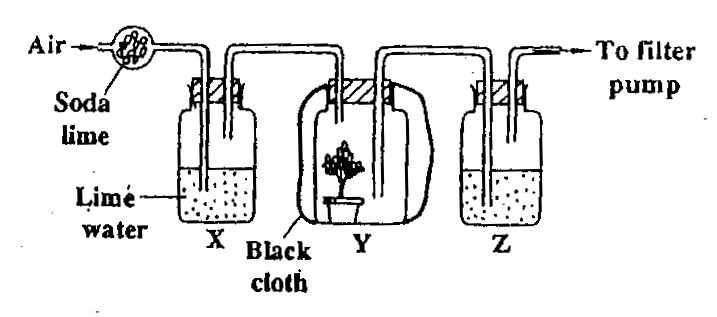
Item 12 refers to the following apparatus set up to test for products of aerobic respiration.
The solution in Jar Z should be
iodine
tap water
calcium hydroxide (lime water)
sodium hydroxide (caustic soda)
Item 13 refers to the following characteristics of certain structures. I. Thin walled surfaces II. Excellent blood supply III. Always moist IV. Large surface area
These characteristics are MOST likely to be associated with the
diffusion of gases
production of energy
movement of water
transport of digested food
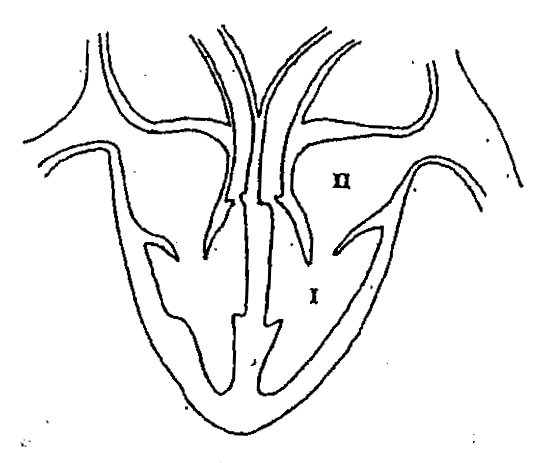
Item 14 refers to the following diagram of the human heart.
In a patient with a certain defective heart condition, it is found that blood flows from Point I to Point II. This is MOST likely due to the malfunction of the
left atrium
left ventricle
semi-lunar valve
bicuspid valve
Items 15-16 refer to the following structures found in the leaf of a flowering plant. I. Epidermis II. Mesophyll layer III. Guard cells IV. Vein.
Which of the structures contain chloroplasts?
I and II
I and III
II and III
II and IV
A whole plant has its roots submerged for a few hours, in water coloured with red ink. In which part of its leaves does the ink FIRST show up?
Epidermis
Mesophyll layer
Guard cells
Vein
Human red blood cells are normally
disc-shaped, without a nucleus
disc-shaped, with a nucleus
spherical, with a nucleus
spherical, without a nucleus
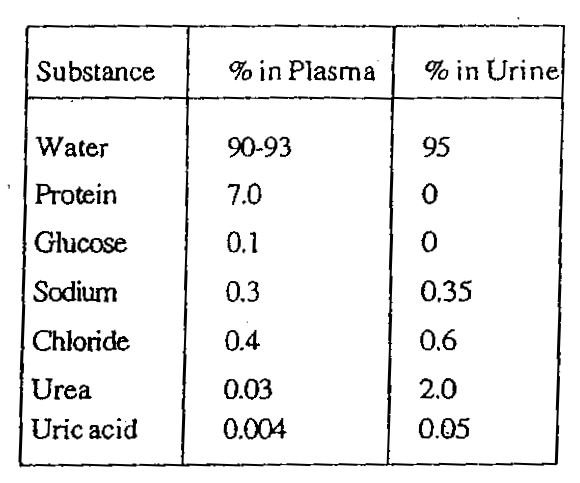
Item 18 refers to the following table which shows approximate concentrations of some substances in the blood plasma and urine of a healthy man.
In which organ of the body do the changes in concentration of the substances shown in the table occur?
Liver
Lung
Kidney
Rectum
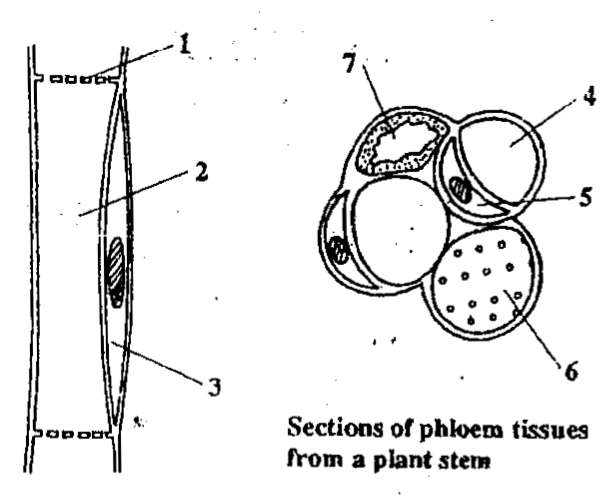
Items 19-20 refer to the following diagrams of plant cells.
<image>Sections of phloem tissues from a plant stem
Manufactured food is transported in
1 and 5
2 and 4
3 and 5
3 and 6
Companion cells are represented by
1 and 7
2 and 6
3 and 5
2 and 5
Which of the following substances is NOT an excretory product of body metabolism?
Faeces
Water
Urea
Sweat
Which of the following organisms has the LEAST need for a transport system?
Amoeba
Honey bee
Seedling
Tadpole
Which of the following arteries does NOT carry oxygenated blood?
Carotid
Hepatic
Pulmonary
Renal
Which of the following sequences BEST describes the circulation of blood in the body?
Lungs → left side of heart → other parts of the body → right side of heart
Lungs → right side of heart → left side of heart → other parts of the body
Lungs → right side of heart → other parts of the body → left side of heart
Lungs → left side of heart → right side of heart → other parts of the body
The MAIN function of cartilage at the end of long bones is to
lubricate joints
increase flexibility
reduce friction
protect nerves
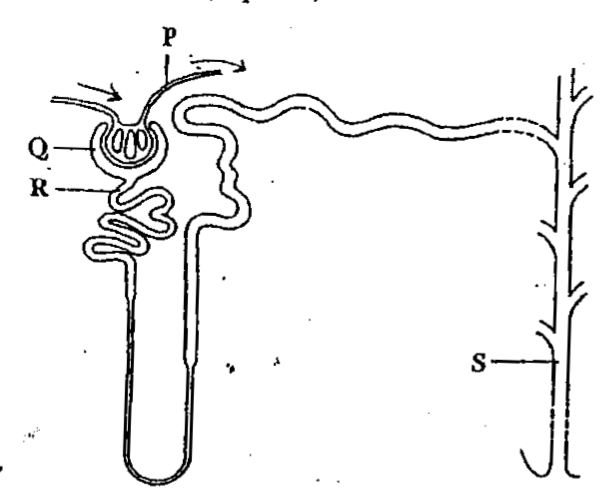
Item 26 refers to the simplified drawing of a renal tubule (nephron) below.
The name of the process which occurs in Q is
secretion
reabsorption
osmosis
filtration
The primary function of the neural spine of the lumbar vertebra is for
attachment of muscles
support of adjacent vertebrae
protection of the spinal cord
movement of bones
Item 28 refers to the actions of the following organisms:
These actions are examples of
growth movements
locomotion
stimuli
responses
Which of the following conditions does NOT increase the rate of transpiration?
Decreased humidity
Decreased temperature
Increased wind velocity.
Increased light intensity
Internal reflection of light within the eye is prevented by the
lens
retina
choroid layer
sclerotic layer
Which of the following statements are true of humans?
I. Males produce more gametes than females. II. Females produce more gametes than males. III. Males produce gametes for a longer period than females. IV. Females produce gametes for a longer period than males.
I only
I and III only
II and III only
II and IV only
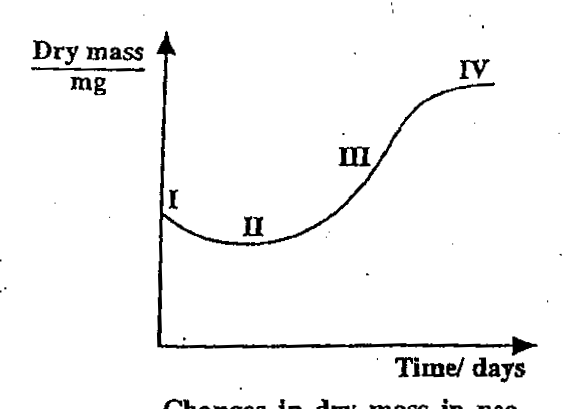
Which of the following processes is likely to contribute MOST to the decrease in dry mass between stages I and II on the graph above?
Photosynthesis
Transpiration
Translocation
Respiration
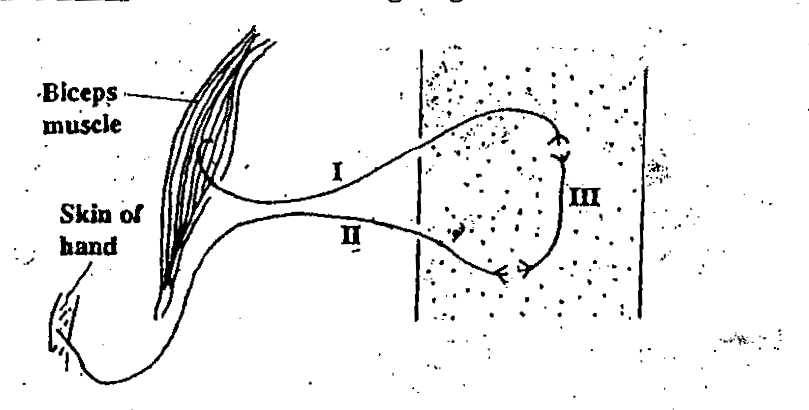
Items 33-34 refer to the following diagram of a reflex arc. <image>
When the skin of the hand touches a hot object, the sequence of impulse flow is
I → II → III
II → III → I
II → I → III
I → III → II
The numbered structures in the reflex arc are
sensory neurone / motor neurone / relay neurone
sensory neurone / relay neurone / motor neurone
motor neurone / relay neurone / sensory neurone
motor neurone / sensory neurone / relay neurone
For a student to recall his biology notes, action takes place in
a reflex arc
the cerebellum
the medulla oblongata
the cerebrum
A seedling illuminated from one side bends towards the light source because the concentration of auxins becomes
greater on the side away from the light
greater on the side towards the light
the same on both sides
greatest at the tip of the shoot
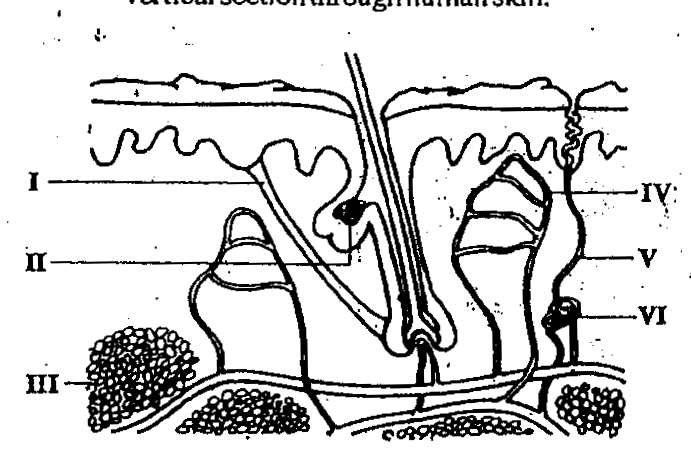
Item 37 refers to the following diagram of a vertical section through human skin.
Which structure(s) above will be involved in temperature regulation if there is a decrease in the external temperature?
I only
II and V only
I, III and IV only
IV, V and VI only
Sexual reproduction is important because
it prevents too much variation in th species
it results in offspring which may no be identical to the parents
the embryos produced by this metho are healthier
a larger number of offspring can b produced
A flower has a long style with a feather stigma, long filaments, no corolla and very small sepals. This flower is adapted for
cross-pollination
pollination by the wind
self-pollination
easy access by insects
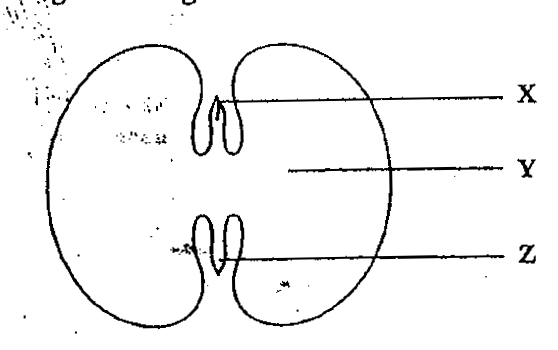
Item 40 refers to the following diagram of a germinating seed.
Which of the following correctly identifies the structures labelled X, Y and Z in the diagram above?
Radicle / plumule / cotyledon
Radicle / cotyledon / plumule
Plumule / radicle / cotyledon
Plumule / cotyledon / radicle
Which of the following processes produce clones?
I. The growth of a fungus on a piece of bread II. The development of plantlets at the leaf margins of Bryophyllum III. Propagation of sugar cane from cuttings IV. Germination of seeds from the same pod
I and II only
II and III only
III and IV only
I and IV only
Each daughter cell produced by mitosis has
half the number of chromosomes as the parent
the same number of chromosomes as the parent
twice the number of chromosomes as the parent
a variable number of chromosomes
The sperm of a certain animal contains 16 chromosomes. How many chromosomes will there be in the nucleus of its skin cell?
8
16
32
64
In which of the following parts of the plant would you expect the process of mitosis to occur?
Phloem
Xylem
In the region behind the root hair
In the region behind the root tip
Which of the following processes produce clones?
I. The growth of a fungus on a piece of bread II. The development of plantlets at the leaf margins of Bryophyllum III. Propagation of sugar cane from cuttings IV. Germination of seeds from the same pod
the same genotype
the same phenotype
homozygous genes
dominant genes
Which of the following crosses will produce a 1:1 ratio in the genotype of the offspring?
Homozygous-recessive female x heterozygous male
Heterozygous female x heterozygous male
Homozygous recessive female x homozygous male
Homozygous female x homozygous-dominant male
Which of the following shows the sex chromosomes present in the human male and female?
xx / xy
y / xy
xy / xx
y / xx
Breeders have developed many varieties of plants and animals with desirable characteristics. This process is called
cloning
genetics
natural selection
artificial selection
To which of the following groups does a disease caused by a pathogen belong?
Infectious
Deficiency
Hereditary
Physiological
Through which of the following means can natural immunity be obtained?
I. Blood transfusion II. Breastmilk III. The placenta IV. Vaccines
I and II only
II and III only
I and IV only
III and IV only
Which of the following are direct consequences of disease in humans? I. Loss of man hours and productivity II. Loss of human life III. Loss of livestock and crops
II only
I and II only
II and III only
I, II and III
The following statements were made by a number of drug users. I. I drink strong coffee every hour. The caffeine keeps me going. II. I have to inject myself with insulin twice a day. III. I know alcohol is not good for me so I only have three drinks a day. IV. I take antibiotics regularly in case I catch a cold.
Which of these individuals could be considered drug abusers?
I only
I, II and III only
I, III and IV only
II, III and IV only
Which of the following is the BEST method for investigating the range of organisms found between the low tide mark and the high tide mark on a sloping, rocky sea shore?
Use a line transect.
Collect as many species as possible.
Use large quadrats.
Take a complete census of the area.
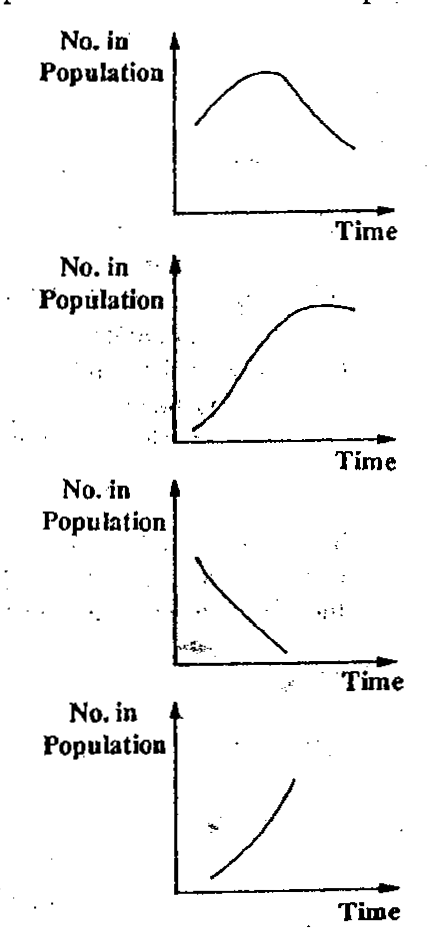
Which of the following graphs BEST represents what will happen to the fish population in a pond after caustic soda is dumped in it?
Graph A
Graph B
Graph C
Graph D
Two soil components that are derived from the parent rock material are
humus and mineral salts
sand and humus
sand and mineral salts
clay and micro-organisms
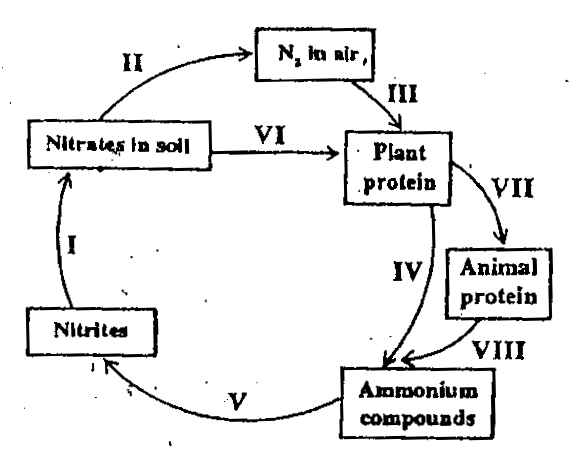
Item 56 refers to the diagram of the nitrogen cycle below.
Which of the stages in the cycle identified below result from the activity of micro-organisms?
I, II, III, IV only
I, II, III, VII only
II, III, IV, VI only
III, IV, V, VI only
Which of the following factors has NOT contributed to the marked increase in the life expectancy of humans over the last 100 years?
Gene mutations
Better medical care
Improved sanitation
Increased information about disease
Item 58 refers to the following characteristics of a plant. I. Thick hairy leaves II. Concealed stomata III. Deeply penetrating rootsystem
These characteristics MOST likely belong to a plant which grows in a region that is
warm and dry
warm and shady
cool and exposed
cool and wet
Replanting trees on a bare hillside is an example of
conservation and reafforestation
preservation and conservation
restoration and preservation
reafforestation and restoration
Which of the following is an advantage of using inorganic fertilizers rather than organic manure?
They help to hold water in the soil.
They improve the crumb structure of soil.
They make nutrients available more quickly.
They do not affect the soil pH.