Free CXC Biology Paper 1 May/June 2015 past paper from 2015. Includes a worked answer key. Open the PDF, take a timed test, and study with AI on Caribbean AI.
Answer keys are free on Caribbean AI. View the answers to every past-paper question at no cost - no payment needed - with step-by-step worked solutions and instant AI marking available on Premium.
CSEC Biology Paper 1 May/June 2015 - Free CXC Past Paper with Answers
Free CXC Biology Paper 1 May/June 2015 past paper from 2015. Includes a worked answer key. Open the PDF, take a timed test, and study with AI on Caribbean AI.
Opening the interactive papers…
Every question from this paper as text. See the answers and worked solutions. Questions are the property of the Caribbean Examinations Council; Caribbean AI is not affiliated with CXC.
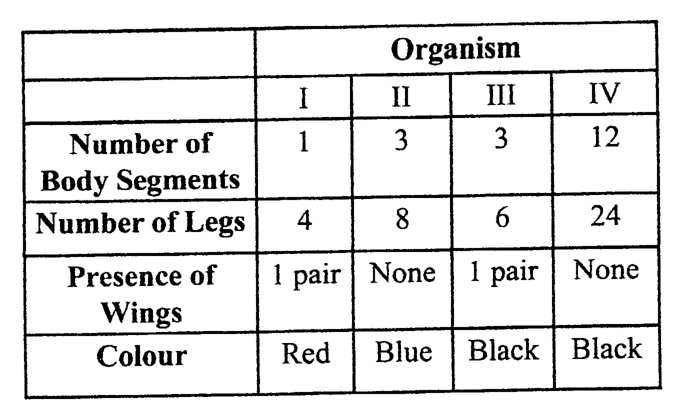
Which organism is MOST likely an insect?
I
II
III
IV
Which of the following organisms occupies the fourth trophic level in the food chain below?
Cabbage → Caterpillar → Small bird → Hawk
Hawk
Cabbage
Small bird
Caterpillar
Which of the following relationships may present harm to one of the organisms involved?
I. Commensalism II. Parasitism III. Predation IV. Mutualism
I and II only
I and IV only
II and III only
III and IV only
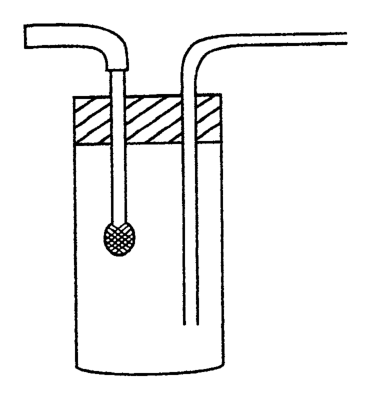
Item 4 refers to the following diagram which shows an apparatus used for collecting organisms.
The apparatus is MOST suitable for collecting
ants
slugs
moths
spiders
Which of the following organisms are MOST important in biodegradation?
Bacteria
Vultures
Omnivores
Earthworms
Which of the following gases does NOT contribute to the greenhouse effect?
Methane
Carbon dioxide
Carbon monoxide
Chlorofluorocarbon
Replanting trees on a bare hillside is an example of
conservation and afforestation
preservation and conservation
restoration and preservation
reafforestation and restoration
Which of the following factors contribute to INCREASED population size? I. Ability to resist disease II. Inadequate water supplies III. Too much or too little light IV. Small number of predators
I and II only
I and IV only
II and III only
I, II, III and IV
When compared to a cheek cell, a muscle cell contains more
vacuoles
ribosomes
mitochondria
chromosomes
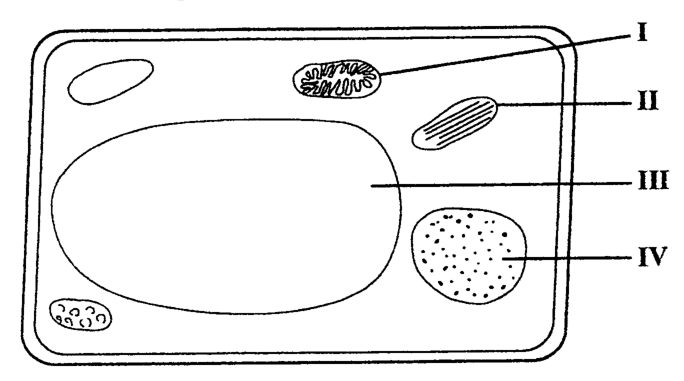
Items 10-11 refer to the following diagram of a plant cell.
Which of the labelled structures is responsible for controlling cellular activities?
I
II
III
IV
Which of the labelled structures is NOT found in an animal cell?
I
II
III
IV
By which two processes do the dissolved minerals from the soil move into the roots of a plant?
Osmosis and diffusion
Active transport and osmosis
Diffusion and active transport
Transpiration pull and osmosis
Autotrophic nutrition does NOT occur in
moss
zooplankton
tomato plants
blue-green algae
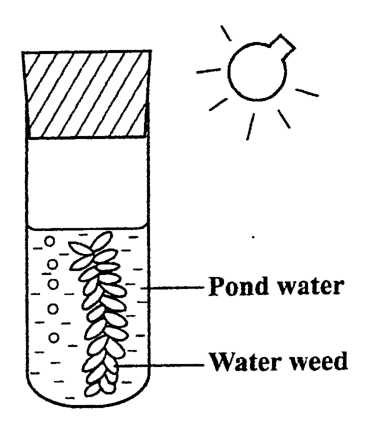
If the bubbles given off by the plants were collected and tested, the gas present would MOST likely be
oxygen
hydrogen
nitrogen
carbon dioxide
The intense yellowing of leaves is MOST likely due to a deficiency of
iron
calcium
magnesium
phosphorus
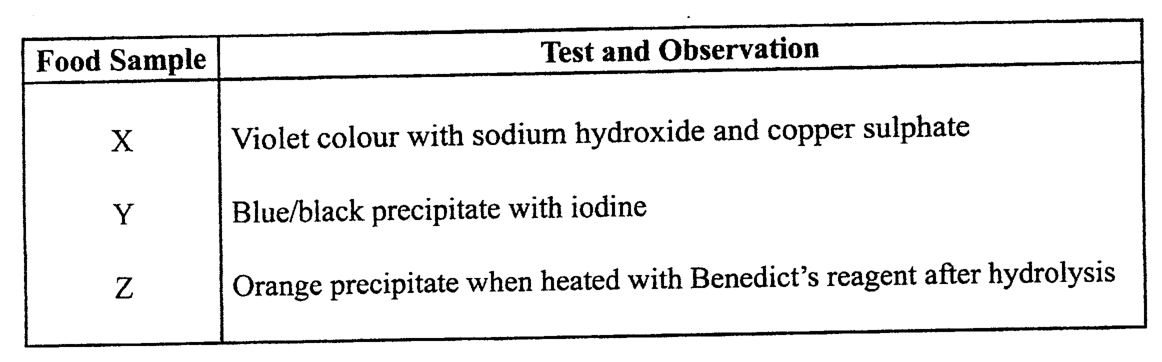
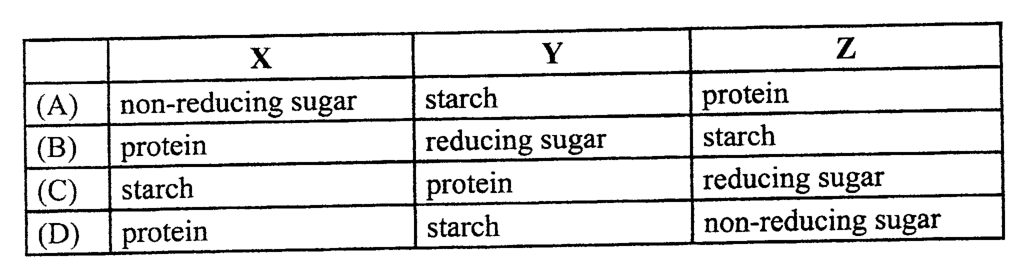
The samples X, Y and Z respectively MOST likely contain
non-reducing sugar / starch / protein
protein / reducing sugar / starch
starch / protein / reducing sugar
protein / starch / non-reducing sugar
Excess amino acids in the diet are
passed out in the faeces
converted to fat and stored
converted to urea in the liver, then excreted
taken directly to the bladder for excretion in urine
Which two vitamins are MOST likely lacking in his diet?
A and B₁
B₁ and B₂
C and A
C and B₂
The surface area of the lungs is greatly increased by the
double membranes of the pleura
large numbers of alveoli
dense network of capillaries
branching of the bronchioles
Which of the following is an effect of nicotine found in cigarette smoke?
Increased heart rate
Increased beating of cilia
Reduced oxygen transport by the blood
Increased mucus production in the cells lining the respiratory passage
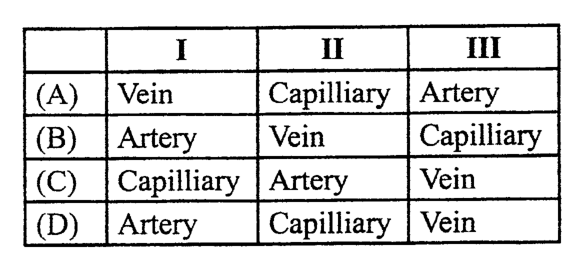
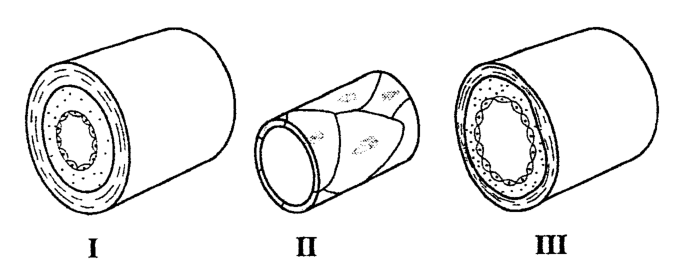
Which of the following correctly identifies the blood vessels?
Vein / Capilliary / Artery
Artery / Vein / Capilliary
Capilliary / Artery / Vein
Artery / Capilliary / Vein
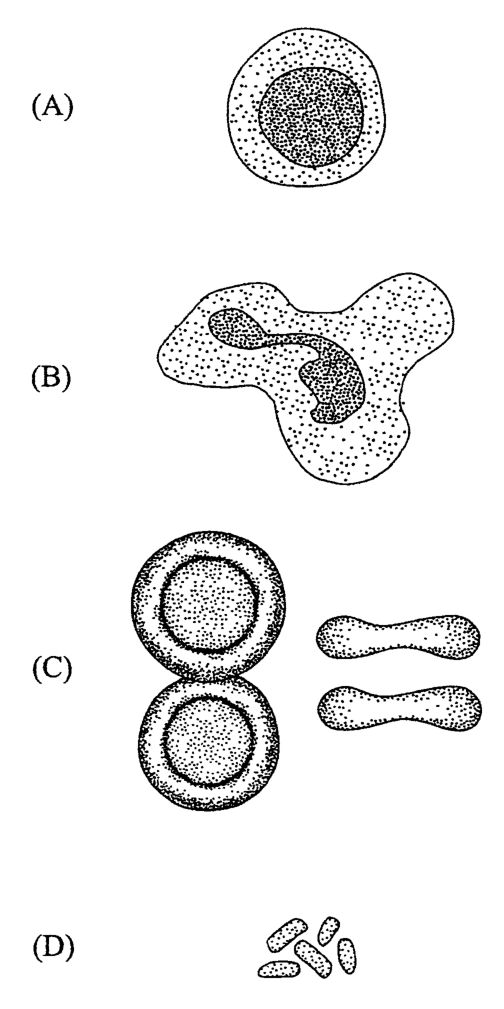
Which of the following components of blood could surround and engulf pathogens?
Diagram A
Diagram B
Diagram C
Diagram D
Which of the following are involved in the formation of blood clots?
Platelets
Antibodies
Phagocytes
Lymphocytes
Immunization is MOST effective in controlling the spread of a communicable disease if
a vaccine is administered to an uninfected individual
serum is administered to an uninfected individual
a vaccine is administered to an infected individual
serum is administered to an infected individual
Which of the following statements is NOT true of the xylem of a flowering plant?
It is non-living.
It contains mitochondria.
It has lignified walls for support.
It transports water and mineral salts.
Which of the following are reasons why transpiration is important to plants?
I. Water and dissolved minerals are transported to the leaves. II. The leaves are cooled. III. Unwanted water is excreted from the leaves.
I and II only
I and III only
II and III only
I, II and III
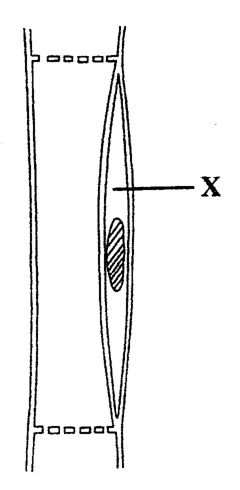
The part labelled X is the
cork cell
cambial cell
cortical cell
companion cell
Food is stored in the bulb of an onion plant to
provide food for humans
provide for the growth of new plants from the buds
prevent the plant from having to photosynthesize continuously
provide food for developing embryos in the next growing season
Which of the following would NOT represent a form of excretion in plants?
Gases diffusing through stomata
Tannins being stored in dead tissue
Water vapour diffusing through epidermis
Stored calcium oxalate crystals in leaves during leaf fall
Although glucose is found in the blood plasma, it does not appear in the urine because of
osmosis
secretion
ultrafiltration
selective reabsorption
Which of the following correctly describes movement in plants?
Irreversible, whole movement
Reversible, whole movement
Irreversible, growth movement
Reversible, growth movement
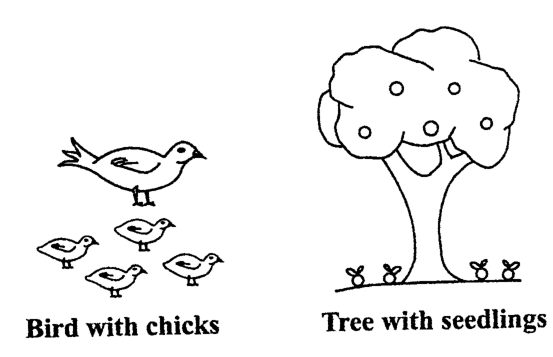
Which of the following advantages does the ability to move about give to the chicks compared to the seedlings?
I and II only
I and III only
II and III only
I, II and III
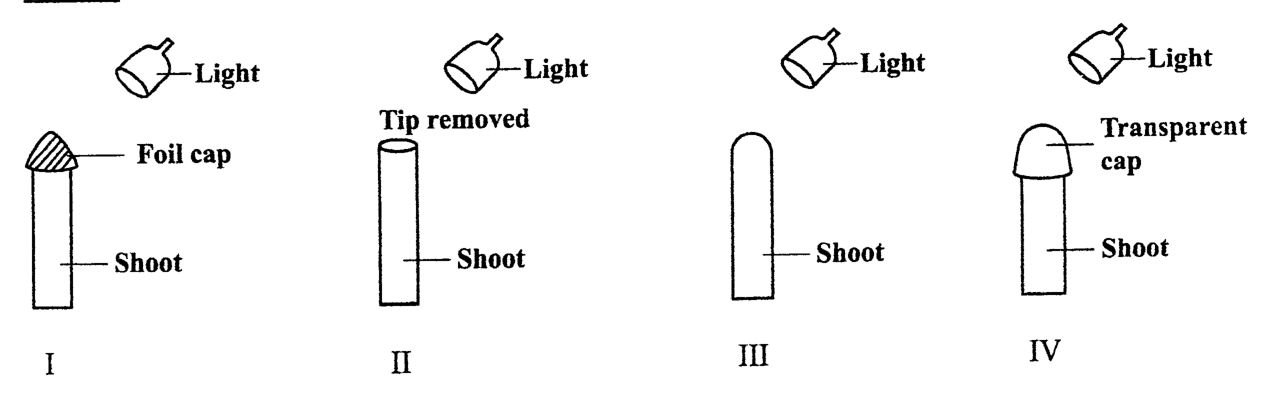
After a few days the TALLEST shoot would MOST likely be
I
II
III
IV
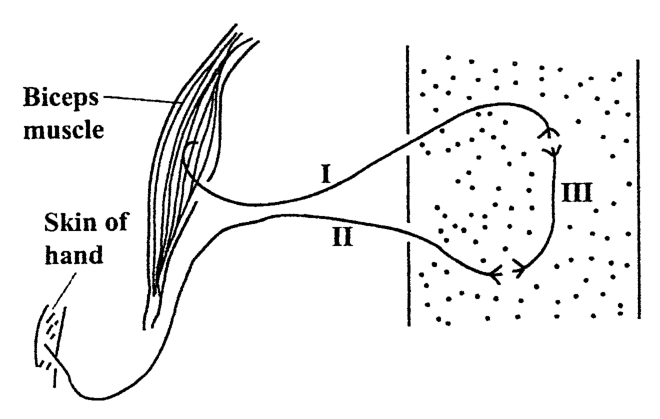
Item 34 refers to the following diagram.
Biceps muscle I III Skin of hand II
The numbered structures are
receptor / effector / relay neurone
receptor / relay / effector neurone
effector / relay / receptor neurone
effector / receptor / relay neurone
The vital centres for the control of heartbeat and respiration are located in the
cerebral hemispheres
medulla
cerebrum
cerebellum
Which of the following is a long-term effect of alcohol abuse?
Slurring of speech
Increased urination
Cirrhosis of the liver
Dilation of blood vessels
Myrie is reading a book. When she looks out of the window to focus on a tree, the lens in her eye becomes
fatter
thinner
more concave
more convex
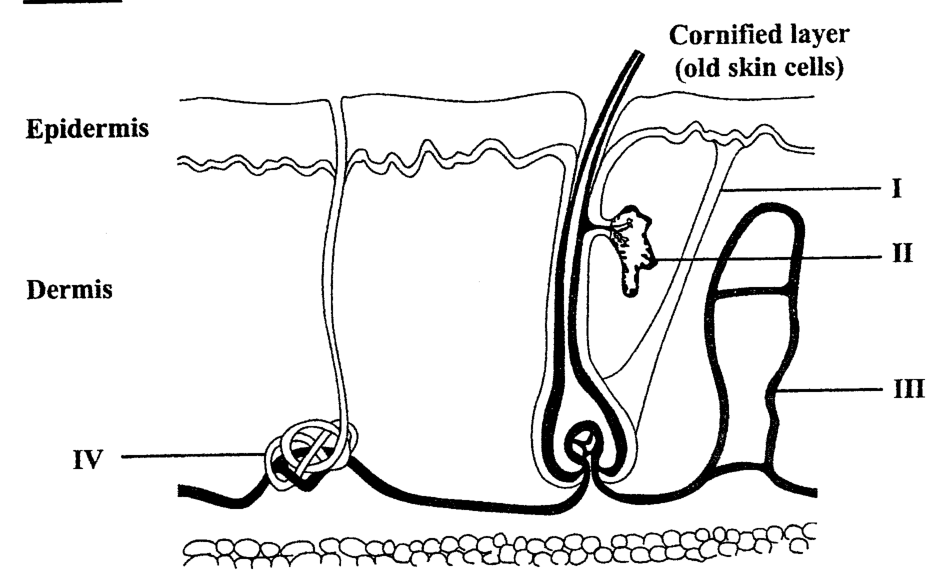
Which structure is NOT involved in temperature regulation?
I
II
III
IV
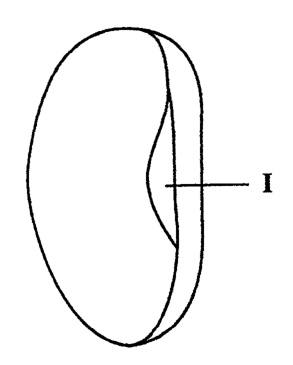
Item 39 refers to the following diagram of a seed.
The part labelled I represents the
hilum
testa
micropyle
position of the radical
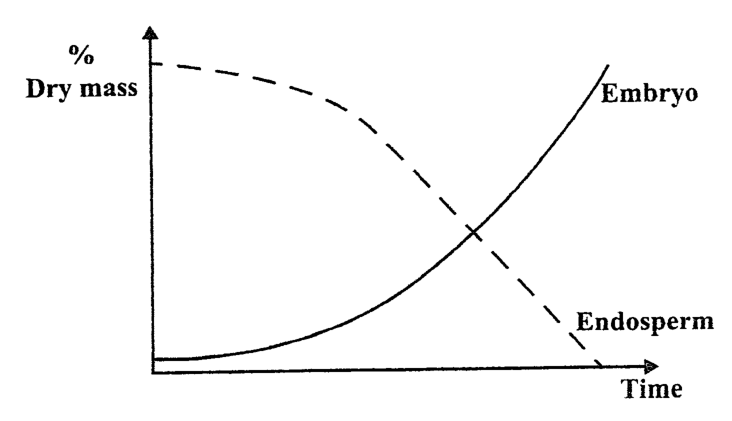
Item 40 refers to the following graph which shows changes in dry mass of embryo and endosperm during germination.
From the graph, it is true to say that
the embryo begins to grow as the endosperm increases in mass
the embryo and the endosperm decrease in mass at the same rate
the embryo and the endosperm increase in mass at the same rate
as the embryo grows, the food reserves are gradually depleted
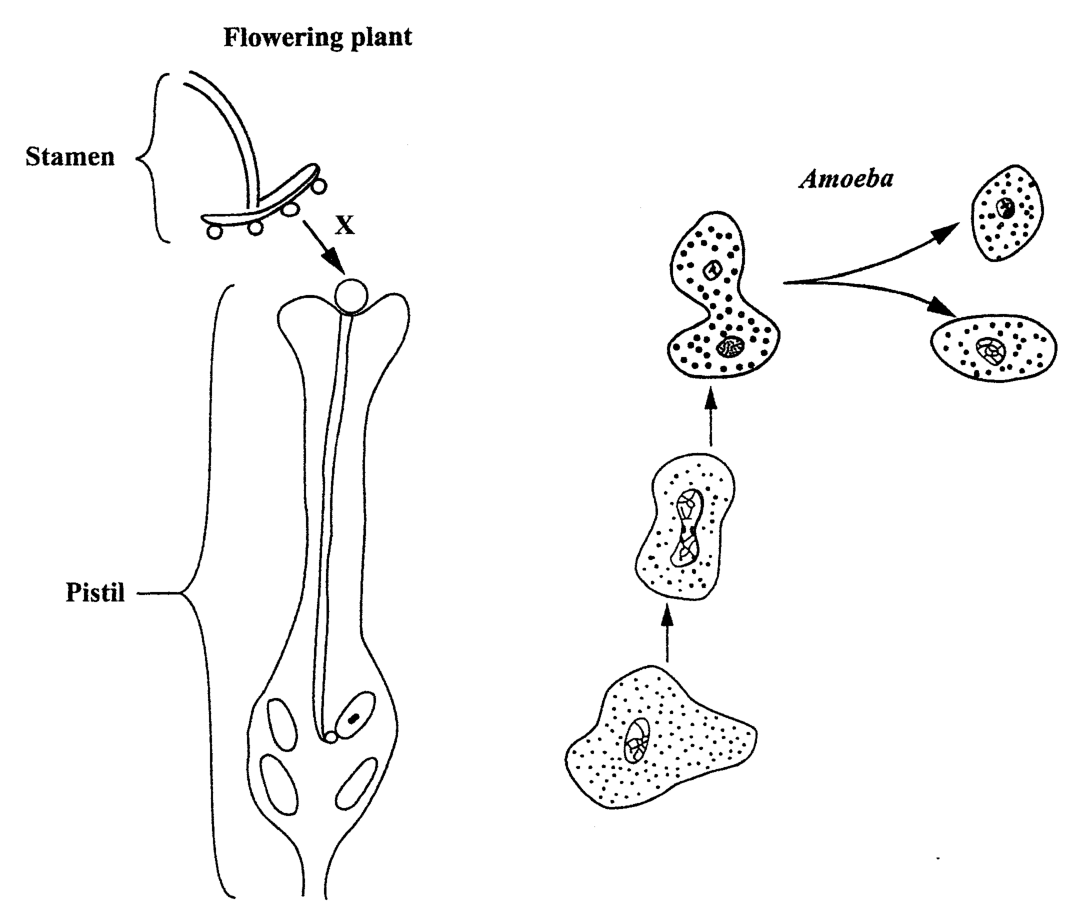
Items 41-42 refer to the following diagrams which represent events involved in reproduction in a flowering plant and an amoeba. Flowering plant Stamen Pistil Amoeba X
Which of the following statements is true for BOTH methods of reproduction?
Cells divide by mitosis.
Offspring are identical to each other.
Cells divide by both mitosis and meiosis.
Both male and female parts are required for reproduction.
The event taking place at X is
growth
dispersal
pollination
fertilization
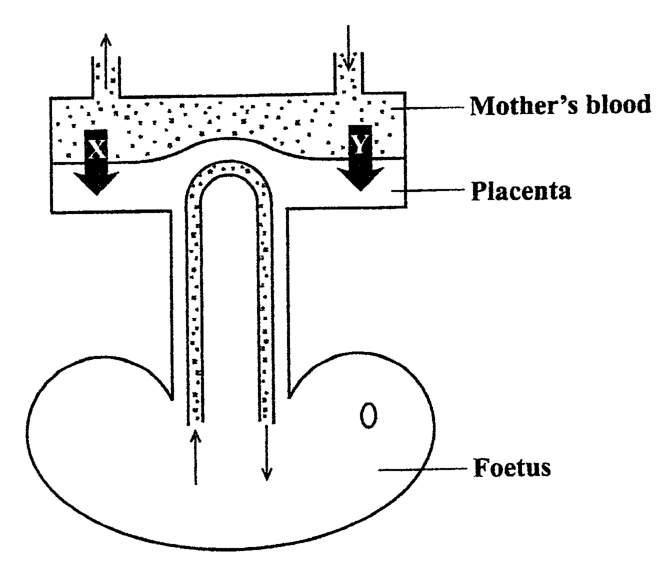
Item 43 refers to the following diagram which shows the relationship between the blood of a foetus and the blood of a mother.
Which substances should NOT move in the direction shown by the arrows labelled X and Y?
Calcium and glucose
Antibodies and calcium
Amino acids and glucose
Progesterone and fibrinogen
A method of contraception that protects against both disease and pregnancy is
the pill
a condom
spermicide
an intrauterine device
Fertilization normally occurs in the
uterus
vagina
oviduct
ovaries
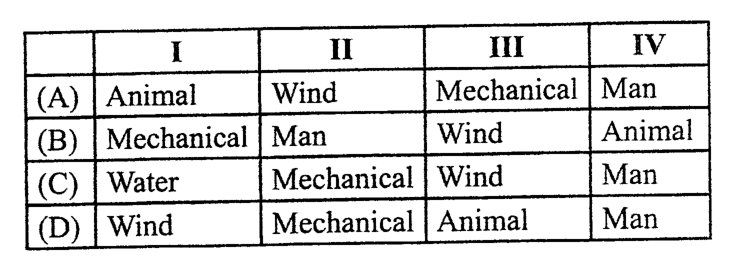
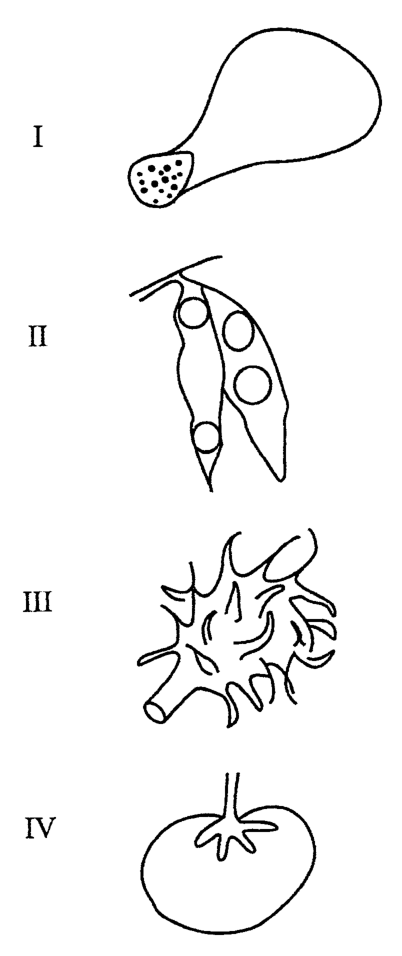
In which of the following is each fruit or seed matched with its correct method of dispersal?
Animal / Wind / Mechanical / Man
Mechanical / Man / Wind / Animal
Water / Mechanical / Wind / Man
Wind / Mechanical / Animal / Man
Items 47-48 refer to the following organisms. (A) Host (B) Vector (C) Parasite (D) Pathogen
In answering Items 47-48, match the following descriptions to one of the options above. Each option may be used once, more than once or not at all.
An organism which causes a disease
Host
Vector
Parasite
Pathogen
An animal which carries a disease-causing organism but is not adversely affected by it.
Host
Vector
Parasite
Pathogen
Which of the following methods would be MOST appropriate for the treatment of chronic hypertension? I. Diet modification II. Exercise III. Vaccination
I and II only
I and III only
II and III only
I, II and III
A species consists of members that
occupy the same habitat
reproduce by asexual means
interbreed under natural conditions
interbreed to produce infertile offspring
On a certain Caribbean island where sugar cane is grown, a fungus is accidentally introduced into the island and it destroys the entire crop of sugar cane. Which of the following BEST describes what happened?
The plants were old and therefore more susceptible to the fungus.
The plants were not of a hardy enough variety to withstand the fungus.
The plants were planted too close together so the fungus spread easily.
There was no genetic variation among the plants so none could survive the attack.
If a diploid organism has two different alleles for the same gene, it is described as being
dominant
homozygous
heterozygous
recessive
Which of the following processes will result in genetically identical offspring?
Cloning
Mutation
Fertilization
Crossing over
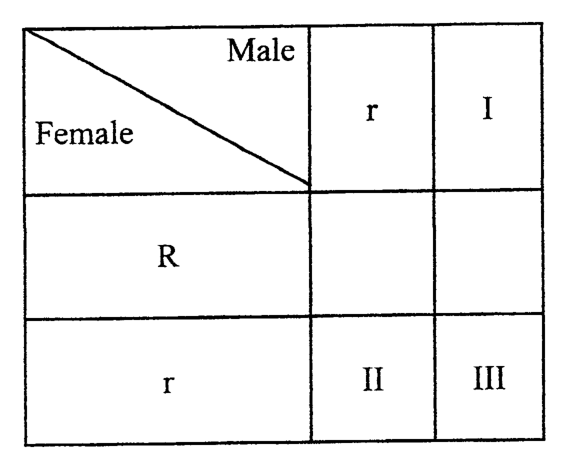
Item 54 refers to the following diagram which represents a cross between two plants, heterozygous for a particular characteristic.
| Male | r | I |
|---|---|---|
| Female | ||
| R | ||
| r | II | III |
Which of the following completes the diagram at I, II and III?
r / Rr / rr
R / rr / Rr
r / rr / Rr
R / Rr / rr
Which of the following terms refers to visible characteristics of living things?
Gene
Genotype
Phenotype
Chromosome
Haemophilia is a sex-linked trait caused by a recessive allele. Which of the following are reasons why the disease is expressed in more men than women?
I. It is caused by a recessive allele carried on the X chromosome. II. There is only one X chromosome in males. III. Women have two X chromosomes so that the recessive allele can be masked by the dominant allele.
I and II only
I and III only
II and III only
I, II and III
Natural selection can be defined as the process by which natural populations
mutate in order to survive
remain well adapted to their habitat
compete with other populations for survival
gradually bring about changes in their habitat
Which of the following is true about the process of artificial selection?
Tissue culture is used to obtain clones.
Traits which benefit the target organism are selected.
Selected traits may not benefit the target organism.
A single beneficial gene is introduced into the cell of the organism.
Which of the following have contributed to the many antibiotic resistant strains of bacteria present today? I. It is possible for bacteria to mutate to antibiotic resistant forms. II. Exposure to an antibiotic causes some bacteria to mutate. III. The mutants reproduce forming a new strain of resistant bacteria.
I and II only
I and III only
II and III only
I, II and III
Which of the following would be involved in the production of insulin by genetic engineering? I. Transfer of the human insulin gene to a bacterium II. A vector to transfer the insulin gene III. Production of insulin by the bacterium
I only
I and II only
II and III only
I, II and III