Item 5 refers to the following diagrams showing beaks and feet of four birds found in the Caribbean.
5.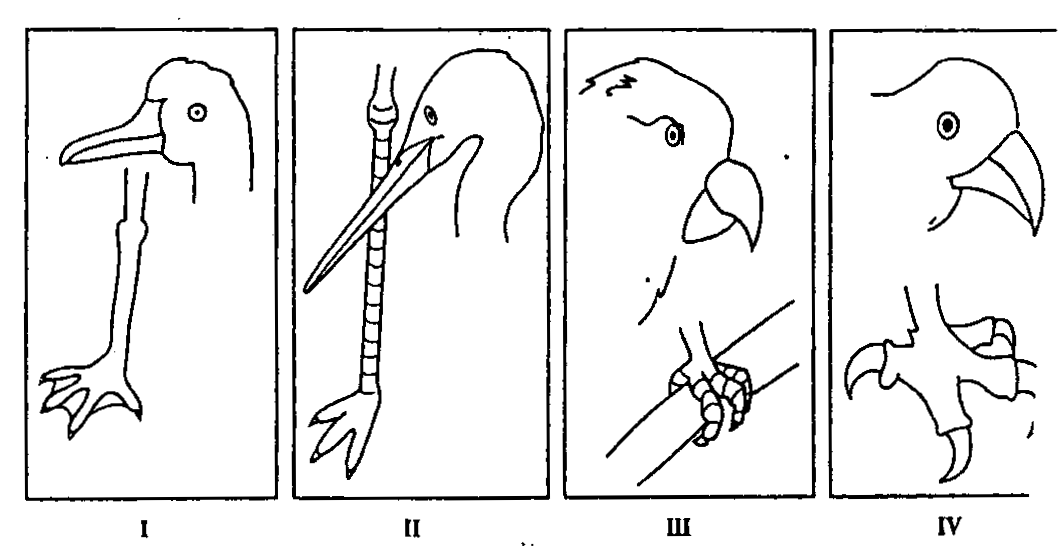
Which bird is BEST adapted to feeding on fish in a swamp?
- (A)
I
- (B)
II
- (C)
III
- (D)
IV
Free CXC Biology Paper 1 January 2013 past paper from 2013. Includes a worked answer key. Open the PDF, take a timed test, and study with AI on Caribbean AI.
Answer keys are free on Caribbean AI. View the answers to every past-paper question at no cost - no payment needed - with step-by-step worked solutions and instant AI marking available on Premium.
CSEC Biology Paper 1 January 2013 - Free CXC Past Paper with Answers
Free CXC Biology Paper 1 January 2013 past paper from 2013. Includes a worked answer key. Open the PDF, take a timed test, and study with AI on Caribbean AI.
Opening the interactive papers…
Every question from this paper as text. See the answers and worked solutions. Questions are the property of the Caribbean Examinations Council; Caribbean AI is not affiliated with CXC.
Items 1-2 refer to the following food chain which shows the feeding relationships in a freshwater habitat. Microscopic → Mosquito → Small → Large Alga Larva Fish Fish
The organism to which the LEAST amount of energy is available is the
large fish
small fish
mosquito larva
microscopic alga
The GREATEST number of individuals in the food chain would be the
large fish
small fish
mosquito larva
microscopic alga
Some fungi are said to be decomposers because they
have no chlorophyll and cannot make their own food
depend on dead organisms as a source of nutrients
break down the bodies of dead organisms to simple substances
use plant and animal materials to make chemicals
Bacteria play an important role in the cycling of nitrogen. Which of the following organisms is NOT a part of this cycle?
Nitrobacter
Nitrosomonas
Rhizobium
Streptococcus
Item 5 refers to the following diagrams showing beaks and feet of four birds found in the Caribbean.
Which bird is BEST adapted to feeding on fish in a swamp?
I
II
III
IV
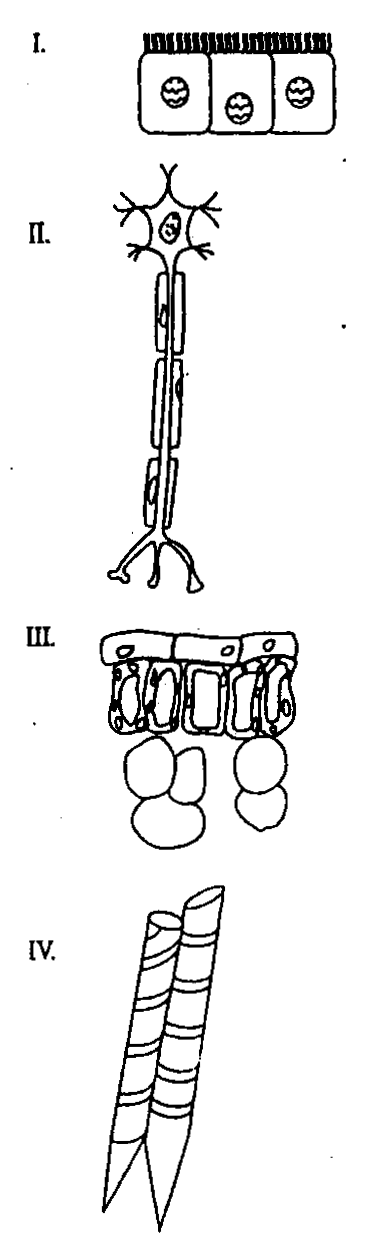
Item 6 refers to the following diagrams of different structures taken from plants and animals. I. II. III. IV.
Which of the above structures is NOT a tissue?
I
II
III
IV
The process being investigated is
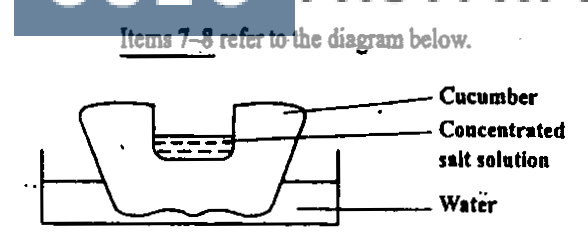
diffusion
osmosis
translocation
active transport
Which diagram BEST illustrates the levels of the liquids if the apparatus is left undisturbed for one hour?


Which of the following pairs of organisms possesses the characteristics for making carbohydrates from inorganic materials?
Algae and flowering plants
Fungi and flowering plants
Bacteria and fungi
Viruses and algae
Item 10 refers to the following diagram which shows organisms in a garden.
The organisms which show heterotrophic and autotrophic nutrition respectively are
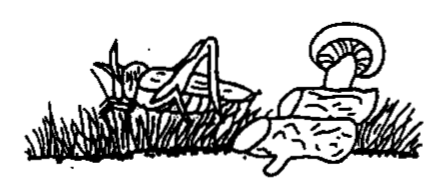
grass / mushroom
tree trunk / grasshopper
grasshopper / grass
grass / tree trunk
The process which moves food through the alimentary canal is called
peristalsis
digestion
mastication
swallowing
Absorption of amino acids takes place in the
duodenum
stomach
ileum
colon
Which of the following statements are true about the suitability of leaves for photosynthesis? I. They are broad and flat and offer a large surface area for absorption of sunlight and carbon dioxide. II. There are many pores on the lower surface of the leaf to permit rapid exchange of gases. III. There is a branching network of veins to provide a ready supply of water. IV. There are often more chloroplasts in the upper cells of the leaf than the lower cells which receive less sunlight.
I and II only
III and IV only
I, II and III only
I, II, III and IV
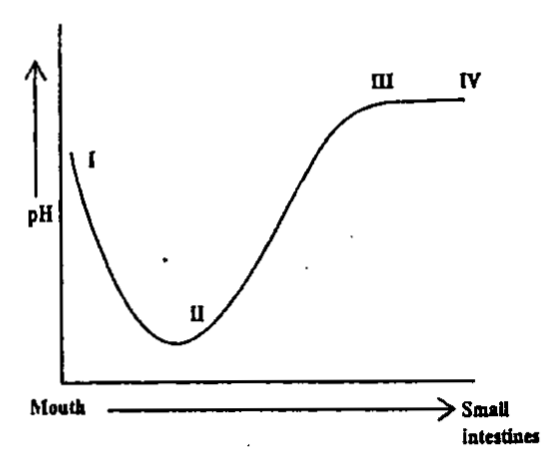
Item 14 refers to the following graph which shows levels of the pH in the alimentary canal.
Which point in the graph MOST likely indicates the presence of hydrochloric acid in the alimentary canal?
I
II
III
IV
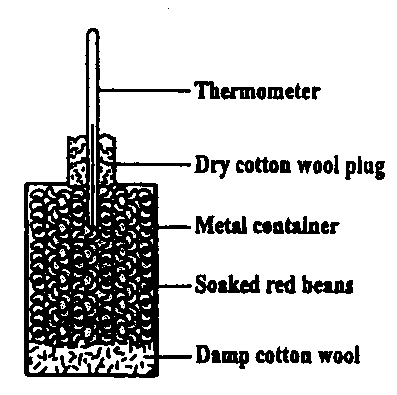
Item 15 refers to the following apparatus used in an investigation.
[Diagram of apparatus]
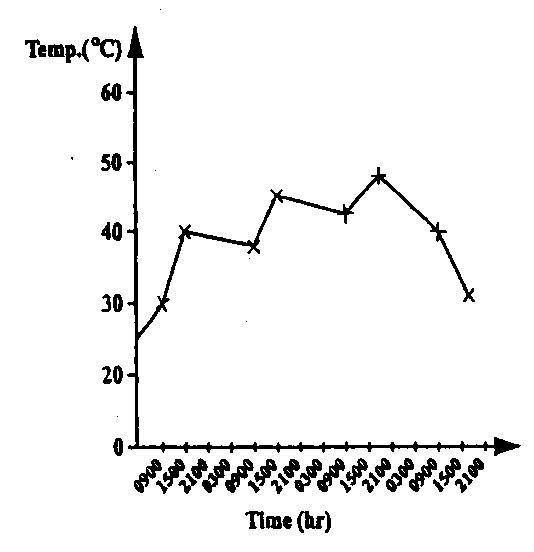
The initial temperature of the beans was noted and readings were taken at regular intervals twice daily for four days. The data obtained were used to plot the graph below.
[Graph showing temperature vs time]
The increase in temperature in the metal container is BEST explained by the fact that the seeds are
numerous
taking in water
placed close together
using their food stores
The rate at which respiration occurs in a mammal is indicated by the rate of
sweat production
urine excretion
oxygen elimination
carbon dioxide elimination
Which of the following events does NOT occur during inspiration?
External intercostal muscles relax.
Internal intercostal muscles relax.
Diaphragm muscles contract.
Volume inside lungs and thorax increases.
Which of the following statements about cigarette smoking are MOST likely true?
I. Results in persistent coughing and shortness of breath. II. There is destruction of the alveolar walls. III. Blood pressure is lowered.
I and II only
I and III only
II and III only
I, II and III
Large organisms cannot depend solely on diffusion for the uptake and transport of gases. This is because as organisms get larger the
surface area to volume ratio increases
surface area to volume ratio decreases
surface area and the volume both increase
surface area and the volume both decrease
Which of the following are involved in the formation of blood clots?
Platelets
Antibodies
Lymphocytes
Phagocytes
Blood vessels which contain valves along their length are
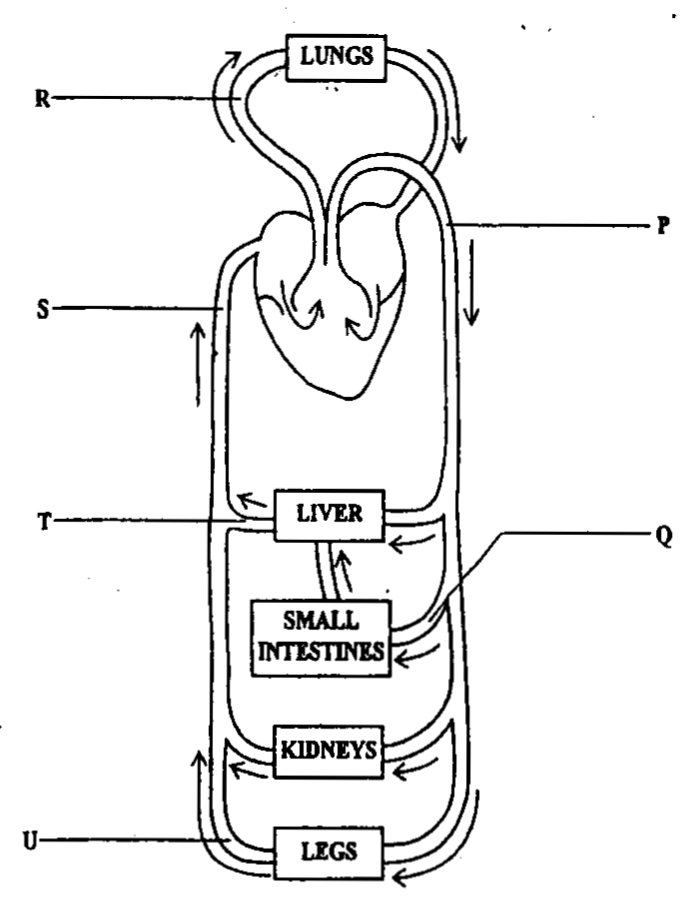
P and T
R and T
S and Q
S and U
Transpiration is important to plants because it
keeps the plants cool
facilitates the movement of manufactured food through the xylem
assists manufactured food to move through the phloem
releases excess water in the form of water vapour
Which of the following statements about translocation is true?
It does not require energy.
It occurs in sieve tubes but not in xylem vessels.
Carbohydrates and proteins are transported by this process.
It involves the movement of inorganic substances.
The body rids itself of nitrogenous waste products through the process of
excretion
diffusion
evaporation
osmoregulation
Dyes in 'heartwood' and tannins in the bark of trees are MOST likely products of
translocation
excretion
respiration
photosynthesis
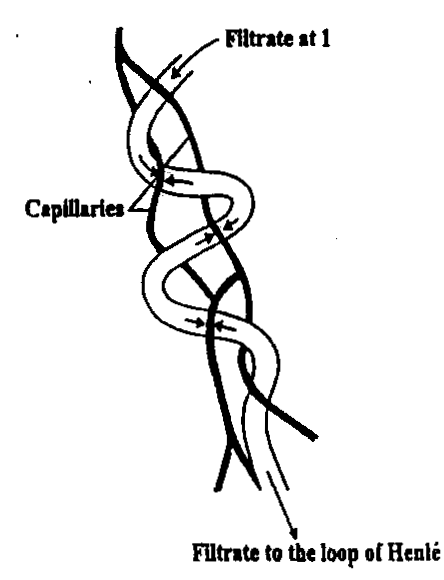
Item 26 refers to the following diagram of part of the proximal convoluted tubule of a person suffering from diabetes mellitus.
The filtrate leaving the tubule MOST likely contains
no glucose
some glucose
less water than the filtrate at 1
more water than the filtrate at 1
Competitive swimmers drink cool water at regular intervals during training to I. reduce the heat lost from their bodies II. replace water lost by sweating III. help their body temperature to remain steady
I and II only
I and III only
II and III only
I, II and III
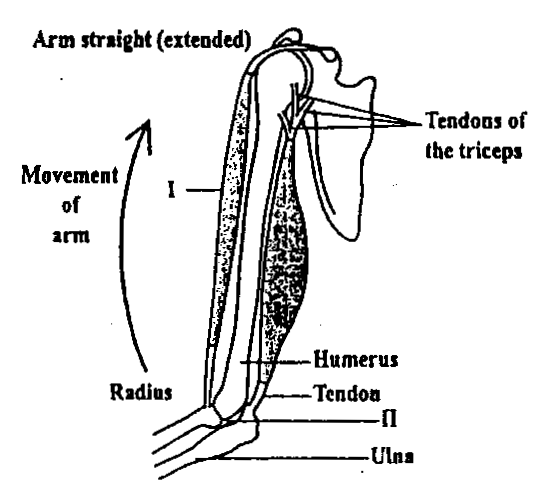
Items 28-29 refer to the following diagram which shows the bones and muscles of the arm.
The muscle at I which is responsible for movement of the limb is
a smooth muscle
an extensor muscle
a flexor muscle
a skeletal muscle
Which of the following types of joints is shown at II?
Hinge
Gliding
Synovial
Ball and socket
Which of the following vertebrae has a centrum that is developed to support the weight of the body?
Sacral
Lumbar
Thoracic
Cervical
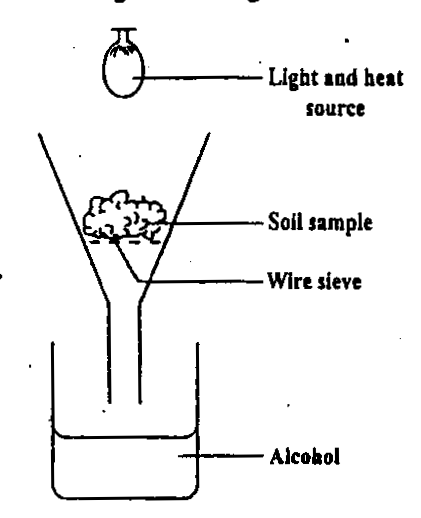
Items 31-32 refer to the following diagram of a Tullgren funnel which is used for collecting small soil organisms.
The purpose of the light bulb is to
enable the investigator to see the small organisms
provide warmth for the soil organisms
drive organisms to the base of the funnel
keep the alcohol at a constant temperature
Which of the following explain why the apparatus works well?
I and II only
II and IV only
I, II and III only
II, III and IV only
Item 33 refers to the events that occur when a student reacts to touching a hot object by withdrawing her hand. Hot object→ Pain→ Effector→ Response
The receptor is the
hot object touched
heat from the hot object
sensory endings in the skin
muscles that contract
Which area of the brain controls heartbeat?
Cerebrum
Cerebellum
Hypothalamus
Medulla oblongata
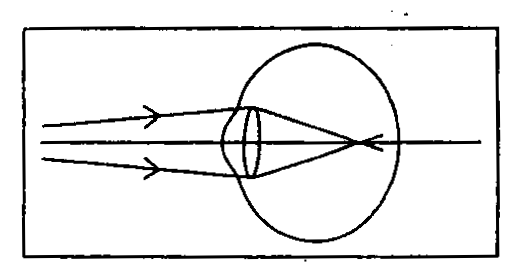
Item 35 refers to the following diagram which shows where light will focus for an individual with an elongated eyeball.
Which of the following types of lens should be used to correct this defect?
Concave
Convex
Cylindrical
Bifocal
Which of the following functions of the skin is an example of homeostasis?
Storage of fats
Release of sweat
Secretion of sebum
Maintenance of body temperature
An athlete who has not eaten a meal in the past four hours is about to run a race. Which of the following hormones will be secreted in his body?
Insulin only
Adrenaline only
Insulin and adrenaline
Glucagon and adrenaline
The pituitary gland is called the 'master gland' because it
controls other endocrine glands
controls thought processes
is found in the brain
is the largest gland
One advantage that sexual reproduction has over asexual reproduction is that sexual reproduction
is conservative
leads to variation
produces disease-resistant crops
produces greater numbers of offspring
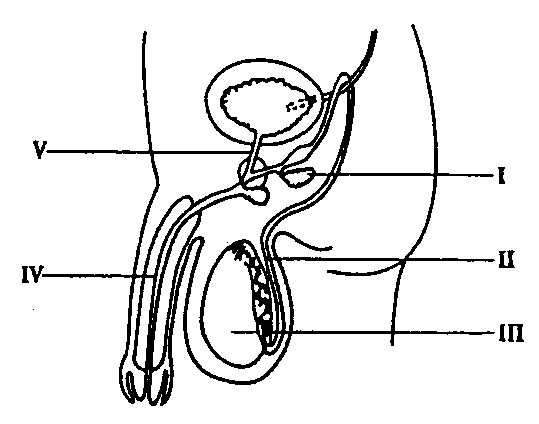
Items 40-41 refer to the following diagram of a longitudinal section of the human male reproductive system.
Production of spermatozoa occurs in

I
II
III
IV
Passage of urine occurs through
I and II
II and IV
III and V
IV and V
The process whereby an embryo attaches itself to the lining of the uterus is called
implantation
fertilization
copulation
gestation
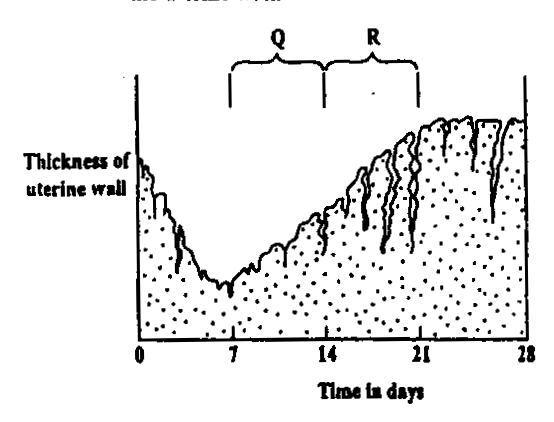
The change in the thickness of the wall of the uterus in phases Q and R is brought about by
increase in oestrogen
increase in oestrogen and progesterone
decrease in oestrogen and progesterone
increase in oestrogen and decrease in progesterone
Which of the following is the function of the testa in a seed?
Absorbs water for germination
Offers physical protection
Forms part of the developing embryo
Is the food source for the developing embryo
Which of the fruits above is dispersed by water?

A
B
C
D
The gene for coat colour in cattle shows incomplete dominance. A purebred cow with red coat, mates with a purebred bull with white coat. All of the offspring have roan coats. Which of the following represents the genotype of the offspring?
RR
WW
RW
RO
Which of the following does NOT result in natural selection?
Mutation
Grafting
Variation
Migration
Which of the following statements about the importance of genetic variation is true?
More offspring can be produced.
Competition is reduced among individuals.
Advantageous characteristics are passed to offspring.
Mutations are less likely to occur.
Mitotic division results in
two daughter cells with chormosome number, n
four daughter cells with chromosome number, 2n
two identical daughter cells with chromosome number, 2n
four identical daughter cells with chromosome number, 2n
Which of the following processes may be used by humans to change a characteristic of a particular organism in a short time?
I. Genetic engineering II. Artificial selection III. Natural selection
I only
I and III only
II and III only
I, II and III
Which of the following factors does NOT contribute to hypertension (high blood pressure)?
Old age
High salt intake
Regular exercise
Saturated fat in the diet
Biological vectors of a disease can
spread all diseases
spread only those diseases where the pathogen must be carried from host to host
spread the pathogen only if part of its life cycle is completed in the body of the vector
be less easily targeted from the pathogen when controlling the spread of the disease
Which of the following statements is true about sexually transmitted infections?
They are difficult to control.
They are caused by bacteria.
They are transmitted by vectors.
They affect the respiratory system.
The rapid spread of HIV/AIDS can be MOST effectively reduced if
a vaccine is made available
treatment is given to all infected with the HIV
all blood is screened before transfusions
risky behaviours linked to transmission methods are eliminated
The type of disease that can be prevented by immunization is
pathogenic
deficiency
hereditary
psychological
Which of the following statements is NOT true about humus?
It improves soil texture.
It increases water retention in soils.
It supplies nutrients to plants and soil organisms.
It reduces aeration of soils.
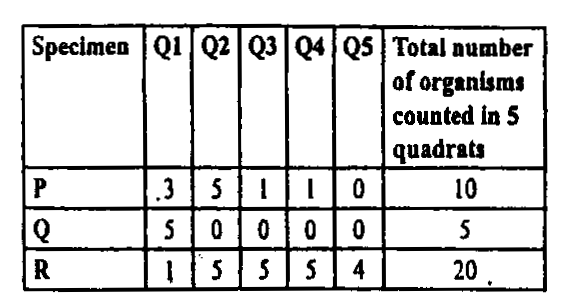
Item 57 refers to the following table which represents data collected for three species of organisms in a particular habitat when five quadrats are thrown. Each quadrat measures 1m².
| Specimen | Q1 | Q2 | Q3 | Q4 | Q5 | Total number of organisms counted in 5 quadrats |
|---|---|---|---|---|---|---|
| P | 3 | 5 | 1 | 1 | 0 | 10 |
| Q | 5 | 0 | 0 | 0 | 0 | 5 |
| R | 1 | 5 | 5 | 5 | 4 | 20 |
Which of the following represents the species density for species R?
1 m²
4 m²
5 m²
20 m²
Which of the following factors limits the growth of natural populations?
Abundance of food supply
Absence of predators
Control of diseases
Competition for space
Which of the following statements BEST describes a fossil fuel?
A substance humans use for fuel
A substance humans produce
The compressed remains of dead plants and animals which can be used as fuel
Mineral compounds which occur as part of the earth's surface and which can be used as fuel
Which of the following pollutants competes with oxygen for haemoglobin?
Ozone
Carbon dioxide
Carbon monoxide
Hydrogen sulphide