Free CXC Biology Paper 1 May/June 2009 past paper from 2009. Includes a worked answer key. Open the PDF, take a timed test, and study with AI on Caribbean AI.
Answer keys are free on Caribbean AI. View the answers to every past-paper question at no cost - no payment needed - with step-by-step worked solutions and instant AI marking available on Premium.
CSEC Biology Paper 1 May/June 2009 - Free CXC Past Paper with Answers
Free CXC Biology Paper 1 May/June 2009 past paper from 2009. Includes a worked answer key. Open the PDF, take a timed test, and study with AI on Caribbean AI.
Opening the interactive papers…
Every question from this paper as text. See the answers and worked solutions. Questions are the property of the Caribbean Examinations Council; Caribbean AI is not affiliated with CXC.
Item 1 refers to the food chain below which shows the feeding relationships in a freshwater habitat.
Microscopic → Mosquito→ Small→ Large Alga Larva Fish Fish
The organism to which the LEAST amount of energy is available is the
microscopic alga
mosquito larva
small fish
large fish
A plant which has reduced leaves with no chlorophyll, lacks a proper root system, and flowers abundantly, is MOST likely to be found
in a habitat where water is scarce
living parasitically on another plant
growing in an area where there are few insects
existing as a commensal with other green plants
In an ecosystem, the organisms which make solar energy available to all other organisms are the
producers
decomposers
primary consumers
secondary consumers
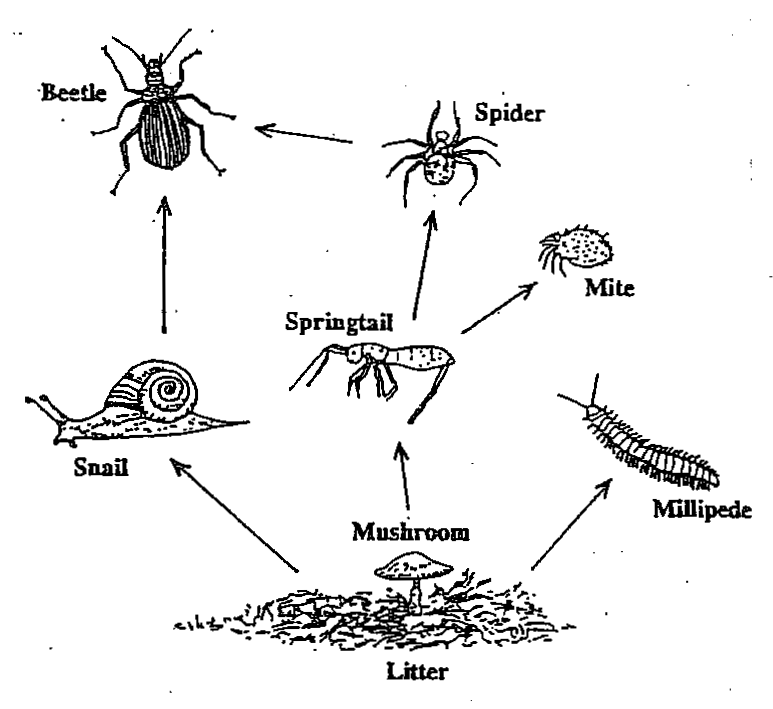
Item 4 refers to the following diagram which represents a food web found in leaflitter.
Which of the following statements about the food web are true?
I. The beetle is a top carnivore. II. The spider and the mite are competitors. III. The mushroom is a producer.
I and II only
I and III only
II and III only
I, II and III
Which of the following organisms would MOST likely live in the same habitat?
I. Amoeba II. Praying mantis III. Guppy (fish) IV. Fern V. Algae
II and V only
III and IV only
I, II and V only
I, III and V only
Which of the following structures may be used to distinguish between a plant cell and an animal cell?
Vacuoles
Cell walls
Mitochondria
Cell membranes
Which of the following pairs of function and organelle is NOT correctly matched?
Osmotic control / Membrane
Polypeptide chain synthesis / Chloroplast
Hereditary materials / Nucleus
Release of energy / Mitochondrion
When a seedling loses water to the atmosphere faster than it can be obtained from the soil, the turgidity of the cells
increases and the seedling wilts
decreases and the seedling wilts
increases and the seedling does not wilt
decreases and the seedling does not wilt
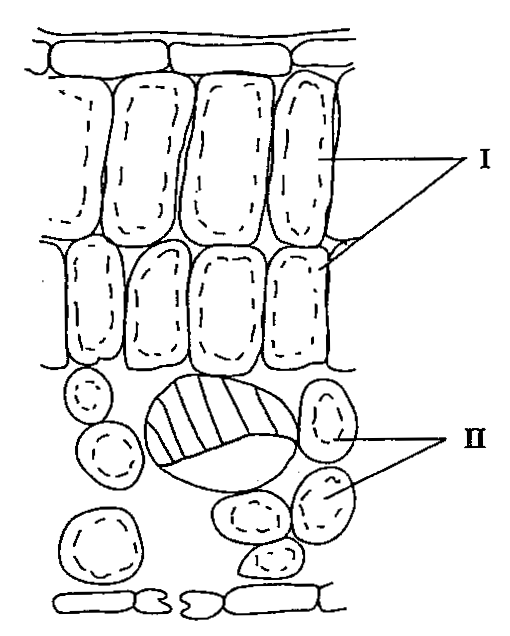
Item 9 refers to the diagram below which shows the cross section through a dicotyledonous leaf.
Which of the following is NOT true of the cells labelled I and II in the diagram above?
I makes most of the food.
I has a relatively larger surface area.
II receives less energy from the sun.
II possesses more chloroplasts than I.
Bile empties into the
duodenum
caecum
ileum
stomach
Sodium hydroxide and weak copper sulphate solution will produce a violet colour with molecules of
fat
starch
sugar
protein
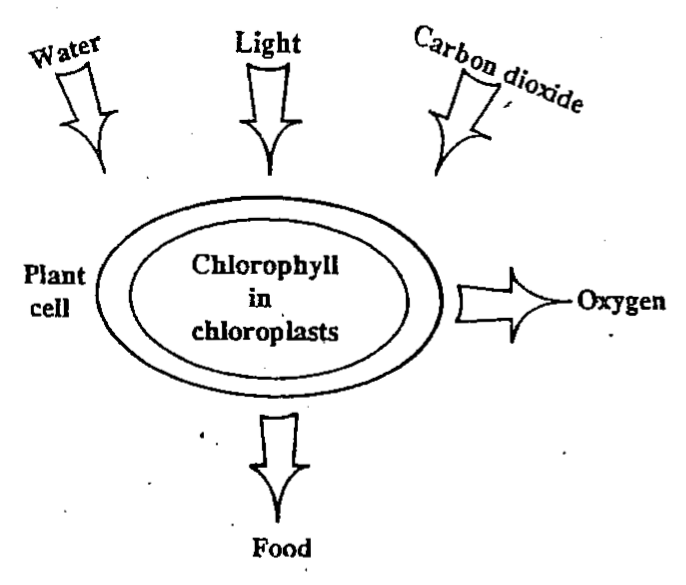
The process represented is
digestion
respiration
photosynthesis
protein synthesis
The food produced is
fat
starch
protein
amino acid
When enzymes are boiled they are unable to function. This is because an increase in temperature
destroys food materials
increases the rate of enzyme action
denatures the protein of enzymes
converts complex sugars to simple sugars
West Indian cherries are rich in Vitamin C. Which of the following BEST describes the benefit a boy derives from consuming West Indian cherries (fruit) everyday? I. Increase in the absorption of iron II. Prevention of bleeding gums III. Increase in the absorption of calcium
I only
I and II only
I and III only
I, II and III
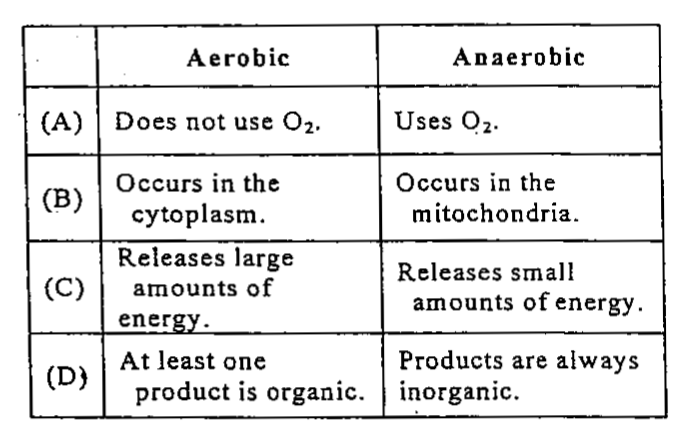
Which of the following options is true for aerobic and anaerobic respiration?
Does not use O₂. / Uses O₂.
Occurs in the cytoplasm. / Occurs in the mitochondria.
Releases large amounts of energy. / Releases small amounts of energy.
At least one product is organic. / Products are always inorganic.
Cigarette smoking sometimes makes it difficult for air to get into the lungs. This is MOST likely due to
constriction of the bronchioles
contraction of the diaphragm
stretching of the alveoli
raising of the ribs
Which of the following statements BEST describes the function of ATP?
It stores food.
It is a means of energy transfer.
Large quantities of energy can become available.
It speeds up chemical reactions in the cell.
Which of the following processes accounts for the movement of oxygen across a respiratory surface?
Diffusion
Absorption
Inhalation
Osmosis
Large organisms CANNOT depend solely on diffusion for the uptake and transport of gases. This is because as organisms get larger the
surface area to volume ratio increases
surface area to volume ratio decreases
surface area and the volume both increase
surface area and the volume both decrease
As part of the sequence of the heartbeat, the ventricular muscle contracts, the atrio-ventricular valves close, and the arterial valves open. This allows blood to flow from
ventricles to the arteries
ventricles to the veins
veins to the atria
atria to the ventricles
The structure of the red blood cell allows it to I. squeeze through tiny blood vessels II. release large quantities of oxygen III. absorb carbon dioxide IV. absorb large quantities of oxygen
I and II only
I and III only
I and IV only
III and IV only
A greenhouse plant which is usually kept at a temperature of 25 °C is subjected to a temperature of 30 °C for 24 hours. The MOST likely effect of this change is that the plant will
lose more water and wilt
absorb more water and open the stomata
absorb less water and close the stomata
lose less water and become turgid
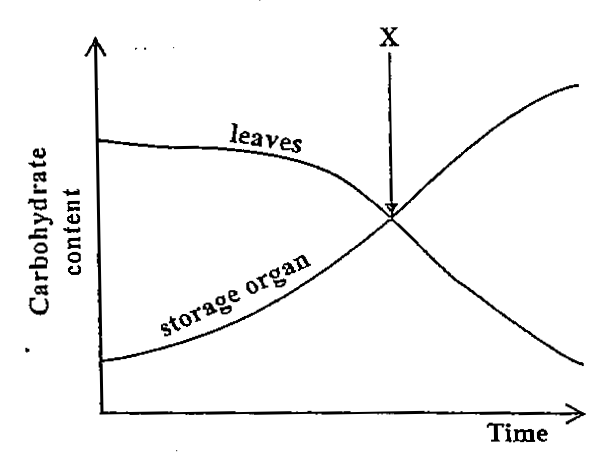
The point X represents the period when the
plant has its highest carbohydrate content
plant dies for regeneration in the next growing season
carbohydrate content of the leaves and storage organ are equal
carbohydrate content of the leaves is higher than that of the storage organ
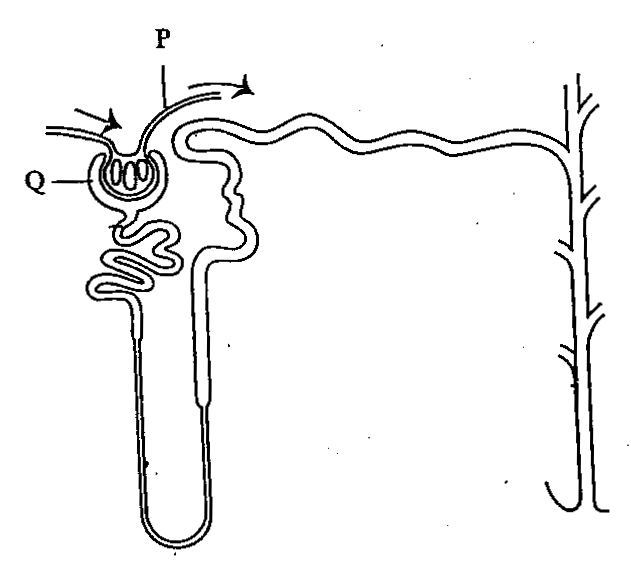
Items 25-26 refer to the simplified drawing of a renal tubule (nephron) below.
The process which occurs in Q is
secretion
reabsorption
osmosis
filtration
One component present in the fluid in P but NOT in the fluid in Q is
urea
glucose
blood proteins
blood plasma
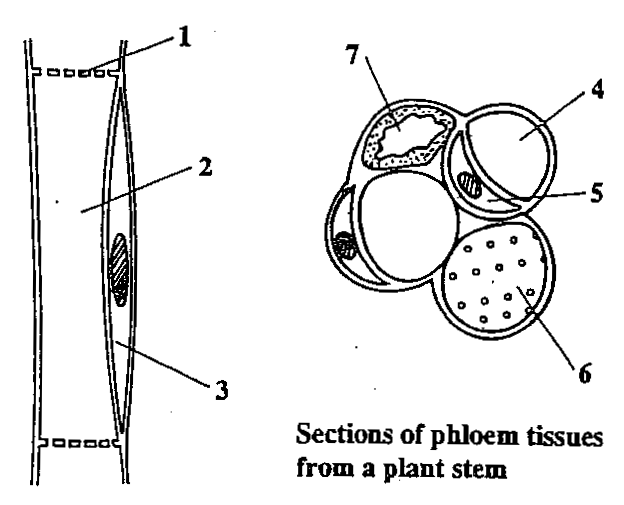
Items 27-28 refer to the following diagrams of sections of phloem tissues from a plant stem.
Manufactured food is transported in
1 and 5
2 and 4
3 and 5
3 and 6
Companion cells are represented by
1 and 7
2 and 5
2 and 6
3 and 5
Which of the following BEST describes excretion?
Getting rid of undigested food from the gut
Loss of water from the contractile vacuole
Getting rid of waste products of metabolism
Loss of water, as a vapour, through the stomata
The MOST important of the minerals stored by bones in the body are
calcium and phosphorus
calcium and potassium
phosphorus and sodium
sodium and potassium
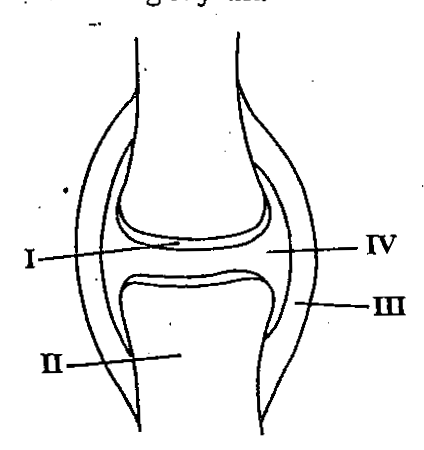
Item 31 refers to the following diagram of a section through a joint.
Which of the following components reduce friction?
I and II
I and IV
II and III
II and IV
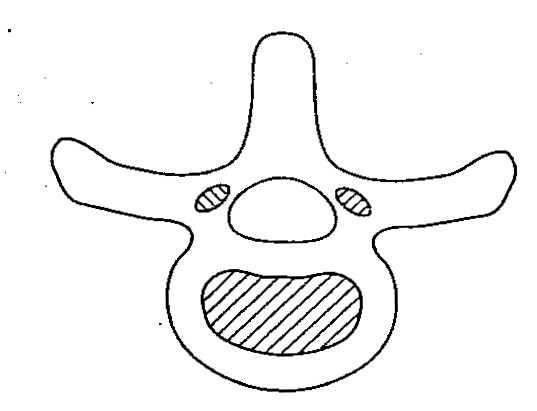
Item 32 refers to the following diagram which shows the plan of a typical vertebra.
Which of the following vertebrae is modified to the greatest extent from the plan shown in the diagram above?
Atlas
Cervical
Lumbar
Thoracic
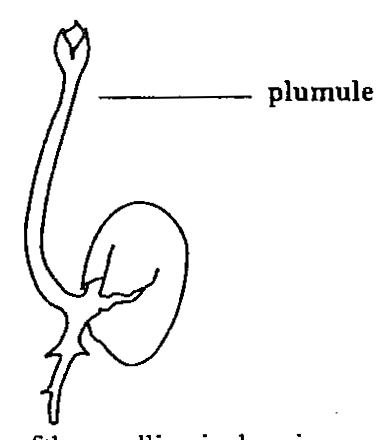
Item 33 refers to the following diagram which represents a seedling that has been growing in the dark.
The plumule of the seedling is showing a
positive response to light
negative response to light
negative response to gravity
positive response to gravity
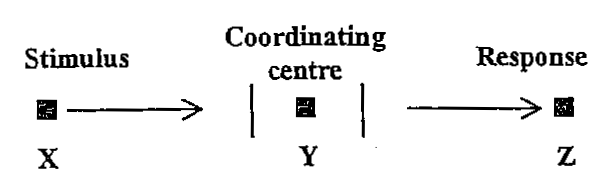
Item 34 refers to the following diagram which shows a coordinated response to a stimulus in humans.
Stimulus Coordinating centre Response X Y Z
The role of Y in the illustration above is to
stimulate receptors
cause reflex actions
react to stimuli
interpret changes in surroundings
For a student to recall his biology notes, action takes place in
a reflex arc
the cerebrum
the cerebellum
the medulla oblongata
Carbohydrate stored in the muscles of a marathon runner is converted to available glucose during a race. This conversion is controlled by the hormone
adrenalin
insulin
thyroxin
testosterone
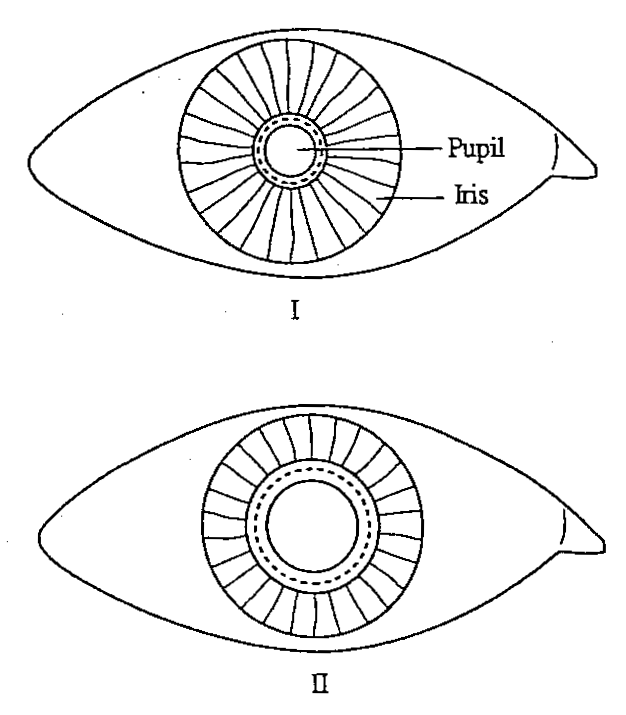
What causes the appearance in I and II to be different?
In bright and dim light the circular and radial muscles both contract.
In bright and dim light both circular and radial muscles relax.
In dim light the circular muscles relax and radial muscles contract, and in bright light radial muscles relax and circular muscles contract.
In bright light circular muscles relax and radial muscles contract, and in dim light radial muscles relax and circular muscles contract.
The following reactions all take place in the skin. I. Blood vessels dilate and constrict. II. Glands produce sweat. III. Hair erector muscles contract. These functions relate to the skin's role as an organ for
mechanical protection only
body temperature control only
both body temperature control and sensitivity to the surroundings
mechanical protection, body temperature control and sensitivity to the surroundings
Secretions from your adrenal glands help you to function more effectively when
doing an examination
eating a meal
listening to music
going to bed
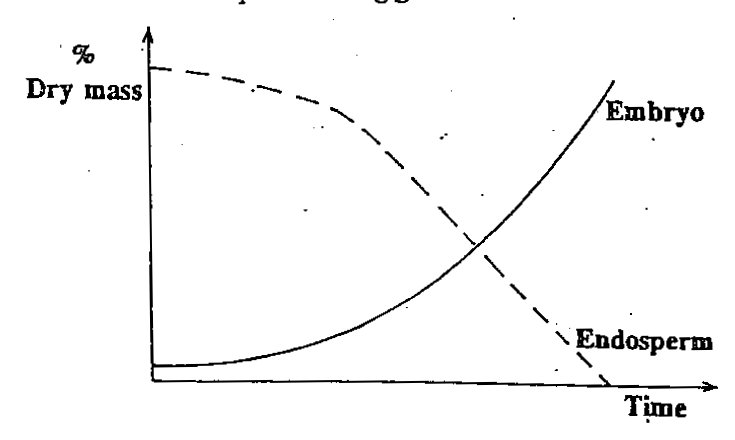
Item 40 refers to the following graph which shows changes in dry mass of embryo and endosperm during germination.
From the graph, it is true to say that
the embryo begins to grow as the endosperm increases in mass
the embryo and the endosperm decrease in mass at the same rate
the embryo and the endosperm increase in mass at the same rate
as the embryo grows, the food reserves are gradually depleted
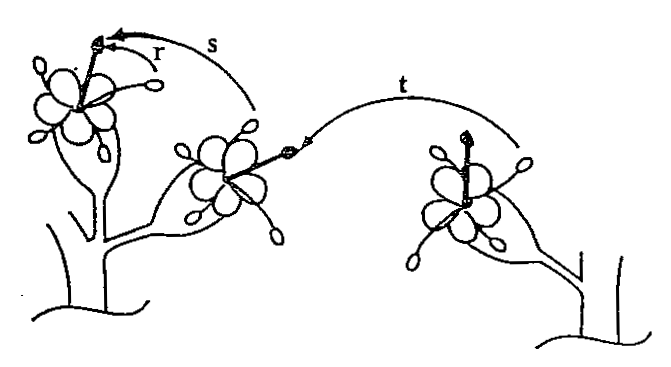
Item 41 refers to the following diagram which illustrates pollination.
Pollination involves the transfer of pollen from anther to stigma. Which of the arrows in the diagram above may be illustrating the movement of pollen in cross-pollination?
s only
t only
r and s
s and t
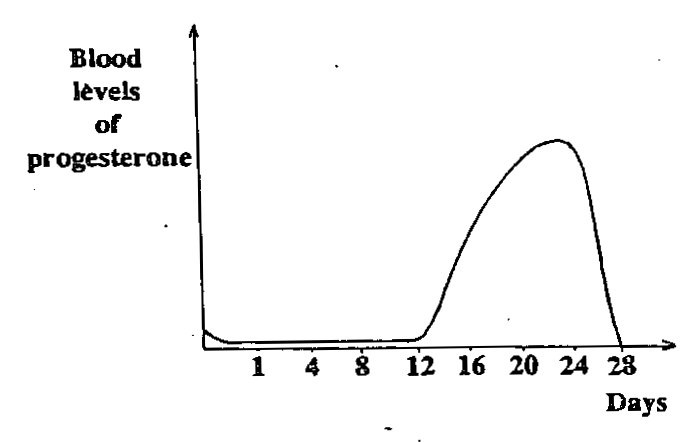
Item 42 refers to the graph below which shows blood levels of progesterone during the menstrual cycle of a human female.
With which process does the HIGHEST point of the curve correspond?
Shedding of the lining of the uterus
Production of a mature egg cell from the ovary
Maximum production of the hormone by the placenta
Maximum production of the hormone by the corpus luteum
Oral contraceptives prevent pregnancy by
killing sperm
killing released eggs
preventing ovulation
preventing implantation
During pregnancy, the developing foetus receives protection against infections, a perfectly balanced diet, warmth and oxygen from its mother. Which of the following can a mother no longer provide for her newborn infant?
Oxygen
Food
Antibodies
Warmth
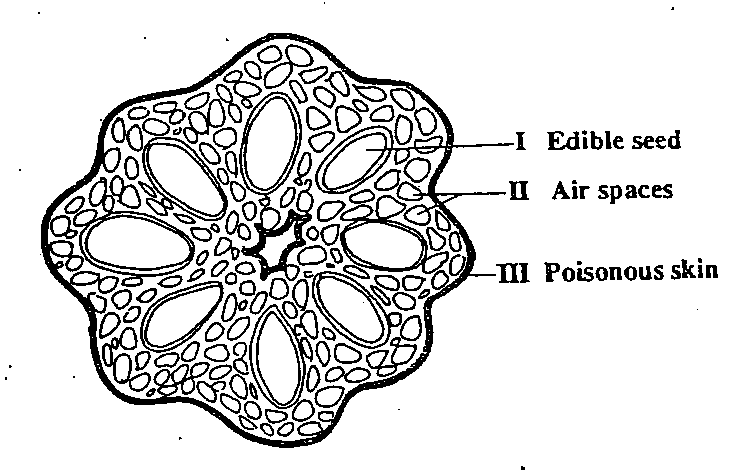
Items 45-46 refer to the following diagram of the cross-section of a fruit of an unknown plant found on the shore of a swamp.
Which of the following is the MOST likely means of dispersed of this fruit?
Wind
Water
Animal
Mechanical
Which of the following would BEST suggest what the agent of dispersal might be?
I only
II only
III only
II and III only
Which of the following describes the chromosomes present in the ordinary cells of a human female?
22 pairs + X
22 pairs + XX
Genetic engineering is BEST described as changing the traits of one organism by
incorporating genes from another organism
incorporating a few chromosomes from a different organism
crossing it with a closely related species
inducing mutation in its sex organs
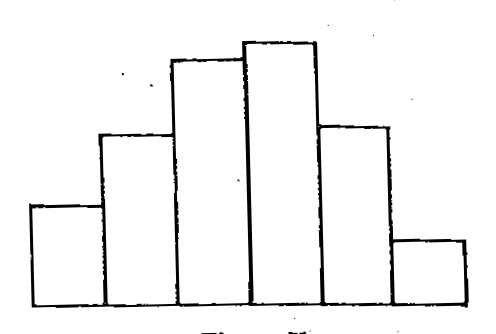
Figure X can be used to show
the number of shrubs in a field
stages in the life history of an insect
the heights of students in a school
variation in skin colour among albinos
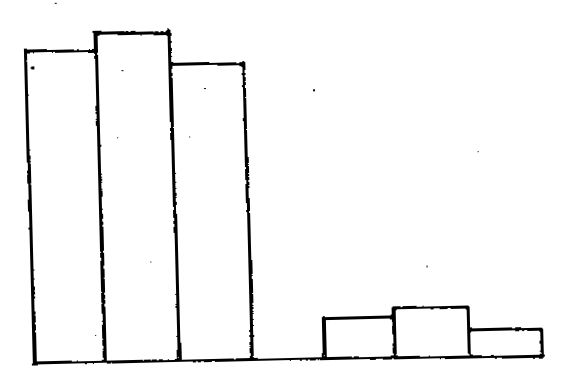
Figures X and Y can both be used to show different kinds of
variation
selection
inheritance
reproduction
Item 51 refers to the following information.
Some fowls (called Erminette) have black and white feathers evenly distributed over the body. A breeder crosses two of these fowls and finds that there are pure white, pure black and Erminette among the offspring.
What would you expect the ratio of black:white:Eminette to be?
1:1:1
1:1:2
1:2:1
3:1:1
Which of the following is NOT one of the body's natural ways of defending itself against infection?
Clotting
Vaccination
Action of phagocytes
Production of antibodies
The type of disease to which sickle-cell anaemia belongs
Pathogenic
Deficiency
Hereditary
Physiological
A disease that can be prevented with immunization
Pathogenic
Deficiency
Hereditary
Physiological
Abuse of prescription drugs is considered a disease because
it is costly to families
it reduces human productivity
many people are involved in it
it affects the functioning of the body
Which of the following statements is true of inorganic fertilisers?
They help to hold water in soils.
They do not affect soil pH.
They make nutrients available more quickly.
They improve the crumb structure of soil.
Items 57-58 refer to the following information.
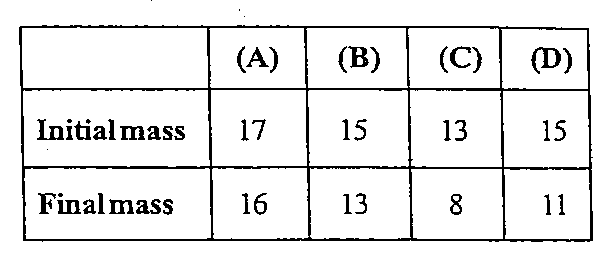
A test was done to determine the water content of 4 different soils - clay, sand, a clayey loam and a sandy loam. The mass of 10 cm³ of each soil was determined before and after heating until completely dry. The results were as follows.
| (A) | (B) | (C) | (D) | |
|---|---|---|---|---|
| Initial mass | 17 | 15 | 13 | 15 |
| Final mass | 16 | 13 | 8 | 11 |
Which soils would be BEST for use as a facial astringent intended to shrink as it dries out, pulling the skin tight?
A
B
C
D
Which soil would be MOST suitable for use in an underground filter?
A
B
C
D
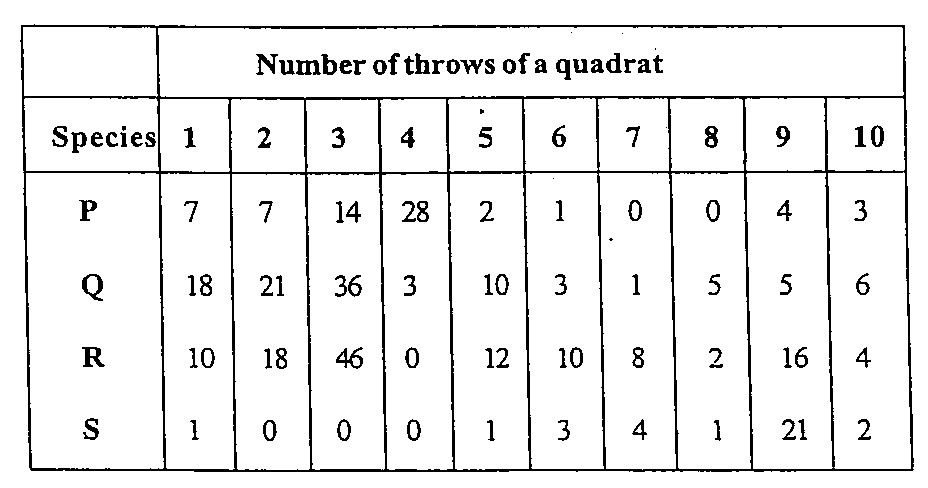
Items 59-60 refer to the following table.
Number of throws of a quadrat
| Species | 1 | 2 | 3 | 4 | 5 | 6 | 7 | 8 | 9 | 10 |
|---|---|---|---|---|---|---|---|---|---|---|
| P | 7 | 7 | 14 | 28 | 2 | 1 | 0 | 0 | 4 | 3 |
| Q | 18 | 21 | 36 | 3 | 10 | 3 | 1 | 5 | 5 | 6 |
| R | 10 | 18 | 46 | 0 | 12 | 10 | 8 | 2 | 16 | 4 |
| S | 1 | 0 | 0 | 0 | 1 | 3 | 4 | 1 | 21 | 2 |
The area in which the quadrat on the third throw fell is probably
under a large tree
close to a source of water
a very sandy area
close to a walkway
Which of the following is MOST likely true about Species P?
It is the commonest plant in the area.
It is taller than the other plants close to it.
It covers most of the area in which the quadrat fell on the 10th throw.
It covers about half the area in which the quadrat fell on the 4th throw.