Free CXC Biology Paper 1 May/June 2007 past paper from 2007. Includes a worked answer key. Open the PDF, take a timed test, and study with AI on Caribbean AI.
Answer keys are free on Caribbean AI. View the answers to every past-paper question at no cost - no payment needed - with step-by-step worked solutions and instant AI marking available on Premium.
CSEC Biology Paper 1 May/June 2007 - Free CXC Past Paper with Answers
Free CXC Biology Paper 1 May/June 2007 past paper from 2007. Includes a worked answer key. Open the PDF, take a timed test, and study with AI on Caribbean AI.
Opening the interactive papers…
Every question from this paper as text. See the answers and worked solutions. Questions are the property of the Caribbean Examinations Council; Caribbean AI is not affiliated with CXC.
Leguminous plants can contribute to soil fertility because they
remove toxic substances
contain nitrogen-fixing bacteria
add trace elements
maintain the moisture content
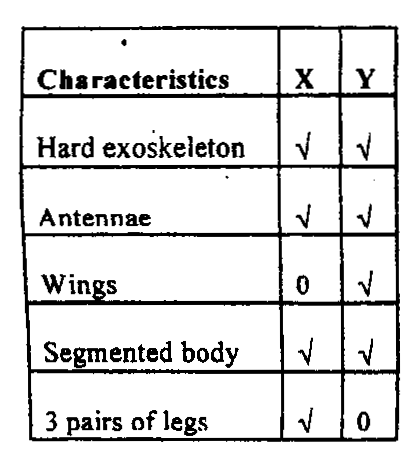
Item 2 refers to the following information. Two organisms were found in the same tree. They were examined and their characteristics recorded as shown in the table below.
| Characteristics | X | Y |
|---|---|---|
| Hard exoskeleton |
| Antennae |
| Wings | 0 |
| Segmented body |
| 3 pairs of legs | 0 |
Key: Present Absent 0
Which of the following statements is supported by the information in the table?
Both X and Y are insects.
Both X and Y are arthropods but only X is an insect.
X is an insect but Y is not.
Neither X nor Y is an insect.
In an ecosystem, the organisms which make solar energy available to all other organisms are the
producers
decomposers
primary consumers
secondary consumers
The bush pig, which has been observed to feed on a diet of plant roots as well as birds' eggs, is
a herbivore
a carnivore
an omnivore
a detritovore
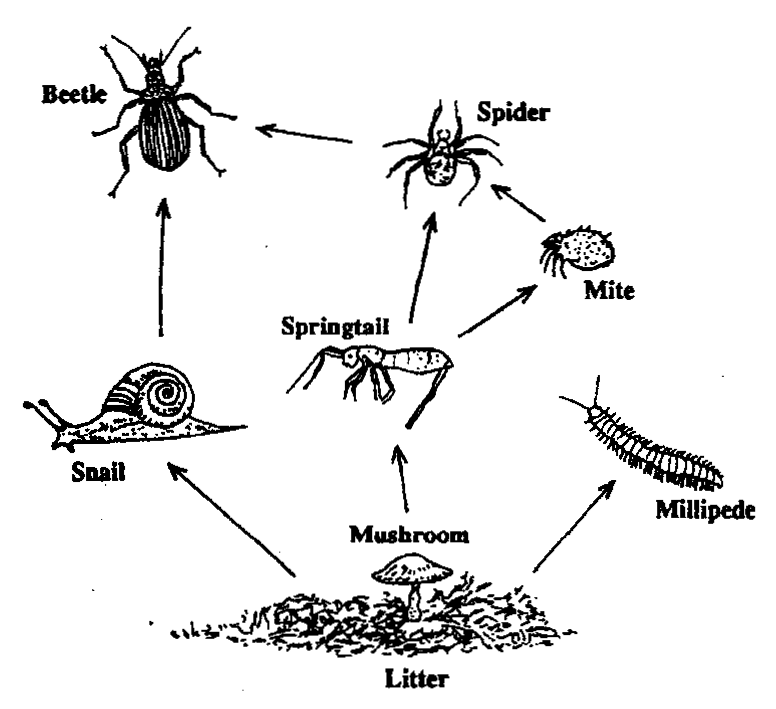
Item 5 refers to the following diagram of a food web found in leaf litter.
[Diagram of food web] Litter
The number of trophic levels illustrated in the food web is
2
3
4
7
A plant which has reduced leaves with no chlorophyll, lacks a proper root system, and flowers abundantly, is MOST likely to be found
in a habitat where water is scarce
living parasitically on another plant
growing in an area where there are few insects
existing as a commensal with other green plants
Which of the following cell structures are associated with energy transfer?
I. Chloroplast II. Mitochondrion III. Nucleus IV. Cell membrane
I and II only
I and III only
II and III only
II and IV only
When a seedling loses water to the atmosphere faster than it can be obtained from the soil, the turgidity of the cells
decreases and the seedling wilts
decreases and the seedling does not wilt
increases and the seedling wilts
increases and the seedling does not wilt
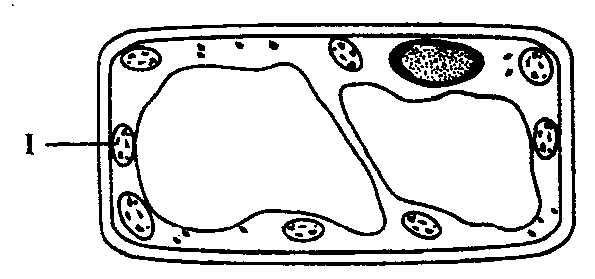
Item 9 refers to the following diagram of a cell.
The structure labelled I is found in
animals
fungi
bacteria
green plants
Which of the following pairs of organisms possesses the requirements for making carbohydrates from inorganic materials?
Algae and flowering plants
Bacteria and fungi
Fungi and flowering plants
Viruses and algae
Sodium hydroxide and weak copper sulphate solution will produce a violet colour with molecules of
fat
starch
sugar
protein
Which of the following is true of photosynthesis and respiration in green plants?
Photosynthesis occurs in the day while respiration occurs in the night.
Photosynthesis never occurs in the dark while respiration occurs only in the dark.
Photosynthesis occurs only in the light while respiration occurs both in the light and in the dark.
Photosynthesis occurs only in the sunlight and respiration takes over when photosynthesis ceases.
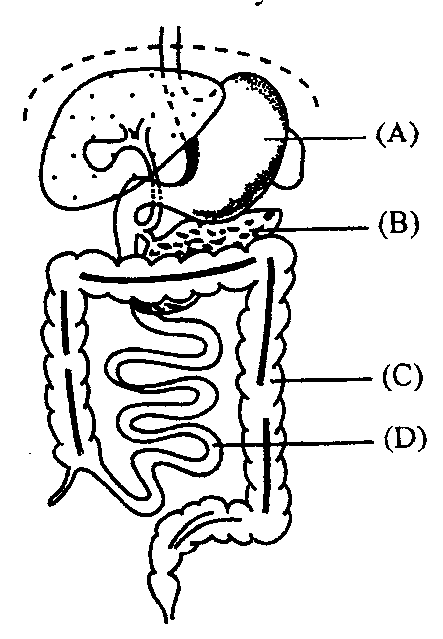
Items 13-14 refer to the following diagram of the human alimentary canal.
In answering items 13 and 14, match each item with one of the labelled parts above. Each part may be used once, more than once or not at all.
Secretes a substance to regulate sugar balance in the body
A
B
C
D
The site for absorption of digested food
A
B
C
D
The rate at which respiration is occurring in a mammal can be indicated by the rate of
sweat production
urine excretion
carbon dioxide elimination
oxygen elimination
The process which releases energy by breaking down organic compounds is
excretion
respiration
photosynthesis
deamination
Item 17 refers to the following characteristics. I. Thin-walled structures II. Excellent blood supply III. Always moist IV. Large surface area
These characteristics are true for a tissue MOST likely found in the
liver
lungs
mouth
skin
Which of the following statements BEST describes the function of ATP?
It is a means of energy transfer.
Large quantities of energy can be- come available.
It speeds up chemical reactions in the cell.
It stores food.
Which of the following sequences represents the route which a red blood cell must take to travel from the lung to the kidney?
Lung → pulmonary vein → heart → aorta → renal artery → kidney
Lung → aorta → hepatic artery → liver → renal artery → kidney
Lung → liver → hepatic portal vein → intestine → renal artery → kidney
Lung → pulmonary vein → hepatic artery → stomach → renal vein → kidney
Mineral salts are transported in plants mainly through the
sieve tubes
cambium
parenchyma
xylem vessels
A greenhouse plant which is usually kept at a temperature of 25°C is subjected to a temperature of 30°C for 24 hours. The MOST likely effect of this change is that the plant
absorbs less water
absorbs more water
loses less water
loses more water
The structure of the red blood cell allows it to I. squeeze through tiny blood vessels II. release large quantities of oxygen III. absorb carbon dioxide IV. absorb large quantities of oxygen
I and II only
III and IV only
I and III only
I and IV only
Which of the following does NOT represent a step in the formation of a blood clot?
Thromboplastin reacts with prothrombin.
Thrombin reacts with fibrinogen.
White blood cells engulf bacteria and digest them.
Blood cells and platelets become trapped in fibres.
Which of the following statements about excretory products in plants are correct? Excretory products I. are stored in leaves and bark II. are converted into insoluble crystals and tannins III. are removed during transpiration IV. result in the formation of storage organs
I and II only
I and IV only
II and III only
II and IV only
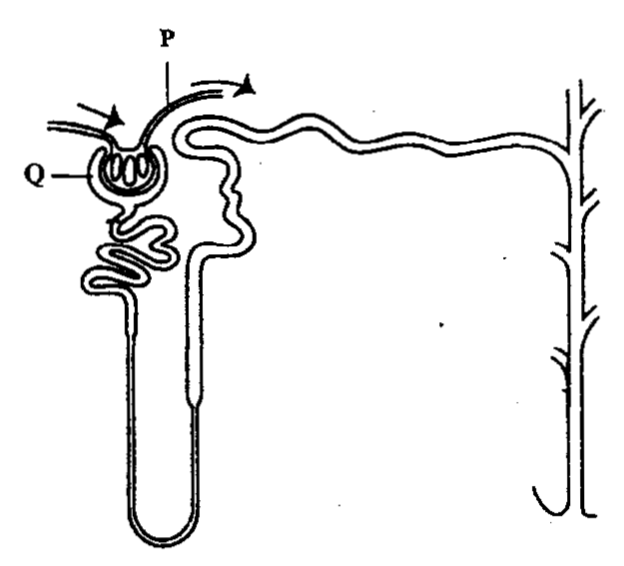
Items 25-26 refer to the simplified drawing of a renal tubule (nephron) below.
The name of the process which occurs in Q is
secretion
reabsorption
osmosis
filtration
One component present in the fluid in P but NOT in the fluid in Q is
glucose
blood proteins
urea
blood plasma
Which of the following is NOT a distinguishing feature of the nervous system?
Rapid response
Localised reaction
Long-lasting effect
Temporary and reversible response
Which of the following statements would describe ligaments?
I. They hold bones together. II. They are tough and fibrous. III. They reduce friction between bones.
I and II only
I and III only
II and III only
I, II and III
Which of the following is NOT a component of joints?
Ligament
Cartilage
Tendon
Synovial fluid
The MOST important of the minerals stored by bones in the body are
calcium and phosphorus
calcium and potassium
phosphorus and sodium
sodium and potassium
The presence of sugar in the urine often indicates a deficiency of
adrenalin
insulin
secretin
thyroxin
A seedling illuminated from one side, bends towards the light source because the concentration of auxins becomes
greater on the side away from the light
greater on the side towards the light
the same on both sides
greatest at the tip of the shoot
Which of the following parts of the eye functions as a receptor?
Iris
Lens
Retina
Optic nerve
Which region of the brain is MOST likely to be used in solving a mathematical problem?
Cerebellum
Cerebrum
Medulla oblongata
Hypothalamus
When someone sees appetizing food saliva is often produced. Which of the following is the correct sequence for this reflex action?
Receptor organ → spinal cord → brain
Receptor organ → salivary gland → brain
Receptor organ → brain → salivary gland
Receptor organ → spinal cord → salivary gland
Carbohydrate stored in the muscles of a marathon runner is converted to available glucose during a race. This conversion is controlled by the hormone
adrenalin
insulin
thyroxin
testosterone
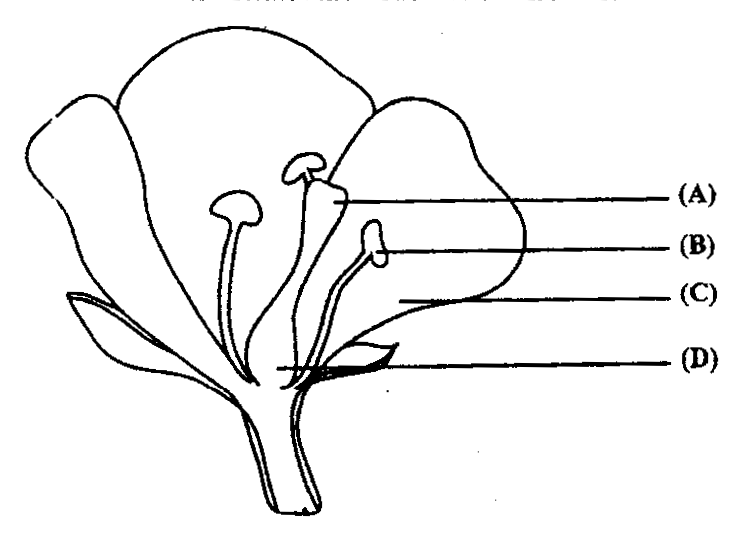
In which part of this flower is pollen produced?
A
B
C
D
Which of the following shows the route taken by a sperm cell when it leaves the testis?
Epididymis → sperm duct → urethra
Sperm duct → urethra → epididymis
Epididymis → urethra → sperm duct
Urethra → sperm duct → epididymis
In the human female, fertilization of the ovum takes place in the
ovary
oviduct
uterus
vagina
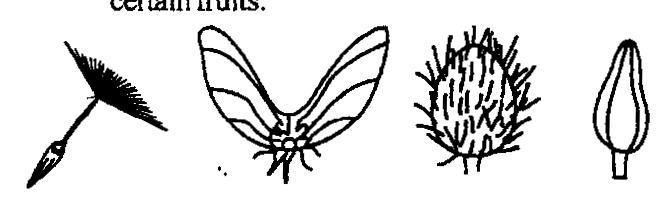
Which of these fruits is MOST likely to be dispersed by animals?
I
II
III
IV
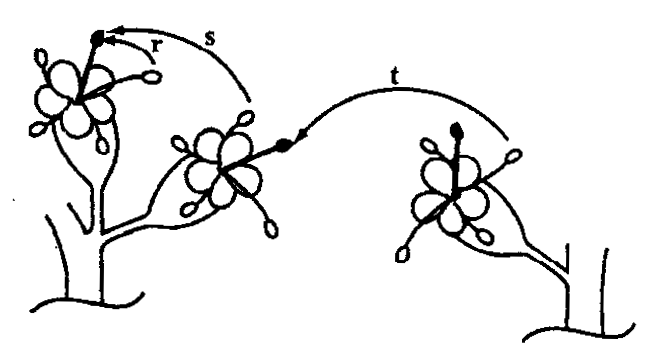
Pollination involves the transfer of pollen from anther to stigma. Which of the arrows in the diagram above may be illustrating the movement of pollen in cross-pollination?
r and s
s and t
s only
t only
Items 42-43 refer to the following options.
In answering items 42-43, match each of the items with one of the options above. Each option may be used once, more than once or not at all.
The descendants of a plant produced by asexual reproduction from a single organism
Diploid
Recessive
Heterozygote
Clone
An allele not expressed in the zygote
Diploid
Recessive
Heterozygote
Clone
Between the ages of 3 and 5, boys and girls show a reduction in their growth rate because
they do not eat a lot of protein
they are suffering from worms
their body cells divide by reduction division
the rate of division of the body cells is slower
Items 45-46 refer to the following information.
A cross between red and white flowered plants of the same species produces plants with pink flowers.
What would be the expected phenotypic ratio if two of the pink flowers are crossed?
1 red : 1 white
1 red : 1 pink : 1 white
1 red : 3 pink : 1 white
1 red : 2 pink : 1 white
If one of the pink flowered plants is crossed with the red parent, what percentage of the offspring would be expected to have pink flowers?
0
25
50
100
Which of the following processes could give rise to new plant varieties? I. Mutations II. Mitosis III. Breeding
I only
II only
I and III only
II and III only
Which of the following statements BEST describes genetic engineering?
Changing the traits of one organism by incorporating genes from another organism
Changing the traits of one organism by incorporating a few chromosomes from a different organism
Changing the traits of one organism by crossing it with a closely related species
Changing the traits of one organism by inducing mutation in its sex organs
Which of the following statements about asexual reproduction is true?
Asexual reproduction is carried out by humans.
Asexual reproduction involves meiosis.
The whole organism is produced by mitotic divisions.
The organisms are produced under the same conditions.
Which of the following characteristics are examples of discontinuous variation in humans? I. Height II. Tongue-rolling III. Blood groups IV. Foot length
I and II only
II and III only
I and IV only
I, II, III and IV
Through which of the following can natural immunity be obtained? I. Blood transfusion II. Breastmilk III. The placenta IV. Vaccines
I and II only
II and III only
I and IV only
III and IV only
Humans can easily overcome the adverse effects of all of the following constraints on their population growth EXCEPT
natural disasters
short food supply
insufficient housing
natural predators
Items 53-54 refer to following types of diseases.
I. Pathogenic II. Deficiency III. Hereditary IV. Physiological
In answering items 53-54, match each item with one of the options above. Each option may be used once, more than once, or not at all.
The type of disease to which sickle-cell anaemia belongs
Pathogenic
Deficiency
Hereditary
Physiological
A disease that can be prevented with immunization
Pathogenic
Deficiency
Hereditary
Physiological
At which stage in the life history of the mosquito is control easiest?
Egg
Larva
Pupa
Imago
Which of the following methods can BEST be used to collect data about the distribution of organisms in a savannah or pasture?
Quadrat
Line transect
Collection
Sweep net
Which of the following factors contribute to increased population size?
I. Ability to resist disease II. Inadequate water supplies III. Too much or too little light IV. Small number of predators
I and II only
II and III only
I and IV only
I, II, III and IV
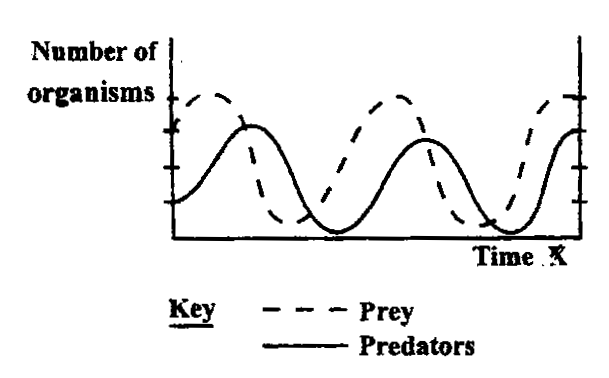
Which of the following inferences can be made from the graph? I. The maximum number of predators never exceeds the maximum number of prey. II. Predation has caused the loss of the entire prey population. III. The populations of predator and prey decrease simultaneously.
(A) I only (B) I and II only (C) II and III only (D) I, II and III
I only
I and II only
II and III only
I, II and III
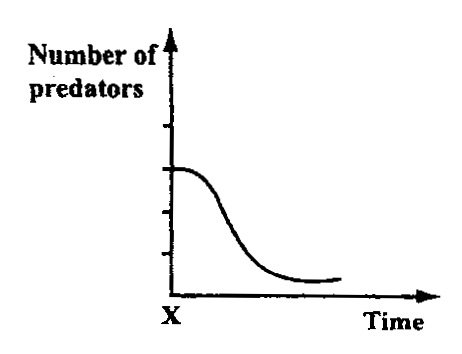
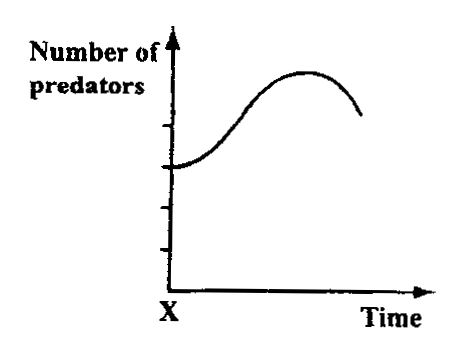
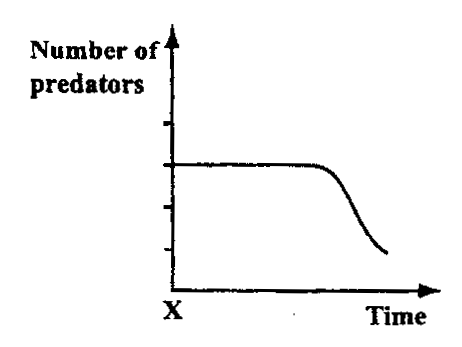
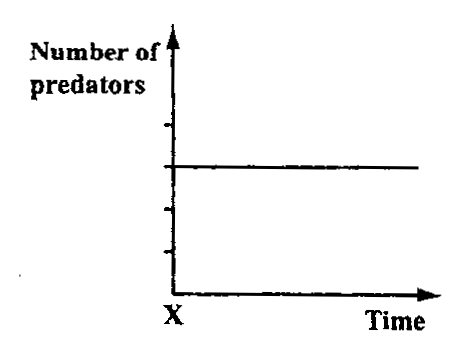
Which of the following graphs represents what may happen if a large number of prey came to live in the habitat at time X?
Number of predators X Time
Which of the following statements is true of inorganic fertilizers? (A) They help to hold water in the soil. (B) They improve the crumb structure of soil. (C) They make nutrients available more quickly. (D) They do not affect the soil pH.
They help to hold water in the soil.
They improve the crumb structure of soil.
They make nutrients available more quickly.
They do not affect the soil pH.