CSEC Geography Paper 3 May/June 2013 - Free CXC Past Paper with Answers
Free CXC Geography Paper 3 May/June 2013 past paper from 2013. Includes a worked answer key. Open the PDF, take a timed test, and study with AI on Caribbean AI.
Answer keys are free on Caribbean AI. View the answers to every past-paper question at no cost - no payment needed - with step-by-step worked solutions and instant AI marking available on Premium.
- All CSEC Past Papers
- CSEC Geography Past Papers
- CSEC Geography Paper 3 May/June 2015
- CSEC Geography Paper 3 May/June 2014
- CSEC Geography Paper 3 May/June 2012
- CSEC Geography Paper 3 May/June 2011
- CSEC Geography Paper 3 May/June 2010
- CSEC Geography Paper 3 May/June 2009
- CSEC Geography Paper 3 May/June 2008
- CSEC Geography Paper 3 May/June 2007
- CSEC Geography Paper 3 May/June 2006
- CSEC Geography Paper 3 May/June 2005
CSEC Geography Paper 3 May/June 2013 - Free CXC Past Paper with Answers
Free CXC Geography Paper 3 May/June 2013 past paper from 2013. Includes a worked answer key. Open the PDF, take a timed test, and study with AI on Caribbean AI.
Opening the interactive papers…
- All CSEC Past Papers
- CSEC Geography Past Papers
- CSEC Geography Paper 3 May/June 2015
- CSEC Geography Paper 3 May/June 2014
- CSEC Geography Paper 3 May/June 2012
- CSEC Geography Paper 3 May/June 2011
- CSEC Geography Paper 3 May/June 2010
- CSEC Geography Paper 3 May/June 2009
- CSEC Geography Paper 3 May/June 2008
- CSEC Geography Paper 3 May/June 2007
- CSEC Geography Paper 3 May/June 2006
- CSEC Geography Paper 3 May/June 2005
CSEC Geography Paper 3 May/June 2013 Questions
Every question from this paper as text. See the answers and worked solutions. Questions are the property of the Caribbean Examinations Council; Caribbean AI is not affiliated with CXC.
Question 1 (4 marks)
A map of Nevis (scale of 1:25,000) is provided as an insert for use in this question.
Imagine you are preparing to study areas of cultivation and forest on the west slopes of Nevis Peak. With reference to the map, complete the TWO sketch maps as indicated below.
Figure 1 shows an outline of Nevis and the parish boundaries and an area of forest.
On this map, show the position of Nevis Peak.
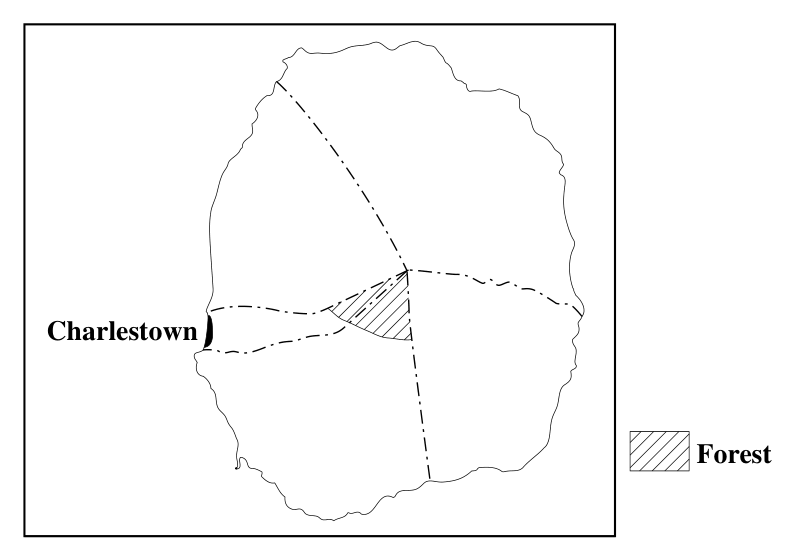
[1 mark]
Figure 2 shows part of the map of Nevis between Eastings 35 and 37 and Northings 95 and 97 at the same scale as the map of Nevis. The 500, 1500 and 2000 foot contour lines are shown.
Complete the sketch map in Figure 2 by adding the following: (i) the 1000 foot contour line (ii) the parish boundary between the parishes of St Thomas Lowland and St Paul-Charlestown (iii) the area of cultivation in squares 3595 and 3695.
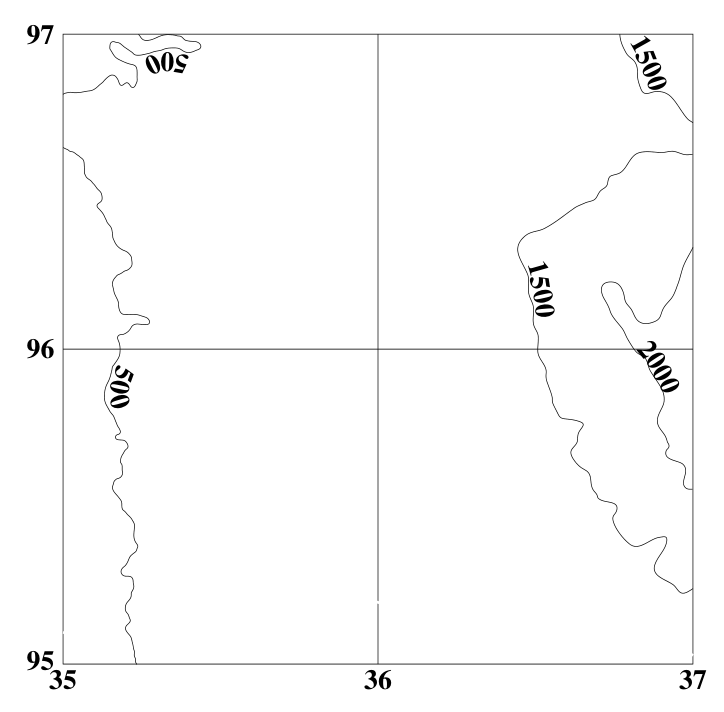
[3 marks]
the 1000 foot contour line
[1 mark]