Free CXC Integrated Science Paper 2 May/June 2006 past paper from 2006. Includes a worked answer key. Open the PDF, take a timed test, and study with AI on Caribbean AI.
Answer keys are free on Caribbean AI. View the answers to every past-paper question at no cost - no payment needed - with step-by-step worked solutions and instant AI marking available on Premium.
CSEC Integrated Science Paper 2 May/June 2006 - Free CXC Past Paper with Answers
Free CXC Integrated Science Paper 2 May/June 2006 past paper from 2006. Includes a worked answer key. Open the PDF, take a timed test, and study with AI on Caribbean AI.
Opening the interactive papers…
Every question from this paper as text. See the answers and worked solutions. Questions are the property of the Caribbean Examinations Council; Caribbean AI is not affiliated with CXC.
Complete the word equation for EACH of the reactions below:
[2 marks]
Aluminium + hydrochloric acid
[1 mark]
Iron + water
[1 mark]
The Ramsingh family moves into their new home by the beach. Within two months the hinges of their metal gate begin to rust.
[4 marks]
Name the chemical process by which rusting takes place.
[1 mark]
Write a word equation for the formation of rust.
[1 mark]
Explain why rusting of the gate has occurred so rapidly.
[2 marks]
The kitchen windows of the Ramsingh's home have also begun to rust. The windows of the bedroom, however, show no signs of rusting. Aluminium, steel and plastic are three materials used to make windows.
Which of the three materials is likely to have been used in the windows
[4 marks]
of the bedroom?
[1 mark]
of the kitchen?
[1 mark]
Give reasons for your answers in (i) and (ii) above.
[2 marks]
The Ramsingh's previous home is located close to several factories. While they lived there, their children were repeatedly affected by various respiratory ailments. At their new home by the beach, there has been a marked decline in the frequency of respiratory ailments.
Suggest what might have been responsible for the
[2 marks]
respiratory ailments
[1 mark]
decline in frequency of the respiratory ailments.
[1 mark]
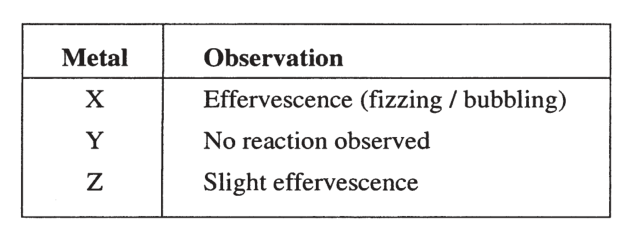
The following experiment is carried out by students in the laboratory. One gram of each metal, X, Y and Z, is placed in a test tube. Five of dilute hydrochloric acid is added to each test tube and the reaction observed. The results are shown in Table 1 below.
| Metal | Observation |
|---|---|
| X | Effervescence (fizzing / bubbling) |
| Y | No reaction observed |
| Z | Slight effervescence |
[5 marks]
Using the experimental results in Table 1, write the metals in order of increasing activity.
[1 mark]
Y is non-reactive in hydrochloric acid.
Suggest the name of ONE metal which is non-reactive in hydrochloric acid.
[1 mark]
Why was the same volume (5 ) of hydrochloric acid added to EACH of the three metals?
[3 marks]
Define the term 'energy'.
[1 mark]
Name TWO forms of energy.
[2 marks]
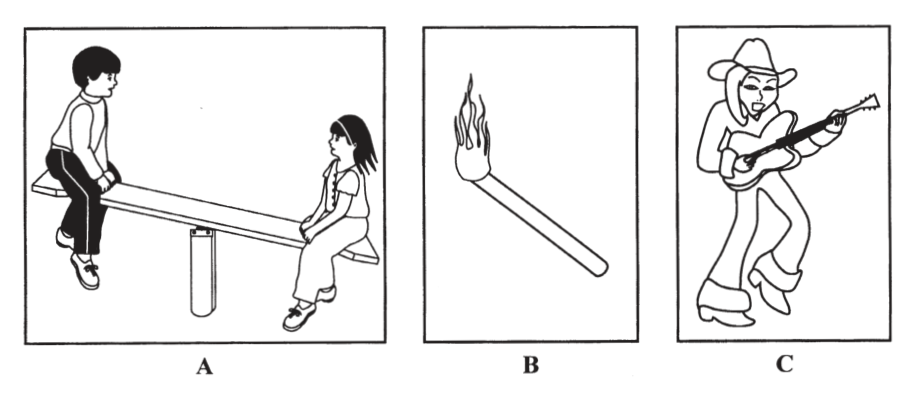
Figure 1 shows three diagrams, A, B and C, of activities in which energy is being converted from one form to another.
[3 marks]
Examine Figure 1 and state the energy conversion taking place in EACH of the diagrams, A, B and C.
A: B: C:
[3 marks]
In Diagram A of Figure 1, the girl weighs 40 kilograms and is seated 3 metres away from the centre of the see-saw. If the boy weighs 30 kilograms, at what distance from the centre should he sit, for them to balance each other?
[3 marks]
State the class of lever represented in Diagram A of Figure 1.
[1 mark]
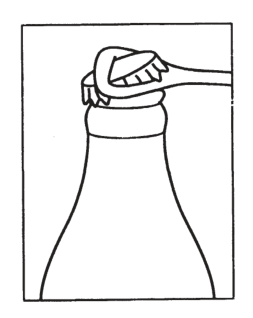
In Figure 2, a drink is being opened with a bottle opener.
If the force applied (load) is 8 Newtons and the effort is 2 Newtons, calculate the mechanical advantage of the bottle opener.
[2 marks]
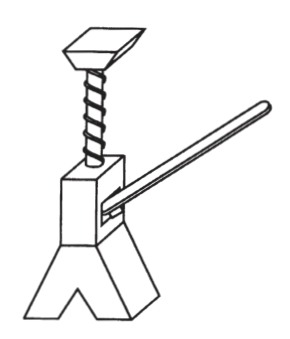
The machine in Figure 3 is a car jack.
[3 marks]
State ONE factor which may contribute to the inefficiency of the car jack shown in Figure 3.
[2 marks]
Suggest ONE method that may be used to overcome the inefficiency of the car jack in (i) above.
[1 mark]
State FOUR functions of the circulatory system in humans.
[2 marks]
The heart of a small mammal is pierced by the spear of a hunter.
Suggest ONE way in which this wound would lead to the death of the animal.
[1 mark]
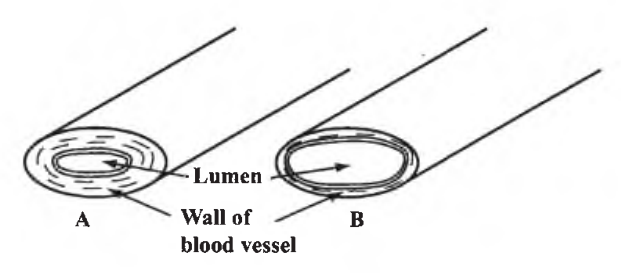
Figure 4 shows two types of blood vessels labelled A and B.
[2 marks]
State the MAIN difference between the blood vessels in Figure 4.
[1 mark]
Identify the type of blood vessel that is labelled A in Figure 4.
[1 mark]
Ben is the managing director of a large company. He spends long hours during the day and night trying to meet deadlines. His daily diet includes bread, salted fish, beef, chicken and fried potato chips. Ben suffers from hypertension (high blood pressure).
[8 marks]
Identify TWO of Ben's dietary habits that could contribute to his hypertension.
[2 marks]
Suggest TWO other factors that could have contributed to Ben's hypertension.
[2 marks]
Suggest THREE ways in which moderate exercise can affect Ben's body.
[3 marks]
Ben develops a disease that weakens the muscular tissues of his body.
Suggest, giving ONE reason, the effect the disease could have on his blood pressure.
Effect:
Reason:
[3 marks]
Explain the meaning of the term 'balanced diet'.
[2 marks]
Identify the nutrients in a ham-and-cheese sandwich.
[3 marks]
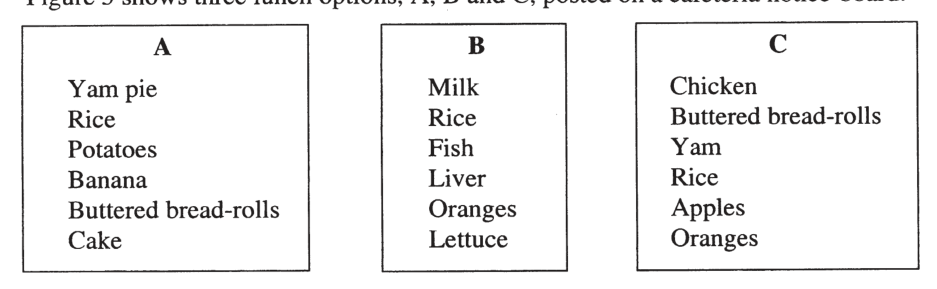
Figure 5 shows three lunch options, A, B and C, posted on a cafeteria notice-board.
Giving an appropriate reason in EACH case, indicate which of the options in Figure 5 would BEST support the dietary requirements of an athlete and a pregnant woman respectively.
Lunch option for an athlete:
Reason:
[4 marks]
Lunch option for a pregnant woman:
Reason:
[4 marks]
Describe how ONE nutrient in cheese is chemically digested before absorption.
[2 marks]
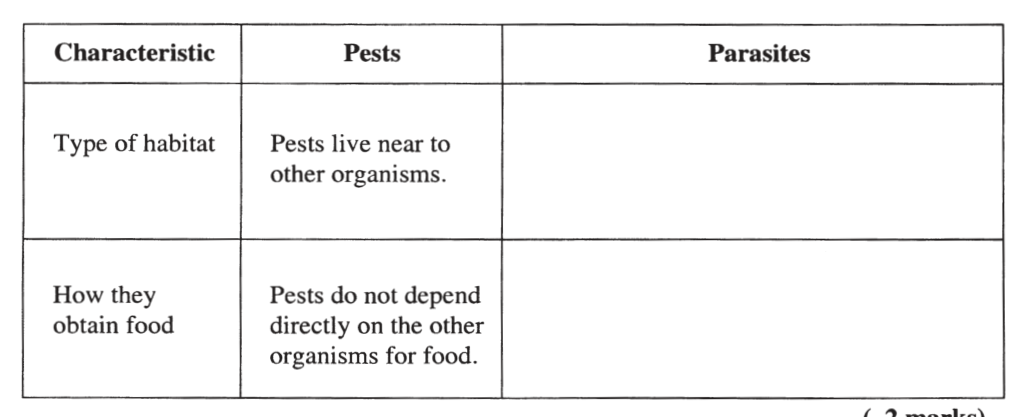
Some characteristics of pests and parasites are described in Table 2.
Complete Table 2 by writing the description for parasites.
TABLE 2: CHARACTERISTICS OF PESTS AND PARASITES
[2 marks]
Name TWO common household pests.
[2 marks]
The members of a rural community, situated near a small river, practise kitchen gardening, livestock rearing and fishing. After experiencing an increase in the number of flies, ants and other insects in their environment, they spray both inside and outside of their homes with the new insecticide advertised in Figure 6.
ERADICATES ALL INSECT PESTS IN THE HOME AND GARDEN, BUT DOES NOT KILL YOUR PLANTS.
Caution: Do not apply to plants in bloom.
Figure 6. Advertisement for new insecticide
Suggest TWO factors that might be responsible for the increase in the number of flies in the rural community.
[2 marks]
In addition to using insecticides, suggest ONE other method which the residents could use to control the number of flies.
[1 mark]
The gardeners in the community observe that there is a decrease in the number of okras, tomatoes and peppers produced in their gardens, despite the formation of large numbers of blossoms by the plants. There is also a decrease in the fish population in the river.
How could spraying of the new insecticide be responsible for
the decrease in produce from the gardens?
[2 marks]
the decrease in the number of fish?
[2 marks]
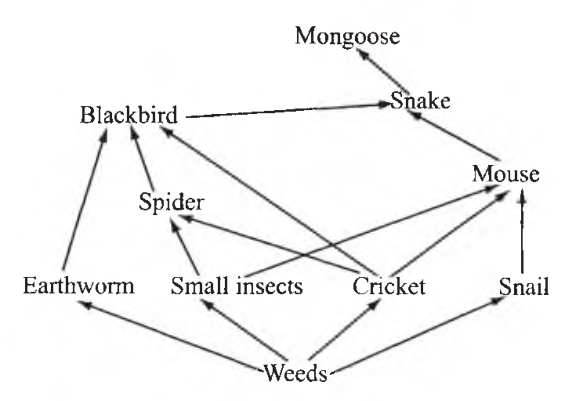
Figure 7 shows a food web from a habitat in the rural community.
Study the food web from the habitat shown in Figure 7 and answer the questions below.
What effect would reducing the insect population have on the weed and the spider populations?
a) Effect on the weed population:
b) Effect on the spider population:
[2 marks]
Select ONE food chain from the food web in Figure 7 and write it in the space provided below.
[2 marks]
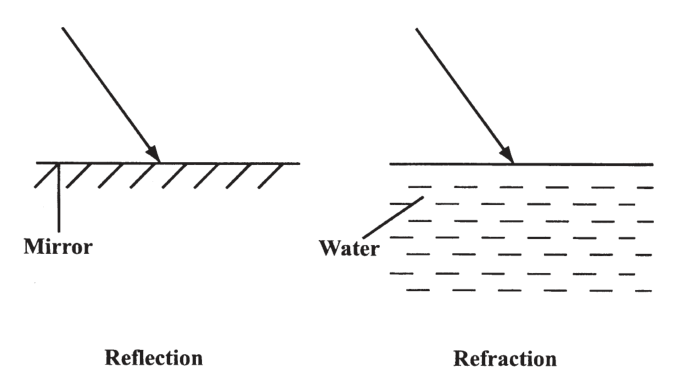
Figure 8 shows the path of two rays of light formed during reflection from a mirror and during refraction at the surface of water.
Distinguish between 'reflection of light' and 'refraction of light' by showing on the diagrams below what happens to the ray of light when it hits EACH surface.
Figure 8. Path of rays of light during reflection and refraction
[2 marks]
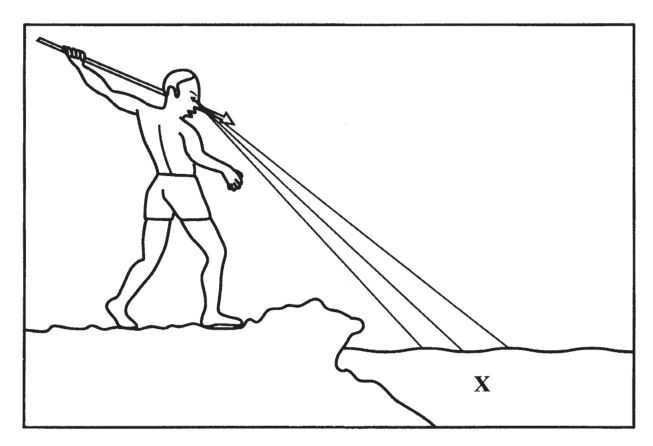
In some cultures, fish are caught by spearing. The fisherman stands on the rocks and aims the spear at the fish under the water as shown in Figure 9.
Figure 9. Spear fishing
When the man looks at the fish through the water, the fish appears to be at point X.
Is the actual position of the fish below or above X?
[1 mark]
Explain your answer to (b) (i) above.
[1 mark]
Where should the fisherman aim his spear in order to strike the fish?
[1 mark]
Name ONE method used to catch deep sea fish.
[1 mark]
When white light passes through a clear glass prism, it is split up into several colours.
What is the term used to describe this splitting up of the light?
[1 mark]
Red, green and blue light can be combined to form white light. These are the primary colours of light.
Explain what is meant by the term 'primary colour'.
[1 mark]
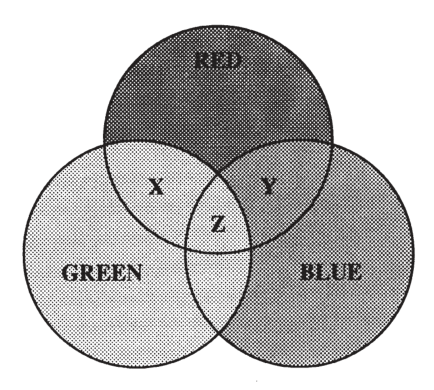
In Figure 10, lights of the primary colours, red, green and blue, are projected on a screen.
Figure 10. Primary colours projected on a screen
What colours would you expect to see in areas X, Y and Z?
X
[1 mark]
Y
[1 mark]
Z
[1 mark]
The pattern on a piece of cloth consists of RED triangles on a BLUE background.
What colours would appear on the cloth in red light and in green light?
Red light:
[2 marks]
Green light:
[2 marks]