Free CXC Geography Paper 2 May/June 2010 past paper from 2010. Includes a worked answer key. Open the PDF, take a timed test, and study with AI on Caribbean AI.
Answer keys are free on Caribbean AI. View the answers to every past-paper question at no cost - no payment needed - with step-by-step worked solutions and instant AI marking available on Premium.
CSEC Geography Paper 2 May/June 2010 - Free CXC Past Paper with Answers
Free CXC Geography Paper 2 May/June 2010 past paper from 2010. Includes a worked answer key. Open the PDF, take a timed test, and study with AI on Caribbean AI.
Opening the interactive papers…
Every question from this paper as text. See the answers and worked solutions. Questions are the property of the Caribbean Examinations Council; Caribbean AI is not affiliated with CXC.
Study the map extract of Pointe Michel, Dominica (scale 1:25 000), provided as an insert, and answer the following questions:
[28 marks]
State the six-figure grid reference of the Police Station in the village of Soufrière.
[2 marks]
What is the direction of the NEAREST school from the Police Station in the village of Soufrière?
[1 mark]
What is the bearing of the minor trigonometrical station, TR 10 (near Easting 68), at Morne Patates from the NEAREST school?
[2 marks]
What is the distance, in a straight line, between the school and the minor trigonometrical station at Morne Patates (to the NEAREST 100 metres)?
[2 marks]
What is the gradient from the trigonometrical station at Morne Patates to the coast, given that the distance to the coast is 1 815 feet?
[3 marks]
List FOUR services provided to the village of Berekua (near Easting 72).
[4 marks]
Describe the drainage in the area between Eastings 66 and 69.
[4 marks]
Describe the site of the town of Pointe Michel.
[4 marks]
Account for the distribution of agriculture in the area between Eastings 66 and 69.
[6 marks]
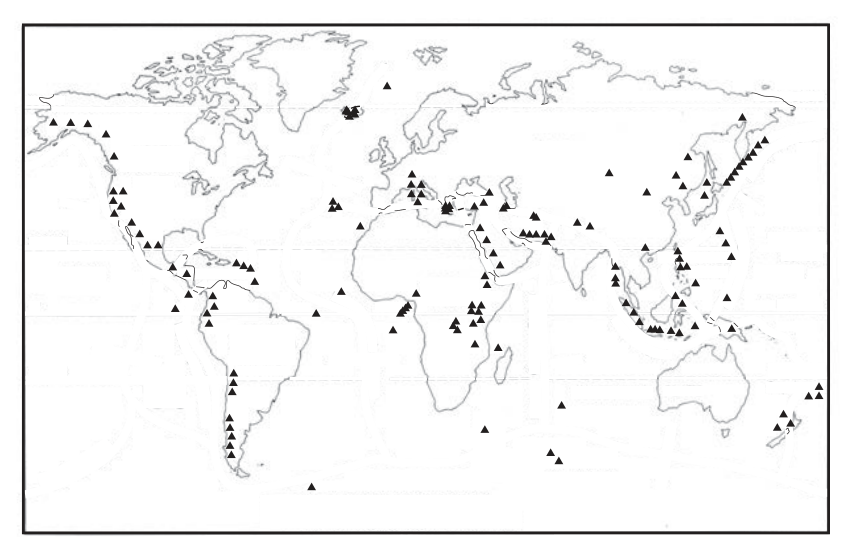
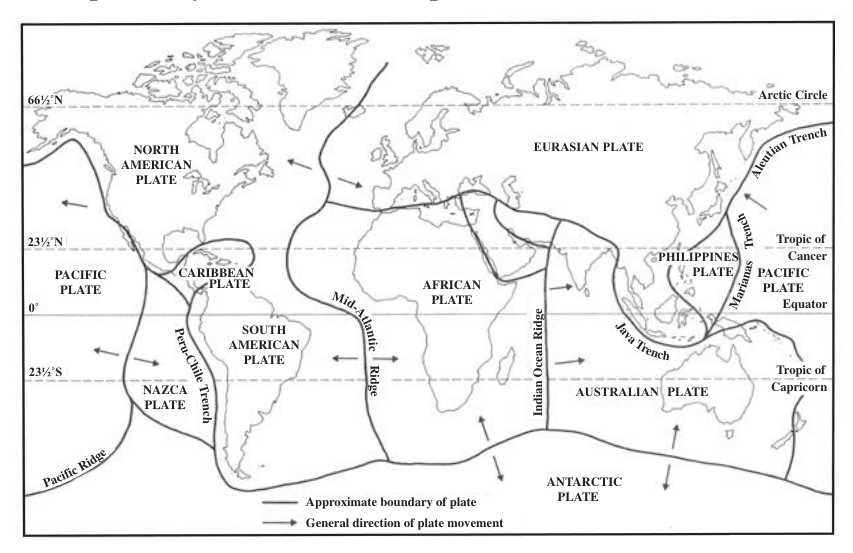
Study Figures 1 and 2, which show the global distribution of tectonic plates and of active volcanoes respectively, and answer the questions that follow.
(Source: London and Senior, Principles of Geography for CXC, Longman, 2001, p.18)
(Source: Nagle, Hazards, Nelson, 1998, p.24)
[4 marks]
Name the continent with no active volcanoes.
[1 mark]
How many active volcanoes are in South America?
[1 mark]
State ONE difference between the distribution of volcanoes in North America and Africa.
[1 mark]
How is the distribution of volcanoes related to plate boundaries?
[1 mark]
With the aid of a diagram, describe the MAIN features of the trellis drainage pattern.
[4 marks]
Describe TWO ways in which rivers transport their load.
[4 marks]
Explain how volcanoes are formed at convergent plate boundaries.
[6 marks]
Account for the formation of fold mountains at a) collision zones b) subduction zones.
(Include examples in your answer.)
[6 marks]
Draw a well-labelled diagram of the water cycle.
[4 marks]
Describe FOUR processes of coastal erosion.
[8 marks]
With the aid of a diagram, explain how bay-head beaches are formed.
[6 marks]
With the aid of a diagram, explain how bay-head beaches are formed.
[6 marks]
Explain how river cliffs and slip-off slopes are formed at meanders.
[6 marks]
Draw a cross section of a hurricane to illustrate its structure.
[4 marks]
Describe FOUR layers of vegetation in tropical rainforests.
[8 marks]
With the aid of a diagram, explain how rain shadow areas develop.
[8 marks]
Explain why the temperature is usually much lower on the summit of a mountain than the surrounding lowlands.
[4 marks]
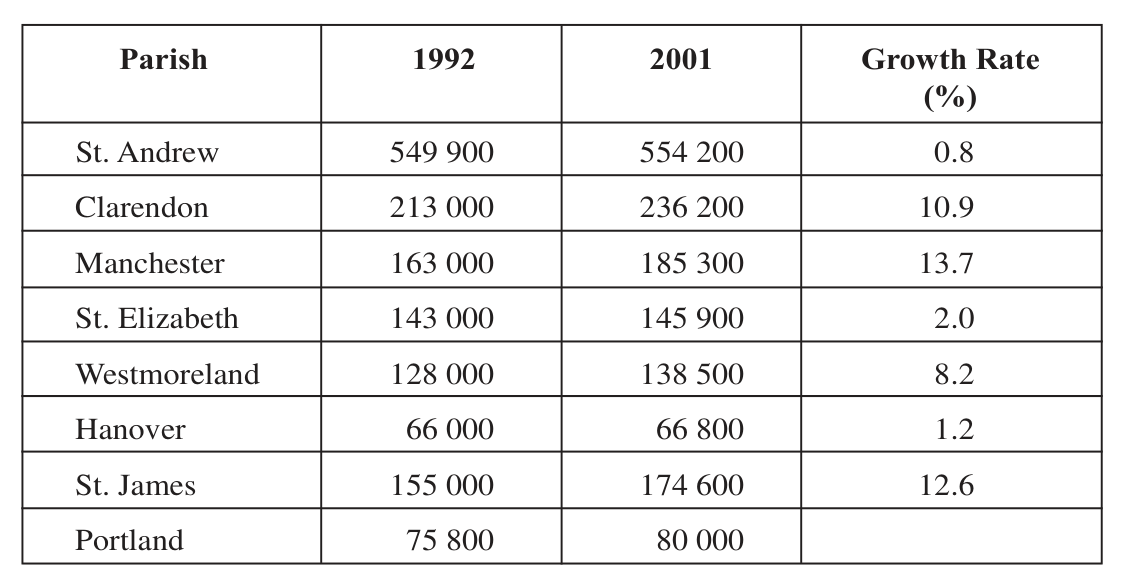
Study Table 1, which shows the population and growth rate of parishes in Jamaica, and answer the questions that follow.
TABLE 1: JAMAICA'S POPULATION AND GROWTH RATE BY PARISH (1992 AND 2001)
| Parish | 1992 | 2001 | Growth Rate (%) |
|---|---|---|---|
| St. Andrew | 549 900 | 554 200 | 0.8 |
| Clarendon | 213 000 | 236 200 | 10.9 |
| Manchester | 163 000 | 185 300 | 13.7 |
| St. Elizabeth | 143 000 | 145 900 | 2.0 |
| Westmoreland | 128 000 | 138 500 | 8.2 |
| Hanover | 66 000 | 66 800 | 1.2 |
| St. James | 155 000 | 174 600 | 12.6 |
| Portland | 75 800 | 80 000 |
Name the parish which had the HIGHEST growth rate.
[1 mark]
Name ONE parish that had growth of less than 2%.
[1 mark]
Calculate the growth in Portland as a percentage.
[1 mark]
Which parish had a population increase of less than one thousand persons?
[1 mark]
Describe THREE problems of urbanisation in the Caribbean.
[6 marks]
State TWO factors which influence population growth.
[2 marks]
Give SIX reasons why people often move from rural areas to cities.
[12 marks]
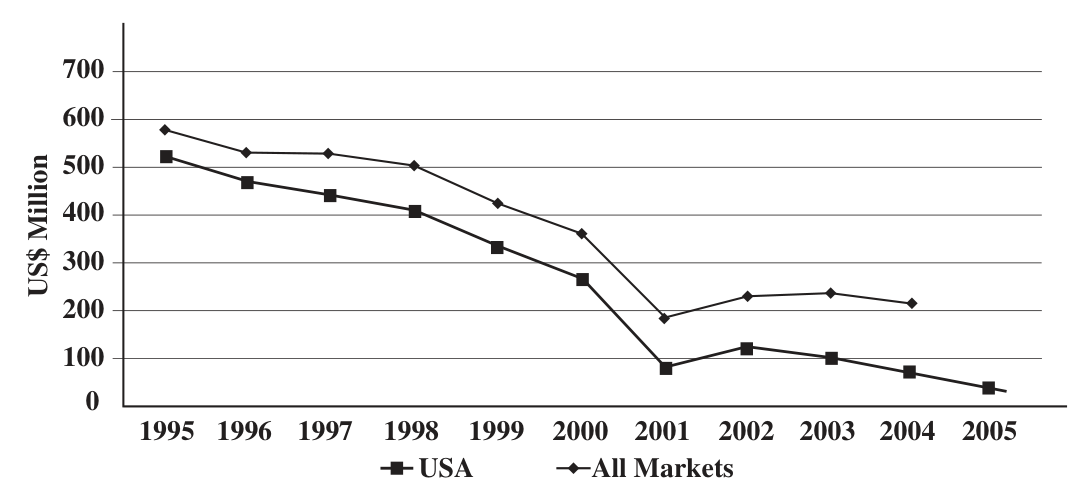
Study Figure 3, which shows apparel exports from Jamaica to the USA and to all other markets for the period 1995 – 2005, and answer the questions that follow.
(Source: Economic and Social Survey, Jamaica, 2005, Sec 12.6)
[4 marks]
What is the trend in apparel exports over the period 1995 – 2005?
[1 mark]
What was the APPROXIMATE value of exports to the USA in 1996?
[1 mark]
What is the value of exports to OTHER countries (excluding the USA) in 1998?
[1 mark]
For exports to the USA, how many years had a value of 100 million or less?
[1 mark]
Name and give an example of TWO types of economic activities in the Caribbean.
[2 marks]
For a named Caribbean country, describe TWO factors which influence the location of a specific type of economic activity.
[6 marks]
For the economic activity identified in (b) (ii), explain TWO challenges it faces.
[4 marks]
For EITHER food processing OR garment manufacturing, explain how the development of the industry in BOTH a named Caribbean country and EITHER Singapore OR Hong Kong is influenced by ANY TWO of the following: (i) Labour (ii) Raw materials (iii) Market
[8 marks]
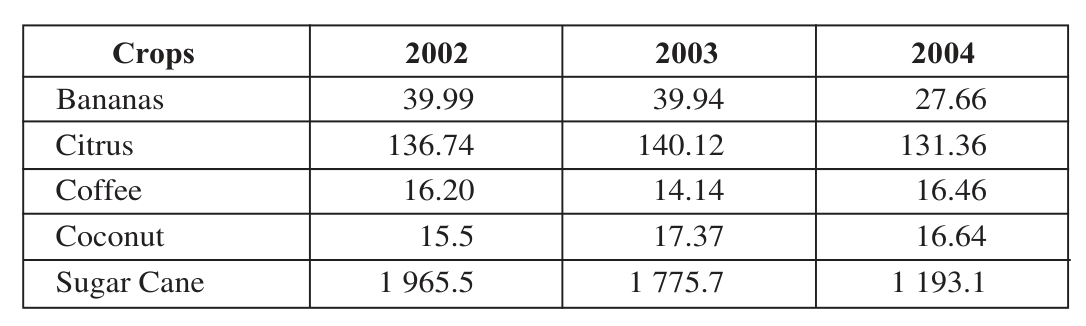
Study Table 2, which shows the production of selected crops for 2002 – 2004 in Jamaica, and answer the questions that follow.
TABLE 2: PRODUCTION OF SELECTED CROPS ('000 Tonnes)
| Crops | 2002 | 2003 | 2004 |
|---|---|---|---|
| Bananas | 39.99 | 39.94 | 27.66 |
| Citrus | 136.74 | 140.12 | 131.36 |
| Coffee | 16.20 | 14.14 | 16.46 |
| Coconut | 15.5 | 17.37 | 16.64 |
| Sugar Cane | 1 965.5 | 1 775.7 | 1 193.1 |
(Source: Economic and Social Survey, Jamaica, 2005)
[24 marks]
Study Table 2, which shows the production of selected crops for 2002 – 2004 in Jamaica, and answer the questions that follow.
TABLE 2: PRODUCTION OF SELECTED CROPS ('000 Tonnes)
| Crops | 2002 | 2003 | 2004 |
|---|---|---|---|
| Bananas | 39.99 | 39.94 | 27.66 |
| Citrus | 136.74 | 140.12 | 131.36 |
| Coffee | 16.20 | 14.14 | 16.46 |
| Coconut | 15.5 | 17.37 | 16.64 |
| Sugar Cane | 1 965.5 | 1 775.7 | 1 193.1 |
(Source: Economic and Social Survey, Jamaica, 2005)
Which crop shows the HIGHEST production?
[1 mark]
Name the crop for which production INCREASED between 2003 and 2004.
[1 mark]
For which crop did production DECLINE the most between 2002 and 2004?
[1 mark]
Name the crop for which production increased and then fell below the 2002 level.
[1 mark]
Describe FOUR characteristics of peasant farming in the Caribbean.
[8 marks]
Explain THREE ways in which the role of commercial arable farming in a named Caribbean country has changed.
[6 marks]
Carefully explain how farming in the Caribbean differs from that in the Prairies of Canada. Include TWO differences in your answer.
[6 marks]
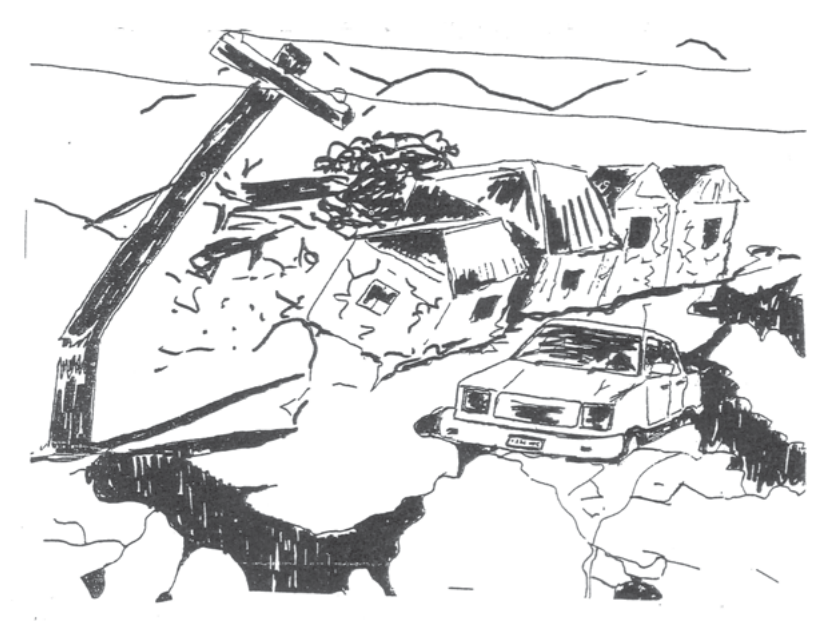
Study Figure 4, which shows the effects of a natural hazard, and answer the questions that follow.
(Source: Jamaica Foundation, Disaster Preparedness, Jamaica, 1990, p.18)
[24 marks]
Study Figure 4, which shows the effects of a natural hazard, and answer the questions that follow.
Figure 4. Effects of a natural hazard (Source: Jamaica Foundation, Disaster Preparedness, Jamaica, 1990, p.18)
Name the event that affected the area.
[1 mark]
List THREE effects of the event on the area.
[3 marks]
Define the term 'natural hazard'.
[2 marks]
Describe THREE measures that an individual or community can take to reduce the effects of a named natural hazard.
[6 marks]
For a named Caribbean country, explain TWO responses at the national level that have been used to alleviate the damage caused by a specific natural hazard.
[6 marks]
Explain how regional agencies assist Caribbean countries in disaster preparedness and response. Include TWO ways in your answer.
[6 marks]
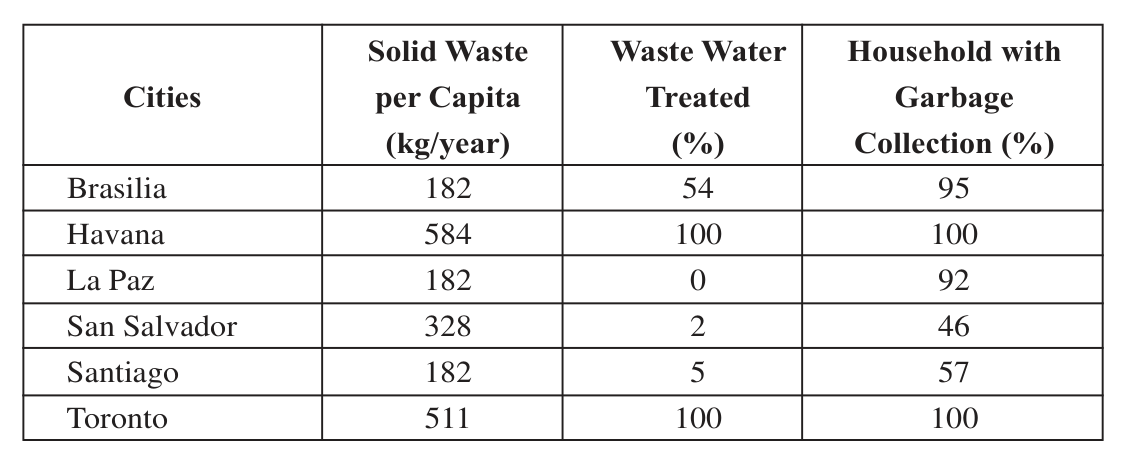
Study Table 3, which shows the solid waste production, waste water treatment and garbage collection of selected cities, and answer the questions that follow.
TABLE 3: SOLID WASTE PRODUCTION IN SELECTED CITIES
| Cities | Solid Waste per Capita (kg/year) | Waste Water Treated (%) | Household with Garbage Collection (%) |
|---|---|---|---|
| Brasilia | 182 | 54 | 95 |
| Havana | 584 | 100 | 100 |
| La Paz | 182 | 0 | 92 |
| San Salvador | 328 | 2 | 46 |
| Santiago | 182 | 5 | 57 |
| Toronto | 511 | 100 | 100 |
(Source: Habitat 1997 (in Geo 2000))
[24 marks]
Study Table 3, which shows the solid waste production, waste water treatment and garbage collection of selected cities, and answer the questions that follow.
TABLE 3: SOLID WASTE PRODUCTION IN SELECTED CITIES
| Cities | Solid Waste per Capita (kg/year) | Waste Water Treated (%) | Household with Garbage Collection (%) |
|---|---|---|---|
| Brasilia | 182 | 54 | 95 |
| Havana | 584 | 100 | 100 |
| La Paz | 182 | 0 | 92 |
| San Salvador | 328 | 2 | 46 |
| Santiago | 182 | 5 | 57 |
| Toronto | 511 | 100 | 100 |
(Source: Habitat 1997 (in Geo 2000))
Name the cities with the same per capita solid waste production.
[1 mark]
Which city had the LOWEST percentage of household waste collection?
[1 mark]
An insert, Figure 5, is provided for this question. Complete the bar graph in Figure 5 to show the data for waste water treated.
[2 marks]
With reference to examples, give the meaning of 'air pollution' and 'land pollution'.
[4 marks]
Describe TWO measures that have been implemented by Caribbean countries to reduce the emission of aerosols.
[4 marks]
Explain how deforestation affects the environment in the Caribbean. Include FOUR effects in your answer.
[12 marks]
Figure 6 (provided as an insert) shows TWO imaginary coral islands.
[24 marks]
Figure 6 (provided as an insert) shows TWO imaginary coral islands.
On the figure, shade the areas of BOTH islands which would be flooded if the sea level rose 30 cm.
[2 marks]
With reference to Figure 6, list TWO effects of the rise in sea level on the people who live on these islands.
[2 marks]
Discuss TWO causes and TWO consequences of global warming.
[8 marks]
Explain how coral reefs in the Caribbean are destroyed. Include SIX different ways in your answer.
[12 marks]