Free CXC Caribbean History Paper 2 May/June 2005 past paper from 2005. Includes a worked answer key. Open the PDF, take a timed test, and study with AI on Caribbean AI.
Answer keys are free on Caribbean AI. View the answers to every past-paper question at no cost - no payment needed - with step-by-step worked solutions and instant AI marking available on Premium.
CSEC Caribbean History Paper 2 May/June 2005 - Free CXC Past Paper with Answers
Free CXC Caribbean History Paper 2 May/June 2005 past paper from 2005. Includes a worked answer key. Open the PDF, take a timed test, and study with AI on Caribbean AI.
Opening the interactive papers…
Every question from this paper as text. See the answers and worked solutions. Questions are the property of the Caribbean Examinations Council; Caribbean AI is not affiliated with CXC.
Read the passage below, and answer the questions that follow.
The Taino (Arawaks) and Kalinago (Caribs) were similar in many ways, but different in others. For example, their technology was quite similar, but their political organisation was, to some extent, different. Their technology was not as advanced as that of the Maya.
[25 marks]
Explain why Mayan technology is considered more advanced than the technology of the Taino (Arawaks) and Kalinago (Caribs).
[4 marks]
Outline the ways in which the technology of the Taino (Arawaks) and Kalinago (Caribs) were similar.
[9 marks]
Describe FOUR ways in which the political organisation of the Taino (Arawaks) was different from the political organisation of the Kalinago (Caribs).
[12 marks]
Imagine that you are a Taino (Arawak) cacique on whose island the Spaniards settled in the early 1500s. You are having a discussion with the Spanish settlers about the meeting of your culture with theirs.
[25 marks]
Explain the aspects of the Spanish presence in your island that pose a problem to your people.
[15 marks]
Describe the features of your culture that have most impressed the Spaniards.
[10 marks]
Imagine that you are an Englishman living in Liverpool in the 1700s. You are having a conversation with your son about the slave trading voyages which you organise to West Africa and the Caribbean. Answer the following questions which he asks you.
[25 marks]
What steps do you take in England before the beginning of a slave trading voyage?
[6 marks]
In what ways do some African states and African people benefit economically from the Atlantic slave trade?
[9 marks]
Explain why so many slaves die during the voyage from Africa to the Caribbean.
[10 marks]
Read the passage below, and answer the questions that follow.
Only a part of the land on a sugar plantation was used for canefields. Much of the land was used for other important purposes.
The cultivation of cane and the production of sugar involved many different tasks. Some of the work was particularly hard, while other jobs were considered light. Most of the field workers were often women, though men were normally required to do particular jobs.
[25 marks]
Identify THREE jobs on a sugar plantation that were considered "particularly hard".
[3 marks]
Name THREE jobs on a sugar plantation which were usually given to men.
[3 marks]
Explain why so many field workers were women.
[9 marks]
Describe the various uses made of land on a sugar plantation, apart from the growing of sugar cane.
[10 marks]
Read the passage below, and answer the questions that follow.
Some of the causes of the slave rebellion in Berbice in 1763 were similar to the causes of the revolts in Barbados in 1816 and Jamaica in 1831, but other causes were quite different. The slaves in Berbice enjoyed success in the early months of the rebellion. The revolts in Barbados and Jamaica, however, were suppressed rather quickly.
[25 marks]
Outline the MAIN cause of the rebellion in Barbados in 1816.
[3 marks]
In what ways were the causes of the 1763 rebellion in Berbice different from the causes of the 1831 revolt in Jamaica?
[9 marks]
Explain why the slaves in Berbice in 1763 were able to gain success in the early months of the rebellion.
[6 marks]
Explain why the rebellion in Jamaica in 1831 collapsed so quickly.
[7 marks]
Describe FIVE ways in which the Haitian economy was affected by the Haitian Revolution.
[15 marks]
Explain FOUR ways in which the wider Caribbean benefitted from the Haitian Revolution.
[10 marks]
Discuss THREE arguments used by both the French and the British abolitionists against Caribbean slavery.
[6 marks]
Outline THREE ways in which the French anti-slavery movement differed from the British anti-slavery movement.
[9 marks]
Explain the factors that accounted for the success of the British anti-slavery movement.
[10 marks]
List THREE provisions of the 1833 Act of Abolition.
[3 marks]
Identify THREE factors that were responsible for the planters' opposition to some of the terms of the 1833 Act of Abolition.
[10 marks]
Outline some of the difficulties that were experienced by the Apprentices between 1834 and 1838.
[12 marks]
Discuss the different ways in which Indian immigrants contributed to Caribbean society up to 1876.
[25 marks]
Examine the factors that encouraged the growth of free villages in Jamaica and Guyana after 1838.
[15 marks]
Outline THREE effects that the establishment of the peasantry had on the supply of estate labour in the British Caribbean between 1838 and 1876.
[10 marks]
Outline the MAJOR problems faced by the British Caribbean sugar industry from the 1880s to 1914.
[15 marks]
Describe FOUR policies used by planters to overcome problems in the sugar industry from the 1880s to 1914.
[10 marks]
Outline FOUR reasons why manufacturing industries increased in the British Caribbean after 1940.
[16 marks]
Discuss the extent to which the growth of manufacturing industries affected women's occupations in the British Caribbean after 1940.
[9 marks]
Explain why wages were so low in the British Caribbean and in the Spanish Caribbean in the 1930s.
[15 marks]
Explain why unemployment increased in the British Caribbean in the 1930s.
[10 marks]
Describe FOUR actions taken by the Universal Negro Improvement Association (UNIA) to improve the situation of blacks in the Caribbean and internationally.
[13 marks]
Outline the reasons why Marcus Garvey was persecuted.
[12 marks]
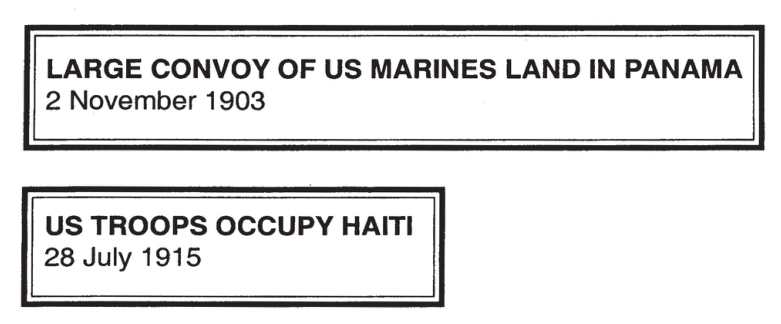
Study the Caribbean Daily News Headlines of 1903 and 1915 below, and answer the questions that follow.
LARGE CONVOY OF US MARINES LAND IN PANAMA 2 November 1903
US TROOPS OCCUPY HAITI 28 July 1915
[25 marks]
Explain briefly why the United States had an interest in a canal across Panama in 1903.
[4 marks]
Explain how the United States succeeded in obtaining rights to construct a canal across Panama in 1903.
[12 marks]
Outline THREE reasons for the United States' intervention in Haiti in 1915.
[9 marks]
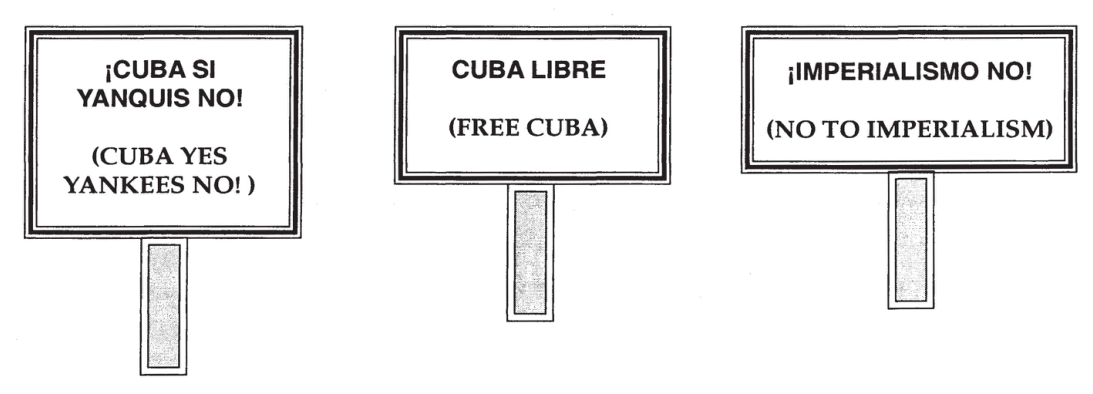
Study the placards below, on United States' relations with Cuba between 1898 and 1962, and answer the questions that follow.
¡CUBA SI YANQUIS NO! (CUBA YES YANKEES NO!)
CUBA LIBRE (FREE CUBA)
¡IMPERIALISMO NO! (NO TO IMPERIALISM)
[25 marks]
Identify the sentiments towards the United States that are conveyed by these placards.
[4 marks]
Outline THREE factors that affected the relations between Cuba and the United States between 1898 and 1959.
[9 marks]
Explain the reasons for the expression of such sentiments in Cuba after 1959.
[12 marks]
Describe TWO contributions that were made by José Martí to the independence movement in Cuba.
[25 marks]
Describe TWO contributions that were made by José Martí to the independence movement in Cuba.
[5 marks]
Outline THREE contributions of Norman Manley to the integration movement in the British Caribbean.
[8 marks]
Outline THREE contributions made by Sir Grantley Adams to the unification process in the British Caribbean.
[12 marks]
Discuss the arrangements that were made for the administration of the French and Dutch colonies after World War II.
[25 marks]
Read the statement below, then answer the questions that follow.
While many people continued to travel by foot, the Caribbean transportation system underwent considerable change in the late nineteenth century, and during the twentieth century.
[25 marks]
Identify THREE means, other than by foot, by which travel was possible in the mid-nineteenth century Caribbean.
[3 marks]
Outline THREE difficulties encountered in transportation in the Caribbean in the mid-nineteenth century.
[10 marks]
Outline the reasons for the changes in the means of transportation in the Caribbean between 1850 and 1962.
[12 marks]
In addition to working in their own homes, working-class women in the Caribbean had to support their families in a variety of ways, both in and outside of the home.
[25 marks]
Describe the different roles performed by men and women in the Caribbean during the period 1838 – 1962.
[4 marks]
Discuss the factors that affected the position of women in Caribbean society between 1838 and 1962.
[15 marks]
Outline TWO ways in which the roles of working-class women differed from those of upper-class women in Caribbean society, between 1838 and 1962.
[6 marks]