Free CXC Caribbean History Paper 2 May/June 2022 past paper from 2022. Includes a worked answer key. Open the PDF, take a timed test, and study with AI on Caribbean AI.
Answer keys are free on Caribbean AI. View the answers to every past-paper question at no cost - no payment needed - with step-by-step worked solutions and instant AI marking available on Premium.
CSEC Caribbean History Paper 2 May/June 2022 - Free CXC Past Paper with Answers
Free CXC Caribbean History Paper 2 May/June 2022 past paper from 2022. Includes a worked answer key. Open the PDF, take a timed test, and study with AI on Caribbean AI.
Opening the interactive papers…
Every question from this paper as text. See the answers and worked solutions. Questions are the property of the Caribbean Examinations Council; Caribbean AI is not affiliated with CXC.
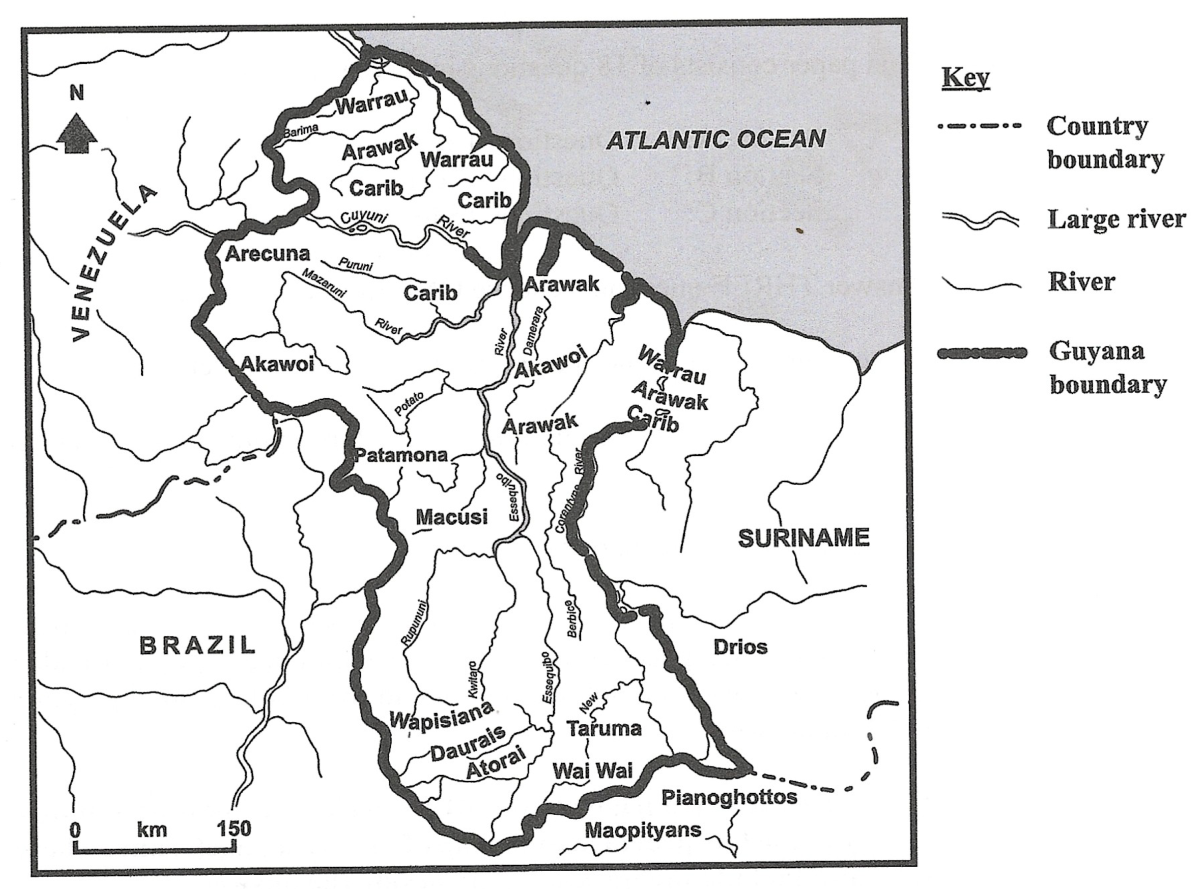
The following map shows the areas of Guyana occupied by various groups in the early nineteenth century. Study it carefully, then answer (a) (i) and (a) (ii) which follow.
Adapted from M. Menezes, The Amerindians and the Europeans. Red Thread Woman's Press, 1993, p. 26.
[25 marks]
State TWO geographic features of the location of Taino (Arawak) and Kalinago (Carib) settlements.
[2 marks]
Outline how ONE feature of the location of Taino and Kalinago settlements may have favoured Taino and Kalinago migration to the Caribbean islands by the fifteenth century.
[2 marks]
Explain THREE ways in which the Maya overcame the challenge of settling in areas where there was little or no surface water for farming or domestic purposes.
[9 marks]
Examine THREE distinctive architectural features of Mayan settlements those associated with overcoming the challenge of a lack of surface water.
[12 marks]
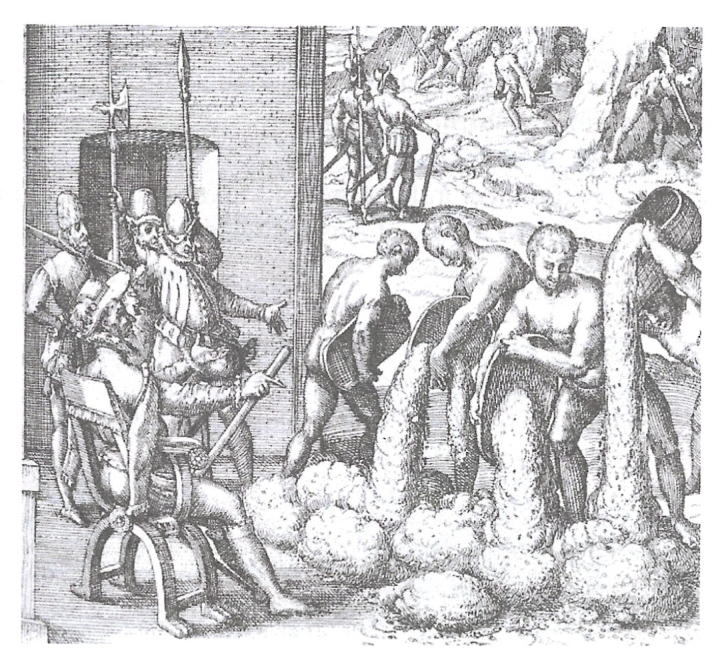
The picture below shows Africans mining gold in the Spanish American empire. The Spaniards are overseeing the activities. Study the picture, then answer the questions which follow.
Source: https://commons.wikimedia.org/wiki/File:Slaves_from_Guinea_digging_for_gold_and_silver_in_mines_in_Hispaniola_-_America_(1595),_A2_-_BL.jpg. Retrieved on November 2018.
[25 marks]
Describe TWO distinct behaviours displayed by the Spaniards during the period depicted in the picture.
[4 marks]
Explain THREE reasons for the establishment of the encomienda system during the period depicted in the picture.
[9 marks]
Examine THREE reasons for the selection of Africans as labourers on the mines operated by the Spaniards.
[12 marks]
The historical record tell us that during the years 1627 to 1640 the settlers in Barbados and elsewhere in the British Caribbean focused mainly on planting tobacco. After this period, they began the search for a viable alternative to this crop.
[25 marks]
List FOUR crops, other than sugar, that were considered as possible viable export alternatives to tobacco in the seventeenth century.
[4 marks]
Explain THREE reasons why the British Caribbean economies switched from cultivating tobacco in the seventeenth century.
[9 marks]
Discuss THREE of the main reasons why sugar was the most viable alternative to tobacco in some British Caribbean countries.
[12 marks]
"Black women were outnumbered by black men in the Atlantic slave trade, but their presence in the trade and their socioeconomic impact on the plantations are very significant factors in the study of Caribbean slavery."
Bernard Moitt, Women and Slavery in the French Antilles, 1635–1848. Indiana University Press, 2001, p. 19.
[25 marks]
List FOUR domestic occupations which enslaved women performed on the plantations.
[4 marks]
Explain the importance of EACH of the following occupations to the functioning of the sugar plantation:
[9 marks]
Jobber
[3 marks]
Cooper
[3 marks]
Boiler
[3 marks]
Examine the contribution of enslaved women in THREE non-domestic occupations on sugar plantations.
[12 marks]
"The Negro's revolutionary history is rich, inspiring, and unknown . . . The docile Negro is a myth . . . The only place where Negroes did not revolt is in the pages of capitalist historians . . . It is not strange that the Negroes revolted. It would have been strange if they had not."
C.L.R. James, "The Revolution and the Negro". In Tony Martin, Caribbean History: From Pre-Colonial Origins to the Present. Pearson, 2012, p. 140.
[25 marks]
Identify TWO enslaved women who were leaders of revolts in the Caribbean and state the territory in which EACH lived.
[4 marks]
Explain the role EACH of the following activities played in the history of resistance by the enslaved in the Caribbean:
[9 marks]
'Pulling foot'/running away
[3 marks]
Sabotage
[3 marks]
Festivals and celebrations
[3 marks]
Discuss THREE reasons why planters regarded women as being the fiercest, most troublesome and ungovernable of all enslaved persons.
[12 marks]
Read the following extract, then answer the questions which follow.
"Let us ensure . . . that a missionary spirit does not destroy our work; let us allow our neighbors to breathe in peace; may they live quietly under the law that they have made for themselves, and let us not, as revolutionary firebrands, declare ourselves the lawgivers of the Caribbean, nor let our glory consist in troubling the peace of the neighboring islands."
"The Haitian Declaration of Independence, January 1, 1804: The Commander in Chief to the People of Haiti." In Laurent Dubois and D.Garrigus, John Slave Revolution in the Caribbean, 1789–1904: A Brief History with Documents. Palgrave Macmillan, 2006, p. 190.
[25 marks]
State the name of the Commander in Chief to the People of Haiti who is speaking in the extract above.
[4 marks]
State the name of the Commander in Chief to the People of Haiti who is speaking in the extract above.
[1 mark]
State the name of ONE revolutionary leader who preceded the Commander in Chief identified in (a) (i).
State the name of TWO revolutionary leaders who succeeded the same commander by 1848.
Explain ONE economic, ONE social and ONE political consequence of the Haitian Revolution on Haiti by 1848.
[9 marks]
Discuss ONE effect of the Haitian Revolution on EACH of the following territories:
[12 marks]
The French Antilles
[4 marks]
The British Caribbean
[4 marks]
Cuba
[4 marks]
Imagine you are a journalist stationed in the Caribbean in 1830. Write an article for a journal in Europe in which you examine the effectiveness of FIVE key measures passed since 1808, aimed at ameliorating conditions of life and work for the enslaved.
[25 marks]
Imagine you are a member of an abolitionist lobby in December 1833. Write a speech to be delivered at a public anti-slavery forum in which you evaluate FIVE key provisions of the recently passed Act for the Abolition of Slavery throughout the British colonies.
[25 marks]
Imagine you are a non-conformist missionary in the British Caribbean in 1860. Write a letter to the parent missionary society in London examining FIVE ways in which the free village movement positively impacted the economy and society.
[25 marks]
Imagine you are a colonial office agent in Jamaica in 1865. Write a report to the colonial secretary explaining FIVE reasons why you are advocating an immediate change to the Crown Colony System from the Old Representative System of government.
[25 marks]
Imagine you are a former sugar grower in the British-colonized Caribbean appearing before the 1897 Royal Commission on the status of sugar in the region. Explain to the commission FIVE environmental factors and/or trade regulations that you think contributed to the crisis in the sugar industry in the late nineteenth century. Include at least ONE environmental factor and ONE trade regulation factor.
[25 marks]
Imagine you are a film-maker in the Cuban film industry doing research for a documentary on the Cuban sugar industry. As part of your research, examine any FIVE factors that contributed to the growth of the Cuban sugar industry in the nineteenth century.
[25 marks]
Examine FIVE reasons why the United States invaded Grenada in 1983.
[25 marks]
With reference to economic, political and social reforms, examine FIVE policies of Castro's revolution in Cuba up to 1985. Include at least ONE economic, ONE political and ONE social reform policy.
[25 marks]
Examine FIVE reforms instituted in Cuba by the revolutionary government of Fidel Castro. Include at least ONE social, ONE political and ONE economic reform.
[25 marks]
Examine FIVE ways in which Puerto Rico pursued constitutional alternatives to independence up to 1985.
[25 marks]
Examine FIVE ways in which trade unions across the Caribbean tried to improve social and economic conditions in the British-colonized Caribbean up to 1985.
[25 marks]
Examine the part played by FIVE types of celebrations in Caribbean social life during the twentieth century up to 1985.
[25 marks]