Free CXC Caribbean History Paper 2 May/June 2015 past paper from 2015. Includes a worked answer key. Open the PDF, take a timed test, and study with AI on Caribbean AI.
Answer keys are free on Caribbean AI. View the answers to every past-paper question at no cost - no payment needed - with step-by-step worked solutions and instant AI marking available on Premium.
CSEC Caribbean History Paper 2 May/June 2015 - Free CXC Past Paper with Answers
Free CXC Caribbean History Paper 2 May/June 2015 past paper from 2015. Includes a worked answer key. Open the PDF, take a timed test, and study with AI on Caribbean AI.
Opening the interactive papers…
Every question from this paper as text. See the answers and worked solutions. Questions are the property of the Caribbean Examinations Council; Caribbean AI is not affiliated with CXC.
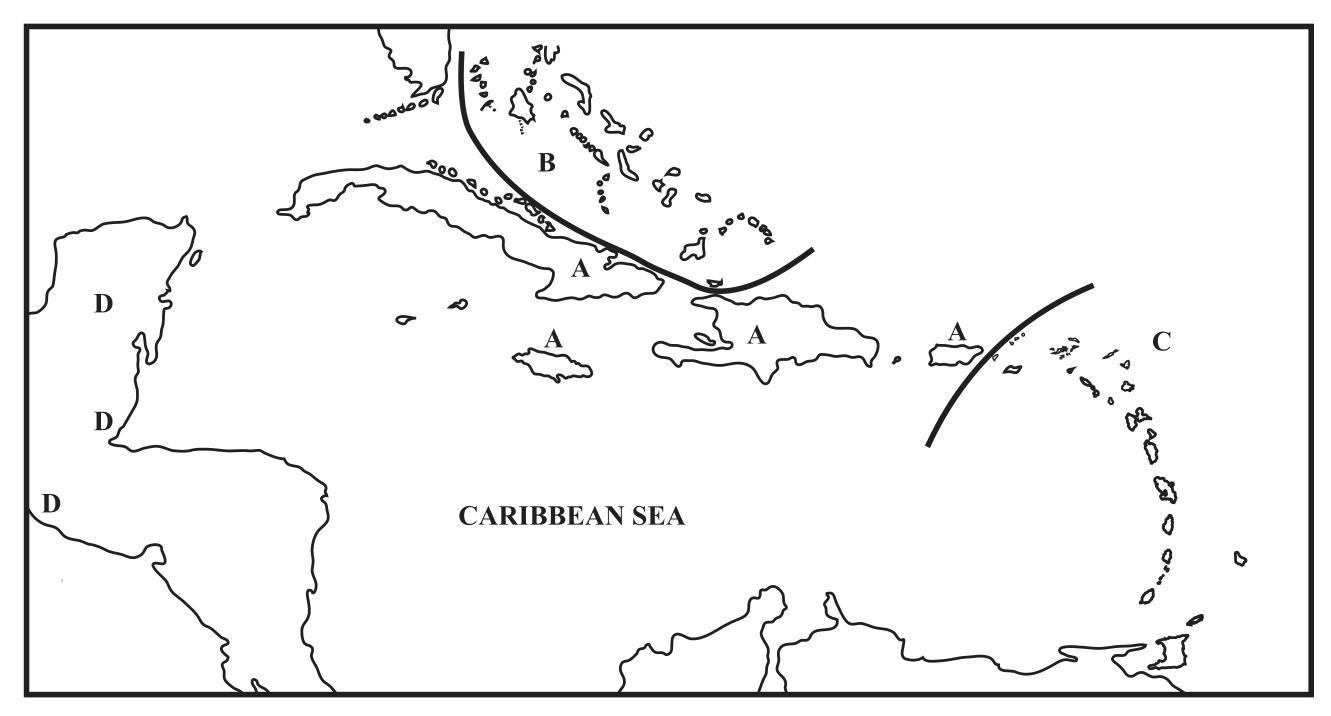
Study the information below and answer the questions which follow.
The first inhabitants of the Caribbean islands were migrants. They were expert mariners and constantly travelled through the region. When the Europeans arrived, they found two main groups occupying the islands. On the mainland, more sophisticated civilizations were found.
<image: map of Caribbean Sea with areas A, B, C, D marked>
[25 marks]
With reference to the map above, name the group of Indigenous People who occupied EACH of the areas marked A, B, C, and D when the Europeans arrived.
[4 marks]
Describe THREE features of the settlement pattern of any one group of Indigenous People in the Caribbean region at the time the Europeans arrived.
[9 marks]
Explain THREE factors which influenced the migratory patterns of the Indigenous Peoples who occupied the Caribbean islands.
[12 marks]
The political and economic systems of the Indigenous Peoples reflected the size and organization of their societies. Each group selected its leaders and sustained its societies in a different way.
[25 marks]
What were the leaders of the Taino and the Kalinago communities called?
[2 marks]
Describe ONE way in which the lifestyle of the Kalinagos affected their economic practices.
[2 marks]
Explain THREE roles of the leader in Taino communities.
[9 marks]
Examine THREE features of the economic system of the Maya.
[12 marks]
The first object which saluted my eyes when I arrived on the coast was the sea, and a slave ship which was then riding at anchor and waiting for its cargo. These filled me with astonishment, which was soon converted into terror when I was carried on board. [...] indeed such were the horrors of my views and fears at the moment that, if ten thousand worlds had been my own, I would have freely parted with them all to have exchanged my condition with that of the meanest slave in my own country.
"Interesting Narrative of the Life of Olaudah Equiano and Gustavus Vasa", 1789, Cited in S.C. Gordon, Caribbean Generations, A CXC History Source Book. Longmans Caribbean, 1983, p. 53.
[25 marks]
List FOUR ways in which Africans might become slaves within Africa.
[4 marks]
Explain THREE ways in which the transatlantic trade in enslaved Africans had a negative effect on West African societies.
[9 marks]
Examine THREE of the conditions on board a slaver which might have made Equiano want to trade places with "the meanest slave in [his] own country".
[12 marks]
Sugar plantations differed in size. The land on the sugar plantation was used for many important purposes with the best land under sugar cane cultivation.
[25 marks]
Identify FOUR uses of plantation land other than for cane fields.
[4 marks]
Examine the functions of the land for THREE of the uses identified in (a) above.
[9 marks]
Explain THREE reasons why so many women were engaged in work in the cane fields.
[12 marks]
Theme 3 – Resistance and Revolt
[25 marks]
Name TWO Caribbean territories where large Maroon settlements developed.
[2 marks]
State what is meant by the term 'maritime marronage'.
[2 marks]
Explain THREE factors which contributed to the development of Maroon societies in the Caribbean.
[9 marks]
Discuss THREE measures which the Maroons took to overcome challenges to the development of their societies.
[12 marks]
Identify TWO of the social groups in St Domingue in 1791.
[2 marks]
Name TWO groups which fought against the revolutionaries in St Domingue.
[2 marks]
Explain THREE factors which led to the outbreak of the revolt in St Domingue.
[9 marks]
Discuss THREE factors which contributed to the success of the revolutionaries by 1804.
[12 marks]
Theme 4 – Metropolitan Movements Towards Emancipation
Imagine that you are a journalist who has been following the anti-slavery movement in Britain. Write an article for your newspaper explaining how the 19th century revolts contributed to the abolition of slavery in the British Caribbean.
[25 marks]
As an MP in the British Parliament, you voted for the Emancipation Act because you thought its terms were favourable to all parties. With reference to its terms, discuss the reasons why the Act will benefit plantation owners as well as enslaved men and women.
Discuss at least TWO benefits for the owners and at least THREE benefits for the enslaved.
[25 marks]
Theme 5 – Adjustments to Emancipation, 1838–1876
You are a journalist in the English speaking Caribbean in the 1850s. You are assigned to the newspaper, The Economic Update. Write an article for the paper highlighting the factors affecting the sugar industry in British Guiana OR Jamaica between 1838 and 1854.
Your article should focus on labour, capital, technology and free trade.
[25 marks]
You are the Governor of Barbados after 1845. Write a letter to the Colonial Office describing the attitudes to labour by land owners/employers and free persons in Barbados in the immediate post-emancipation period.
[25 marks]
Imagine you are an estate manager in the Windward Islands in the late 1800s. Explain FIVE factors which, in your view, led to a gradual decline in the sugar industry during the period 1875–1900.
Your answer should focus on the areas of environment, technological backwardness and competition from beet sugar producers.
[25 marks]
Imagine you are living in Trinidad and Tobago in the 1960s and 1970s and have experienced changes in the oil industry. Examine the impact of the development of the industry on (a) occupations (b) women (c) the standard of living.
[25 marks]
Discuss THREE measures adopted by Fidel Castro to consolidate the Cuban Revolution and TWO ways in which he opposed the United States.
[25 marks]
Discuss THREE ways in which the United States used its political influence and TWO ways in which it used its economic influence, to prevent the spread of Communism in the Caribbean between 1962 and 1985.
[25 marks]
Examine THREE economic factors and TWO political factors which contributed to the failure of the attempt to unify the Windward Islands in the 1870s.
[25 marks]
Choose ONE of the following Caribbean personalities and examine his contribution to national politics and the regional integration movement between 1945 and 1962.
Examine at least TWO contributions for EACH area.
[25 marks]
Examine FIVE initiatives undertaken by governments OR by the trade union movement to improve social conditions in the British Caribbean territories after 1945.
[25 marks]
Examine THREE reasons why, up to the 1960s, some sections of Caribbean society were reluctant to participate in the festivals and celebrations of the region and discuss TWO factors which were responsible for a change in this attitude.
[25 marks]