Free CXC Caribbean History Paper 2 May/June 2019 past paper from 2019. Includes a worked answer key. Open the PDF, take a timed test, and study with AI on Caribbean AI.
Answer keys are free on Caribbean AI. View the answers to every past-paper question at no cost - no payment needed - with step-by-step worked solutions and instant AI marking available on Premium.
CSEC Caribbean History Paper 2 May/June 2019 - Free CXC Past Paper with Answers
Free CXC Caribbean History Paper 2 May/June 2019 past paper from 2019. Includes a worked answer key. Open the PDF, take a timed test, and study with AI on Caribbean AI.
Opening the interactive papers…
Every question from this paper as text. See the answers and worked solutions. Questions are the property of the Caribbean Examinations Council; Caribbean AI is not affiliated with CXC.
The Taino, Maya and Kalinago impressed some Europeans with their architecture, craftsmanship, weaving, boatbuilding and so on. However, some Europeans believed that these early inhabitants of the Americas had no religion, writing or monuments to their past.
[25 marks]
With which early inhabitants do you associate the following examples of craftsmanship?
[4 marks]
Zemi
[1 mark]
Carbet
[1 mark]
Duho
[1 mark]
Matapi or matapee
[1 mark]
The canoe was the main form of transportation for the Kalinago. Explain THREE reasons why the canoe was of such importance to the Kalinago.
[9 marks]
Examine THREE examples from the Maya which would challenge the European's view that the early inhabitants had "no religion".
[12 marks]
Like other European explorers of his time from the Iberian Peninsula, Christopher Columbus was motivated to explore and claim colonies in the "New World" in the name of the monarch.
[25 marks]
Name the countries which make up the Iberian Peninsula.
[2 marks]
Name the monarchs in whose name Columbus claimed lands in the Americas.
[2 marks]
Explain how THREE technological innovations or developments made Columbus' voyages possible.
[9 marks]
Examine THREE reasons, other than to claim colonies for the monarch, why Columbus made his voyages to the "New World".
[12 marks]
Theme 2 – Caribbean Economy and Slavery
"One day, when all our people were gone out to their works as usual and only I and my dear sister were left to mind the house, two men and a woman got over our walls, and in a moment seized us both, and without giving us time to cry out or make resistance they stopped our mouths and ran off with us into the nearest wood.
. . . I continued to travel, sometimes by land, sometimes by water, through different countries and various nations, till at the end of six or seven months after I had been kidnapped I arrived at the sea coast.
. . . The first object which saluted my eyes when I arrived on the coast was the sea, and a slave ship . . . waiting for its cargo."
Adapted from Olaudah Equiano, Equiano’s Travels: The Interesting Narrative of the Life of Olaudah Equiano or Gustavus Vassa the African, Heinemann, 1996, pp. 13–14 and 21–22.
[25 marks]
Name TWO slave-trading forts on the Gold Coast in West Africa.
[2 marks]
Name TWO slave-trading ports in Europe — one in Britain and one in France.
[2 marks]
Describe the part played by EACH of the following in the transatlantic trade in enslaved Africans: (i) Asiento (ii) Coffle (iii) Loose packing
[9 marks]
Asiento
[3 marks]
Coffle
[3 marks]
Loose packing
[3 marks]
Examine THREE ways in which the transatlantic trade in enslaved Africans impacted the West African economy.
[12 marks]
"Magnum est saccharum et prevalebit! Great is sugar, and it will prevail! The colonies, wrote Howard Walpole, were 'the source of all our riches, and preserve the balance of trade in our favour, for I don't know where we have it but by the means of our colonies'."
Eric Williams, From Columbus to Castro: The History of the Caribbean. First Vintage Books, 1984, p. 153.
[25 marks]
List FOUR factors that accounted for the 'greatness' of British Caribbean sugar.
[4 marks]
Explain the significance of EACH of the following factors to the marketing of eighteenth-century British Caribbean sugar: (i) Mercantile system (ii) Industrialization in Britain (iii) Brokers/commissioned agents
[9 marks]
Mercantile system
[3 marks]
Industrialization in Britain
[3 marks]
Brokers/commissioned agents
[3 marks]
Discuss THREE challenges to British Caribbean sugar trade which resulted from war and revolution prior to 1834.
[12 marks]
Theme 3 – Resistance and Revolt
"Some time in the year 1801, a negro slave . . . was . . . accused of sorcery . . . etc. This slave was Pierre François, . . . Without hearing any defence for the prisoner, he . . . was ordered to fall down on his knees, and adjudged to be burnt alive! A little after 3 p.m. poor Pierre was conducted by a file of soldiers to the gallows, where they chained him to a stake, and covered his body with a shirt loaded with brimstone. Faggots being placed around the stake. They were set on fire by the executioner."
Shirley C. Gordon, Caribbean Generations. Longman Group Ltd., 1983, p. 84.
[25 marks]
List FOUR practices of the enslaved people, other than sorcery, of which Caribbean planters were afraid.
[4 marks]
Describe THREE ways in which Caribbean slave societies used manumission for control.
[9 marks]
Discuss THREE ways in which Caribbean slave societies tried to discourage revolts by the enslaved men and women.
[12 marks]
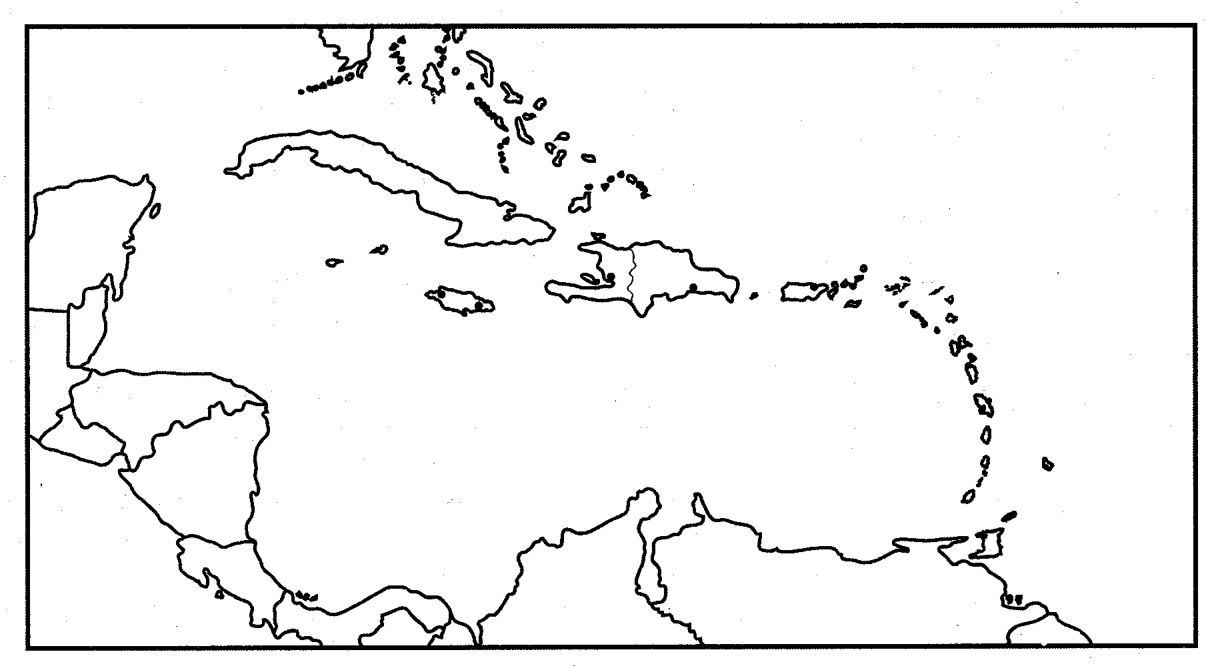
Study the map of the Caribbean below, then answer the questions which follow.
[25 marks]
Write the letter A on the map, to identify the territory where the Bussa Rebellion of 1816 occurred.
[1 mark]
Name this territory.
[1 mark]
Write the letter B on the map, to identify the territory where the 1831 rebellion occurred.
[1 mark]
Name this territory.
[1 mark]
Explain THREE causes of the Christmas Rebellion led by Samuel Sharpe in 1831.
[9 marks]
Examine THREE consequences of the Christmas Rebellion led by Samuel Sharpe in 1831.
[12 marks]
Imagine you are a journalist and observer in the Caribbean in August 1833. Using FIVE distinct points, write a newspaper article making a case for the significance of revolts in bringing about an end to the system of slavery.
[25 marks]
Imagine you are an investigator in a British Caribbean territory in 1837. Write a report to a British anti-slavery society in which you discuss the impact of FIVE problems regarding the functioning of the Apprenticeship System.
[25 marks]
Pretend you are a sugar planter in a British Caribbean territory in 1854. Write a letter to the editor of a local newspaper in which you examine FIVE main threats facing the sugar industry since 1838.
[25 marks]
Pretend you are a governor of either British Guiana or Trinidad in 1876. Write a report to the Colonial Office in which you examine FIVE ways migrants from both China and Madeira impacted the economy and society of the selected Caribbean territory.
[25 marks]
You are the governor of an island in the British-colonized Caribbean during the late nineteenth century and early twentieth century. Write a letter to the Colonial Secretary in which you assess the measures taken to address the crisis in the sugar industry in those British-colonized Caribbean islands. Your letter must assess THREE measures related to science and technology and TWO measures related to imperial policy.
[25 marks]
As the head of the Caribbean Farmers' Association in 1935, write a letter to the members of the association in the English-speaking territories who may be thinking of switching from sugar production to other crops. In your letter, explain to these members how any FIVE factors have encouraged the growth and survival of alternate agricultural enterprises up to 1935.
[25 marks]
Examine FIVE factors responsible for the involvement of the USA in Cuba in 1898 and in Panama in 1903. Your examination should address THREE factors for Cuba and TWO factors for Panama.
[25 marks]
Discuss FIVE ways in which Castro’s revolution in Cuba impacted the rest of the Caribbean between 1959 and 1985.
[25 marks]
Examine FIVE ways in which the Moyne Commission’s recommendations provided an adequate response to the concerns expressed through popular protests in the Caribbean between 1935 and 1958.
[25 marks]
Examine FIVE reasons why the British West Indies Federation failed in 1962.
[25 marks]
Discuss FIVE efforts made by women's organizations to improve the social conditions of women across the Caribbean between 1900 and 1985.
Write your answer to the question you have chosen from Section C here. Remember to write the question number in the box below.
[25 marks]
Examine FIVE reasons for the development of Hinduism in the Caribbean from 1900 to 1985.
Write your answer to the question you have chosen from Section C here. Remember to write the question number in the box below.
[25 marks]