Free CXC Caribbean History Paper 2 May/June 2017 past paper from 2017. Includes a worked answer key. Open the PDF, take a timed test, and study with AI on Caribbean AI.
Answer keys are free on Caribbean AI. View the answers to every past-paper question at no cost - no payment needed - with step-by-step worked solutions and instant AI marking available on Premium.
CSEC Caribbean History Paper 2 May/June 2017 - Free CXC Past Paper with Answers
Free CXC Caribbean History Paper 2 May/June 2017 past paper from 2017. Includes a worked answer key. Open the PDF, take a timed test, and study with AI on Caribbean AI.
Opening the interactive papers…
Every question from this paper as text. See the answers and worked solutions. Questions are the property of the Caribbean Examinations Council; Caribbean AI is not affiliated with CXC.
List FOUR materials used by the Taino to construct their houses.
[4 marks]
Outline THREE ways in which Taino and Kalinago technologies were similar.
[9 marks]
Describe THREE achievements of the Maya in science and technology.
[12 marks]
State FOUR ways in which Europeans used the forced labour of the indigenous peoples.
[4 marks]
Explain THREE reasons why Europeans became dependent on the food of indigenous peoples.
[9 marks]
Explain THREE reasons why there was 'withdrawal or loss' of indigenous labour.
[12 marks]
Study the map of the Caribbean below, which has four territories labelled, and then answer the questions which follow.
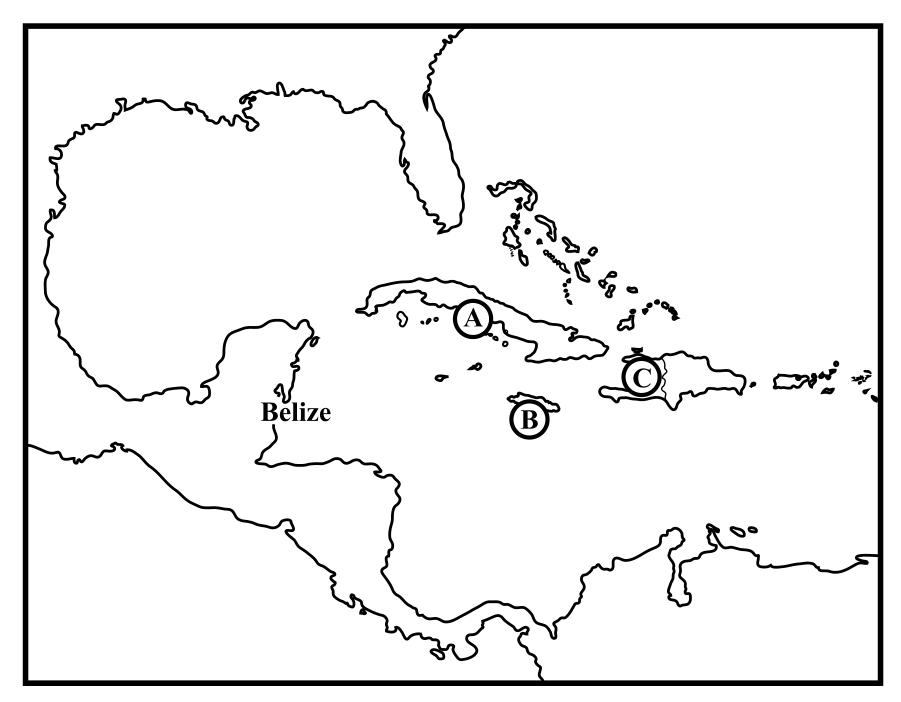
[25 marks]
Identify TWO of the territories labelled A, B and C.
[2 marks]
For EACH of the two territories identified, give ONE nonsugar agricultural pursuit for which African labour was used.
[4 marks]
Explain THREE reasons why African labour was used for nonsugar agricultural pursuits.
[9 marks]
Examine THREE social effects of the shift to mahogany as the main economic activity in Belize.
[12 marks]
Study the Vodun hymn and the translation given below and then answer the questions which follow.
Eh! Eh! Bomba! Eh! Eh! Canga, bafio té! Canga, moune délé! Canga, do ki la! Canga, li!
Translation: "Eh Eh! Rainbow Spirit! Tie up the BaPíoti Tie up the whites Tie up the whites Tie them."
Vodun hymn taken from Carolyn E. Fick, The Making of Haiti: The Saint Domingue Revolution from Below. Knoxville: Univ. of Tennessee Press, 1990, p. 266.
[25 marks]
List TWO aspects of African culture that may be supported by the extract above.
[2 marks]
List TWO aspects of African culture that may be supported by the extract above.
[2 marks]
Name TWO other aspects of African culture practised by enslaved Africans.
[2 marks]
Describe THREE measures or methods used to suppress African cultural expression during slavery.
[9 marks]
Examine THREE reasons for the persistence of African cultural forms in the Caribbean up to 1838.
[12 marks]
There was no natural subservience here. Nobody didn't bow down to nobody just so. To get a man to follow your instructions you had to pen him and beat him and cut off his ears or his foot when he run away. You had to was to take away his woman and his child. And still that fellow stand up and oppose you ...
And it wasn't just men alone. It had women there that was even more terrible.
Earl Lovelace, Salt. New York: Persea Books, 1996, p. 6–7.
[25 marks]
Name FOUR forms of resistance used by enslaved men and women in the Caribbean.
[4 marks]
Outline THREE causes of resistance by enslaved Africans and give ONE example of EACH.
[9 marks]
Examine THREE factors that usually prevented the enslaved from overthrowing the system of slavery.
[12 marks]
Identify ONE male and ONE female leader of major nineteenth-century slave revolts in the British Caribbean, and the territories with which these leaders were associated.
[4 marks]
Explain THREE main causes of the Demerara Revolt of 1823.
[9 marks]
Examine THREE major consequences of the Demerara Revolt of 1823.
[12 marks]
The year is 1848. You are an abolitionist writer who has been covering the movements in the Caribbean. Imagine you are writing an article for a pamphlet. In your article, examine FIVE factors that influenced the course of the French anti-slavery movements.
Write your answer to the question you choose on pages 14–17.
[25 marks]
As stated in the Abolition of Slavery Act of 1833, the Apprenticeship System in the British Caribbean colonies was intended, among other things,
"for promoting the industry of the manumitted slaves".
As a nonconformist missionary in the British Caribbean in 1837, assess FIVE reasons why you think the Apprenticeship System has failed to achieve its objectives.
F.R. Augier and S.C. Gordon ed., Sources of West Indian History. Trinidad and Jamaica: Longman Caribbean Limited, 1962, 141.
Write your answer to the question you choose on pages 14–17.
[25 marks]
The year is 1897. You are a Member of Parliament and a die-hard advocate of imported contract labour in the British Caribbean, giving a speech on this topic to the House of Commons. In your speech, analyse FIVE reasons for your continued support of the importation of Indian indentured workers.
Write your answer to the question you choose on pages 14–17.
[25 marks]
You are the Colonial Secretary for the British Caribbean territories in 1866. Write a letter to the British Caribbean Governors examining FIVE reasons which justify Britain's replacement of the Old Representative System of Government with the Crown Colony System.
Write your answer to the question you choose on pages 14–17.
[25 marks]
Imagine that you are a journalist living in early twentieth-century Cuba and you are writing a book on the Cuban sugar industry. Explain FIVE factors responsible for the growth of this industry between 1875 and the end of the nineteenth century.
Write your answer to the question you choose on pages 14–17.
[25 marks]
You are a merchant in the Caribbean, shipping goods to Britain. Write a report to a group of potential investors in London in which you explain FIVE reasons for the growth of nonsugar agricultural industries in the British Caribbean up to 1935.
Write your answer to the question you choose on pages 14–17.
[25 marks]
Examine FIVE reasons for the USA's invasion of Grenada in 1983.
All essays in this section must be well developed with a clear introduction and conclusion. Points must be logically sequenced and should be supported with relevant details and examples. Marks will be awarded for good organization and correct grammar, spelling and punctuation.
[25 marks]
Examine FIVE ways in which the USA responded to Castro's revolution between 1959 and 1962.
All essays in this section must be well developed with a clear introduction and conclusion. Points must be logically sequenced and should be supported with relevant details and examples. Marks will be awarded for good organization and correct grammar, spelling and punctuation.
[25 marks]
Examine FIVE of the ways in which popular protest in the 1930s affected political development in the British Caribbean up to 1958.
All essays in this section must be well developed with a clear introduction and conclusion. Points must be logically sequenced and should be supported with relevant details and examples. Marks will be awarded for good organization and correct grammar, spelling and punctuation.
[25 marks]
In a 1962 referendum, the French Caribbean territories chose to remain departments of France (DOMs). Assess FIVE reasons why the French territories retained DOM status in preference to independence.
All essays in this section must be well developed with a clear introduction and conclusion. Points must be logically sequenced and should be supported with relevant details and examples. Marks will be awarded for good organization and correct grammar, spelling and punctuation.
[25 marks]
Examine THREE housing and TWO unemployment conditions that existed in the Caribbean between 1900 and 1935.
All essays in this section must be well developed with a clear introduction and conclusion. Points must be logically sequenced and should be supported with relevant details and examples. Marks will be awarded for good organization and correct grammar, spelling and punctuation.
[25 marks]
Choose EITHER cricket OR transportation. Examine THREE ways in which the upper class experienced that aspect of social life in the Caribbean from 1945 to 1985, and TWO ways in which the working class experienced that same aspect of social life from 1945 to 1985.
All essays in this section must be well developed with a clear introduction and conclusion. Points must be logically sequenced and should be supported with relevant details and examples. Marks will be awarded for good organization and correct grammar, spelling and punctuation.
[25 marks]