Free CXC Caribbean History Paper 2 May/June 2014 past paper from 2014. Includes a worked answer key. Open the PDF, take a timed test, and study with AI on Caribbean AI.
Answer keys are free on Caribbean AI. View the answers to every past-paper question at no cost - no payment needed - with step-by-step worked solutions and instant AI marking available on Premium.
CSEC Caribbean History Paper 2 May/June 2014 - Free CXC Past Paper with Answers
Free CXC Caribbean History Paper 2 May/June 2014 past paper from 2014. Includes a worked answer key. Open the PDF, take a timed test, and study with AI on Caribbean AI.
Opening the interactive papers…
Every question from this paper as text. See the answers and worked solutions. Questions are the property of the Caribbean Examinations Council; Caribbean AI is not affiliated with CXC.
Name the "coveted land" that Columbus was seeking.
[1 mark]
Identify THREE items produced in this land which Europeans desired.
[3 marks]
Explain THREE reasons why the European demand for the items produced in the "coveted land" was so great.
[9 marks]
Discuss THREE ways in which the King and Queen of Spain thought they could benefit from Columbus' proposal.
[12 marks]
List FOUR factors that contributed to a decline in the population of Indigenous Peoples after the Europeans came.
[4 marks]
Describe THREE ways in which Indigenous Peoples were affected by cultural impositions of the Europeans.
[9 marks]
Explain THREE reasons for the economic changes that the Indigenous Peoples faced as a result of the European presence.
[12 marks]
List FOUR Western European nations which were directly involved in the trade of enslaved Africans on the West African coast in the 1600s.
[4 marks]
Give THREE reasons for the small number of enslaved Africans in the Caribbean before 1600.
[9 marks]
Examine THREE reasons which the French and British colonists gave for their increased importation of Africans after 1700.
[12 marks]
Study the following diagram which illustrates the ranking of three major groups in society during slavery then answer the questions which follow.
/\
/ \
/____\
WHITES
/ \
/________\
FREE COLOUREDS AND FREE BLACKS
/ \
/____________\
ENSLAVED PERSONS
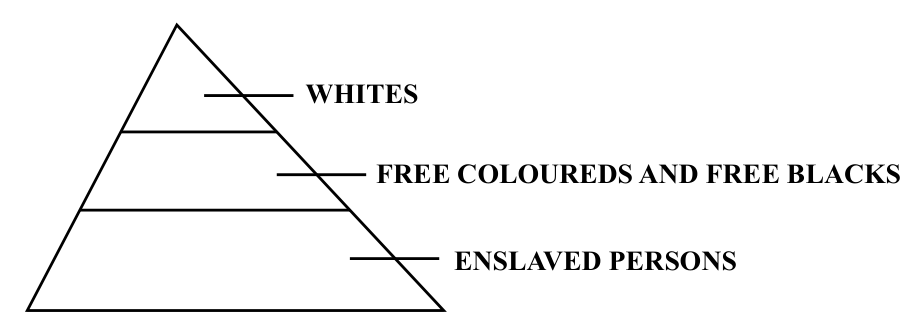
[25 marks]
Identify FOUR factors which determined ranking within this pyramid.
[4 marks]
Describe THREE qualities which might determine the status of an enslaved woman or man in the eyes of other enslaved persons.
[9 marks]
Examine THREE features of housing on the sugar plantation during slavery showing how they reflected social status.
[12 marks]
In the 17th and 18th centuries, the French and Spanish introduced slave laws to regulate the lives of enslaved men and women.
[25 marks]
Name EACH of the following: (i) TWO Caribbean territories to which the Code Noir applied directly. (ii) TWO Caribbean territories to which the Siete Partidas applied directly.
[4 marks]
Name TWO Caribbean territories to which the Code Noir applied directly.
[2 marks]
Name TWO Caribbean territories to which the Siete Partidas applied directly.
[2 marks]
Explain THREE reasons why "the French and Spanish introduced slave laws to regulate the lives of enslaved men and women".
[9 marks]
Discuss THREE ways in which the British Caribbean planters attempted to control the economic activities of enslaved men and women.
[12 marks]
Identify EACH of the following: (i) TWO major crops grown in St. Domingue in 1791. (ii) TWO social groups in St. Domingue in 1789.
[4 marks]
Identify TWO major crops grown in St. Domingue in 1791.
[2 marks]
Name TWO social groups in St. Domingue in 1789.
[2 marks]
Describe THREE ways in which the Haitian Revolution affected the Haitian economy.
[9 marks]
Explain THREE ways in which the wider Caribbean benefited from the Haitian Revolution.
[12 marks]
It is the first anniversary of abolition of slavery in Cuba. As a Frenchman who has visited the island, write an article for your local newspaper stating FIVE reasons why slavery was abolished as late as 1886 in Cuba.
[25 marks]
You are a stipendiary magistrate who has been employed since the beginning of apprenticeship. It is now 1837. Write a letter to a close friend in Britain explaining FIVE reasons why you and other magistrates have found it difficult to overcome some of the challenges you have encountered.
[25 marks]
The year is 1876 and you are the colonial governor of Guyana. Write a report in which you discuss at least FIVE effects of Indian immigrant labour on the sugar industry in Guyana.
[25 marks]
You are a newspaper correspondent covering the West Indian Royal Commission of 1897. Write an article for your newspaper explaining the contribution of the peasantry to the economy of the British Caribbean between 1838 and 1876.
[25 marks]
As the Secretary of the Caribbean Sugar Producers Association, write a presentation to the West Indian Royal Commission of 1897 explaining the major factors which have caused difficulties for the sugar industry within the English-speaking Caribbean between 1875 and 1897. You should explain at least FIVE factors.
[25 marks]
It is 1989 and you are a final year university student. You have formed a company and you are investing in the industrial sector in the Caribbean. You have to convince your parents that the investment is sound and that they should tend you some money.
Write a letter to your parents in the United Kingdom explaining how industrialization has improved the economic prospects of the Caribbean.
[25 marks]
Examine THREE economic and TWO political consequences of the United States involvement in Cuba between 1898 and 1985.
[25 marks]
Examine THREE political and TWO cultural effects of United States involvement in the English-speaking Caribbean between 1939 and 1985.
[25 marks]
Discuss FIVE similarities among the British West Indian territories which supported the establishment of a Federation between 1945 and 1958.
[25 marks]
Discuss the role of EITHER Theophilus Albert Marryshow or Sir Grantley Adams in the formation of the British West Indies Federation of 1958. In your answer, pay particular attention to the career, contribution to national politics, and the impact on the Federal movement.
[25 marks]
Examine the social conditions which existed in the British Caribbean in the period 1900 to 1935 under the following areas: (a) Housing (b) Health
Examine any FIVE conditions, at least TWO from EACH area.
[25 marks]
Housing
[12 marks]
Health
[13 marks]
Hinduism emerged as a major religion in Guyana and Trinidad and Tobago. Examine THREE examples of social interaction and TWO examples of political interaction between Hindus and the wider society in Guyana and Trinidad and Tobago.
[25 marks]