Free CXC Chemistry Paper 1 May/June 2003 past paper from 2003. Includes a worked answer key. Open the PDF, take a timed test, and study with AI on Caribbean AI.
Answer keys are free on Caribbean AI. View the answers to every past-paper question at no cost - no payment needed - with step-by-step worked solutions and instant AI marking available on Premium.
CSEC Chemistry Paper 1 May/June 2003 - Free CXC Past Paper with Answers
Free CXC Chemistry Paper 1 May/June 2003 past paper from 2003. Includes a worked answer key. Open the PDF, take a timed test, and study with AI on Caribbean AI.
Opening the interactive papers…
Every question from this paper as text. See the answers and worked solutions. Questions are the property of the Caribbean Examinations Council; Caribbean AI is not affiliated with CXC.
Which of the following apparatus/instruments is most suitable for obtaining both cooking oil and water from a mixture of the two?
Filter funnel
Separating funnel
Fractionating column
Volumetric flask
Which TWO of the following statements are true about the arrangement of electrons, protons and neutrons in an atom? I. Protons and neutrons are found in the nucleus. II. Electrons can be found anywhere outside the nucleus. III. The number of protons always equals the number of neutrons. IV. The number of protons always equals the number of electrons.
I and III
I and IV
II and III
II and IV
Which of the following compounds may be conveniently prepared by precipitation?
Barium sulphate
Sodium sulphate
Copper (II) sulphate
Magnesium nitrate
Which of the atoms represented below by their electronic configuration will most readily form a positive ion?
2, 8, 1
2, 8, 2
2, 8, 7
2, 8, 8
In descending Group VII of the periodic table, which TWO of the following trends occur? I. The density of the elements increases II. The relative atomic mass of the elements decreases III. The melting point of the elements increases IV. The reactivity of the elements increases
I and III
I and IV
II and III
II and IV
Dilute sulphuric acid is classified as a strong acid because it
produces 2 moles of hydrogen ions per mole of acid
requires 2 moles of sodium hydroxide for neutralisation
is almost completely ionised and is a good conductor of electricity
ionises to give both hydrogen ions and sulphate ions
When a saturated solution of copper (II) sulphate is cooled, crystals of copper (II) sulphate-5-water begin to form because solubility of copper (II) sulphate-5-water
increases with decreasing temperature
decreases with increasing temperature
decreases with decreasing temperature
increases with increasing temperature
The arrangement of elements in the periodic table is based on
relative atomic mass
atomic number
mass number
relative molecular mass
When iron (III) sulphate reacts with aqueous potassium iodide, a brown colouration of iodine is produced. Which of the following deductions is correct?
Iron (III) sulphate is a reducing agent.
The iodide ion, I⁻, has been oxidised to iodine.
The iron (III) sulphate has lost electrons.
The iodide ion, I⁻, has gained electrons.
Which of the following statements about sodium metal are CORRECT? I. It contains Na⁺ ions and mobile electrons. II. It contains Na⁺ ions and mobile electrons. III. It contains cations which repel each other. IV. It contains anions which repel each other.
I and III only
I and IV only
II and III only
II and IV only
When aqueous silver nitrate is added to an aqueous solution of magnesium chloride, a white precipitate forms. The ionic equation for the formation of this precipitate is
Mg²⁺(aq) + NO₃⁻(aq) = MgNO₃(s)
Ag⁺(aq) + 2Cl⁻(aq) = AgCl₂(s)
Mg²⁺(aq) + 2NO₃⁻(aq) = Mg(NO₃)₂(s)
Ag⁺(aq) + Cl⁻(aq) = AgCl(s)
In which TWO of the following equations are the UNDERLINED reagents acting as oxidising agents?
I and III
I and IV
II and III
II and IV
When crystals of potassium nitrate are dissolved in water, the temperature of the solution decreases because
little energy is required to break down the crystal structure of the potassium nitrate
heat is always absorbed when a substance dissolves
the energy content of dissolved potassium nitrate is higher than that of solid potassium nitrate
potassium nitrate is colder than water
The high melting point of ionic compounds may be due to the
arrangement of ions
large numbers of ions
attraction among ions
movement of ions
Which of the following statements about chemical reactions is NOT correct?
Energy is given out when bonds break and taken in when bonds form.
Chemical reactions involve the making and breaking of bonds.
Endothermic reactions take energy from the surroundings.
Exothermic reactions give energy to the surroundings.
A substance that conducts an electric current but remains chemically unchanged is
aqueous copper (II) sulphate
copper
sulphur
solid sodium chloride
Which of the following can exactly neutralise 20 cm³ of 2.0 mol dm⁻³ sodium hydroxide?
I. 10 cm³ of 4.0 mol dm⁻³ hydrochloric acid
II. 10 cm³ of 2.0 mol dm⁻³ sulphuric acid
III. 20 cm³ of 4.0 mol dm⁻³ nitric acid
I only
II only
I and II only
II and III only
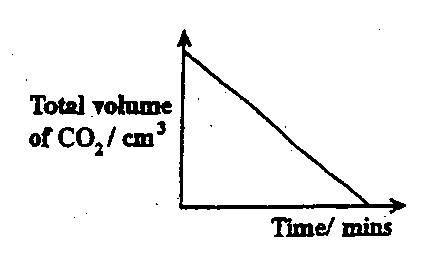
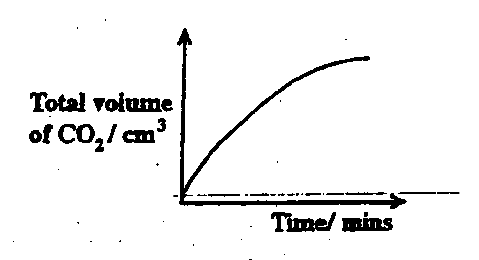
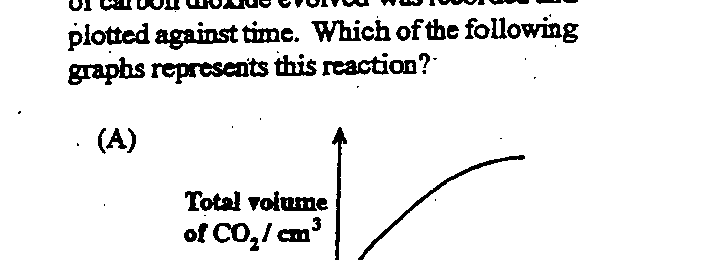
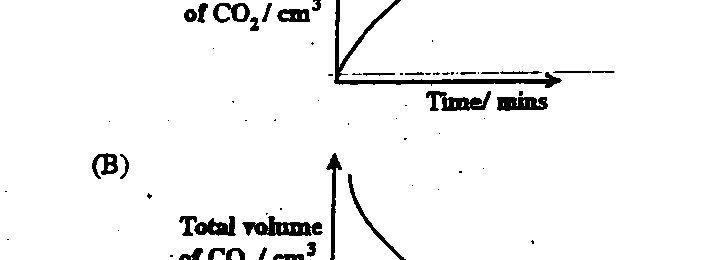
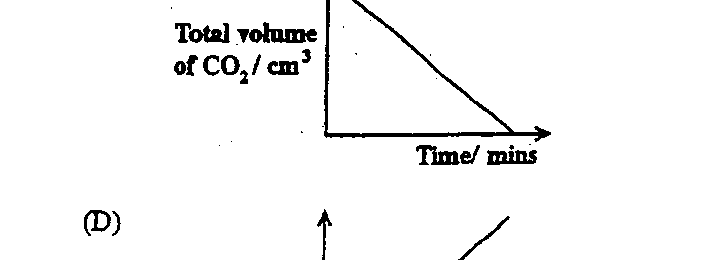
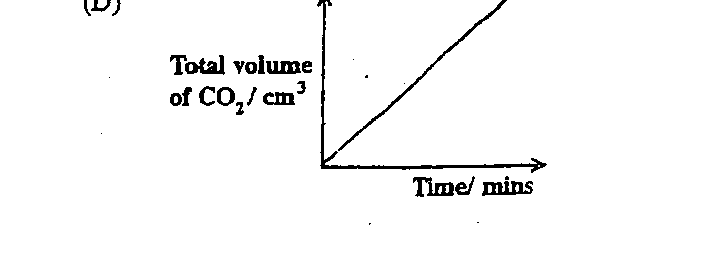
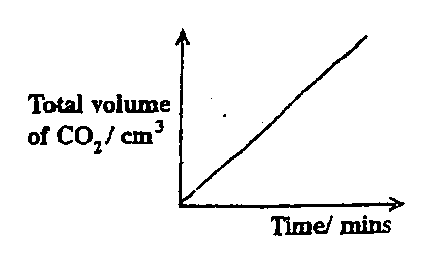
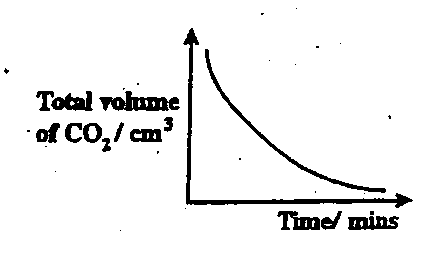
Some calcium carbonate was reacted with excess dilute hydrochloric acid. The volume of carbon dioxide evolved was recorded and plotted against time. Which of the following graphs represents this reaction?
In which of the following processes is fractional distillation NOT used?
Refining of crude petroleum
Separation of methanol from a methanol-water mixture
Separation of chlorophyll in a leaf extract
Separation of liquid air into nitrogen and oxygen
Graphite can be used as a lubricant because of
strong attraction between the hexagonal layers of carbon atoms
weak attraction between the hexagonal layers of carbon atoms
the loose electrons which can move throughout the lattice
strong attraction within the hexagonal layers of carbon atoms
Which of the following sulphates are insoluble? I. Barium sulphate II. Magnesium sulphate III. Lead sulphate IV. Aluminium sulphate
I and III only
I and II only
II and IV only
III and IV only
The mass of an element produced in electrolysis is proportional to the I. quantity of electricity which has been passed II. volume of the electrolyte III. mass of the electrolyte IV. mass of the electrode
I only
II and IV only
I and III only
III and IV only
Which of the following statements BEST characterises a catalyst?
It increases the activation energy of the reaction.
It alters the quantity of the products formed.
It is always unchanged physically at the end of a reaction.
It is always unchanged chemically at the end of a reaction.
Which of the following operations results in sublimation?
Heating of solid sodium chloride
Cooling of oxygen gas
Heating of ethanol
Heating of iodine crystals
How many neutrons and electrons does the particle have?
12 / 10
12 / 12
24 / 10
24 / 12
Which of the following sources of energy is the MOST commonly used in the world today?
Nuclear
Fossil fuels
Biogas
Gasohol
Which of the following methods can be used to compute the value of -B kJ? I. Energy of Z minus the energy of X and Y II. Energy of X and Y minus the energy of Z III. The sum of the energies of X, Y and Z
I only
I and II only
III only
II and III only
Which of the following processes provides evidence in support of the particulate nature of matter?
Diffusion
Precipitation
Condensation
Filtration
Sulphuric acid forms the sodium salts NaHSO₄ and Na₂SO₄. Its basicity is therefore
1
2
3
4
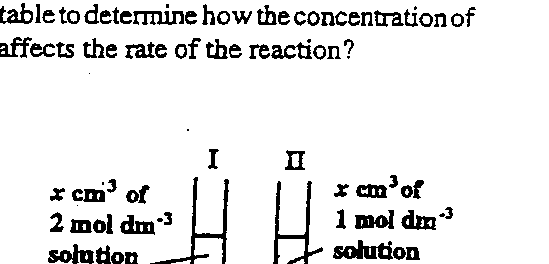
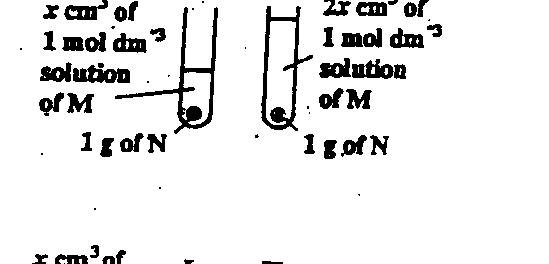
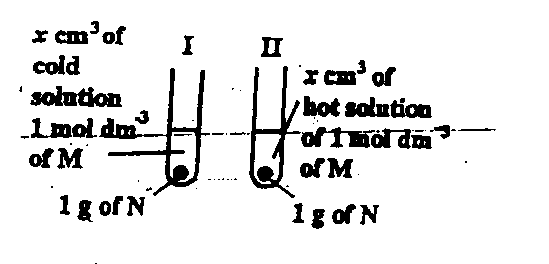
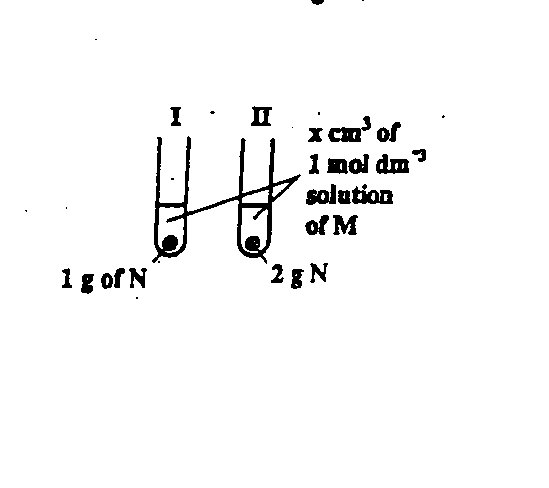
A sample of substance N was placed in solution M. Which of the following diagrams represents pairs of experiments that would be most suitable to determine how the concentration of M affects the rate of the reaction?
Atoms of isotopes, X and Y, have I. the same number of electrons. II. the same number of protons. III. different numbers of neutrons.
III only
II and III only
I and II only
I, II and III
Which of the following could produce carbon dioxide and carbon monoxide as pollutants? I. Geothermal energy II. Solar energy III. Fossil fuels IV. Biogas
I only
II only
II and III only
III and IV only
At 1 atmospheric pressure, the particles move fastest in a
liquid at 25 °C
gas at 25 °C
liquid at 100 °C
gas at 100 °C
Which of the following pairs of acids is monobasic?
HCl and CH₃CO₂H
HCl and H₂SO₄
HNO₃ and H₂SO₄
CH₃CO₂H and HO₂CCO₂H
All of the following gases are colourless EXCEPT
O₂
H₂
NO₂
NH₃
Which of the following elements reacts most vigorously with H⁺(aq) ions to give hydrogen gas?
Zinc
Lead
Iron
Copper
Which of the following is a weak electrolyte?
Molten lead
Aqueous ethanoic acid
Dilute hydrochloric acid
Molten lead bromide
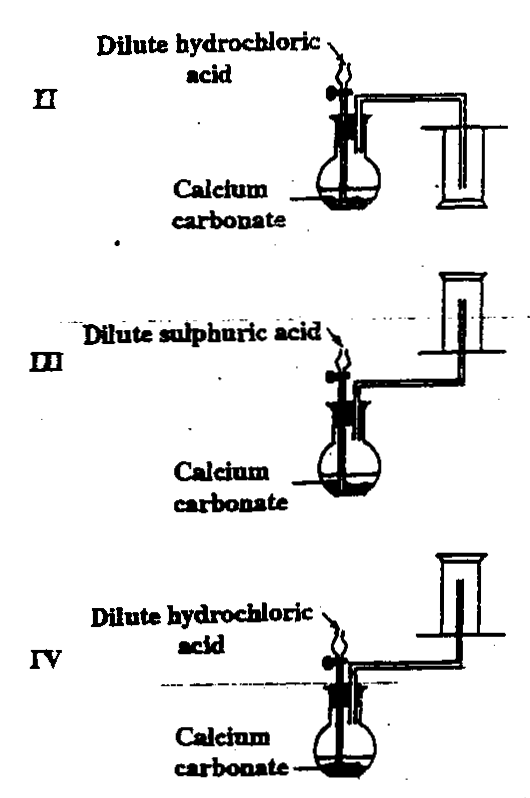
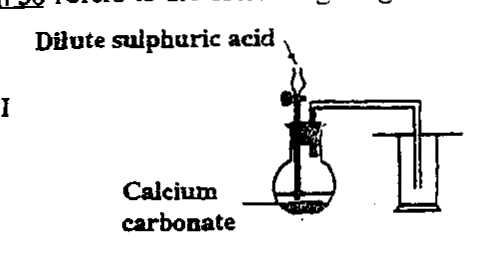
Item 38 refers to the following diagrams.
In which of the experiments would the amount of carbon dioxide collected be GREATEST?
I
II
III
IV
Which of the following gives an alkaline reaction with moist litmus paper?
Ammonia
Nitrogen (IV) oxide
Hydrogen chloride
Water
Which of the following aqueous solutions will produce a blue precipitate with aqueous sodium hydroxide?
Calcium nitrate
Iron (II) nitrate
Copper (II) nitrate
Aluminium nitrate
Which of the following statements is true?
Ammonia is an acidic gas.
Ammonia is soluble in water and functions as a base.
Nitric acid is used as a fertilizer and a reducing agent.
Nitric acid contains two replaceable hydrogen atoms.
Aluminium is more reactive than iron yet, after a while, a piece of aluminium left exposed to the atmosphere becomes corrosion resistant whilst a similar piece of iron continues to corrode. This is because the
aluminium has reacted completely
iron oxide formed is more reactive than the aluminium oxide formed
oxide film on aluminium protects the metal from further corrosion but the oxide film on iron does not
iron oxide reacts with the iron below but aluminium oxide does not react with the aluminium below
Which of the following methods is used for the extraction of metals at the top of the electrochemical series?
Electrolysis of molten chloride
Electrolysis of aqueous chloride
Electrolysis of molten oxide
Reduction of oxide with carbon
Which of the following metals will NOT react with water under any conditions?
Magnesium
Aluminium
Iron
Copper
Which of the following observations would you expect to make when excess sodium hydroxide solution is added to a solution containing zinc ions?
An alkaline gas produced
White precipitate soluble in excess
White precipitate insoluble in excess
A green precipitate insoluble in excess
Items 46-47 refer to the following organic compounds. (A) Ethanol (B) Ethene (C) Ethanoic acid (D) Ethyl ethanoate
In answering items 46-47 a particular choice from the above may be made more than once, once, or not at all.
Which of the organic compounds
undergoes addition reactions?
Ethanol
Ethene
Ethanoic acid
Ethyl ethanoate
is immiscible with water and is sweet-smelling?
Ethanol
Ethene
Ethanoic acid
Ethyl ethanoate
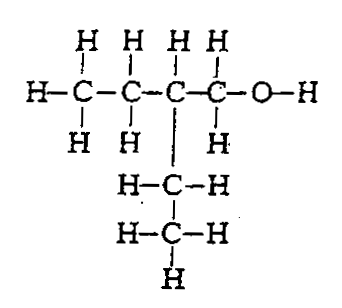
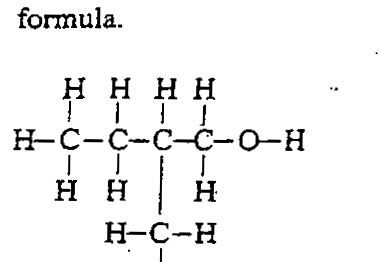
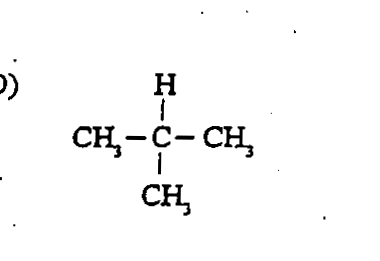
A compound has the following structural formula.
Which TWO of the following statements are correct? The compound I. is an alcohol. II. is a branched alkane. III. can react with sodium. IV. is an unreactive substance.
I and III
I and IV
II and III
II and IV
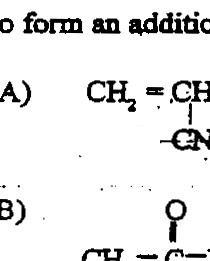
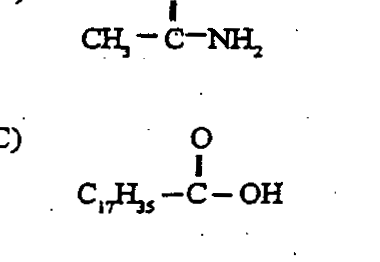
Which of the following would you expect to form an addition polymer?
Ethanol is NOT used as a
beverage
fuel
lubricant
solvent
In which of the following is the amide linkage present?
Polythene
Nylon
Starch
Terylene
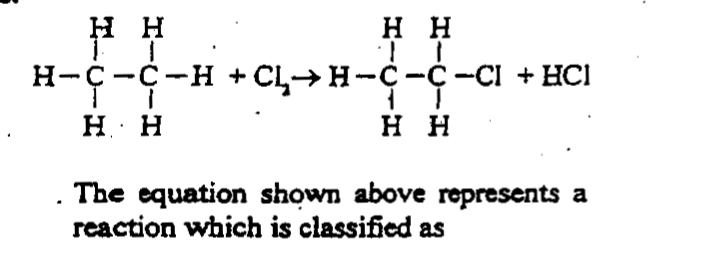
The equation shown above represents a reaction which is classified as
addition
neutralisation
polymerisation
substitution
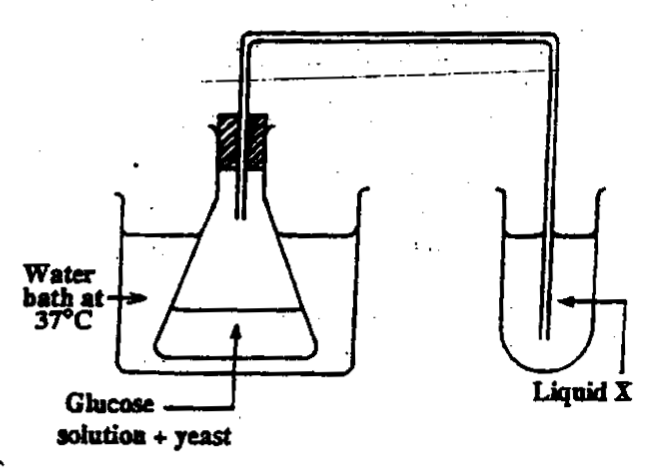
Yeast may be used in the fermentation of starch to ethanol because
it is acidic
it contains enzymes which act on starch
yeast itself produces the ethanol
it fixes the oxygen needed in the reaction from the atmosphere
The process by which large molecules of hydrocarbon are broken up into smaller molecules is called
saponification
cracking
polymerization
condensation
Which of the following is/are condensation polymers? I. Terylene II. Nylon III. Starch IV. Polythene
I only
I and IV only
I, II and III only
II, III and IV only
Which of the following substances gives a blue colouration with iodine?
Fats
Starches
Proteins
Polyamides
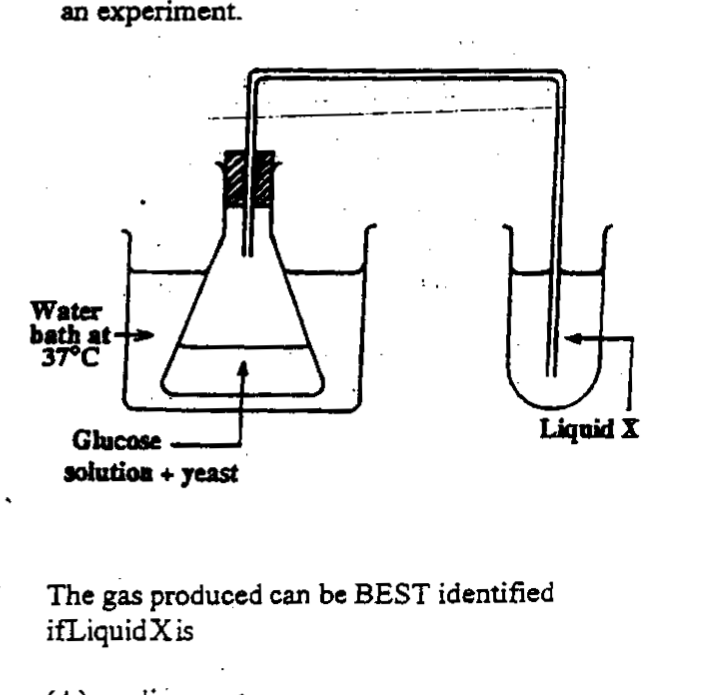
The gas produced can be BEST identified if Liquid X is
lime water
litmus solution
bromine water
sodium hydroxide solution
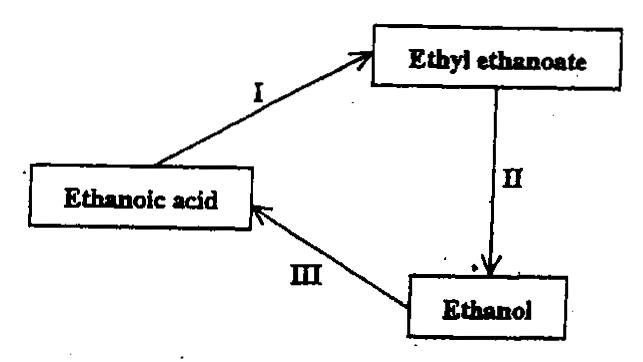
Items 58-59 refer to the following diagram which represents three conversions in organic chemistry
Which of the following equations BEST represents Conversion I?
CH₃COOH + C₂H₅OH → CH₃COOC₂H₅ + H₂O
C₂H₃COOH + C₂H₅OH → C₂H₃COOC₂H₅ + H₂O
For Conversion II, ethyl ethanoate is heated under reflux with another compound. The name of the compound is
sodium chloride
ethanol
fatty acids
sodium hydroxide
The compound propene, CH₃CH=CH₂, reacts with bromine to produce
CH₃CBrCHBr + HBr
CH₃CHBrCHBr + HBr
CH₂CH₂CHBr₂
CH₃CHBrCH₂Br