Item 11 refers to the following table.
11.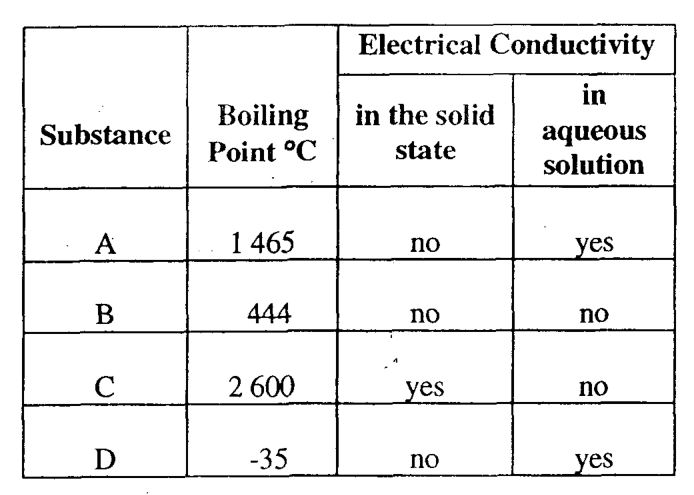
Which of the substances A, B, C or D is MOST LIKELY sodium chloride?
- (A)
A
- (B)
B
- (C)
C
- (D)
D
Free CXC Chemistry Paper 1 May/June 2004 past paper from 2004. Includes a worked answer key. Open the PDF, take a timed test, and study with AI on Caribbean AI.
Answer keys are free on Caribbean AI. View the answers to every past-paper question at no cost - no payment needed - with step-by-step worked solutions and instant AI marking available on Premium.
CSEC Chemistry Paper 1 May/June 2004 - Free CXC Past Paper with Answers
Free CXC Chemistry Paper 1 May/June 2004 past paper from 2004. Includes a worked answer key. Open the PDF, take a timed test, and study with AI on Caribbean AI.
Opening the interactive papers…
Every question from this paper as text. See the answers and worked solutions. Questions are the property of the Caribbean Examinations Council; Caribbean AI is not affiliated with CXC.
Which of the following is NOT a characteristic of ionic compounds?
They have high melting and boiling points.
They are soluble in polar solvents.
They conduct electricity in the solid state.
They form crystal lattices.
Which of the following is the correct order of increasing bond strength?
Cl-Cl < Br-Br < F-F
F-F < Cl-Cl < Br-Br
Br-Br < Cl-Cl < F-F
F-F < Br-Br < Cl-Cl
Which of the following is a Lewis acid?
The pH of a solution is 5. What is the concentration of hydrogen ions?
mol/dm
mol/dm
mol/dm
mol/dm
Which of the following oxides is amphoteric?
Sodium oxide
Magnesium oxide
Aluminium oxide
Sulphur trioxide
Which of the following reactions is an example of a redox reaction?
Which of the following is the correct IUPAC name for ?
2-methylbutane
3-methylbutane
2-ethylpropane
3-ethylpropane
Which of the following is a saturated hydrocarbon?
Ethene
Ethyne
Ethane
Benzene
In the reaction between zinc and dilute sulphuric acid
water is formed
an insoluble salt is formed
neutralisation occurs
oxidation and reduction occur
Which of the following exhibits allotrophy?
Carbon
Uranium
Butane
Silicon
Item 11 refers to the following table.
Which of the substances A, B, C or D is MOST LIKELY sodium chloride?
A
B
C
D
Two particles have the following composition: (i) 10 protons, 12 neutrons, 10 electrons (ii) 10 protons, 11 neutrons, 10 electrons They are therefore both
allotropes
cations
isotopes
metals
A certain base reacted with a salt, producing a gas which turned damp red litmus paper blue. Which of the following ions does the salt contain?
Which of the following can act as oxidising agents? I. Metallic atoms II. Non-metallic atoms III. Metallic ions IV. Non-metallic ions
I only
IV only
II and III only
I and IV only
The number of shared electron pairs in the methane molecule is
4
6
8
10
A mixture of copper (II) oxide and copper (II) sulphate could BEST be separated by
shaking with excess water and then filtering
heating the mixture and condensing
shaking with excess water followed by fractional distillation
distilling the mixture
Two solutions are mixed in order to demonstrate endothermic change. Which of the following techniques is MOST appropriate?
Taking mass readings
Taking temperature readings
Carefully observing colour changes
Monitoring the pH of the solutions
An ion with a single negative charge may be converted into a neutral atom of the same element by
losing an electron
gaining an electron
gaining a proton
losing a neutron
Which of the following possible effects of a catalyst on a reaction is NOT correct?
It has no effect on the yield of products.
It is unchanged chemically on completion of the reaction.
It lowers the energy of the reactants so that the reaction occurs at a faster rate.
It allows equilibrium to be attained more rapidly in a reversible reaction.
Which of the following halogens is a liquid at room temperature?
Bromine
Fluorine
Chlorine
Iodine
In which of the following does hydrogen have a negative oxidation number?
CH₄
H₂O₂
NH₃
NaH
Which of the following elements does NOT exhibit allotropy?
Carbon
Phosphorus
Sulphur
Silicon
The atoms of Element X contain nineteen electrons. With which of the following elements will the chemistry of X be similar?
Aluminium
Bromine
Lithium
Magnesium
Which of the following processes correctly describes the reaction above?
Precipitation
Neutralization
Reduction
Decomposition
Which of the following statements is/are true of atoms?
I. They contain three fundamental particles. II. They are indivisible in chemical reactions. III. Those of an element are all exactly alike. IV. They contain particles which all carry charges.
I only
I, II and III only
II and IV only
I and III only
When solid lead nitrate in heated, it decomposes giving off nitrogen (IV) oxide and oxygen. The balanced equation for this reaction is
Calcium chloride
A giant ionic structure
A molecular crystal
A macromolecule
An atomic crystal
Starch
A giant ionic structure
A molecular crystal
A macromolecule
An atomic crystal
Sodium reacts with water according to the equation (Molar volume = 24 litres at room temperature and pressure).
The number of litres of hydrogen liberated when 0.1 mole of sodium reacts with excess water is
1.2
2.4
12
24
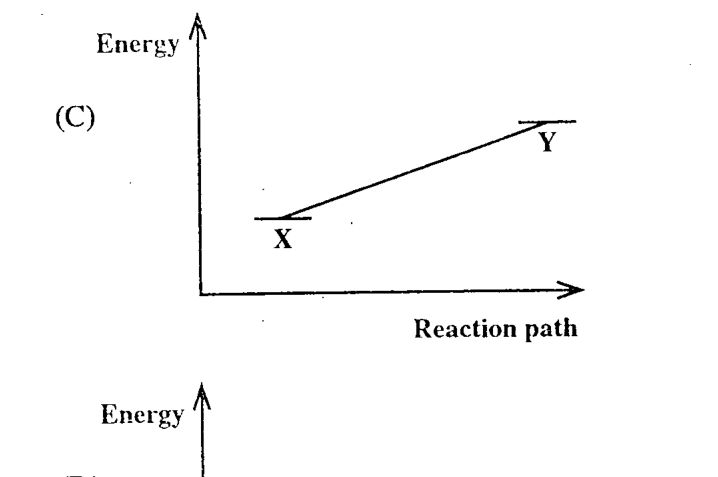
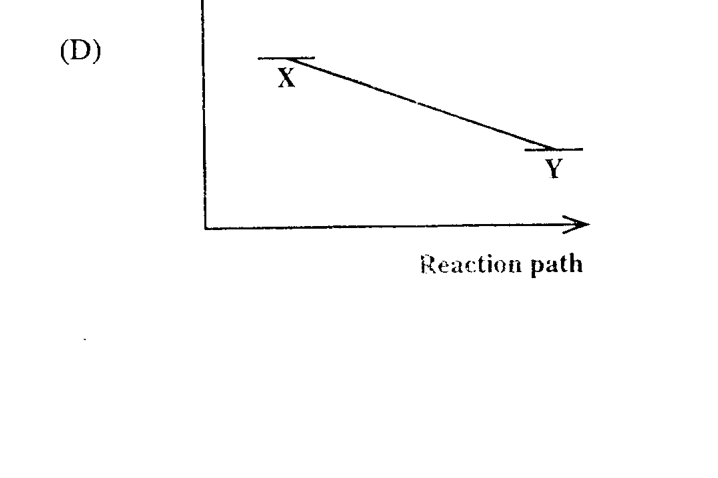
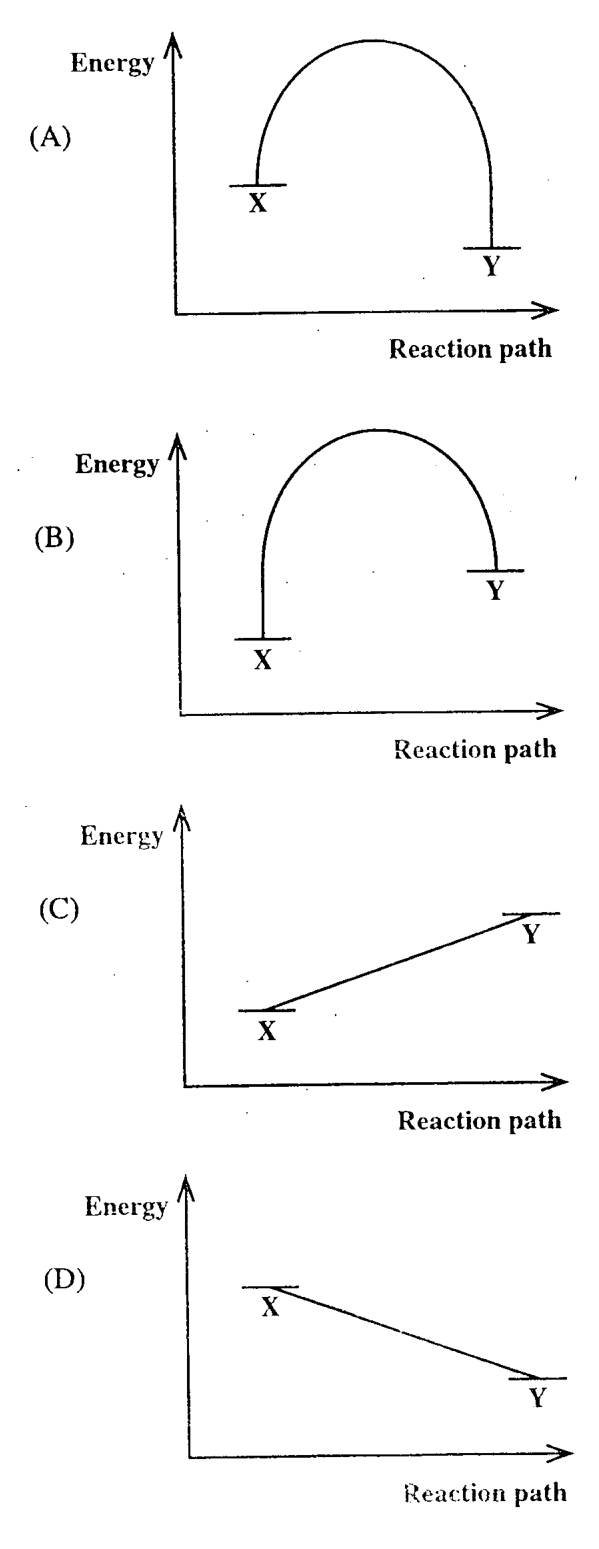
Which of the following diagrams BEST illustrates the course of an exothermic reaction?
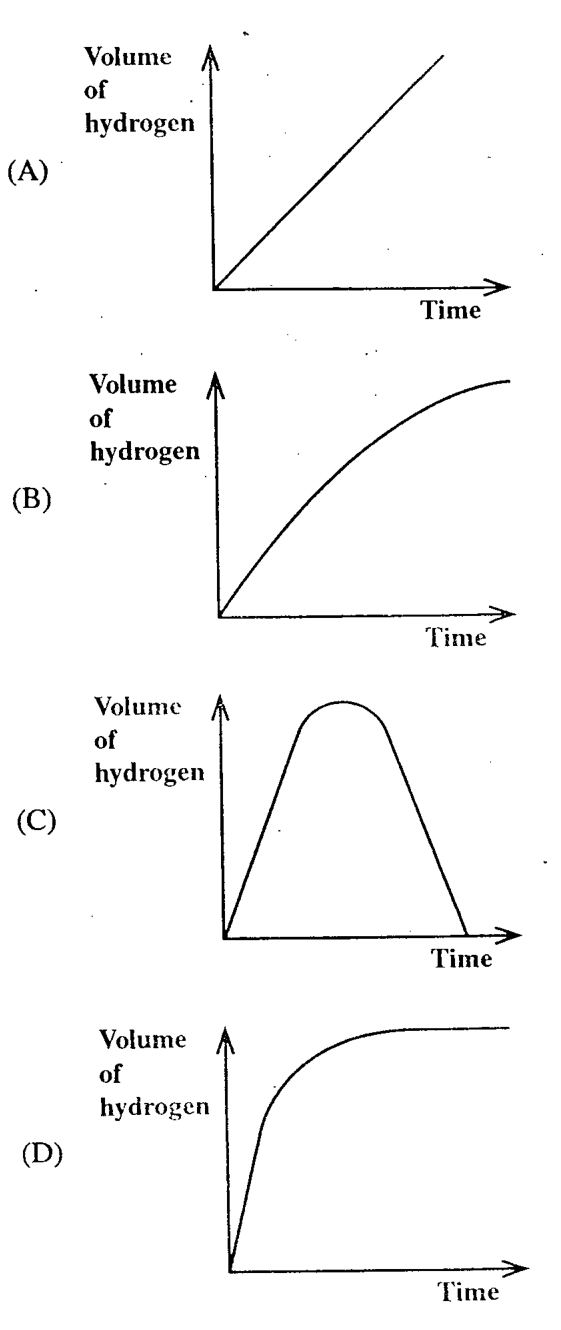
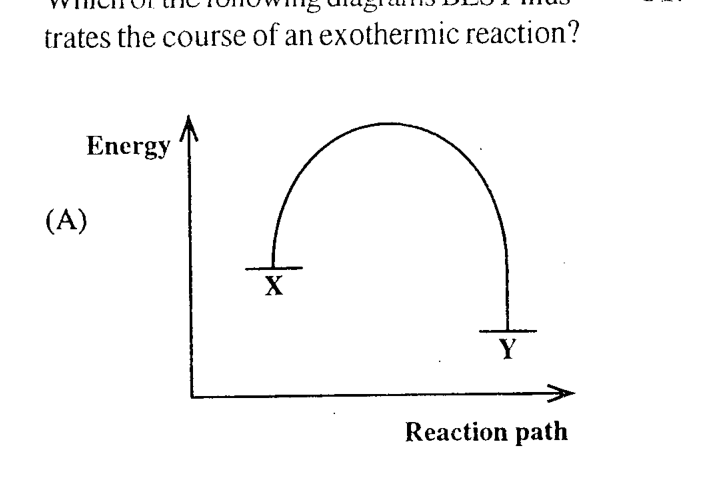
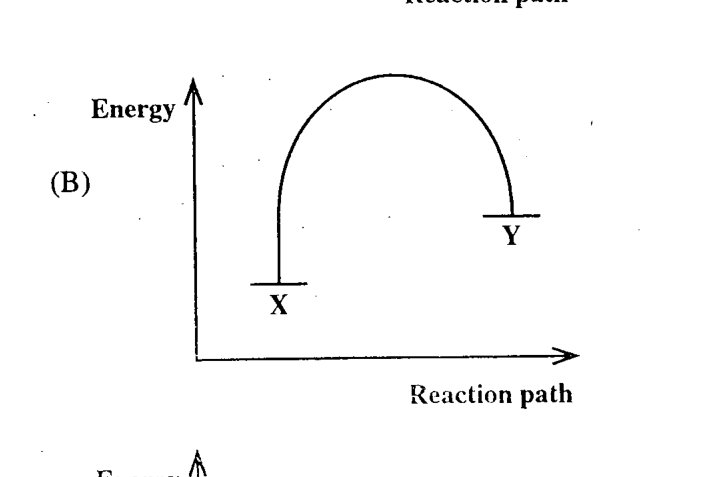
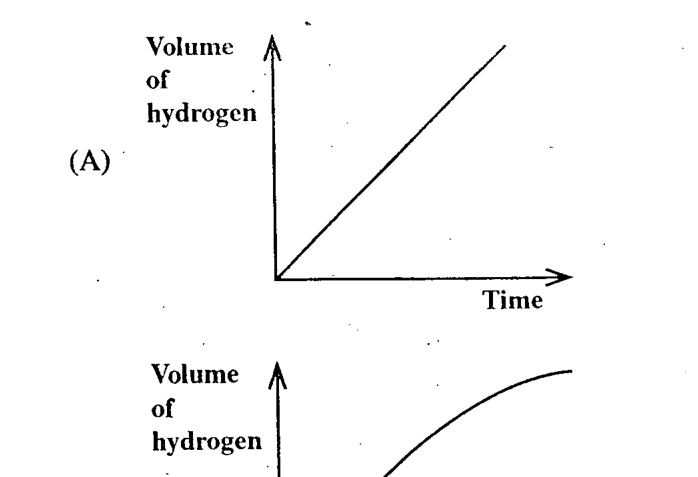
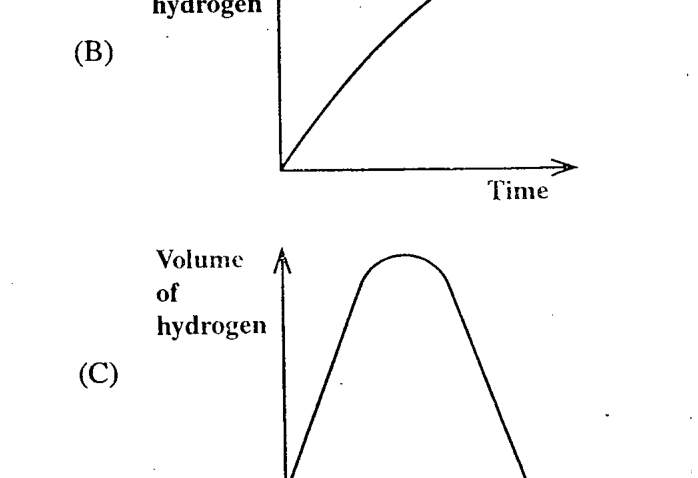
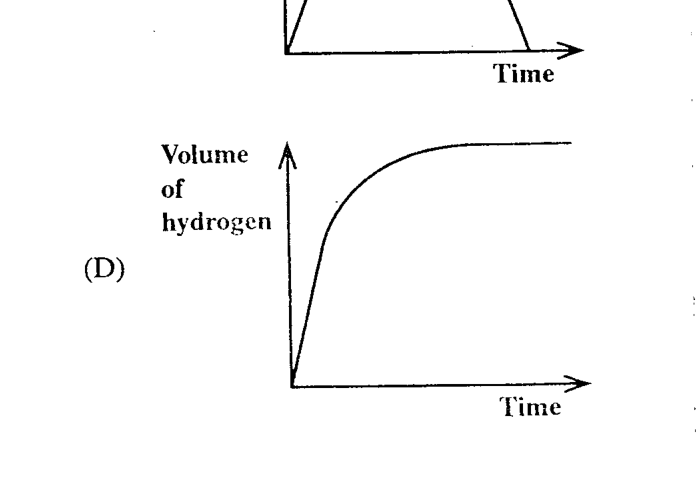
An excess of magnesium powder was added to 50 cm³ of dilute sulphuric acid, and the reaction was allowed to continue until no more hydrogen evolved. Which of the following graphs BEST represents the complete reaction?
The arrangement of elements in the periodic table is based on
relative atomic mass
atomic number
mass number
relative molecular mass
How many neutrons and electrons does the particle have?
Neutrons: 12, Electrons: 10
Neutrons: 12, Electrons: 12
Neutrons: 24, Electrons: 10
Neutrons: 24, Electrons: 12
Which of the atoms represented below by their electronic configuration will most readily form a positive ion?
2, 8, 1
2, 8, 2
2, 8, 7
2, 8, 8
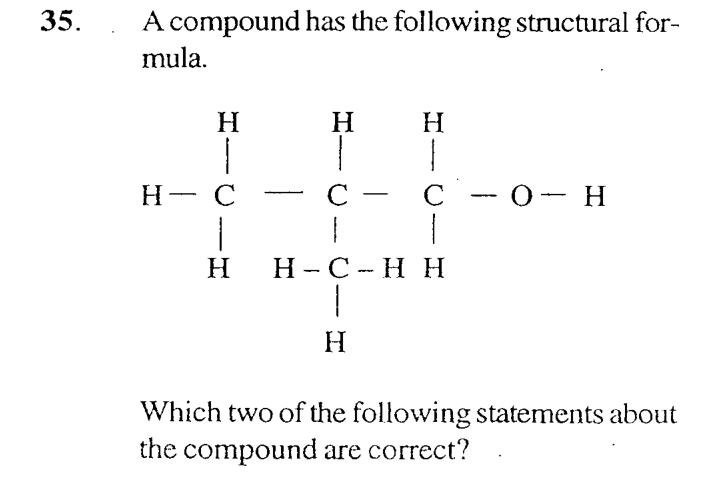
Which two of the following statements about the compound are correct? I. It is an alcohol. II. It is a branched alkane. III. It can react with sodium. IV. It is an unreactive substance.
I and III
I and IV
II and III
II and IV
Ethanol can react with concentrated sulphuric acid to produce ethene. This reaction can be referred to as
dehydration
esterification
dehydrogenation
neutralisation
Which of the following equations represents a condensation reaction?
Which of the following can be produced in one step from ethanol? I. Ethene II. Ethane III. Sodiumethanoate IV. Ethylethanoate
I and II only
II and III only
I and IV only
II and IV only
Compounds in a homologous series
exist in the same state
possess only carbon in straight chains
possess the same molecular formula
differ successively by a - CH₂ - group
Items 40-41 refer to the following chart.
I H₂O conc. H₂SO₄ ETHENE POLYTHENE Br₂ II
The product I is
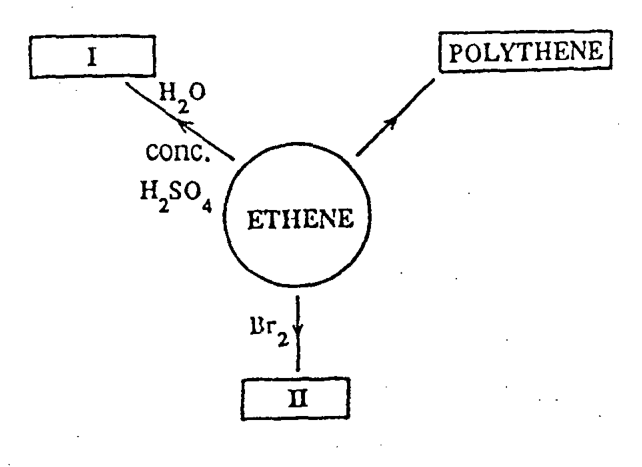
ethanol
ethane
ethanoic acid
ether
The product, polythene, is a
monomer
dimer
polymer
isomer
The number of isomers of butane C₄H₁₀ is
1
2
3
4
Glucose is converted to starch or cellulose by
addition polymerisation
oxidation and reduction
condensation polymerisation
dehydrogenation
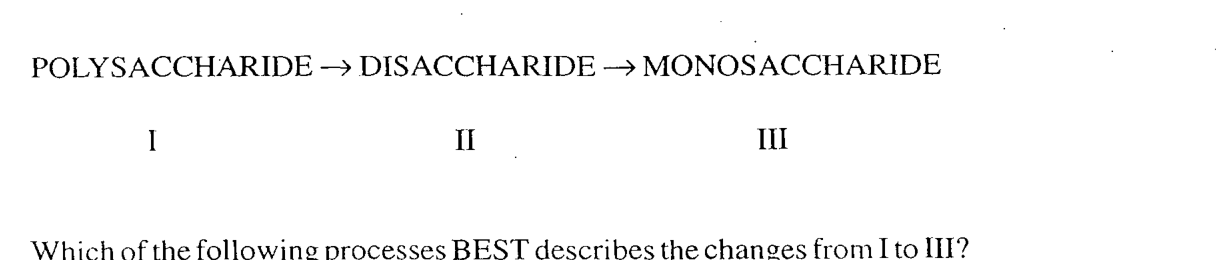
POLYSACCHARIDE → DISACCHARIDE → MONOSACCHARIDE I II III Which of the following processes BEST describes the changes from I to III?
Reduction
Hydrolysis
Oxidation
Synthesis
A compound was found to have a molecular formula C₄H₆. Which of the following is NOT an isomer of this compound?
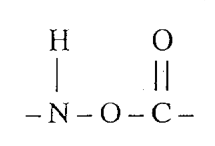
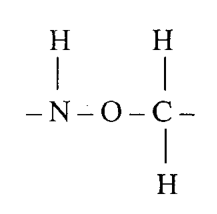
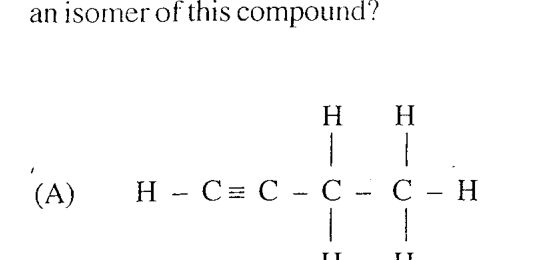
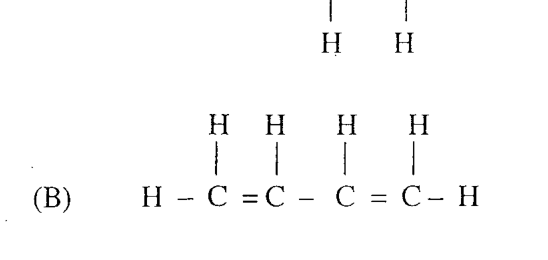
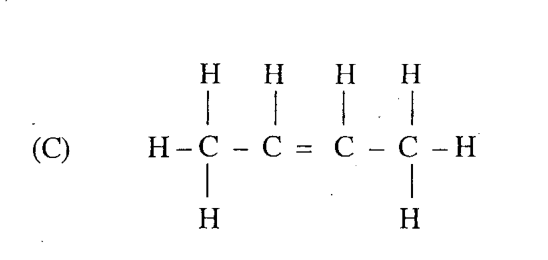
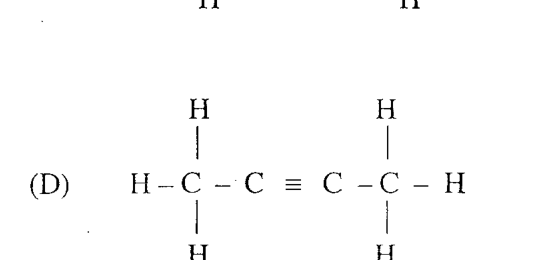
With which of the following substances would n-octane, an alkane, react?
Chlorine
Hydrogen
Hydrogen bromide
Steam
X and Y represent the monomers minus the functional groups, and - represents the linkage. The linkage could BEST be represented by
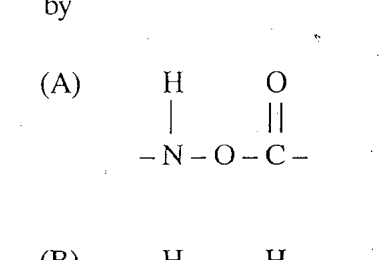
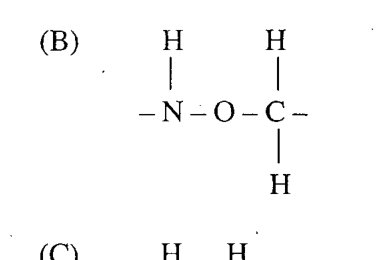
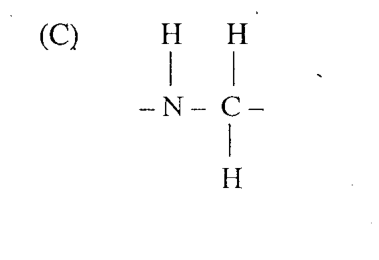
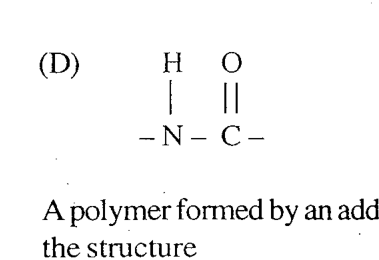
A polymer formed by an addition reaction has the structure -CHX-CH₂-CHX-CH₂-CHX-CH₂-CHX-CH₂- The formula of the monomer would be
XCH₂ - CH₂X
CH₂ = CHX
CH₃ - CH₂X
CH₂ = CHX
Item 49 refers to the following diagrams.
In which of the experiments would the amount of chlorine gas collected be GREATEST?
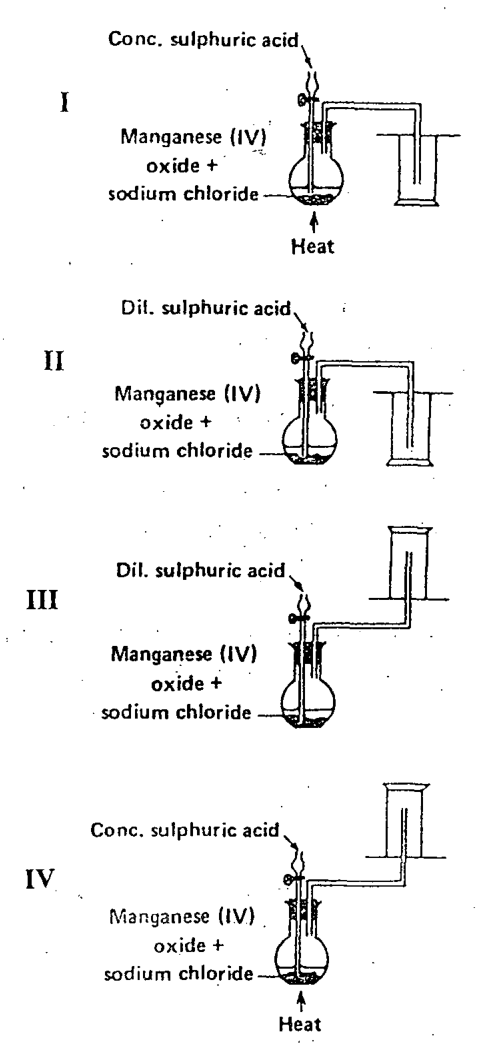
I
II
III
IV
Item 49 refers to the following diagrams.
Aluminium is more reactive than iron yet, after a while, a piece of aluminium left exposed to the atmosphere becomes corrosion resistant whilst a similar piece of iron continues to corrode. This is because the
aluminium has reacted completely
iron oxide formed is more reactive than the aluminium oxide formed
oxide film on aluminium protects the metal from further corrosion but the oxide film on iron does not
iron oxide reacts with the iron below but aluminium oxide does not react with the aluminium below
Which of the following elements reacts most vigorously with H+(aq) ions to give hydrogen gas?
Zinc
Lead
Iron
Copper
Which of the following statements about sulphur are true? I. It is used in the manufacture of matches. II. It is used in the vulcanisation of rubber. III. It is used in the extraction of iron from its ore. IV. It is used in the manufacture of explosives.
I and II only
I, II and III only
II and IV only
I, II and IV only
Chloride ions can be identified by using
silver nitrate solution and dilute nitric acid
barium chloride solution and hydrochloric acid
sodium hydroxide solution and litmus
concentrated sulphuric acid and cop- per turnings
Which of the following methods can be used in the extraction of aluminium?
Reduction of the oxide by carbon or carbon monoxide
Oxidation of the sulphide to the oxide followed by reduction of the oxide by carbon
Partial oxidation of the sulphide to the oxide followed by self-reduction of the oxide by the sulphide
Electrolysis of a compound of the element in the molten state
Which of the following metals will NOT displace hydrogen from dilute hydrochloric acid?
Zinc
Iron
Copper
Aluminium
Which of the following is an important constituent of chlorophyll?
Iron
Copper
Calcium
Magnesium
The main substance responsible for 'acid rain' is
dust particles
radioactive fallout
carbon dioxide
sulphur dioxide
Which of the following processes gives a different gaseous product from the others?
Photosynthesis in plants
Respiration in animals
Oxidation of carbon monoxide
Heating calcium carbonate
Yeast may be used in the fermentation of starch to ethanol because
it is acidic
it contains enzymes which act on starch
yeast itself produces the ethanol
it fixes the oxygen needed in the reaction from the atmosphere
Which of the following is/are condensation polymers?
I. Terylene II. Nylon III. Starch IV. Polythene
I only
I and IV only
I, II and III only
II, III and IV only