Free CXC Chemistry Paper 1 May/June 2025 past paper from 2025. Includes a worked answer key. Open the PDF, take a timed test, and study with AI on Caribbean AI.
Answer keys are free on Caribbean AI. View the answers to every past-paper question at no cost - no payment needed - with step-by-step worked solutions and instant AI marking available on Premium.
CSEC Chemistry Paper 1 May/June 2025 - Free CXC Past Paper with Answers
Free CXC Chemistry Paper 1 May/June 2025 past paper from 2025. Includes a worked answer key. Open the PDF, take a timed test, and study with AI on Caribbean AI.
Opening the interactive papers…
Every question from this paper as text. See the answers and worked solutions. Questions are the property of the Caribbean Examinations Council; Caribbean AI is not affiliated with CXC.
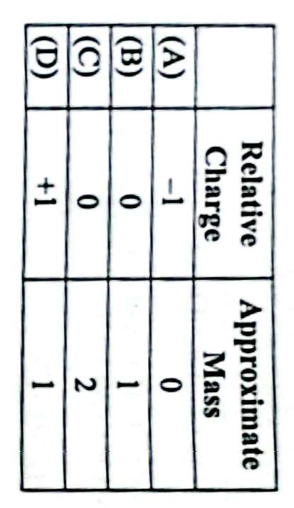
Which of the following properties refer to an electron?
Relative Charge: -1, Approximate Mass: 0
Relative Charge: 0, Approximate Mass: 1
Relative Charge: 0, Approximate Mass: 2
Relative Charge: +1, Approximate Mass: 1
Which of the following processes does NOT provide evidence in support of the particulate nature of matter?
Osmosis
Diffusion
Filtration
Brownian motion
From which of the following substances can a solid be obtained by the process of sedimentation?
Gels
Foams
Emulsions
Suspensions
Which of the following substances consists of the cation of a base and an anion of an acid?
Salt
Alkali
Neutral oxide
Acid anhydride
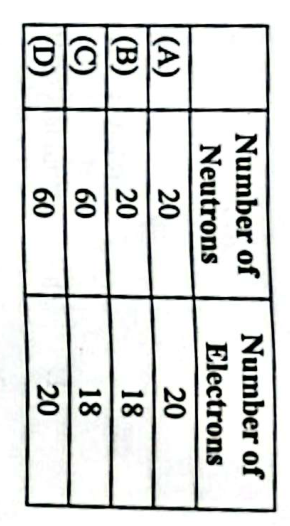
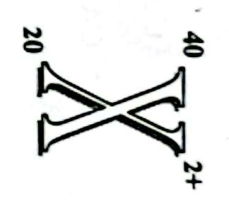
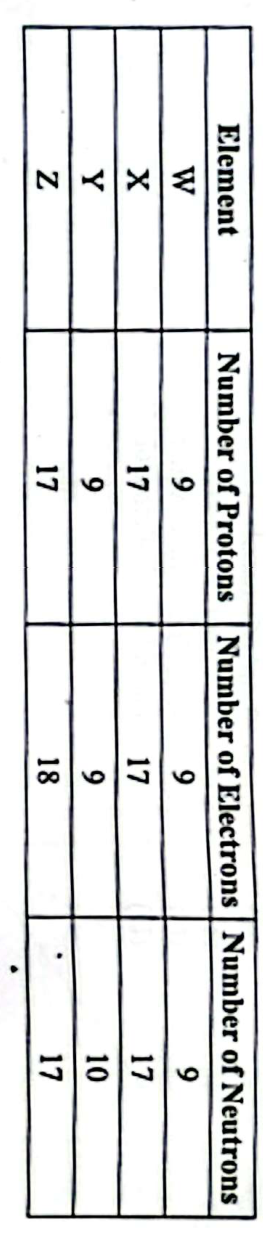
Which of the following pairs represents the number of neutrons and electrons in X?
Number of Neutrons: 20, Number of Electrons: 20
Number of Neutrons: 20, Number of Electrons: 18
Number of Neutrons: 60, Number of Electrons: 18
Number of Neutrons: 60, Number of Electrons: 20
What mass of neon atoms contains the same number of moles as 140 g of calcium atoms? [RAM: Ne = 20; Ca = 40]
0.70 g
7.00 g
70.00 g
700.00 g
Which of the following salts is an acid salt?
NaHSO₄
Na₂SO₄
Na₃PO₄
Na₂CO₃
A 'weak acid' is BEST described as one that yields a
low reading on the pH meter
low concentration of acid in aqueous solution
high concentration of hydrogen ions in solution
low concentration of hydrogen ions in aqueous solution
Which of the following substances do NOT produce water when reacted with acid?
Carbonates
Metal oxides
Active metals
Metal hydroxides
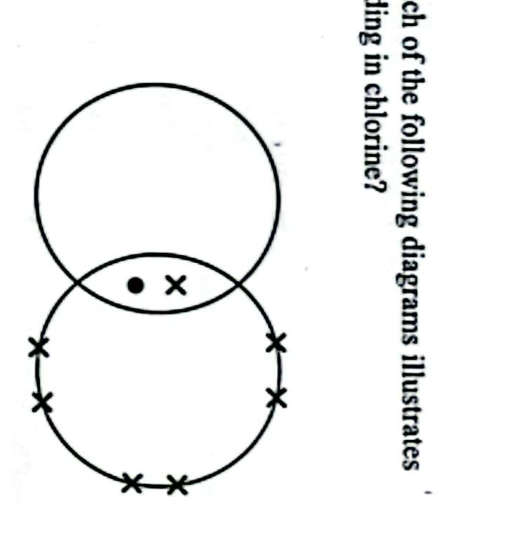
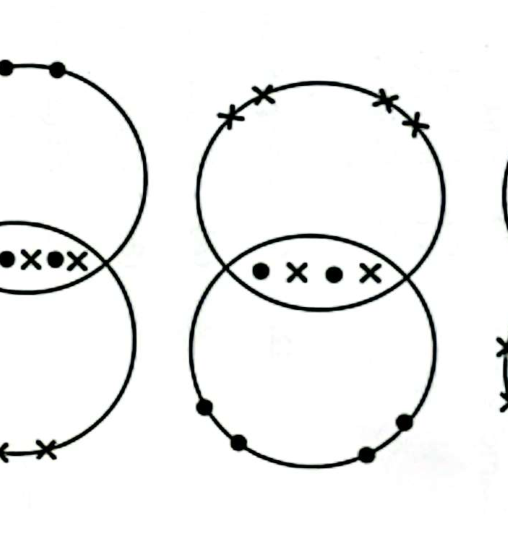
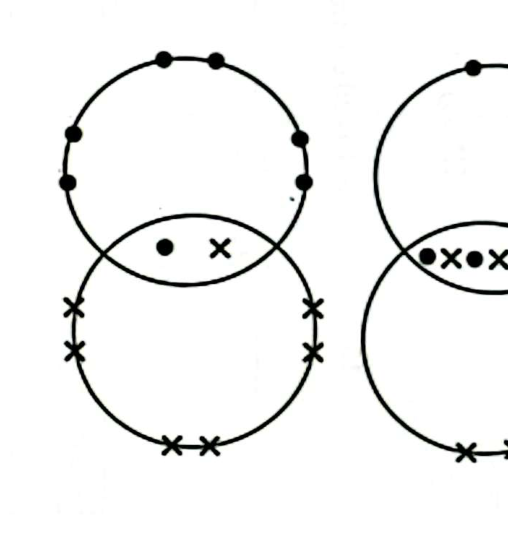
Which of the following diagrams illustrates bonding in chlorine?
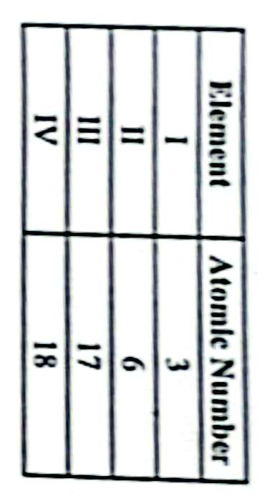
Which TWO elements above, when combined with each other, form an ionic compound?
I and II
I and III
II and IV
III and IV
The ionic equation for the reaction between an acid and a carbonate is represented by
An atom has 20 electrons. When it ionizes, it has the same electronic configuration as
neon
argon
sodium
calcium
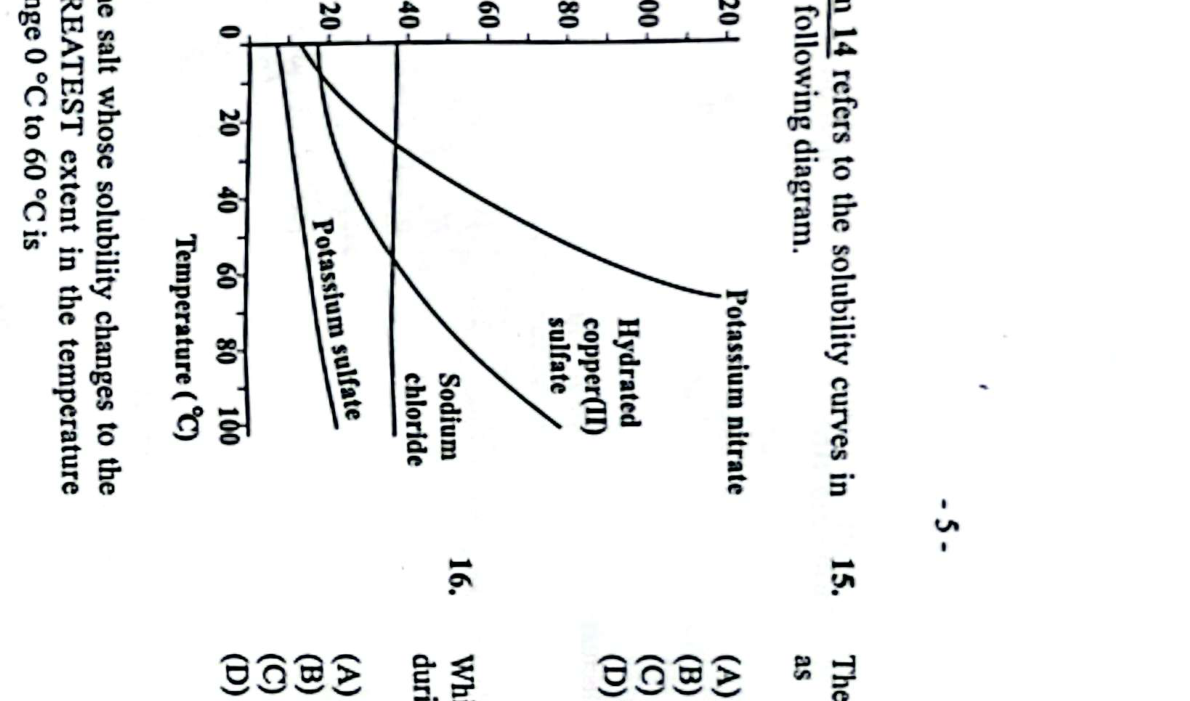
The salt whose solubility changes to the GREATEST extent in the temperature range 0 °C to 60 °C is
sodium chloride
potassium nitrate
potassium sulfate
hydrated copper(II) sulfate
The mass number of an element is defined as
the number of neutrons
the number of electrons
the number of neutrons and protons
the number of electrons and neutrons
Which of the following acids is formed during intense exercise?
Lactic
Ascorbic
Ethanoic
Methanoic
All of the elements shown above belong to which group of the periodic table?
Group IV
Group V
Group VI
Group VII
Crystals of sodium chloride are BEST described as
ionic
metallic
molecular
macromolecular
Where does oxidation take place during electrolysis?
Conductor
Electrolyte
Cathode
Anode
Which of the following is the correct formula for ammonium carbonate?
NH,CO,
NH (CO₂),
(NH), CO,
(NH), (CO₂),
Which of the following mixtures can be referred to as a standard solution?
Iodine in 50 cm³ of ethanol
30 g of sodium chloride in water
Sodium chloride in 50 cm³ of water
30 g of iodine in 50 cm³ of ethanol
Which of the following elements exhibit allotropy?
Silicon
Carbon
Uranium
Aluminium
The relative atomic mass of carbon is 1: and that of oxygen is 16. Therefore, 88 g of carbon dioxide consists of
3.1 moles of carbon dioxide
12 moles of carbon and 32 mole of oxygen
1 mole of carbon atoms an 2 moles of oxygen atoms
2 moles of carbon atoms an 4 moles of oxygen atoms
A mixture of copper(II) oxide an copper(II) sulfate is BEST separated by
distilling the mixture
heating the mixture and condensin
shaking with excess water and the filtering
shaking with excess water followe by fractional distillation
When 100 cm³ of 2 mol dm⁻³ hydrochloric acid (in excess) is added to 5.0 g of granulated zinc, hydrogen gas is evolved at a certain rate. If 5.0 g of powdered zinc were used instead, the rate of production of hydrogen gas would
increase because of the greater concentration of powdered zinc
increase because of the increased surface area of powdered zinc
decrease because of the decreased surface area of powdered zinc
decrease because of the lower solubility of powdered zinc
The Faraday constant has a value of
96 500 C mol⁻¹
9 500 C mol⁻¹
950 C mol⁻¹
95 C mol⁻¹
Which of the following occurs during the breaking of a chemical bond?
There is an exothermic reaction.
There is no energy change.
Energy is required.
Energy is released.
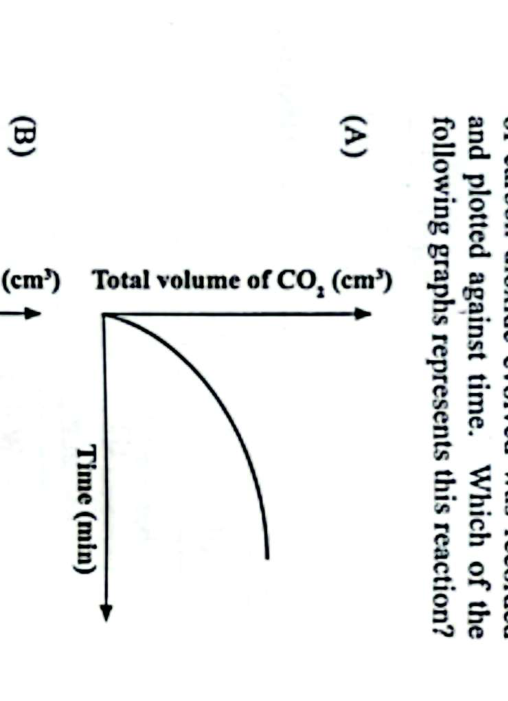
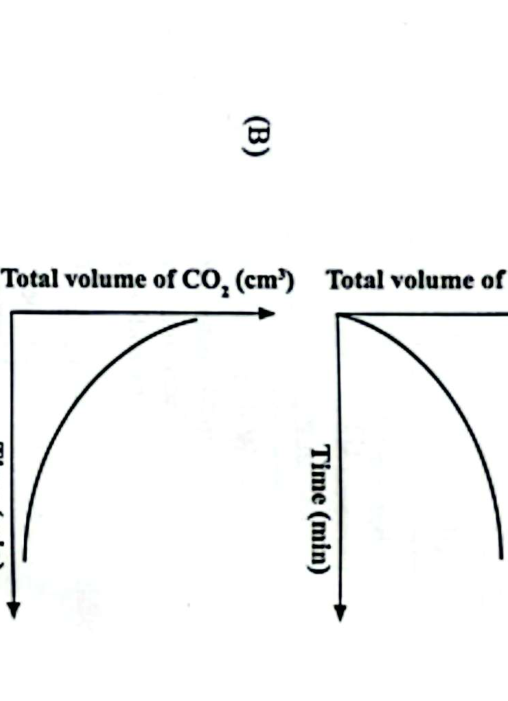
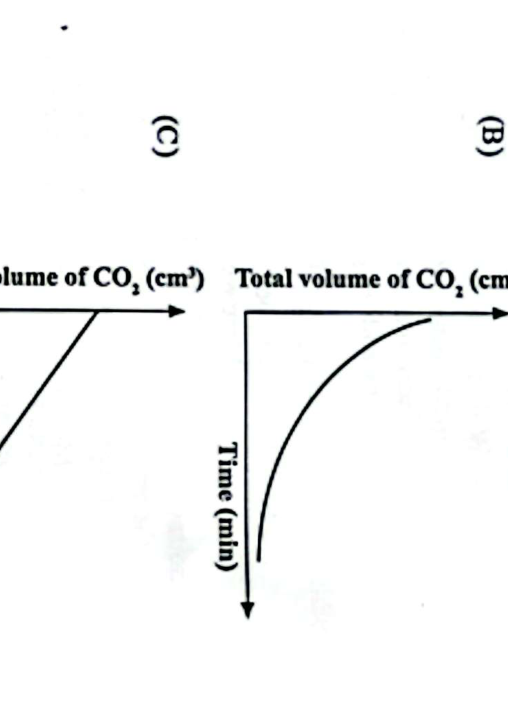
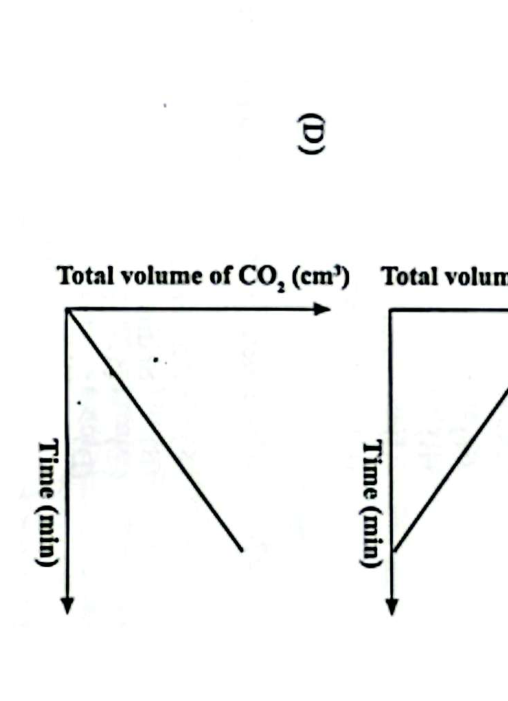
Some calcium carbonate was reacted with excess dilute hydrochloric acid. The volume of carbon dioxide evolved was recorded and plotted against time. Which of the following graphs represents this reaction?
Item 29 refers to the following sequence of reactions involving iron compounds, where I, II, III and IV represent progressive stages in the sequence. I II → FeCO, FeO Fe₂O₃ III IV →Fe2(SO4)3 → Fe(OH)3
In which stage is the oxidation state of iron increased?
I
II
III
IV
Which of the following metals has become an environmental hazard because of the indiscriminate disposal of thermometers by labs and hospitals?
Lead
Copper
Mercury
Aluminium
Which of the following metals will react MOST vigorously with dilute acid?
Zinc
Iron
Lead
Copper
Which metal is MOST easily ionized?
Aluminium
Sodium
Copper
Iron
Stainless steel is used to make utensils and surgical instruments. Which of the following is the major metal found in steel?
Iron
Sodium
Copper
Aluminium
Which of the following is the reason for adding cryolite to pure alumina during the extraction of aluminium by electrolysis?
It lowers the melting point.
It reduces the resistance.
It reduces the current.
It prevents damage.
When copper(II) carbonate is heated alone in a dry test tube, a gas is evolved and a black residue is formed. This gas is expected to
turn red litmus blue
relight a glowing splint
decolourize acidified aqueous potassium manganate(VII)
form a white precipitate with aqueous calcium hydroxide
A suitable drying agent for the laboratory preparation of ammonia gas is
calcium oxide
calcium chloride
concentrated sulfuric acid
anhydrous copper sulfate
Which of the following compounds may be used to counteract the effects of acid rain on the soil?
CaO
HS
SO
CO
An element that is a non-metal
is a solid at room temperature
can act as a reducing agent
forms an acidic oxide
conducts electricity
Which of the following aqueous solutions will produce a blue precipitate with aqueous sodium hydroxide?
Aluminium nitrate
Copper(II) nitrate
Iron(II) nitrate
Iron(III) nitrate
Which of the following is NOT a method used to treat water for domestic purposes?
Chlorinating
Filtering
Stirring
Boiling
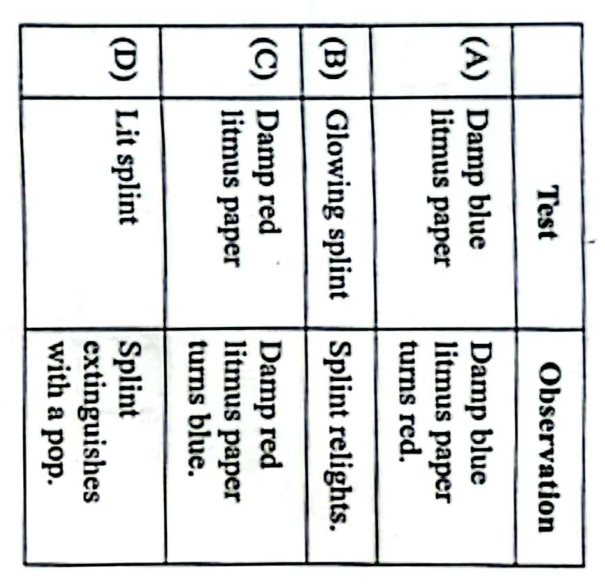
Which test can be used to identify an acidic gas?
Damp blue litmus paper
Glowing splint
Damp red litmus paper turns blue.
Lit splint
Which of the following observations is expected when aqueous silver nitrate is added to aqueous potassium chloride?
A pungent gas is evolved.
A blue precipitate appears.
A white precipitate appears.
A brown precipitate appears.
Why is aluminium more resistant to corrosion than iron?
Aluminium oxide formed is more reactive than iron oxide formed.
Aluminium has reacted completely but iron has not reacted completely.
Aluminium oxide does not react with aluminium but iron oxide reacts with iron.
Aluminium oxide protects the aluminium but iron oxide does not protect the iron.
Which of the following properties of water explains why ice floats on the surface of a lake?
Density
Surface tension
Universal solvent
Heat of vaporization
Which of the following hydrocarbons is the MAJOR constituent of natural gas?
Butane
Ethane
Propane
Methane
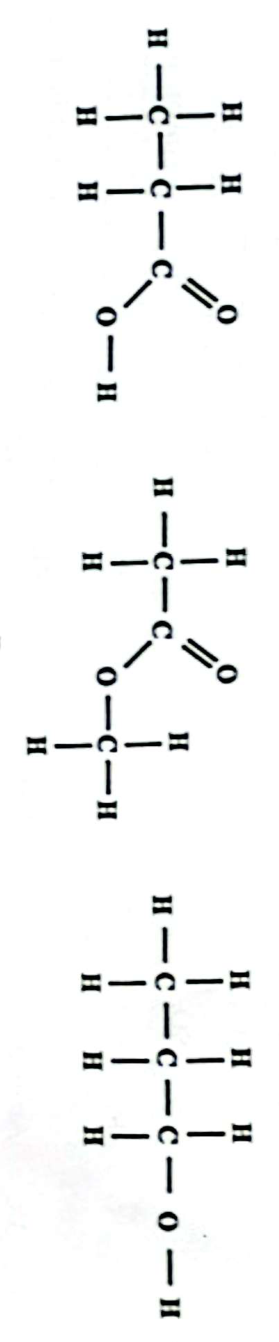
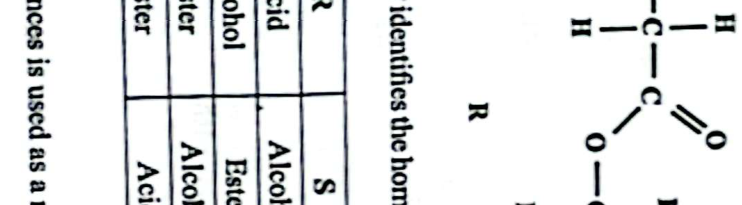
Item 46 refers to the fully displayed structural formulae of compounds Q, R and S shown below. H H H H H H H H-C-C H-C H-C-C-C-O-H о-и H O-C-H H H H H H H H Q R S
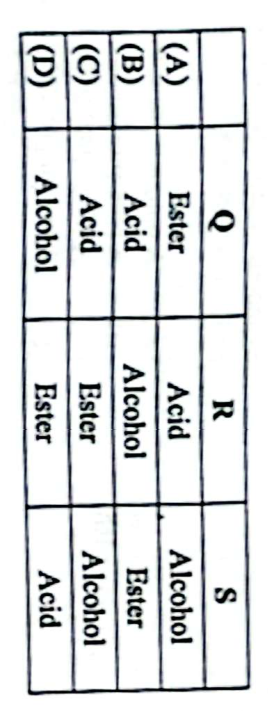
Which of the following correctly identifies the homologous series to which each compound belongs?
Which of the following substances is used as a monomer in addition polymerization?
C₂H₅OH
CH₄
C₂H₄
CH₃COOC₂H₅
When large alkane molecules are cracked, the products are a mixture of
small alkane molecules only
small alkene molecules only
large and small alkane molecules
small alkane and alkene molecules
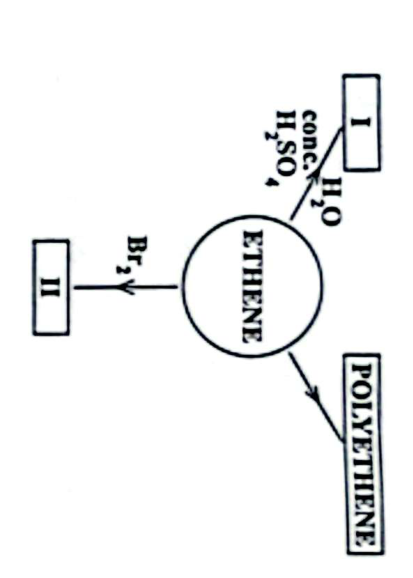
Item 49 refers to the following chart showing the conversion of ethene to different products.
I H₂O conc. H₂SO₄ ETHENE POLYETHENE Br₂ II
The product, polyethene, is a
gas
solid
liquid
solution
Which of the following features is NOT true of all homologous series of compounds?
The members of the series have the same functional group
the same general formula
similar chemical properties
the same empirical formula
Which of the following is the residue in the fractional distillation of petroleum?
Propene
Bitumen
Methane
Paraffin
Which of the following terms describes starch?
Giant ionic structure
Giant covalent structure
Simple molecular crystal
Macromolecular structure
Which of the following statements is/are true of alkenes? I. They react with KMnO₄/H⁺. II. They undergo addition reactions. III. They undergo substitution reactions.
I only
I and II only
I and III only
I, II and III
The compound CH₃CH₂CH₂CH₂OH is called
1-propanol
4-propanol
1-butanol
4-butanol
A hydrocarbon is described as being unsaturated. This means that the
molecule has insufficient hydrogen atoms
molecule contains at least one double bond
carbon atoms in the molecule are very reactive
carbon atoms in the molecule are linked by single bonds
Which of the following compounds can be dehydrated?
Natural gas
Propene
Vinegar
Ethanol
Which of the following statements are true of alkanes and alkenes? I. Both alkanes and alkenes burn in air to produce carbon dioxide and water. II. Alkanes undergo substitution reactions whilst alkenes undergo addition reactions. III. Alkanes are saturated hydrocarbons, whilst alkenes are unsaturated hydrocarbons.
I and II only
I and III only
II and III only
I, II and III
During the manufacture of ethanol by fermentation, the gas which is evolved
turns lime water cloudy
burns with a blue flame
relights a glowing splint
turns potassium dichromate green
Item 59 refers to the following equation.
Organic acid + Alcohol Ester + Water
The reverse reaction is known as
synthesis
hydrolysis
esterification
polymerization
Which of the following are reactions of ethanoic acid?
I. It forms a salt with aqueous sodium hydroxide.
II. It liberates carbon dioxide from a carbonate.
III. It liberates hydrogen on contact with a strongly electropositive metal.
I and II only
I and III only
II and III only
I, II and III