Free CXC Chemistry Paper 1 May/June 2009 past paper from 2009. Includes a worked answer key. Open the PDF, take a timed test, and study with AI on Caribbean AI.
Answer keys are free on Caribbean AI. View the answers to every past-paper question at no cost - no payment needed - with step-by-step worked solutions and instant AI marking available on Premium.
CSEC Chemistry Paper 1 May/June 2009 - Free CXC Past Paper with Answers
Free CXC Chemistry Paper 1 May/June 2009 past paper from 2009. Includes a worked answer key. Open the PDF, take a timed test, and study with AI on Caribbean AI.
Opening the interactive papers…
Every question from this paper as text. See the answers and worked solutions. Questions are the property of the Caribbean Examinations Council; Caribbean AI is not affiliated with CXC.
Items 1-2 refer to the following atoms represented by their electronic configuration.
(A) 2,4 (B) 2,8 (C) 2,8,6 (D) 2,8,8,2
Match each item below with one of the options above. Each option may be used more than once, once or not at all.
Which element
combines with chlorine to form ionic bonds?
2,4
2,8
2,8,6
2,8,8,2
forms many giant structures occuring both naturally and artificially?
2,4
2,8
2,8,6
2,8,8,2
In which of the following are radioactive isotopes NOT used?
Radiotherapy
Carbon dating
Metal extraction
Energy generation
'One mole of atoms of an element' refers to the mass of
1 atom of the element
the element which contains atoms
the element which occupies at s.t.p.
the element which combines completely with 12 g of carbon-12
Which of the following requires the LARGEST number of moles of electrons to liberate one mole of it?
Which of these elements has seven electrons in its outer shell?
Hydrogen
Oxygen
Nitrogen
Chlorine
The ionic equation for the reaction between an acid and a carbonate may be represented as
Which of the following can be referred to as a standard solution?
Iodine in 50 cm³ ethanol
Sodium chloride in 50 cm³ water
30 g of sodium chloride in water
30 g of iodine in 50 cm³ ethanol
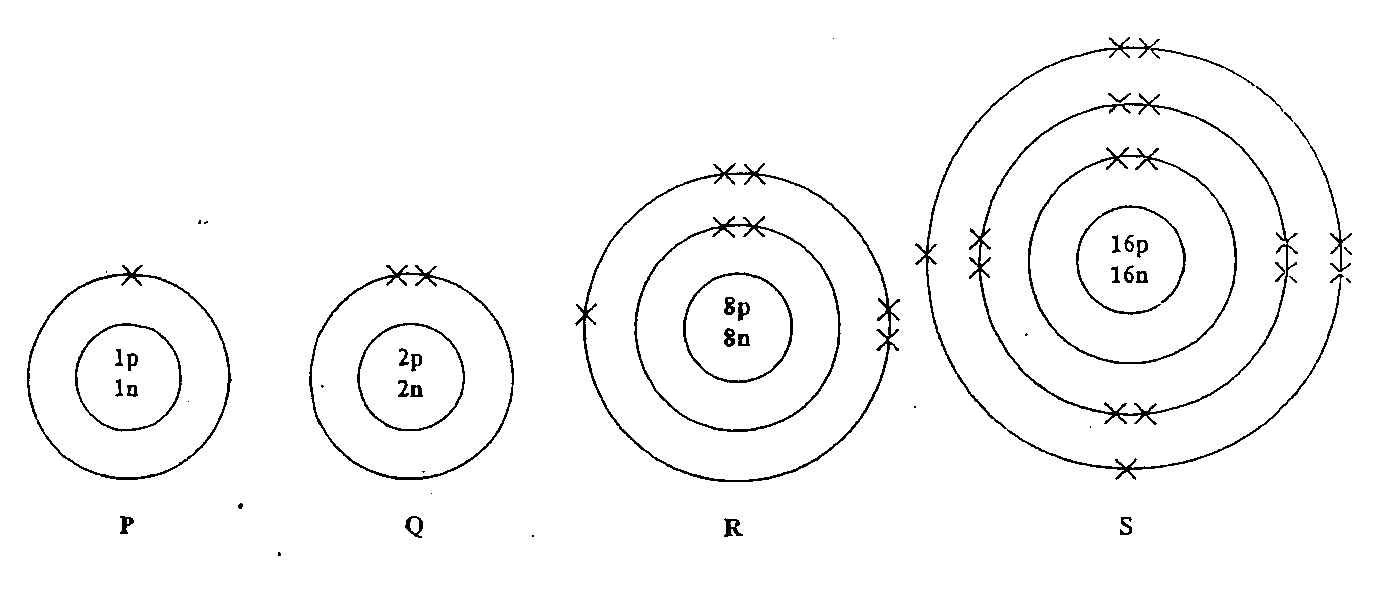
Item 9 refers to the following illustrations of the electronic structure of four atoms.
P Q R S
Which pair of atoms forms covalent bonds when reacted together?
P and Q
P and S
Q and S
Q and R
Which of the following is the type of crystal structure of iodine at room temperature and pressure?
Ionic
Metallic
Giantmolecular
Simplemolecular
A metallic bond is formed when
cations are held together by a sea of mobile electrons
positive metal ions are held together by a sea of anions
anions are held together by negative electrons
metal atoms are held together by molecular forces
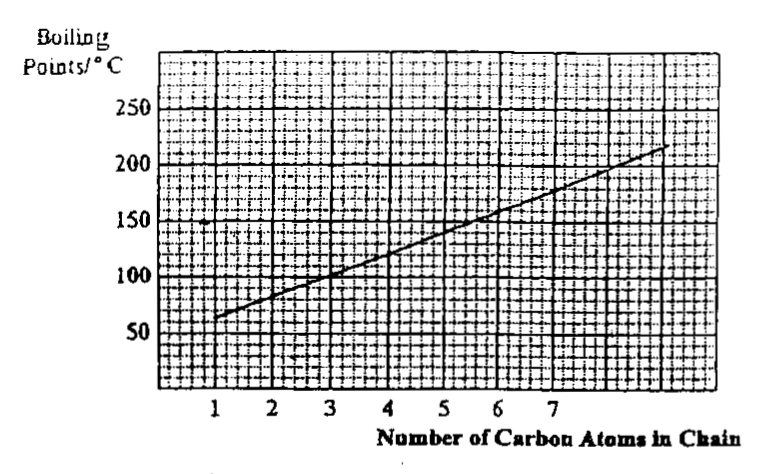
Item 12 refers to the following graph which shows the boiling points of some straight-chain alcohols:
The MOST suitable method for separating the 4-carbon alcohol from a mixture with the 5-carbon alcohol is
fractional distillation
solvent extraction
simple distillation
simple evaporation
Which of the following is the correct formula for ammonium carbonate?
NH₄CO₃
NH₄(CO₃)₂
(NH₄)₂CO₃
(NH₄)₂(CO₃)₂
Which of the following separation techniques is NOT used during the extraction of sucrose from sugar cane?
Filtration
Precipitation
Centrifugation
Chromatography
Which of the following does NOT affect the solubility of a substance?
Catalyst
Pressure
Stirring
Temperature
A piece of calcium is added to some distilled water in a container and a gas is produced. The gas produced is expected to
relight a glowing splint
give a 'pop' with a lighted splint
decolourise acidified aqueous potassium manganate (VII)
turn acidified aqueous potassium dichromate green
Which set of elements has atoms with two electrons in their outer shells?
The halogens
Period 2 elements
Group II elements
The transition elements
The oxide of a metal
Salt
Base
Alkali
Acid
Supplies protons as the only positive ions in aqueous solutions
Salt
Base
Alkali
Acid
When X and Y are stirred together in a beaker and the mixture filtered, X and Y are both present in the filtrate. Which of the following could describe the mixture formed by X and Y?
I. Solution II. Colloid III. Suspension
I only
III only
I and II only
II and III only
Which of the following compounds are acid salts?
I. NaH₂PO₄ II. CaSO₄ III. Al₂CO₃ IV. KHSO₄
I and II only
I and IV only
II and III only
III and IV only
reacts with an acid, liberating a gas which turns lime water milky?
Calcium carbonate
Magnesium metal
Barium chloride
Litmus solution
reacts with sulphuric acid to produce hydrogen gas?
Calcium carbonate
Magnesium metal
Barium chloride
Litmus solution
Acidified potassium manganate (VII) is
an oxidising agent
a reducing agent
a dehydrating agent
both an oxidising and reducing agent
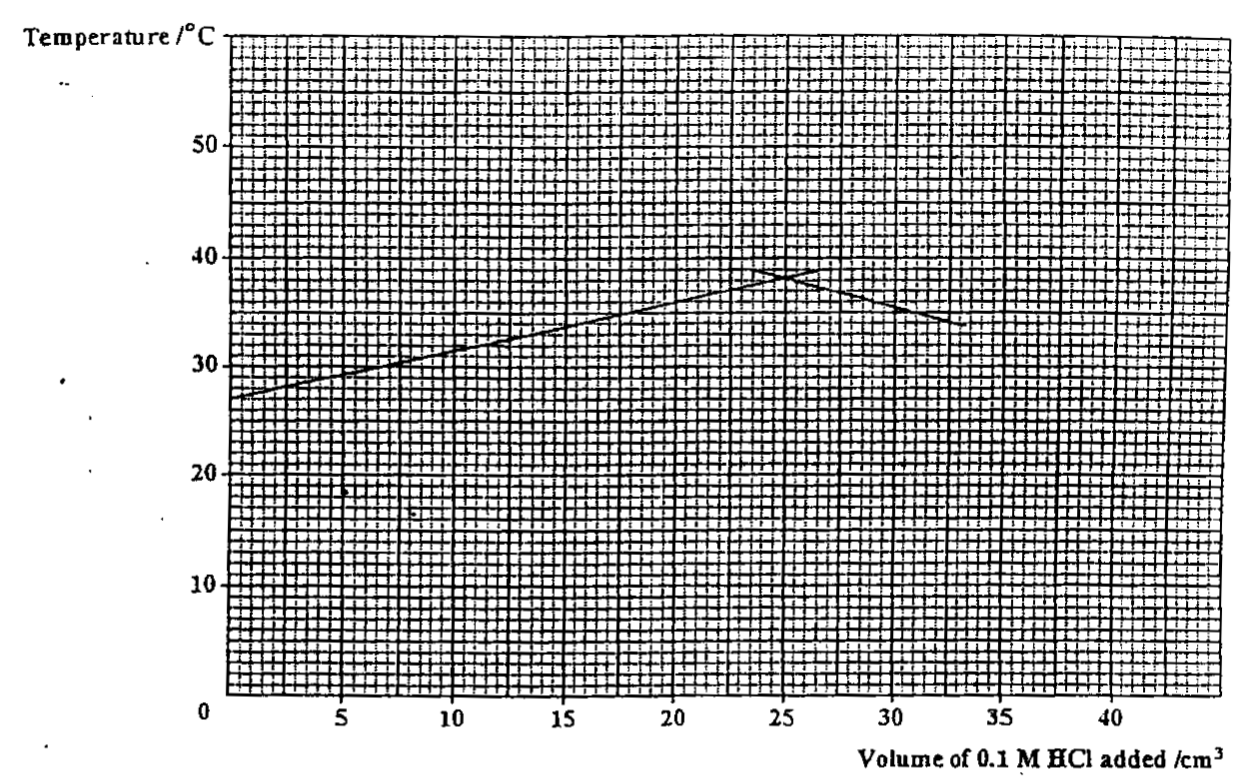
The temperature at which neutralisation occurred is
25°C
27°C
34°C
38°C
Which of the following occurs when a metal atom becomes an ion?
It gains electrons and is oxidised
It gains electrons and is reduced.
It loses electrons and is oxidised
It loses electrons and is reduced.
Item 27 refers to the following information. 2.32 g of an oxide of iron, Fe, O,, are heated in dry hydrogen. When the reaction is complete, 1.68 g of iron are left. [Rel. atomic mass: Fe = 56; 0=16]
When this reaction is completed, the oxide of iron is completely
reduced
oxidised
neutralised
decomposed into its elements
In an experiment, on heating 402 g of mercury, a black powder with a mass of 434 g is obtained (Rel. atomic mass: Hg = 201; O=16). The balanced equation representing this reaction is
Hg(l) + O2(g) = HgO(s)
2Hg(l) + O2(g) = 2HgO(s)
Hg(s) + O2(g)=HgO(s)
2Hg(s) + O2(g)=2HgO(s)
Items 29-30 refer to the following options which represent the order of some metals in the activity series. (A) Magnesium (B) Iron (C) Lead (D) Copper In answering items 29-30, each option may be used once, more than once or not at all. Which element
would be liberated at the cathode from the aqueous solution of its salts during electrolysis?
Magnesium
Iron
Lead
Copper
forms an oxide which CANNOT be reduced by hydrogen?
Magnesium
Iron
Lead
Copper
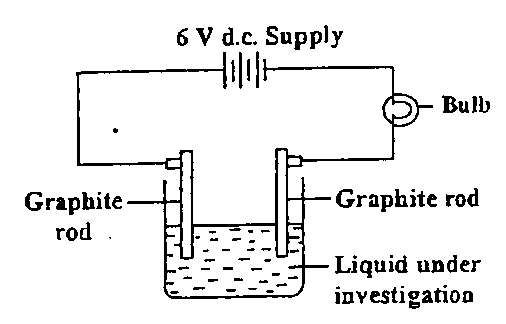
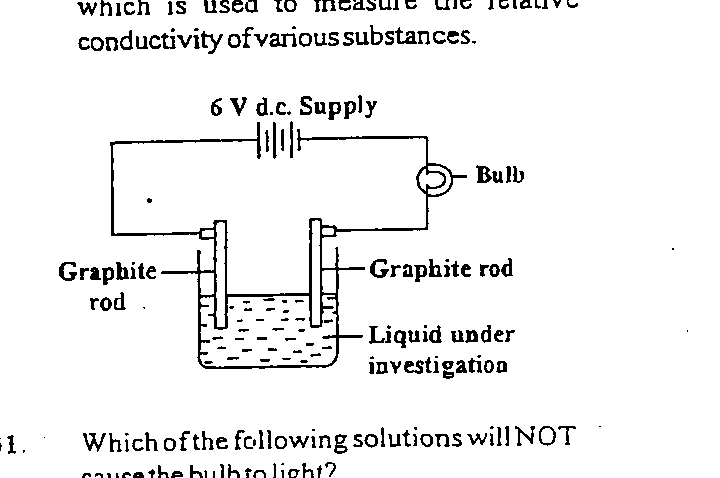
Item 31 refers to the following apparatus which is used to measure the relative conductivity of various substances.
Which of the following solutions will NOT cause the bulb to light?
Sea water
Pure ethanol
Aqueous ethanoic acid
Aqueous propanoic acid
Which of the following describes the effect on the AVERAGE rate of reaction AND the final volume of hydrogen gas collected in going from Experiment I to Experiment II?
Effect on Rate Effect on Final Volume of H₂(g) collected
Increased / Unchanged
Increased / Increased
Decreased / Decreased
Decreased / Unchanged
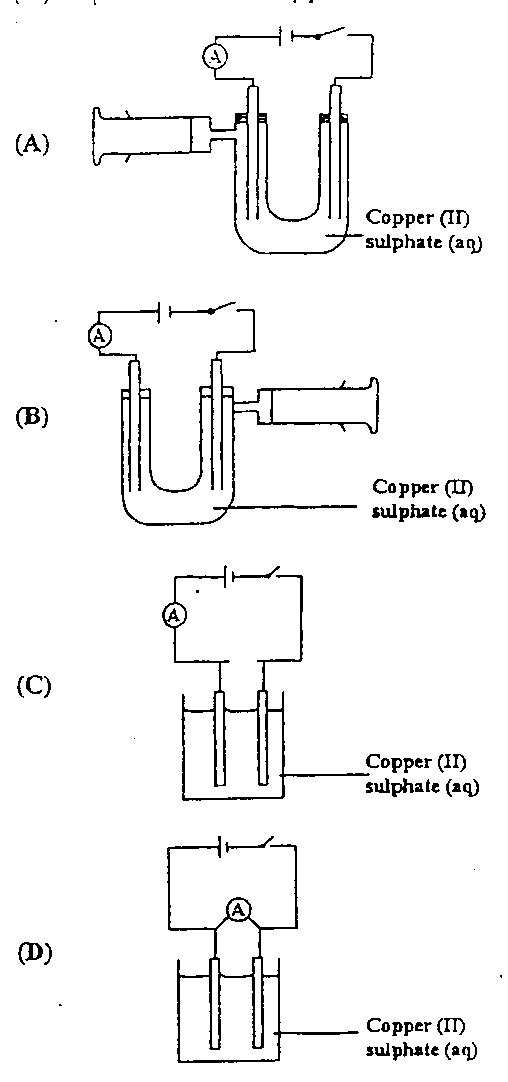
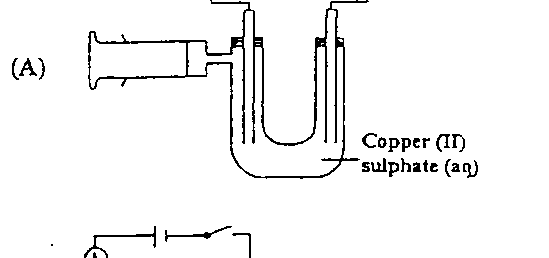
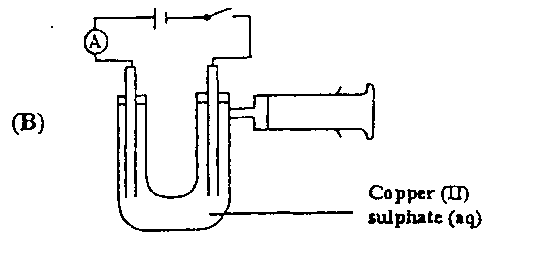
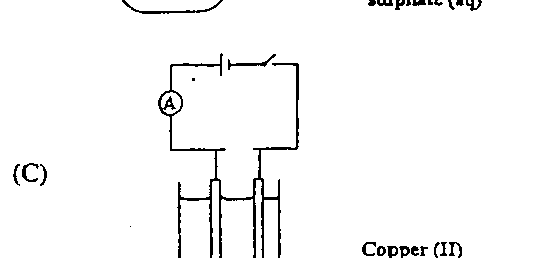
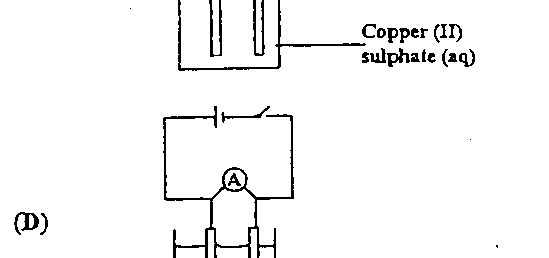
Which of the following apparatus is the MOST suitable for the electrolysis of copper (II) sulphate between copper electrodes?
The reaction occurring at the cathode during the electrolysis of copper sulphate using inert electrodes is given by the equation
Cu → Cu²⁺ + 2e⁻
Cu²⁺ + 2e⁻ → Cu
2H⁺ + 2e⁻ → H₂
4OH⁻ - 4e⁻ → 2H₂O + O₂
Which of the following is true when an aluminium pot is being anodised?
Aluminium is the anode in the cell.
Hydrogen is given off at the anode.
The electrolyte is a solution of sodium chloride.
A layer of aluminium hydroxide forms on the pot.
Items 36–37 refer to the following sequence of reactions involving iron compounds, where I, II, III and IV represent the stages involved. <br> <img src="image_crop_1.png"> <br>
In which stage is the oxidation state of iron increased?
I
II
III
IV
A suitable reagent that could be used at IV is
steam
hydrogen
solid copperoxide
aqueous sodium hydroxide
A recently discovered element is thought to be a metal. Which of the following physical properties would BEST confirm this?
Density
Hardness
Melting point
Electrical conductivity
Chlorine can be obtained by
warming sodium chloride with concentrated sulphuric acid
boiling sodium chloride with manganese (IV) oxide
electrolysing a concentrated solution of sodium chloride
adding aqueous bromine to aqueous sodium chloride
Which of the following metals will react MOST vigorously with dilute acid?
Zinc
Iron
Lead
Copper
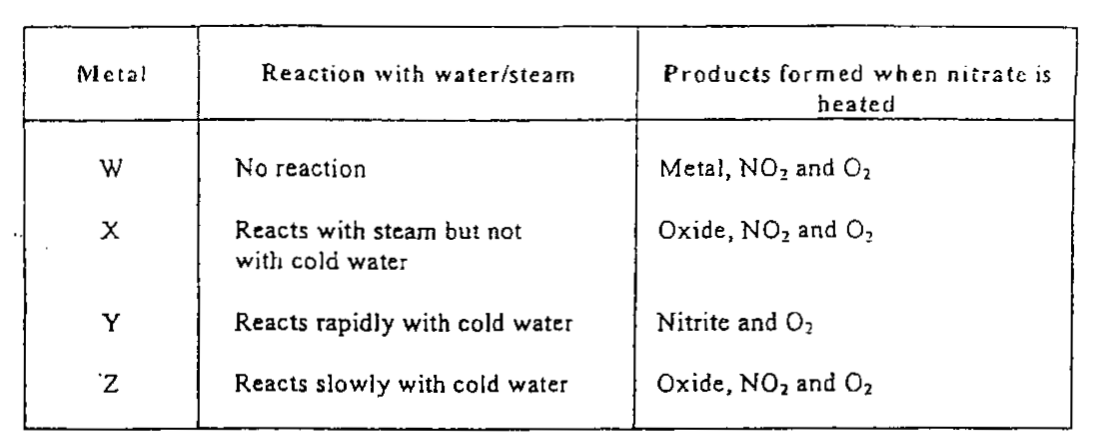
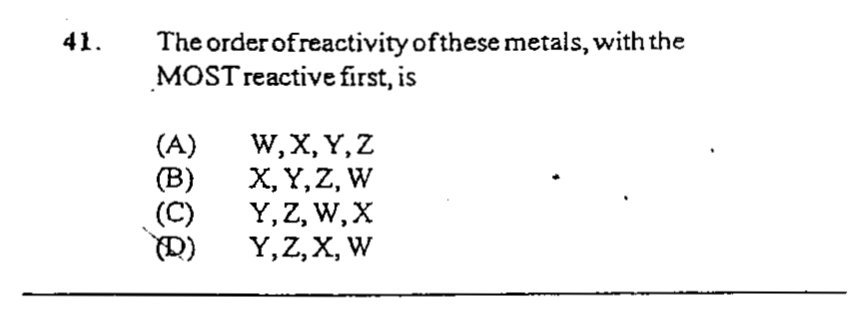
The order of reactivity of these metals, with the MOST reactive first, is
W, X, Y, Z
X, Y, Z, W
Y, Z, W, X
Y,Z, X, W
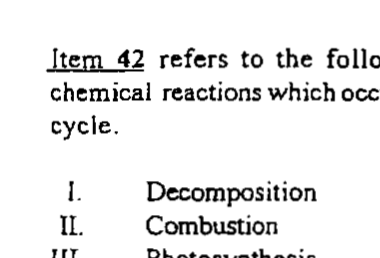
Item 42 refers to the following types of chemical reactions which occur in the carbon cycle. I. Decomposition II. Combustion III. Photosynthesis
Which of these reactions would be responsible for returning carbon dioxide to the atmosphere?
I only
III only
I and II only
I, II and III
Overtime, aluminium articles do not deteriorate ir air as do iron articles. Which of the following statements gives the correct reason for this?
Aluminium is higher up in the activity serie: than iron, therefore it is more resistant to corrosion than iron.
Both metals form oxide coats but aluminium oxide prevents further reaction, while the iron oxide does not.
Both metals form hydroxide coats but the aluminium hydroxide prevents further reaction, while the iron hydroxide doe not.
Aluminium is lower than iron in the activity series, therefore it reacts less readily with air than iron.
Which of the following substances forms dens white fumes with ammonia gas?
Oxygen
Hydrogen
Nitrogen dioxide
Hydrogen chloride
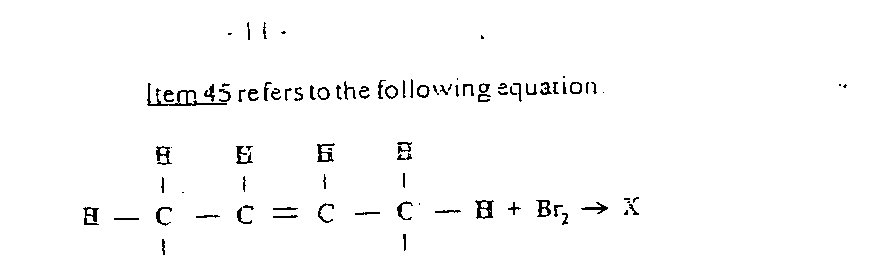
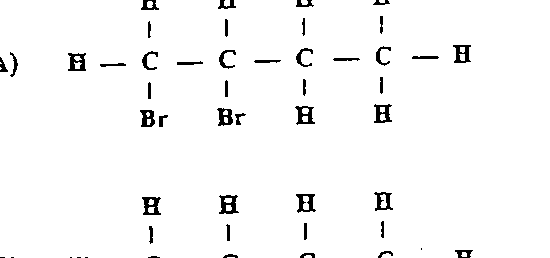
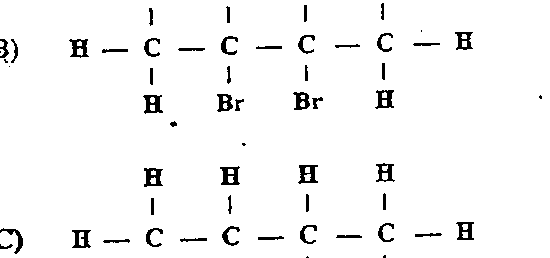
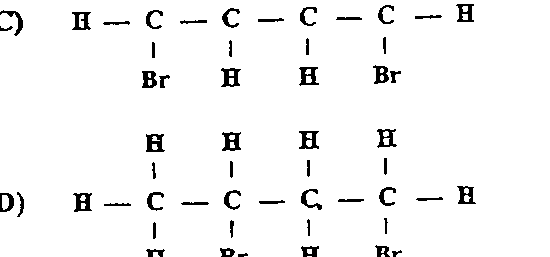
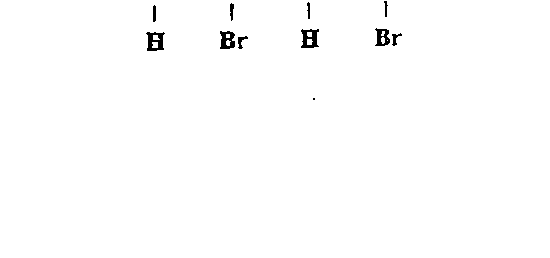
Which is the correct structural formula for X?
The compound, ethene, is described as being unsaturated. This means that the
carbon atoms in ethene are linked by single bonds
molecule has insufficient hydrogen atoms
carbon atoms in the molecule are very reactive
molecule contains at least one double bond
All members of a homologous series have similar
densities
boiling points
chemical properties
physical properties
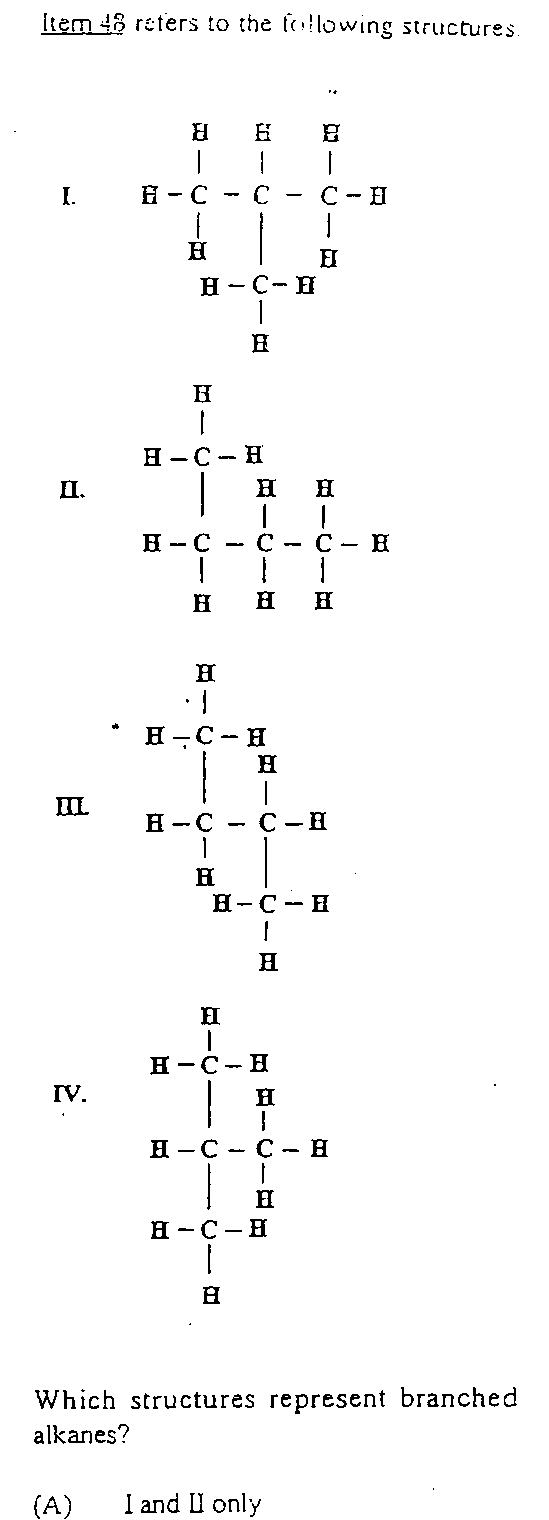
Item 48 refers to the following structures.
Which structures represent branched alkanes?
I and II only
I and IV only
II and IV only
I, II and III only
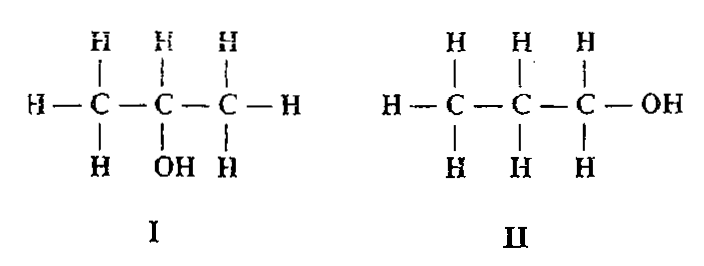
Item 49 refers to two organic compounds, I and II, of molecular formula C₃H₈O, with the following structures H H H H-C-C-C-H | | | H H H I H H H H-C-C-C-OH | | | H H H II
Compounds I and II are known as the
isomers of C₃H₈O
isotopes of C₃H₈O
condensed formulae of C₃H₈O
molecular formulae of C₃H₈O
Items 50-51 refer to the following compounds. I. Fats II. Nylon III. Proteins IV. Terylene
Which of the above compounds are synthetic?
I and II only
I and III only
II and III only
II and IV only
Ester linkage exists in
III only
I and III only
I and IV only
II and IV only
Which of the following is used in the breathalyser test to detect the presence of alcohol?
Lime water
Lightersplint
Bromine water
Potassium dichromate
Which equation BEST represents the balanced equation for the reaction between aqueous ethanoic acid and magnesium?
CH₃COOH(aq) + Mg(s) → CH₃COOMg(aq) + H₂(g)
2CH₃COOH(aq) + Mg(s) → (CH₃COO)₂Mg(aq) + H₂(g)
2CH₃COOH(aq) + Mg(s) → 2CH₃COOMg(s) + H₂(g)
2CH₃COOH(aq) + 2Mg(s) → (2CH₃COO)₂Mg₂(aq) + H₂(g)
During the manufacture of ethanol by fermentation, the gas evolved
relights a glowing splint
burns with a blue flame
turns lime water milky
turns potassium dichromate green
The reaction of fats with concentrated aqueous sodium hydroxide is commonly referred to as
condensation
esterification
neutralisation
saponification
When ethene reacts with steam the ethene is
decomposed to carbon
converted to ethanol
converted to an ester
oxidised to carbon dioxide
Chlorofluorocarbons are MAINLY responsible for
acid rain
the greenhouse effect
destruction of the ozone layer
destruction of limestone statues
Which two groups are present in the molecules of amino acids?
-NH, group and -COOH group
-NH, group and -OH group
-OH group and -COOH group
-COOH group and C=C group
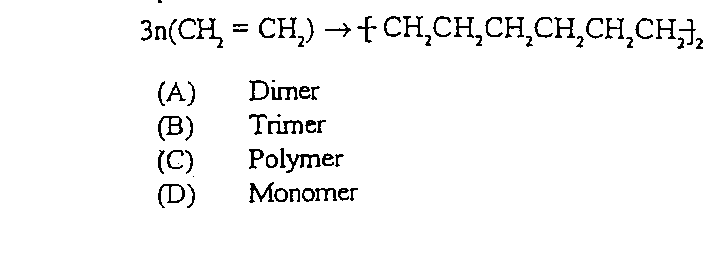
Which of the following names refers to the product formed in the reaction
Dimer
Trimer
Polymer
Monomer
Nylon is a macromolecule which is held together by the same linkage as a protein molecule. What is the name given to this type of linkage?
Ether linkage
Double bond
Ester linkage
Amide bond