12.
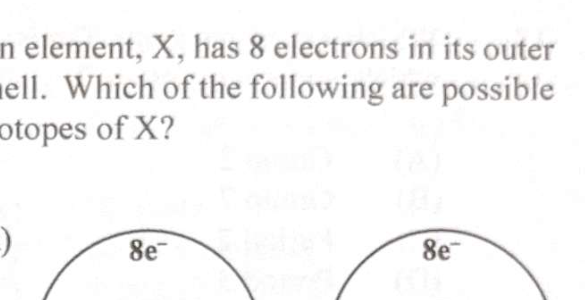
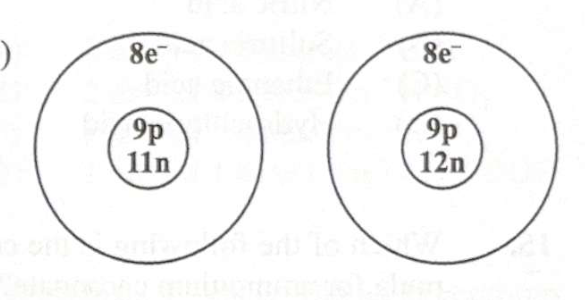
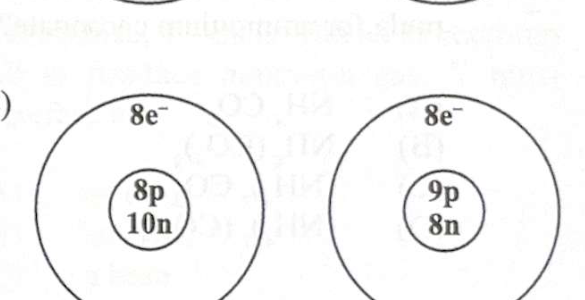
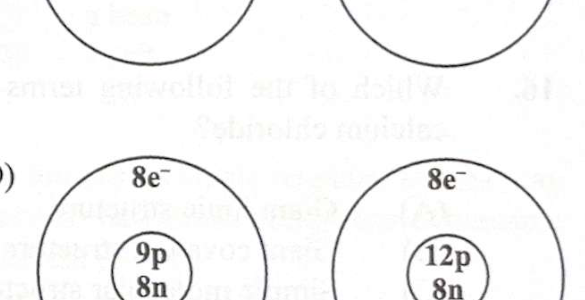
An element, X, has 8 electrons in its outer shell. Which of the following are possible isotopes of X?
- (A)
- (B)
- (C)
- (D)
Free CXC Chemistry Paper 1 May/June 2026 past paper from 2026. Includes a worked answer key. Open the PDF, take a timed test, and study with AI on Caribbean AI.
Answer keys are free on Caribbean AI. View the answers to every past-paper question at no cost - no payment needed - with step-by-step worked solutions and instant AI marking available on Premium.
CSEC Chemistry Paper 1 May/June 2026 - Free CXC Past Paper with Answers
Free CXC Chemistry Paper 1 May/June 2026 past paper from 2026. Includes a worked answer key. Open the PDF, take a timed test, and study with AI on Caribbean AI.
Opening the interactive papers…
Every question from this paper as text. See the answers and worked solutions. Questions are the property of the Caribbean Examinations Council; Caribbean AI is not affiliated with CXC.
'Mass number' is the number of
neutrons plus protons
electrons plus protons
electrons plus neutrons
neutrons minus protons
Which of the following statements is true with regard to protons?
Protons are negatively charged and are found in shells.
Protons are positively charged and are found in the nucleus.
Protons have no charge and are found in the nucleus.
Protons are positively charged and are found in the shells.
Which of the following terms describes the structure of copper?
Simple molecular
Macromolecular
Ionic crystals
Metallic
Which of the following techniques may be used to separate a mixture of plant pigments?
Centrifugation
Solvent extraction
Fractional distillation
Paper chromatography
The calcium ion has an oxidation number of +2 because the calcium atom has
two electrons in its outermost shell
six electrons in its outermost shell
two allotropes
two isotopes
Item 6 refers to Compound X which melts at 18 °C and boils at 55 °C.
Compound X is MOST likely
a liquid metal
a giant molecule
a simple molecule
an ionic compound
In which of the following compounds does hydrogen have a negative oxidation number?
CH₄
NaH
NH₃
H₂O₂
Which of the following mixtures are arranged in order of INCREASING particle size?
Solutions, colloids, suspensions
Solutions, suspensions, colloids
Colloids, solutions, suspensions
Suspensions, colloids, solutions
The rate of a chemical reaction does NOT depend on the
presence of a catalyst
concentration of the reactants
temperature of the reacting system
energy change associated with the reaction
Sodium hydrogen carbonate and hydrochloric acid reacted to produce sodium chloride. The mixture effervesced. The effervescence is caused by the evolution of
oxygen
hydrogen
carbon dioxide
hydrogen chloride
In order to prepare a sample of sodium chloride, 3 g of sodium hydrogen carbonate are added to 100 cm³ of 0.2 mol dm⁻³ hydrochloric acid. The number of moles of hydrochloric acid used in this reaction is
An element, X, has 8 electrons in its outer shell. Which of the following are possible isotopes of X?
Which set of elements forms molecules which contain two atoms?
Group 2
Group 7
Period 2
Period 3
Which of the following acids is weakly ionized in aqueous solutions?
Nitric acid
Sulfuric acid
Ethanoic acid
Hydrochloric acid
Which of the following is the correct formula for ammonium carbonate?
NH₄ CO₃
NH₄ (CO₃)₂
(NH₄)₂ CO₃
(NH₄)₂ (CO₃)₂
Which of the following terms describes calcium chloride?
Giant ionic structure
Giant covalent structure
Simple molecular structure
Macromolecular structure
Item 17 refers to the following graph which shows what occurs when a solution of sodium hydroxide is neutralized by the addition of dilute hydrochloric acid.
Which of the points on the graph represents the neutralization point of the reaction?
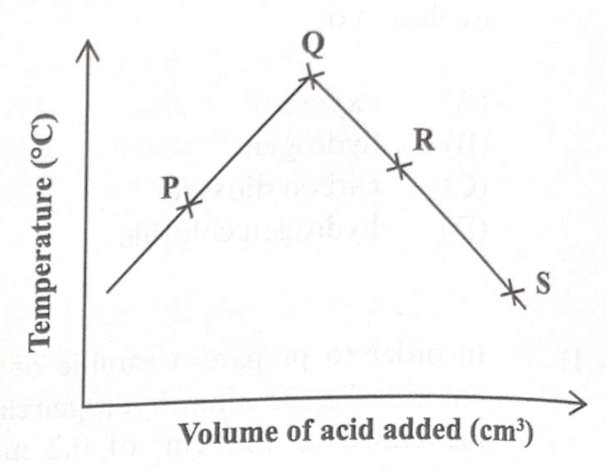
P
Q
R
S
Which of the following atoms would NOT form a positive ion?
Chlorine
Lithium
Hydrogen
Beryllium
Which of the following pairs of substances would be MOST suitable for the preparation of copper sulfate crystals?
Copper and dilute sulfuric acid
Copper and concentrated sulfuric acid
Copper nitrate and dilute sulfuric acid
Copper oxide and dilute sulfuric acid
Which of the following ionic equations involves oxidation?
The atomic number of Element D is 13. In which group of the periodic table would Element D be found?
5
4
3
2
Which of the following statements is true of an endothermic reaction?
Heat is given up to the surroundings.
Heat is absorbed from the surroundings.
The products have less energy than the reactants.
The products have the same energy as the reactants.
Which of the following substances, when added to pure water, SIGNIFICANTLY increases the water's conductivity?
Graphite
Sodium chloride
Iron(II) hydroxide
Copper(II) hydroxide
Which of the following aqueous solutions contains 1 mole of hydrogen ions?
2 dm³ of 0.5 mol dm⁻³ HCl
2 dm³ of 0.5 mol dm⁻³ H₂SO₄
1 dm³ of 1.0 mol dm⁻³ H₂SO₄
1 dm³ of 1.0 mol dm⁻³ CH₃COOH
A substance, Y, reacts with an ammonium salt to produce ammonia gas. Y must therefore be
an ester
an acid
a base
a salt
An ion with a single negative charge may be converted into a neutral atom of the same element by
gaining an electron
losing an electron
losing a neutron
losing a proton
How many coulombs (C) of electricity passes through an electrolyte when a current of 100 A flows for 10 minutes?
100
600
10 000
60 000
The particle has 12 protons. How many neutrons and electrons does the particle have?
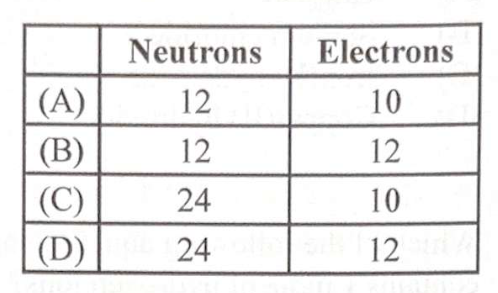
Neutrons 12 / Electrons 10
Neutrons 12 / Electrons 12
Neutrons 24 / Electrons 10
Neutrons 24 / Electrons 12
Which of the following oxides reacts with both acids and bases?
MgO
CuO
CaO
Item 30 refers to the following table.
The strongest acid is
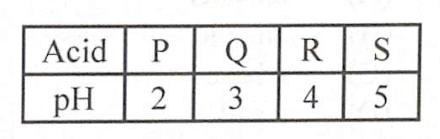
S
R
Q
P
In which of the following substances will electrolysis NOT occur when an electrical current is passed through it?
Sodium hydroxide solution
Molten sodium chloride
Solid sodium chloride
Dilute sulfuric acid
Barium is below calcium in Group II of the periodic table. When these two metals react with water, the main difference observed is the
rate of reaction
type of gas evolved
colour of the product
colour change with litmus
Which metal reacts vigorously with water to produce a strongly alkaline solution?
Al
Cu
Fe
Na
Which metal has an alloy which is used in the manufacture of aircraft?
Fe
Cu
Al
Na
Which of the following methods can be used in the extraction of aluminium?
Displacement by a metal higher up the electrochemical series
Electrolysis of the oxide in its molten state
Reduction of the oxide by hydrogen
Reduction of the oxide by carbon
Which of the following compounds may be used to counteract the effects of acid rain on the soil?
CaO
CO
Which of the following metals neither reacts with water nor displaces hydrogen from dilute hydrochloric acid?
Iron
Zinc
Copper
Calcium
Why is aluminium more resistant to corrosion than iron?
Aluminium oxide formed is more reactive than iron oxide formed.
Aluminium has reacted completely but iron has not reacted completely.
Aluminium oxide does not react with aluminium but iron oxide reacts with iron.
Aluminium oxide protects the aluminium but iron oxide does not protect the iron.
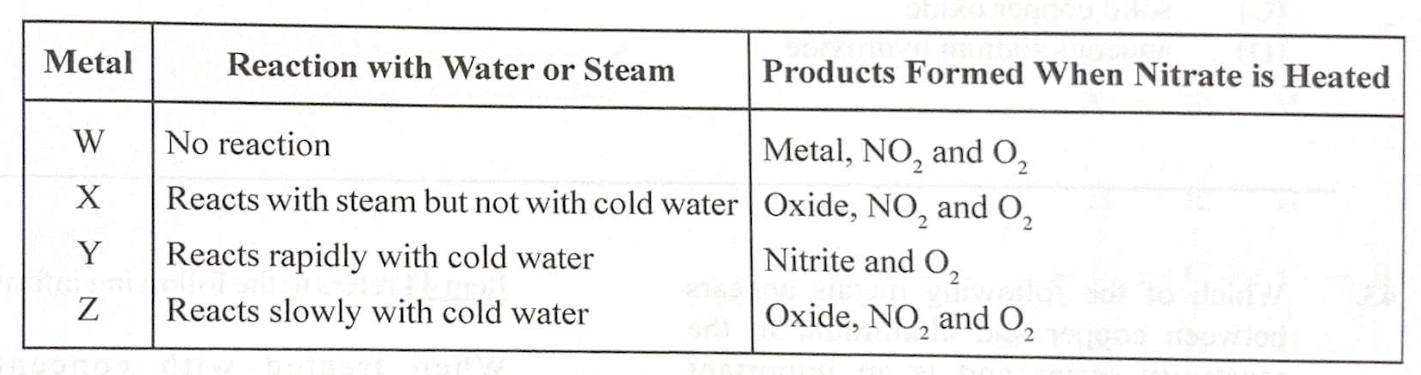
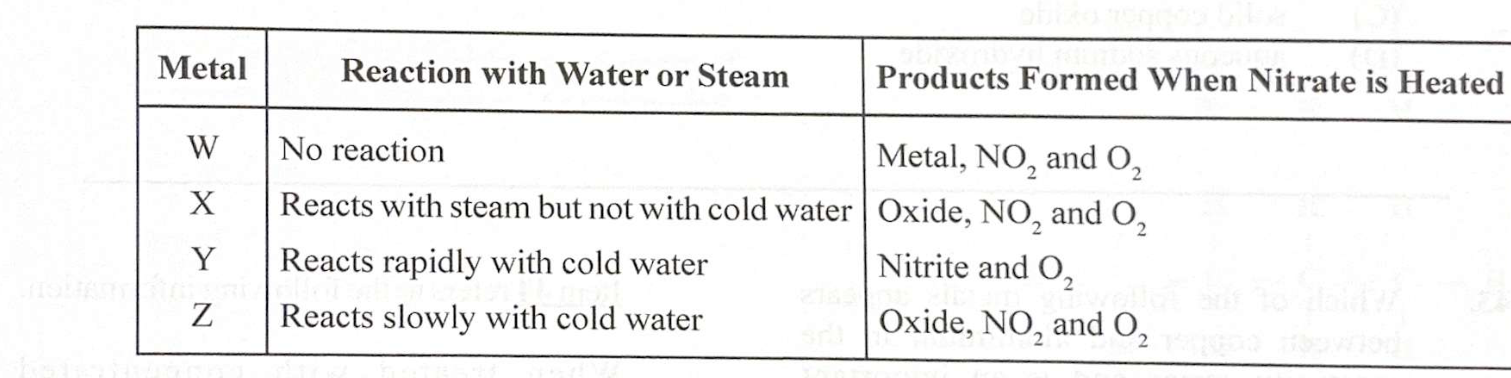
Item 39 refers to the following table which shows the reaction of four metals, W, X, Y and Z, with water or steam. The table also shows the products formed when the nitrates of each metal are heated.
| Metal | Reaction with Water or Steam | Products Formed When Nitrate is Heated | | Metal | Reaction with Water or Steam | Products Formed When Nitrate is Heated | | W | No reaction | Metal, NO and O | | X | Reacts with steam but not with cold water | Oxide, NO and O | | Y | Reacts rapidly with cold water | Nitrite and O | | Z | Reacts slowly with cold water | Oxide, NO and O |
Which of the metals is likely to form a soluble hydroxide?
Z
Y
X
W
Which of the following elements would NOT form an acidic oxide when burnt in air?
Sulfur
Carbon
Nitrogen
Magnesium
Ammonia may be produced in the laboratory by heating a mixture of ammonium chloride and
ammonium sulfate
calcium hydroxide
calcium chloride
copper
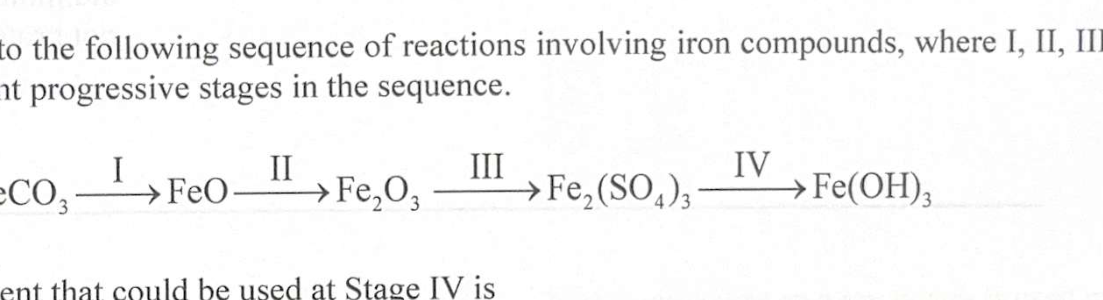
Item 42 refers to the following sequence of reactions involving iron compounds, where I, II, III and IV represent progressive stages in the sequence. <math xmlns="http://www.w3.org/1998/Math/MathML"><mi>F</mi><mi>e</mi><mi>C</mi><msub><mi>O</mi><mn>3</mn></msub><mover><mo>→<!-- → --></mo><mi>I</mi></mover><mi>F</mi><mi>e</mi><mi>O</mi><mover><mo>→<!-- → --></mo><mrow><mi>I</mi><mi>I</mi></mrow></mover><mi>F</mi><msub><mi>e</mi><mn>2</mn></msub><msub><mi>O</mi><mn>3</mn></msub><mover><mo>→<!-- → --></mo><mrow><mi>I</mi><mi>I</mi><mi>I</mi></mrow></mover><mi>F</mi><msub><mi>e</mi><mn>2</mn></msub><mo stretchy="false">(</mo><mi>S</mi><msub><mi>O</mi><mn>4</mn></msub><msub><mo stretchy="false">)</mo><mn>3</mn></msub><mover><mo>→<!-- → --></mo><mrow><mi>I</mi><mi>V</mi></mrow></mover><mi>F</mi><mi>e</mi><mo stretchy="false">(</mo><mi>O</mi><mi>H</mi><msub><mo stretchy="false">)</mo><mn>3</mn></msub></math>
A suitable reagent that could be used at Stage IV is
steam
hydrogen
solid copper oxide
aqueous sodium hydroxide
Which of the following metals appears between copper and aluminium in the reactivity series and is an important component in haemoglobin?
Magnesium
Lead
Iron
Zinc
Item 44 refers to the following information. When treated with concentrated hydrochloric acid, a compound gives off a greenish-yellow gas which bleaches moist red litmus paper.
The gas given off is
chlorine
sulfur dioxide
hydrogen sulfide
nitrogen dioxide
How many covalent bonds are there in a nitrogen molecule?
4
3
2
1
Item 46 refers to the following information.
A solution of iron(II) sulfate was added to a solution of barium nitrate until in EXCESS. The precipitate produced was filtered off and water was added to the residue in the filter paper.
The colour of the precipitate produced was
yellow
brown
green
white
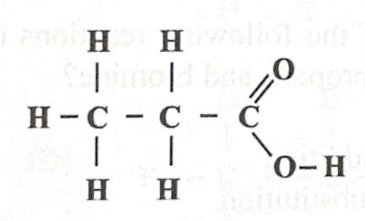
Item 47 refers to the following diagram of the fully displayed formula of a compound.
H H O | | || H-C-C-C | | H H O-H
To which homologous series does the compound belong ?
Alkanoic acids
Alcohols
Alkenes
Alkanes
When a hydrocarbon molecule is cracked, which of the following smaller molecules are produced?
I. An alkane II. An alkene III. An alcohol
I and II only
I and III only
II and III only
I, II and III
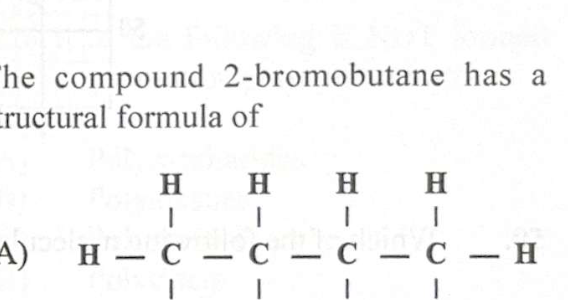
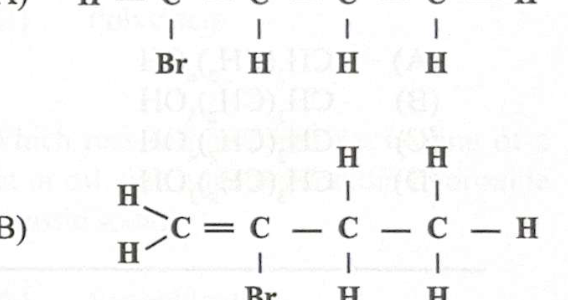
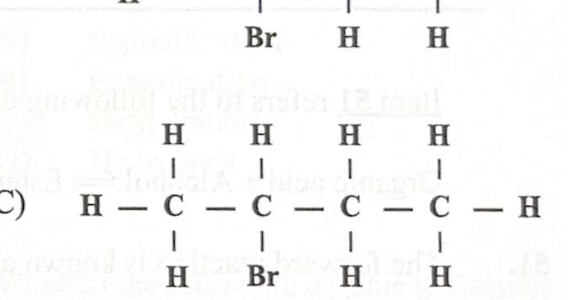
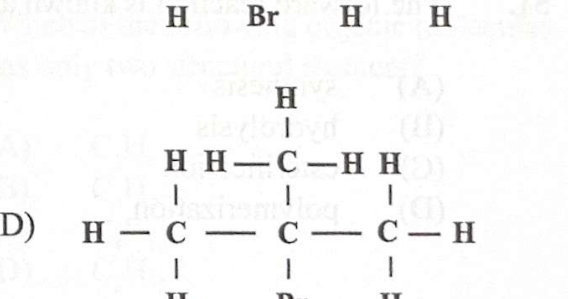
The compound 2-bromobutane has a structural formula of
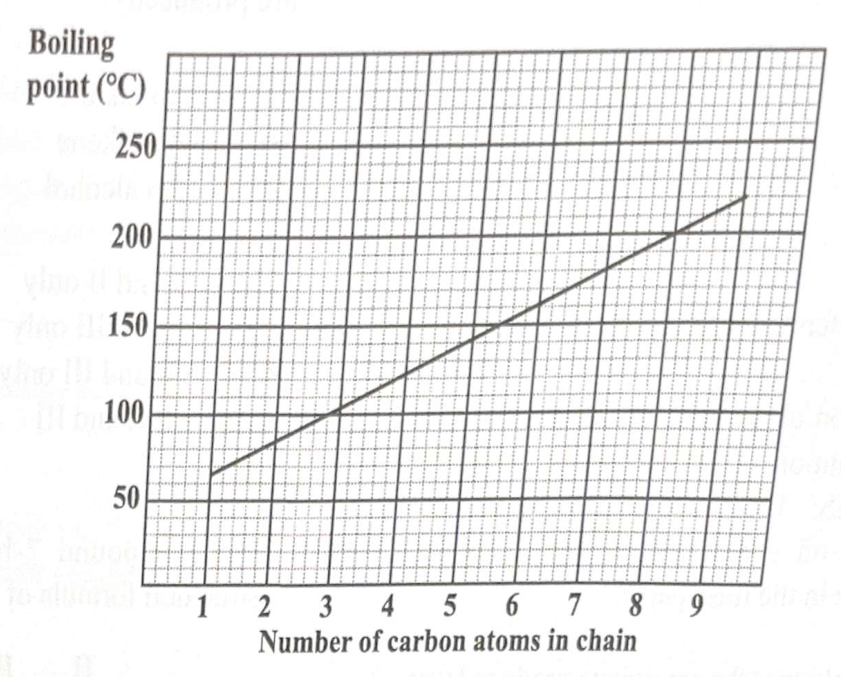
Which of the following molecular formulae represents the alcohol whose boiling point is 160 °C?
CH3(CH2)6OH
CH3(CH2)5OH
CH3(CH2)4OH
CH3(CH2)3OH
The forward reaction is known as
synthesis
hydrolysis
esterification
polymerization
Cellulose is an example of a polysaccharide that can be used for the manufacture of
guttering
pipe fittings
garbage bags
paper
Which of the following reactions occurs between propene and bromine?
Addition
Substitution
Precipitation
Condensation
Which of the following statements is true of soapless detergents?
They are made from fats.
They are all biodegradable.
They are inorganic materials.
They are not affected by hard water.
What is the name of the process by which proteins are formed from amino acids?
Addition
Isomerism
Esterification
Polymerization
Which of the following compounds can decolourize potassium manganate(VII)?
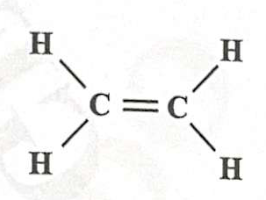
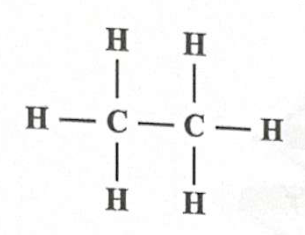
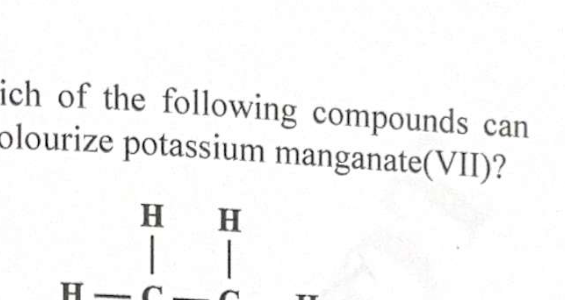
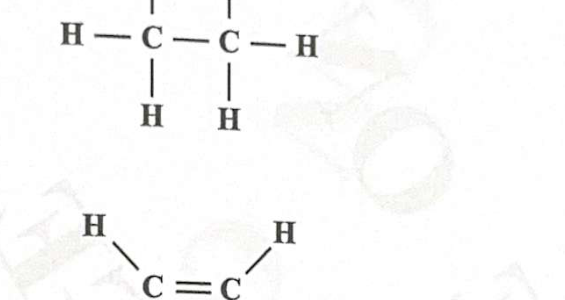
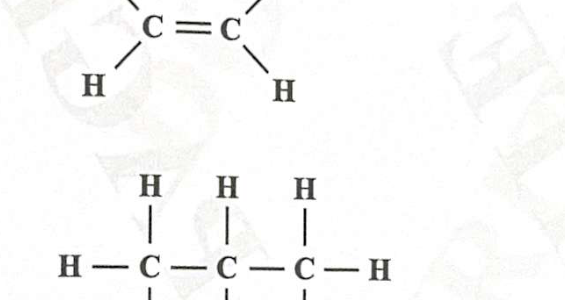
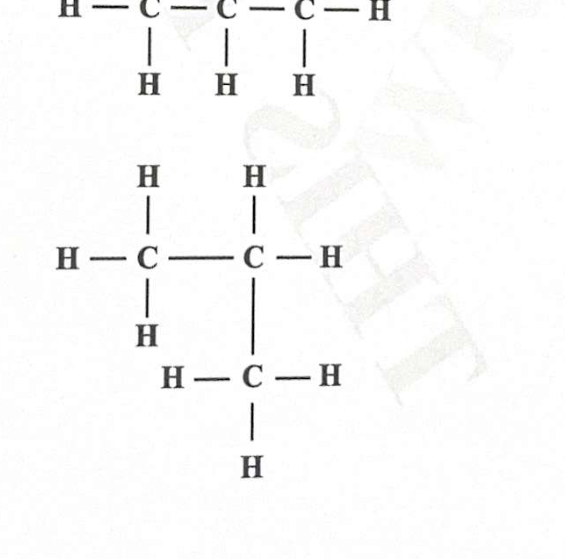
Octane, the major component of gasoline, is an alkane with eight carbon atoms per molecule. Which of the following formulae represents octane?
Which of the following is NOT formed from condensation polymerization?
Polysaccharides
Polyalkenes
Polyamides
Polyesters
Which reaction involves the boiling of a fat or oil with aqueous sodium hydroxide (caustic soda)?
Saponification
Esterification
Dehydration
Hydrolysis
Which of the following organic molecules has only two structural isomers?