9.
The mass concentration of a potassium chloride solution is 60gdm⁻³. What is the mass of potassium chloride in 25 cm³ of this solution?
- (A)
0.0015 g
- (B)
0.15 g
- (C)
1.5 g
- (D)
15 g
Free CXC Chemistry Paper 1 May/June 2010 past paper from 2010. Includes a worked answer key. Open the PDF, take a timed test, and study with AI on Caribbean AI.
Answer keys are free on Caribbean AI. View the answers to every past-paper question at no cost - no payment needed - with step-by-step worked solutions and instant AI marking available on Premium.
CSEC Chemistry Paper 1 May/June 2010 - Free CXC Past Paper with Answers
Free CXC Chemistry Paper 1 May/June 2010 past paper from 2010. Includes a worked answer key. Open the PDF, take a timed test, and study with AI on Caribbean AI.
Opening the interactive papers…
Every question from this paper as text. See the answers and worked solutions. Questions are the property of the Caribbean Examinations Council; Caribbean AI is not affiliated with CXC.
Which of the following is a characteristic of a non-metal?
It is a good conductor of heat and electricity.
It has a low melting point and boiling point.
It forms basic oxides.
It has a high ionization energy.
Which of the following elements has the highest first ionization energy?
Na
Mg
Al
Si
Which of the following is a characteristic of a halogen?
It is a noble gas.
It is a metal.
It has 7 valence electrons.
It forms positive ions.
Which of the following is the correct order of reactivity for the halogens?
I > Br > Cl > F
F > Cl > Br > I
Cl > F > Br > I
Br > I > Cl > F
Which of the following is the most electronegative element?
Oxygen
Nitrogen
Fluorine
Chlorine
Which of the following is the correct electronic configuration for a sodium ion, Na?
$2.8.1$
$2.8.8$
Which of the following is the correct electronic configuration for a chloride ion, Cl?
$2.8.7$
$2.8.8$
Which of the following is the correct electronic configuration for a magnesium ion, Mg?
$2.8.2$
$2.8.8$
The mass concentration of a potassium chloride solution is 60gdm⁻³. What is the mass of potassium chloride in 25 cm³ of this solution?
0.0015 g
0.15 g
1.5 g
15 g
The number of shared electron pairs in a methane molecule is
4
6
8
10
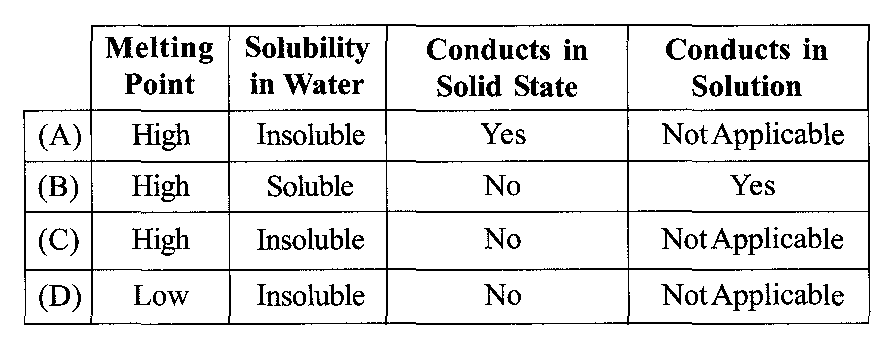
Items 11-13 refer to the information in the table below.
Match each item below with ONE of the options, A, B, C, D above. Each option may be used more than once, once or not at all.
Simple molecular structure
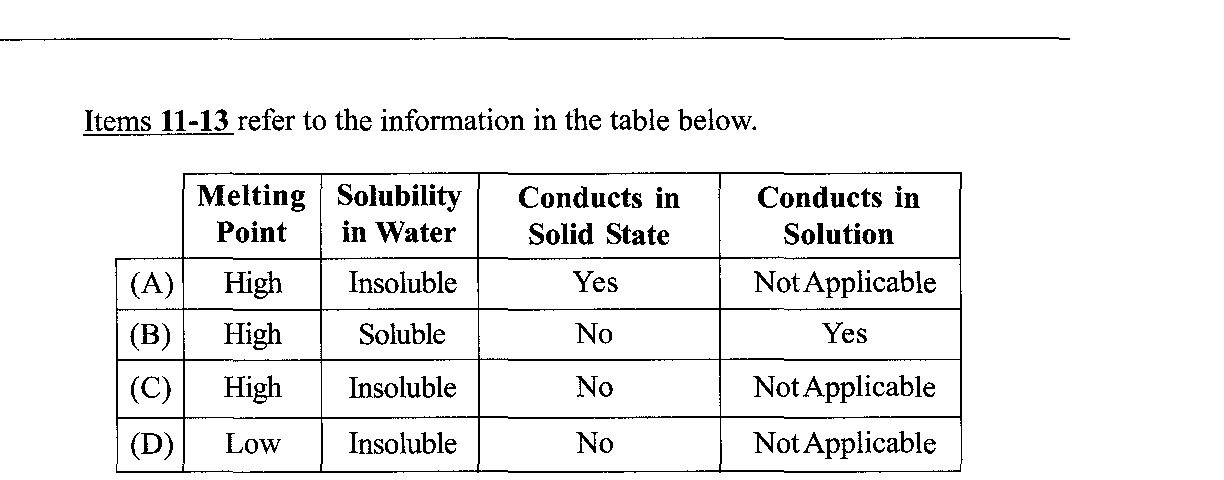
High / Insoluble / Yes / Not Applicable
High / Soluble / No / Yes
High / Insoluble / No / Not Applicable
Low / Insoluble / No / Not Applicable
Ionic structure
High / Insoluble / Yes / Not Applicable
High / Soluble / No / Yes
High / Insoluble / No / Not Applicable
Low / Insoluble / No / Not Applicable
Metallic structure
High / Insoluble / Yes / Not Applicable
High / Soluble / No / Yes
High / Insoluble / No / Not Applicable
Low / Insoluble / No / Not Applicable
Graphite can be used as a lubricant because of
strong attraction among the hexagonal layers of carbon atoms
weak attraction among the hexagonal layers of carbon atoms
the loose electrons which can move throughout the lattice
strong attraction within the hexagonal layers of carbon atoms
Which of the following substances is a suspension?
Milk
Gasoline
Chalk in water
Sugar in water
When a saturated solution of copper(II) sulphate is cooled, crystals of copper(II) sulphate-5-water begin to form because solubility of copper(II) sulphate-5-water
decreases with decreasing temperature
decreases with increasing temperature
increases with decreasing temperature
increases with increasing temperature
A separating funnel can be used to separate a mixture of
water and ethanol
water and kerosene
water and solid sodium chloride
kerosene and solid sodium chloride
In the portion of the periodic table indicated below, which of the elements, A, B, C and D, is MOST easily ionized?
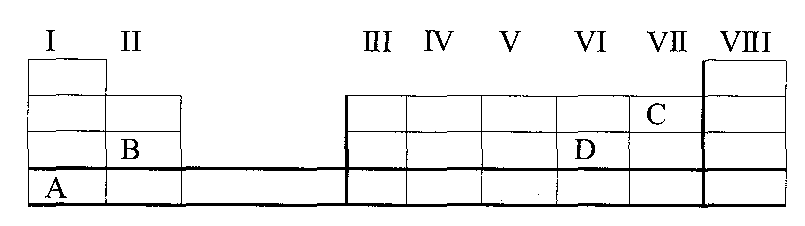
A
B
C
D
Which of the following is NOT true of the group of elements known as the halogens?
They are all nonmetals.
They form negative ions by the loss of electrons from their atoms.
The boiling point of the elements increases as their atomic numbers increase.
The oxidizing power of the elements decreases as their atomic numbers increase.
A solution has a pH of 1. This solution would be expected to
neutralise a solution of pH 4
react with zinc metal to produce a solution of pH 10
react with zinc metal to produce hydrogen
react with hydrochloric acid to produce a salt and water
Ethanoic acid is a weak acid because it
is a carboxylic acid
does not irritate the skin
is not completely ionized in water
produces one hydrogen ion per molecule
A substance P, has the following properties. I. It is insoluble in water. II. A gas is evolved when P is added to dilute acids. III. P gives off a gas when heated. P is MOST likely
zinc oxide
calcium hydroxide
potassium carbonate
copper(II) carbonate
A specific base reacts with a salt to produce a gas which turns damp red litmus paper blue. Which of the following ions does the salt contain?
Ammonium
Carbonate
Nitrate(V)
Sulphate(VI)
Which of the following salts can be prepared by mixing two solutions and then filtering? I. Barium sulphate II. Calcium nitrate III. Silver chloride IV. Ammonium carbonate
I and II only
I and III only
II and IV only
III and IV only
A solution, when treated with the gas sulphur dioxide, becomes green. Which of the following does the solution contain?
Potassium nitrate
Potassium sulphate
Potassium dichromate(VI)
Potassium manganate(VII)
In which of the following reactions is sulphur dioxide acting as an oxidising agent?
Which of the following pairs of reactions would you expect to take place? I. II. III. IV.
I and III only
II and III only
II and IV only
III and IV only
Which of the following statements are true? I. Metals conduct electricity by the movement of electrons. II. Electrolytes conduct electricity by the movement of positive and negative ions. III. Electrolytes conduct electricity by the movement of electrons.
I and II only
I and III only
II and III only
I, II and III
During the electrolysis of aqueous copper(II) sulphate solution using inert electrodes, the ions migrating to the cathode are
Cu (aq) and (aq) SO
H (aq) and OH(aq)
SO (aq) and OH(aq)
Cu (aq) and H (aq)
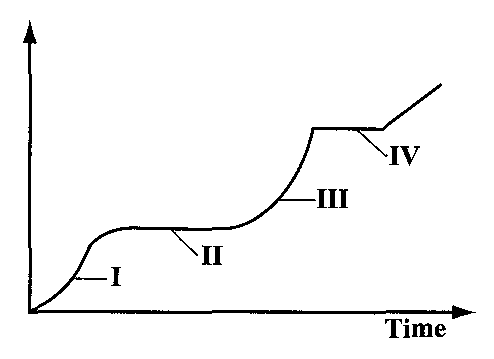
Item 30 refers to the following graph which shows the changes in temperature with time, for a substance heated until no further physical change takes place.
At which portion of the curve, I, II, III and IV, is the substance a liquid only?
I
II
III
IV
Which of the following is NOT achieved by one Faraday of electricity?
Deposit of one mole of any element during electrolysis
Deposit of 12 g of magnesium during electrolysisC
Migration of Avogadro's number of electrons
Passage of electricity equivalent to 96 500
What quantity of electricity passes through the electrolyte when a current of 100 A flows for 10 minutes?
100 C
600 C
10 000 C
60 000 C
A piece of metal is reacted with an acid to produce hydrogen gas. Which of the following procedures should be employed in order to increase the rate of the reaction? I. Increasing the temperature at which the reaction is carried out II. Subdividing the lump of metal III. Reducing the concentration of the acid
I and II only
I and III only
II and III only
I, II and III
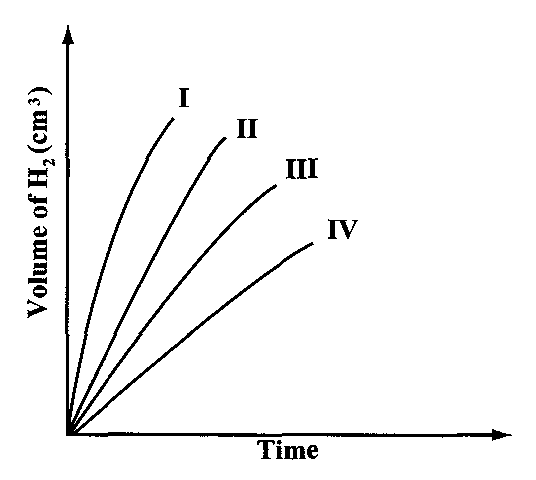
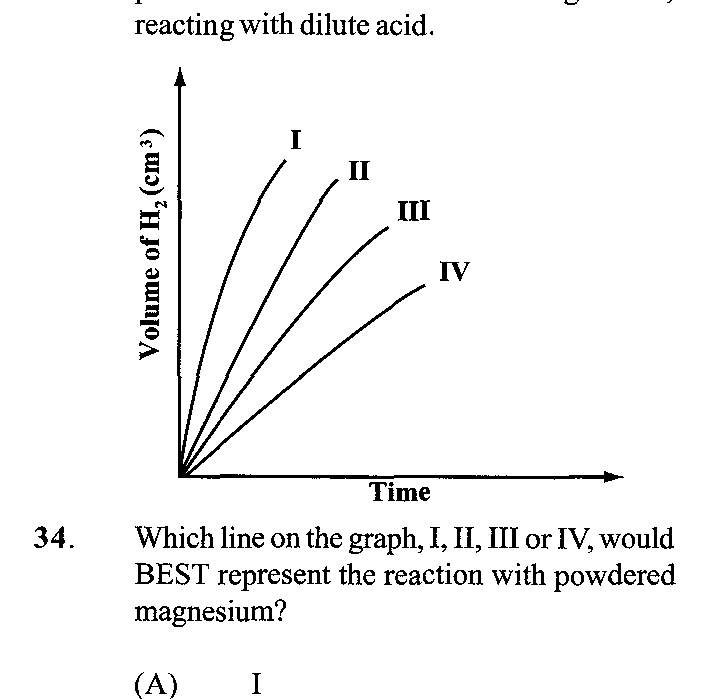
Item 34 refers to the graph below which shows the rate of reaction for different particle sizes of the same mass of magnesium, reacting with dilute acid.
Which line on the graph, I, II, III or IV, would BEST represent the reaction with powdered magnesium?
I
II
III
IV
Which of the following is true of an endothermic reaction?
Heat is given up to the surroundings.
Heat is absorbed from the surroundings.
The products have less energy than the reactants.
The products have the same energy as the reactants.
When crystals of potassium nitrate are dissolved in water, the temperature of the solution decreases because
energy is required to break down the crystal structure of the potassium nitrate
heat is always absorbed when a substance dissolves
the energy content of dissolved potassium nitrate is lower than that of solid potassium nitrate
the energy content of dissolved potassium nitrate is higher than that of solid potassium nitrate
The members of a homologous series have
different chemical properties
the same physical properties
the same functional group
different general formulae
Which of the following compounds is NOT a member of the alkene series?
Items 39-40 refer to the following options.
Match each item below with ONE of the options above, each of which may be used more than once, once or not at all.
An alcohol
An alkane
Isomerism is a property shown by compounds possessing
the same structures but different molecular formulae
different structures and different empirical formulae
the same structures but different empirical formulae
different structures but the same molecular formulae
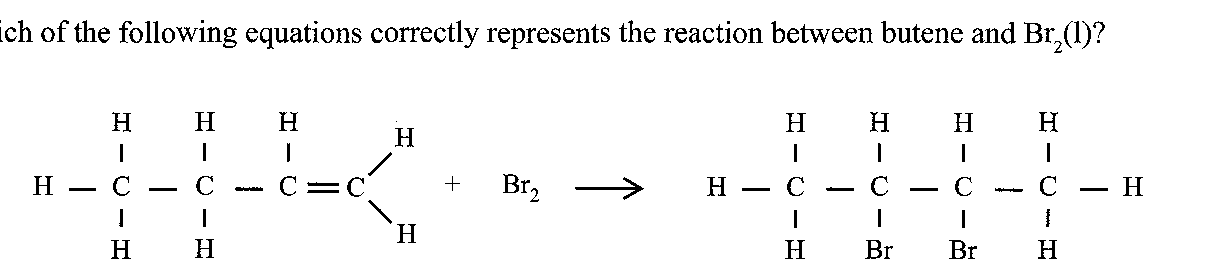
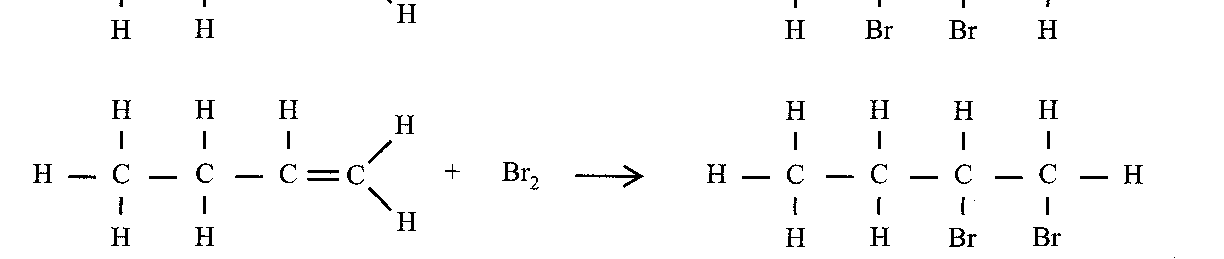
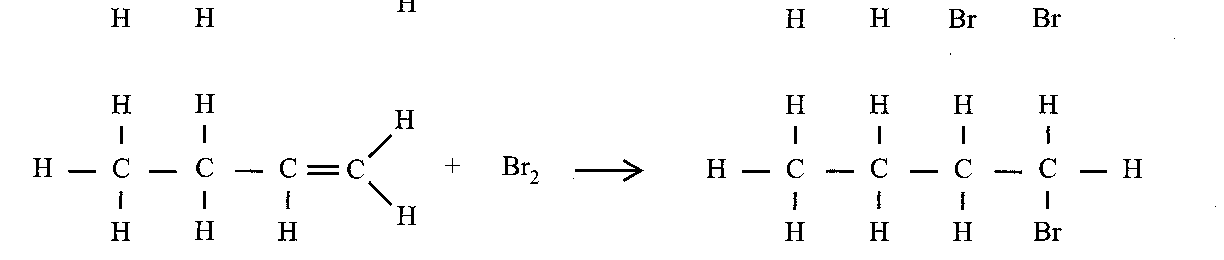
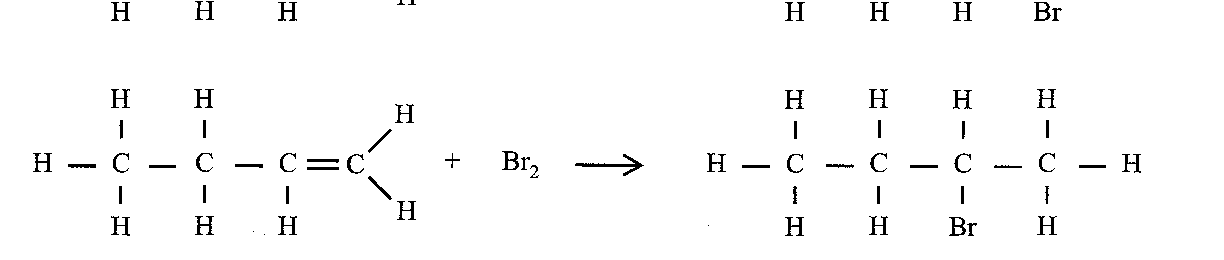
Which of the following equations correctly represents the reaction between butene and Br₂(l)?
Which of the following reactions correctly represents the dehydration of ethanol?
CH₃CH₂OH → CH₃COOH
CH₃CH₂OH → CH₃CHO
CH₃CH₂OH → C₂H₄
CH₃CH₂OH → 2CO₂ + 3H₂O
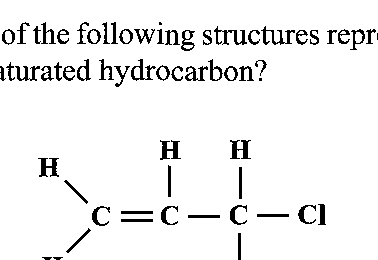
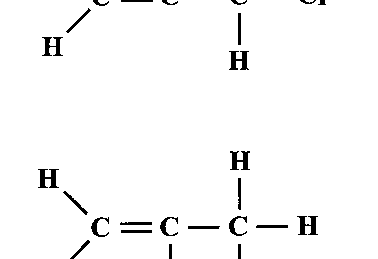
Which of the following structures represents an unsaturated hydrocarbon?
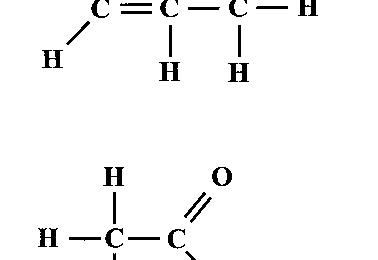
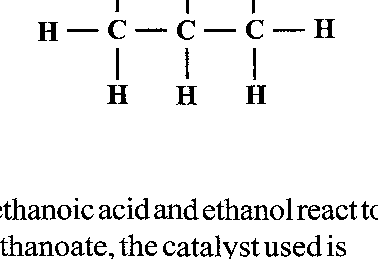
When ethanoic acid and ethanol react to form ethyl-ethanoate, the catalyst used is
dilute sulphuric acid
dilute hydrochloric acid
concentrated hydrochloric acid
concentrated sulphuric acid
When hydrocarbons with 5 to 12 carbon atoms are cracked, which of the following can be obtained?
I. Ethene II. Propene III. Methane IV. Petroleum
I and II only
I and IV only
I, II and III only
II, III and IV only
Which of the following statements are true for the fermentation of carbohydrates to produce ethanol?
I. The enzymes are obtained from yeast. II. The reaction mixture is kept at 50 °C. III. Carbon dioxide is a by-product of the reaction. IV. Ethanol is obtained from the mixture by titration.
I and III only
I and IV only
II and III only
II and IV only
Which of the following compounds produces amino acids, when hydrolysed?
Fat
Starch
Protein
Polyamine
Sodium chloride solution is used in the laboratory preparation of soap to
increase the solubility of the soap
make the soap more biodegradable
make the soap produce more lather in hard water
separate the glycerol formed from the soap
Which of the following statements about polymers are true?
I. Polymers are long-chain molecules made by joining together a large number of monomer units. II. Condensation polymers are generally made up from one type of monomer. III. Addition polymerization involves the breaking of a C = C double bond in the monomer.
I and II only
I and III only
II and III only
I, II and III
Which of the following compounds are naturally occurring?
I. Terylene II. Nylon III. Fats IV. Proteins
I and II only
I and III only
II and III only
III and IV only
Which of the following can decolourize potassium manganate(VII)?
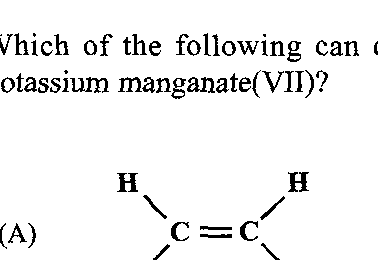
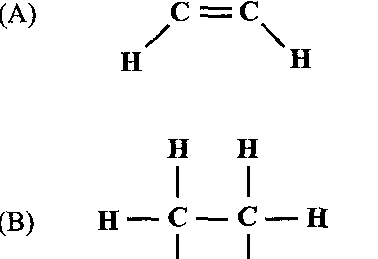
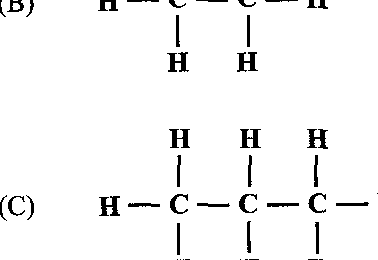
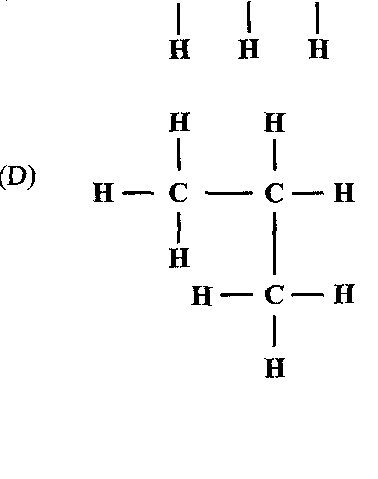
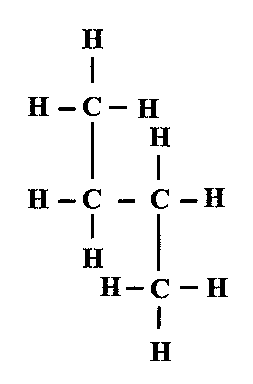
Item 53 refers to the following structures.
Which structures represent branched alkanes?
I and II only
I and IV only
III and IV only
I, II and III only
Which of the following are properties of a metal? I. High melting point II. Good oxidizing agent III. Good conductor of electricity IV. Low density
I and III only
II and IV only
I, II and III only
I, III and IV only
Which of the following can be extracted by chemical reduction?
K
Ca
Mg
Fe