Free CXC Chemistry Paper 1 January 2005 past paper from 2005. Includes a worked answer key. Open the PDF, take a timed test, and study with AI on Caribbean AI.
Answer keys are free on Caribbean AI. View the answers to every past-paper question at no cost - no payment needed - with step-by-step worked solutions and instant AI marking available on Premium.
CSEC Chemistry Paper 1 January 2005 - Free CXC Past Paper with Answers
Free CXC Chemistry Paper 1 January 2005 past paper from 2005. Includes a worked answer key. Open the PDF, take a timed test, and study with AI on Caribbean AI.
Opening the interactive papers…
Every question from this paper as text. See the answers and worked solutions. Questions are the property of the Caribbean Examinations Council; Caribbean AI is not affiliated with CXC.
From which of the following can a solid be obtained by the process of sedimentation?
Gels
Emulsions
Foams
Suspensions
Which of the following actions will usually INCREASE the rate of catalytic decomposition of hydrogen peroxide?
Increasing the temperature
Applying greater external pressure
Using a larger volume of hydrogen peroxide
Using the catalyst in lumps rather than in powder form
Which of the following BEST describes sodium chloride?
Ionic crystal
Metallic crystal
Molecular crystal
Macromolecule
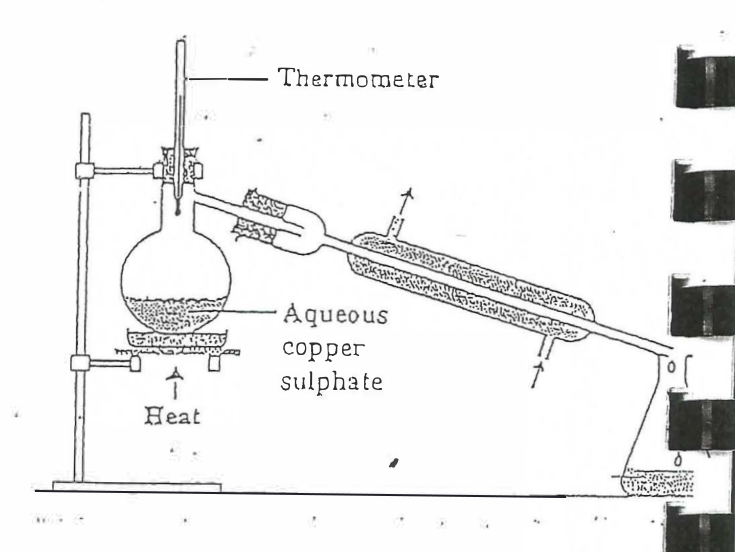
Item 4 refers to the following apparatus which is used to distill some aqueous copper sulphate solution.
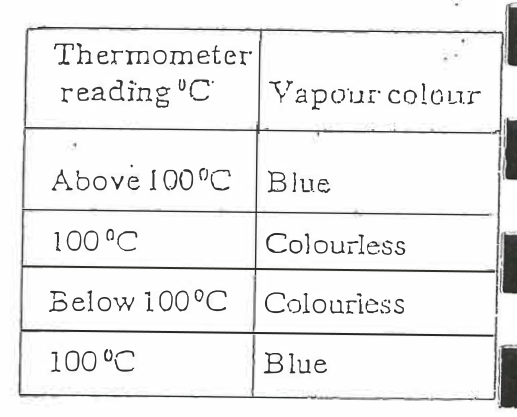
When the solution is boiling, what will be the reading on the thermometer and the colour of the vapour?
Above 100°C / Blue
100°C / Colourless
Below 100°C / Colourless
100°C / Blue
Sodium and potassium compounds behave in similar ways because both elements
do not occur in the free state
have low relative densities
belong to the same group of the periodic table
are extracted from their chlorides by electrolysis
Which of the following sequences is correct for the process of distillation?
Evaporation → cooling → heating → condensation
Heating → evaporation → cooling → condensation
Evaporation → heating → condensation → cooling
Heating → evaporation → condensation → cooling
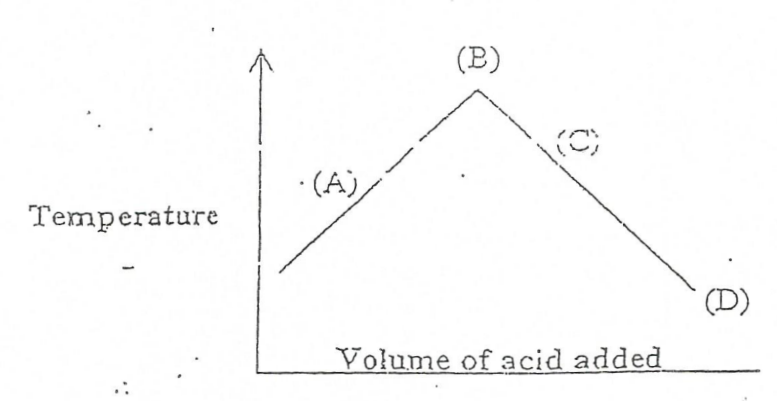
Which part of the curve BEST represents the neutralisation point of the reaction?
(A)
(B)
(C)
(D)
In which of the following reactions is there a DECREASE in the oxidation state of the metal?
Mg(s)+2H⁺(aq) → Mg²⁺(aq)+H₂(g)
Al³⁺(aq) + 3e⁻ → Al(s)
Fe³⁺(aq) +3OH⁻(aq)→ Fe(OH)₃(s)
Al₂O₃(l)→2A1³⁺(l) +3O²⁻(l)
Which of the following BEST describes the difference between an atom and an ion?
An atom is electrically neutral but an ion is positively charged.
An atom is electrically neutral but an ion is negatively charged.
An atom contains equal numbers of protons and electrons whereas an ion contains more electrons than protons.
An atom contains equal numbers of protons and electrons whereas an ion contains unequal numbers of protons and electrons.
Which of the atoms listed below form a positive ion?
Beryllium
Hydrogen
Lithium
Chlorine
The number of sodium hydrogencarbonate molecules added to the hydrochloric acid is
A solution has a pH of 1. This would be expected to
react with zinc metal to produce hydrogen
react with zinc metal to produce a solution of pH 10
neutralise a solution of pH 7
react with hydrochloric acid to produce a salt and water
A solution, X, is added to acidified aqueous potassium iodide which turns brown. Addition of starch to the solution results in a dark blue colouration. It is possible that solution X contains
ions
a reducing agent
ions
an oxidising agent
Which of the following would allow the passage of an electric current through it?
Solid potassium bromide
Pure water
Sugar solution
Sodium chloride solution
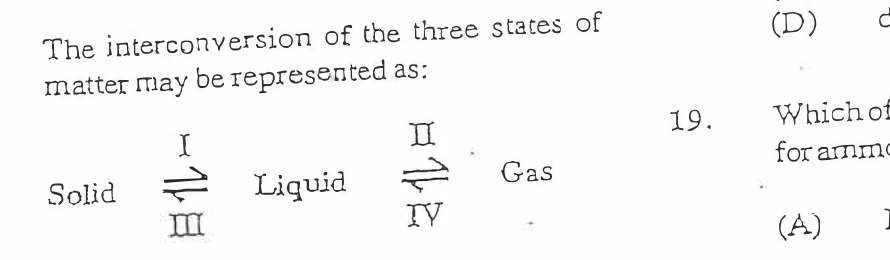
The interconversion of the three states of matter may be represented as:
Which two of the following changes are exothermic?
I and II
I and III
III and IV
II and IV
Items 16-17 refer to the following processes. (A) Neutralisation (B) Reduction (C) Synthesis (D) Electrolysis
In answering items 16-17, a particular choice from the above may be made more than once or not at all.
Which process is used to obtain
bromine from liquid lead bromide?
Neutralisation
Reduction
Synthesis
Electrolysis
potassium nitrate from nitric acid?
Neutralisation
Reduction
Synthesis
Electrolysis
Acetic/ethanoic acid is a weak acid because it
produces one hydrogen ion per molecule
is a carboxylic acid
is not completely ionized in water
does not irritate the skin
Which of the following is the correct formula for ammonium carbonate?
Which of the following pairs of substances would be MOST suitable for the preparation of copper sulphate crystals?
Copper and dilute sulphuric acid
Copper and concentrated sulphuric acid
Copper nitrate and dilute sulphuric acid
Copper oxide and dilute sulphuric acid
Which of the following would be correct?
I. 1 mole of sulphuric acid is neutralised by 1 mole of barium hydroxide. II. Barium sulphate is soluble. III. Barium hydroxide is a strong alkali.
I only
I and II only
II and III only
I, II and III
Anodizing is a process which may BEST be described as the
dissolving of the anode in the elec- trolyte
thickening of the oxide layer on the surface of the anode
liberation of oxygen on the surface of the anode
electroplating of the anode by a metal
Which of the following properties would be exhibited by covalent substances?
I. They are mostly liquids and gases. II. They are generally insoluble in water. III. They generally have low melting points. IV. The majority of them do not conduct electricity.
I only
II and III only
II, III and IV only
I, II, III and IV
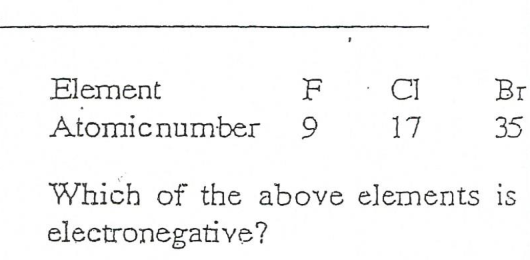
Which of the above elements is electronegative?
F
Cl
Br
I
Which acid, when dilute, reacts with nitrate to produce a white precipitate dissolves in excess aqueous ammonia?
Sulphuric acid
Hydrochloric acid
Nitric acid
Ethanoic acid
Which of the following are physical properties of ionic substances?
I. Formation of white crystals II. High melting points III. Good conductors of electricity in solid state IV. Good conductors of electricity in liquid state
I and IV only
II and III only
II and IV only
III and IV only
Which form of carbon is used for cutting metals?
Charcoal
Coke
Graphite
Diamond
Radioactive isotopes are NOT normally used in the
determination of the age of fossils
treatment of cancer
treatment of influenza
powering of certain types of sub-marines..
Which of the following statements is NOT true in relation to acids? Acids react with
carbonates to give carbon dioxide only
active metals to form a salt and liberate hydrogen only
metal oxides to form a salt and water only
metal hydroxides to form a salt and water only
Which of the following has the greatest percentage by mass of carbon present in one mole? (M_r = relative molecular mass; relative atomic mass: H=1; C = 12; O = 6)
C₂H₄O₂ (M_r = 60)
C₆H₁₂O₆ (M_r = 180)
C₂H₂O (M_r = 46)
C₃H₈O (M_r = 60)
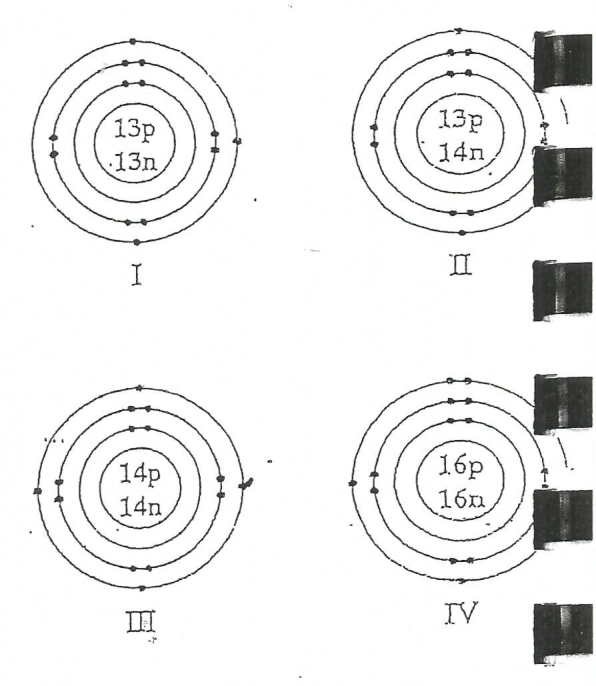
Item 31 refers to the following diagrams which represent the structure of four atoms
Which atom would show an oxidation state of -2?
I
II
III
IV
Which of the following requires the largest number of moles of electrons to liberate on mole of it?
Cl⁻
Al³⁺
Cu²⁺
O²⁻
The oxygen atom in a molecule of water surrounded by
2 bonding pairs of electrons and non-bonding pairs
4 bonding pairs of electrons
4 non-bonding pairs of electrons
3 bonding pairs of electrons and non-bonding pair
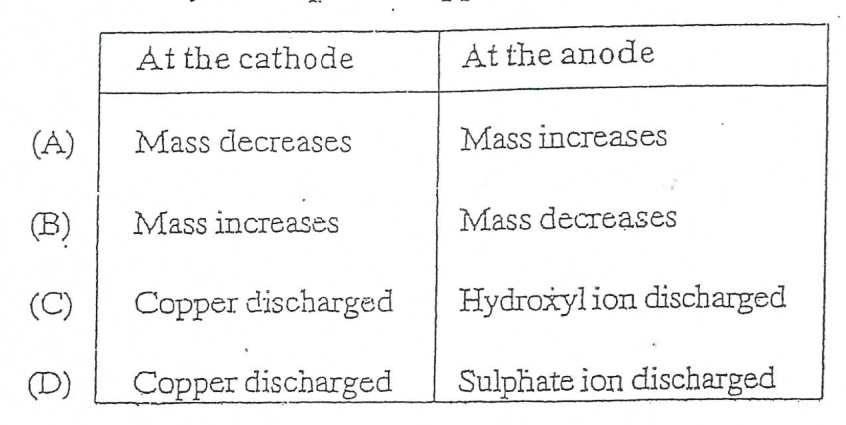
Which of the following is true of the changes taking place at the electrodes during the electrolysis of aqueous copper (II) sulphate using copper electrodes?
Mass decreases / Mass increases
Mass increases / Mass decreases
Copper discharged / Hydroxyl ion discharged
Copper discharged / Sulphate ion discharged
Which of the following is the oxidation number of X in the compound Na₂X₂O₃?
+1
+2
+3
+4
The condensation of steam is an exothermic reaction. Which of the following would therefore be true? I. Heat is absorbed. II. Heat is evolved. III. ΔH is negative. IV. ΔH is positive.
I only
II and III only
I and IV only
I, II and III only
Both glass and ceramics contain the non-metal
phosphorus
nitrogen
silicon
sulphur
Many fertilisers contain ammonium because these salts
are all very soluble in water
improve the texture of the soil
dissolve to give acidic solution which keep away pests
are a source of nitrogen which is essential to plant growth
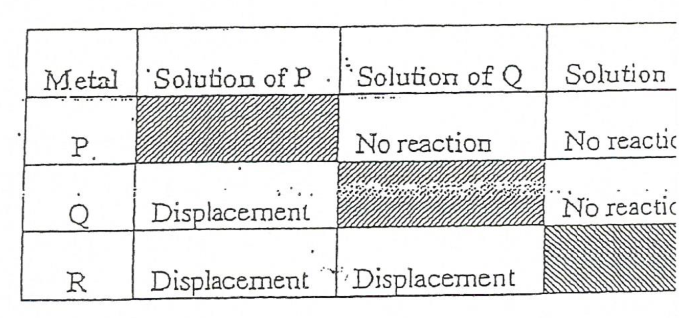
Item 39 refers to the following table.
| Metal | Solution of P | Solution of Q | Solution |
|---|---|---|---|
| P | No reaction | No reaction | |
| Q | Displacement | No reaction | |
| R | Displacement | Displacement |
Which of the following gives the correct order of descending reactivity, (most reactive first), for metals P, Q and R?
R, Q, P
P, Q, R
Q, R, P
R, P, Q
Which of the following fractions of petroleum distillation is used in paving surfaces?
Refinery gas
Kerosene
Fuel oil
Residue
A metal, M, can be extracted by roasting its ore in air with carbon. Metal M could be
Mg
Al
Ca
Fe
A recently discovered element is thought to be a metal. Which of the following physical properties would BEST confirm this?
Melting point
Electrical conductivity
Density
Hardness
When ethanoic acid and ethanol react to form ethyl ethanoate, the catalyst used is
dilute hydrochloric acid
concentrated hydrochloric acid
dilute sulphuric acid
concentrated sulphuric acid
With which of the following substances would n-octane (an alkane, C₈H₁₈), react?
Chlorine
Hydrogen
Hydrogen bromide
Steam
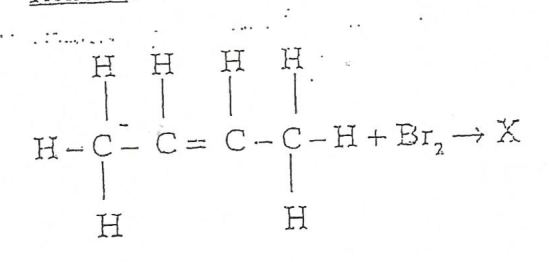
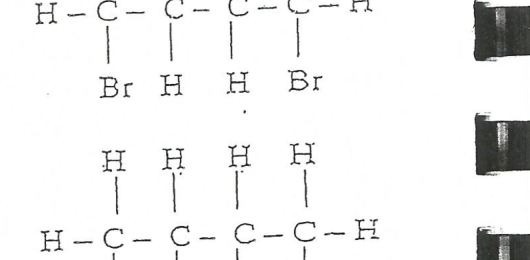
Item 45 refers to the following equation HHHH H-C-C=C-C-H + Br₂ → X H H H H
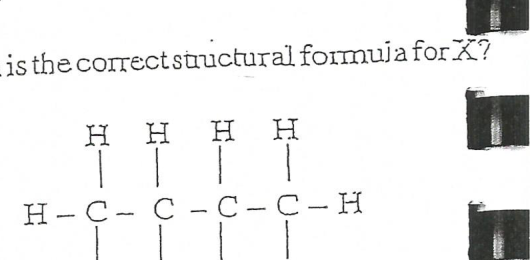
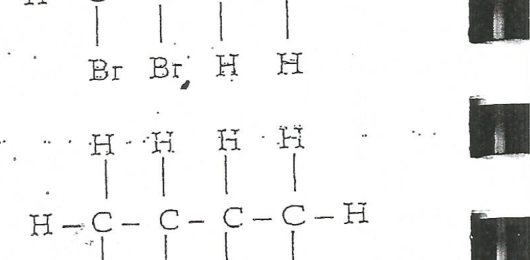
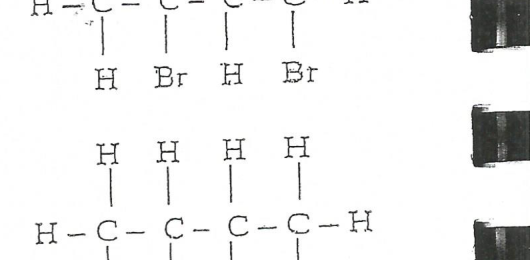
Which is the correct structural formula for X?
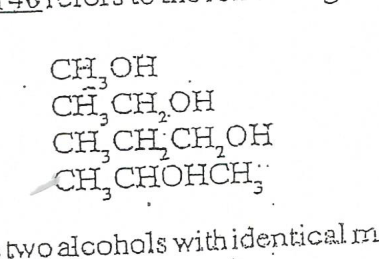
Item 46 refers to the following alcohols. I. CH₃OH II. CH₃CH₂OH III. CH₃CH₂CH₂OH IV. CH₃CHOHCH₃
The two alcohols with identical molar masses are
I and III
II and III
II and IV
III and IV
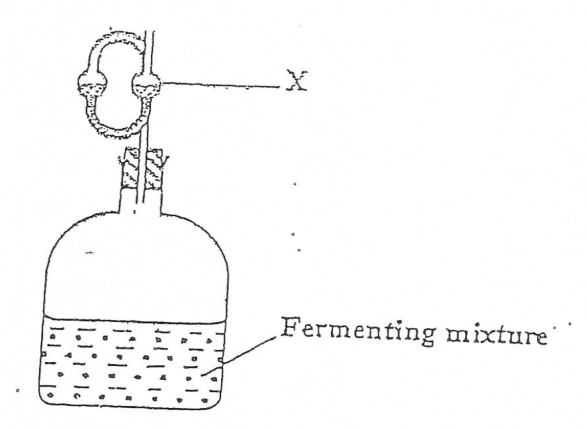
Items 47-48 refer to the following apparatus which is used in the fermentation process.
The correct equation for the final reaction taking place in the flask is
A student attempts to make wine but obtains a product of pH3. Which of the following is a suitable reason for the results obtained?
Carbon dioxide dissolves in the wine, thus lowering the pH.
Ethanol in the wine is converted to ethanoic acid, thus lowering the pH.
The fruits decay, causing the wine to turn sour.
The heat produced during fermentation destroys the yeast, causing the wine to turn sour.
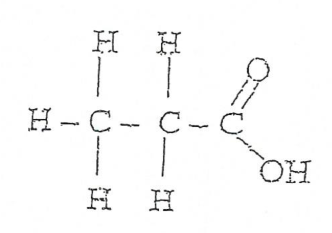
To which homologous series does the following structure belong?
Alkanes
Alcohols
Acids
Alkenes
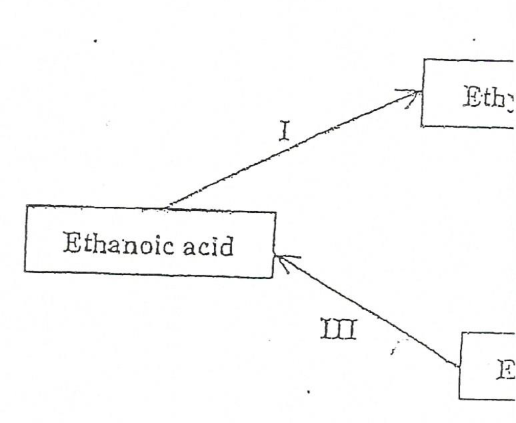
Items 50-51 refer to the following which represents three conversions in organic chemistry
For Conversion II, ethyl ethanoate is heated under reflux with another compound. The name of the compound is
sodium chloride
ethanol
fatty acids
sodium hydroxide
Which of the following contains one reagent that is NOT suitable for Conversion II?
Acidified potassium dichromate (VI), concentrated sulphuric acid
Acidified potassium permanganate (VII), concentrated hydrogen peroxide
Acidified potassium dichromate (VI), acidified potassium manganate (VII)
Acidified potassium manganate (VII), concentrated nitric acid
Which of the following products is formed when ethane reacts with chlorine?
CH₃Cl
C₂H₄Cl
CH₃CH₂Cl
C₂H₅Cl
Which of the following is a list in which all compounds contain peptide linkages?
Proteins, nylon, amino acids
Carbohydrates, fats, proteins
Fats, carbohydrates
Proteins, nylon
Which of the following names refers to the product formed in the reaction 3n(CH₂ = CH₂)→ (CH₂-CH₂-CH-CH₂-CH₂-CH₂)n ?
Dimer
Trimer
Polymer
Monomer
Proteins are products of the TYPE of process called
isomerism
polymerisation
addition
esterification
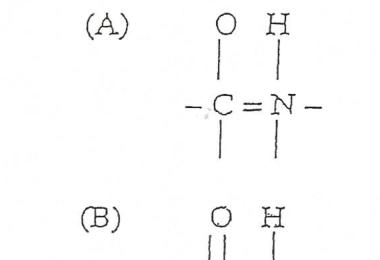
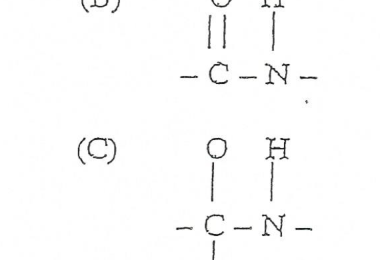
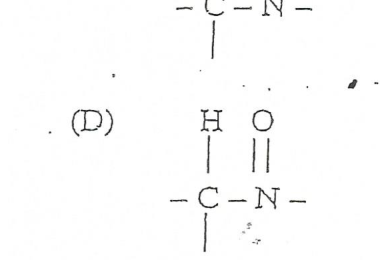
Which of the following represents the amide linkage?
Which of the following methods is used for the extraction of aluminium?
Reduction of its oxide using coke
Reduction of its oxide using carbon monoxide
Electrolysis of its aqueous chloride
Electrolysis of its molten oxide
Which of the following properties of sulphur dioxide is responsible for its ability to corrode buildings?
Acidity
Oxidising nature
Reducing nature
Solubility in water
Items 59-60 refer to the following observations. (A) An alkaline gas produced (B) White precipitate soluble in excess (C) White precipitate insoluble in excess (D) A green precipitate insoluble in excess Each observation may be used once, more than once or not at all to answer the items below. Which observation is expected when
aqueous ammonia is added to aqueous lead (II) nitrate until no further change takes place?
An alkaline gas produced
White precipitate soluble in excess
White precipitate insoluble in excess
A green precipitate insoluble in excess
excess sodium hydroxide solution is added to a solution containing zinc ions?
An alkaline gas produced
White precipitate soluble in excess
White precipitate insoluble in excess
A green precipitate insoluble in excess