Free CXC Chemistry Paper 3 May/June 2005 past paper from 2005. Includes a worked answer key. Open the PDF, take a timed test, and study with AI on Caribbean AI.
Answer keys are free on Caribbean AI. View the answers to every past-paper question at no cost - no payment needed - with step-by-step worked solutions and instant AI marking available on Premium.
CSEC Chemistry Paper 3 May/June 2005 - Free CXC Past Paper with Answers
Free CXC Chemistry Paper 3 May/June 2005 past paper from 2005. Includes a worked answer key. Open the PDF, take a timed test, and study with AI on Caribbean AI.
Opening the interactive papers…
Every question from this paper as text. See the answers and worked solutions. Questions are the property of the Caribbean Examinations Council; Caribbean AI is not affiliated with CXC.
Describe ONE piece of experimental evidence for the existence of the particulate nature of matter.
[2 marks]
Water can exist as solid ice, liquid water or gaseous steam in spite of the fact that the individual particles in these three states are the same.
Explain the differences between these three states in terms of the arrangement of their particles, forces between them, and their kinetic energy.
[6 marks]
Discuss how it is possible for gaseous pollutants emitted from a factory to affect areas far removed from its source. You should include in your answer the role of the air molecules in this process.
[4 marks]
The experimental arrangement in Figure 1 is set up by a group of students.
Figure 1: Diagram showing arrangement at start of experiment.
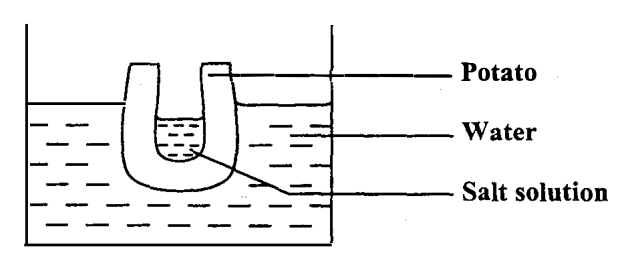
What phenomenon are the students investigating?
[1 mark]
Make a drawing of Figure 1 in your answer booklet. Next to it make another drawing to show any changes which may have occurred after two hours.
[2 marks]
Suggest reasons for the changes you described in (ii) above.
[2 marks]
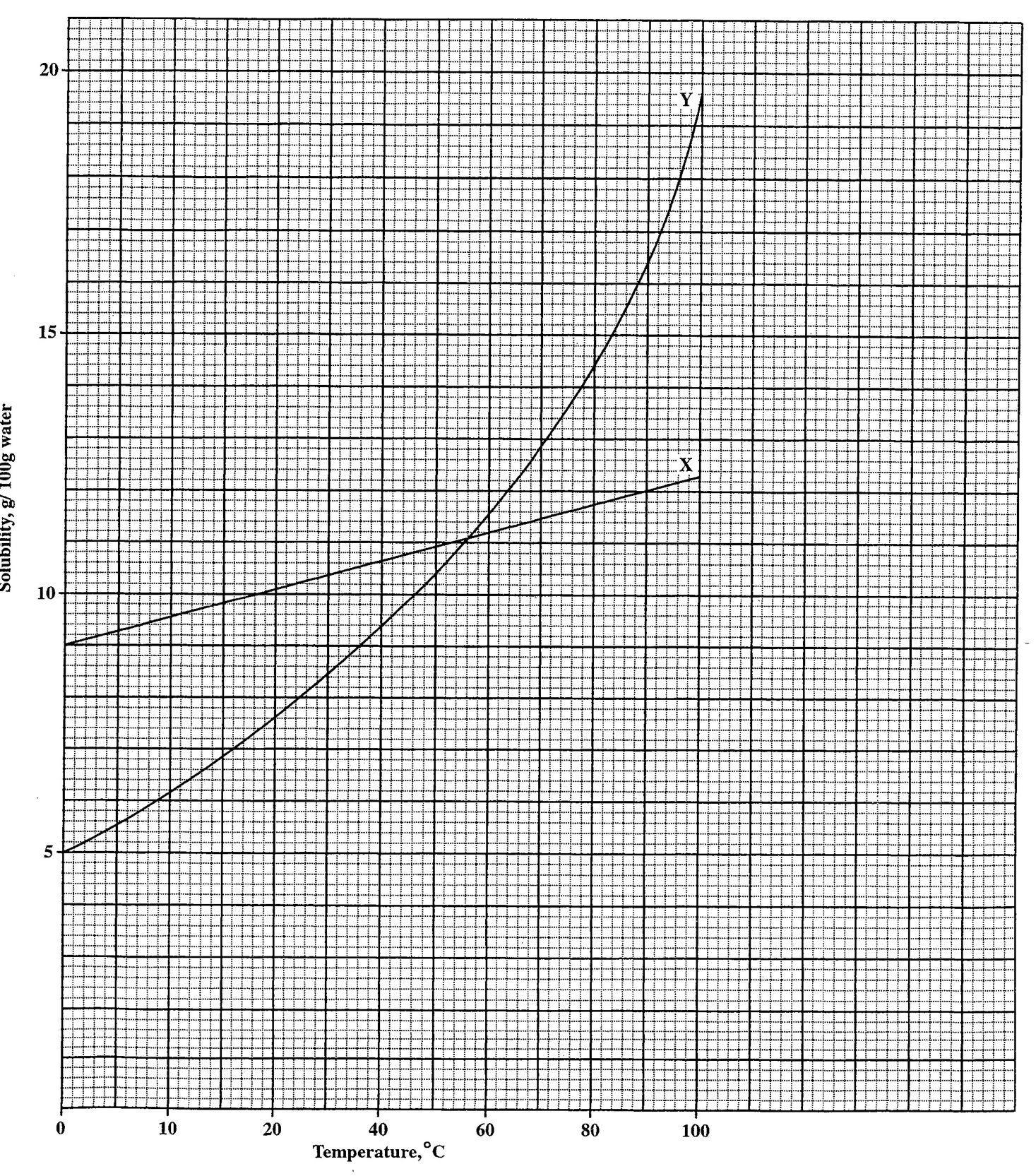
Figure 2 on page 3 shows the solubility curves for two substances, X and Y. Use this information to answer the following questions:
Which of the two substances, X or Y, has a greater solubility at ?
[1 mark]
Calculate the mass of Y which would be deposited when its saturated solution is cooled from to .
Show your method of calculation.
[2 marks]
The element chromium (Cr) forms a number of compounds in which chromium exhibits different oxidation numbers. Chromium, unlike iron, is also highly resistant to corrosion and, as such, it is widely used to chrome-plate metal objects.
[20 marks]
Potassium dichromate () is a common reagent in a school's laboratory.
Describe ONE use of potassium dichromate as a laboratory reagent.
Your answer should include the test it is used for, the method of carrying out the test and any colour changes expected.
[4 marks]
Calculate the oxidation number of chromium in potassium dichromate () and in chromium sulphate ().
Based on your answer in (ii) above, deduce the type of reaction which occurs when is converted to .
In many Caribbean countries steel pans, in particular the tenor pans, are electroplated with chromium. Chrome-plating is believed to improve the pitch of the pan.
Describe how a tenor pan could be chrome-plated.
You should include in your answer:
[8 marks]
Given that the mass of the chromium needed to plate a tenor pan is $0.52 kg$, calculate the length of time (in seconds) that a current of $20.0 A$ would have to flow through the electrolytic cell to plate the pan.
Use the following data in your calculation:
[5 marks]
Answer ONE question from this section.
[20 marks]
Explain how the electronic configuration of the carbon atom, , can account for the fact that the bonding in carbon compounds is covalent rather than ionic. You should use the bonding in methane to illustrate your answer.
[5 marks]
Alkanes are relatively unreactive compounds. However, under certain conditions, they may undergo reactions with chlorine.
Write a balanced equation for the reaction between methane and chlorine. Include in your answer the reaction conditions and the type of reaction taking place.
[3 marks]
By including certain functional groups such as the , or to the alkane structure, the reactivity greatly increases.
a) Identify an alkene and an acid from among the following compounds: , , ,
Describe ONE chemical reaction in EACH case which can be used to illustrate the differences in REACTIVITY between a) an alkane and an alkene b) an alkane and a carboxylic acid.
In EACH case you should include a chemical equation in your answer.
[4 marks]
Name the industrial process which is used to bring about conversion of the following types: (long chain alkanes) (short chain alkanes) + alkenes
State ONE advantage of the process you named in (d) (i) above.
[1 mark]
The electrochemical series is a convenient way for arranging metals. A metal's position in the electrochemical series can give information about its properties and uses.
Use the principles for placing metals in the electrochemical series to explain the following observations.
Copper, silver and gold are used to make coins but magnesium, sodium and calcium are not. Support your answer with a suitable ionic equation.
[6 marks]
When a zinc rod is placed in a copper sulphate solution, after a while a brown deposit (precipitate) is produced, the zinc rod gets smaller and the blue colour of the solution fades. However, there is no visible change when a copper rod is placed in a zinc sulphate solution. Support your answer with a suitable equation.
[6 marks]
Iron and aluminium are both extracted from ores mined from the earth. However, different methods are used to extract each metal from its ore. You should state in your answer the names of the methods of extraction used.
[5 marks]
Sometimes a metal is most useful when it is pure. However, many metals are more useful when they contain a small percentage of one or more additional metals.
Suggest why copper wire might be more useful when it is pure but iron is almost never used in its pure form.
[3 marks]
Answer ONE question from this section.
Dough is a mixture consisting of flour, water and a leavening agent as the major ingredients. During the making and baking of the dough, a number of important physical and chemical changes take place.
[20 marks]
Discuss the role of EACH of the following in the making and baking of a dough:
Include in your answer THREE relevant chemical equations, with at least ONE equation EACH, from the action of yeast and baking powder.
[14 marks]
Flour usually consists of between 65 – 80% carbohydrates (starches). Iodine can be used to test for the presence of starches.
There is no blue-black colouration when flour, which is stored in a hot, humid room for a long time, is tested with iodine.
Suggest a possible explanation for this. Include an appropriate chemical equation in your answer.
[4 marks]
Carbohydrates are polymers of simple sugars. Using the symbol to represent a simple sugar, show how THREE of these units can be linked together to form part of the polymer chain found in carbohydrates present in flour.
[2 marks]
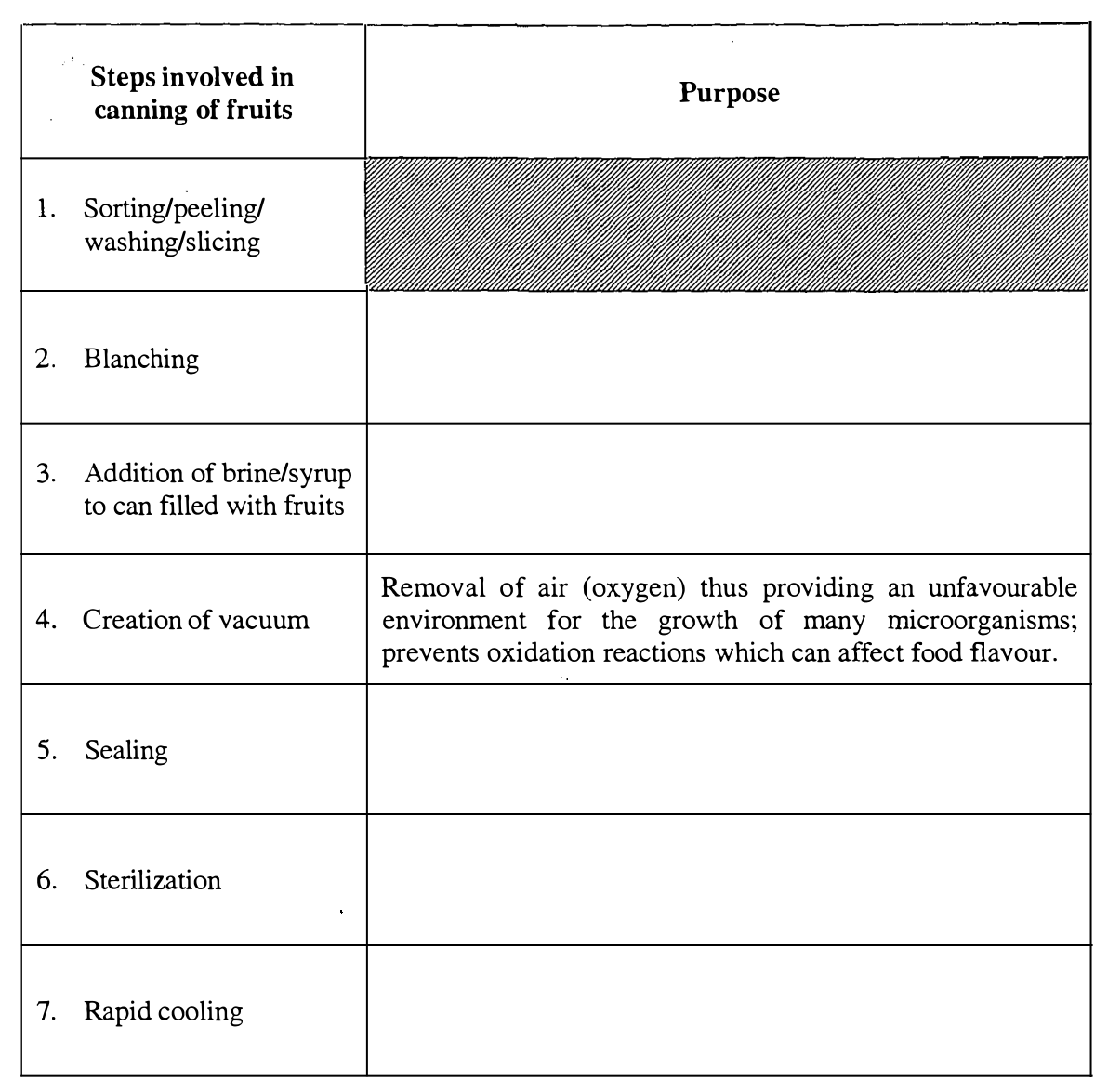
Canning is one of the most widely used methods of food preservation in use today. Table 1 below lists the steps involved in the canning of fruits.
| Steps involved in canning of fruits | Purpose |
|---|---|
| 1. Sorting/peeling/ washing/slicing | |
| 2. Blanching | |
| 3. Addition of brine/syrup to can filled with fruits | |
| 4. Creation of vacuum | Removal of air (oxygen) thus providing an unfavourable environment for the growth of many microorganisms; prevents oxidation reactions which can affect food flavour. |
| 5. Sealing | |
| 6. Sterilization | |
| 7. Rapid cooling |
[20 marks]
Copy Table 1 in your answer booklet. In the blank spaces, fill in the purpose of steps 2, 3, 5, 6 and 7 in the canning process.
[5 marks]
Nisin, an antibiotic, is often added after step 3 of the canning process. Suggest a possible reason for this.
[2 marks]
You are required to select one of two metals, A or B, to coat steel cans for canning fruit juices. Metal A is just above hydrogen and metal B is just below hydrogen in the electrochemical series.
Which of these two metals would be more suitable? You should include in your answer: (i) A discussion on
A discussion on
[9 marks]
Any relevant chemical equations
[4 marks]
[2 marks]
[1 mark]
b) Draw and name the structures you identified in (c) (i) a) above.
[6 marks]