(a)
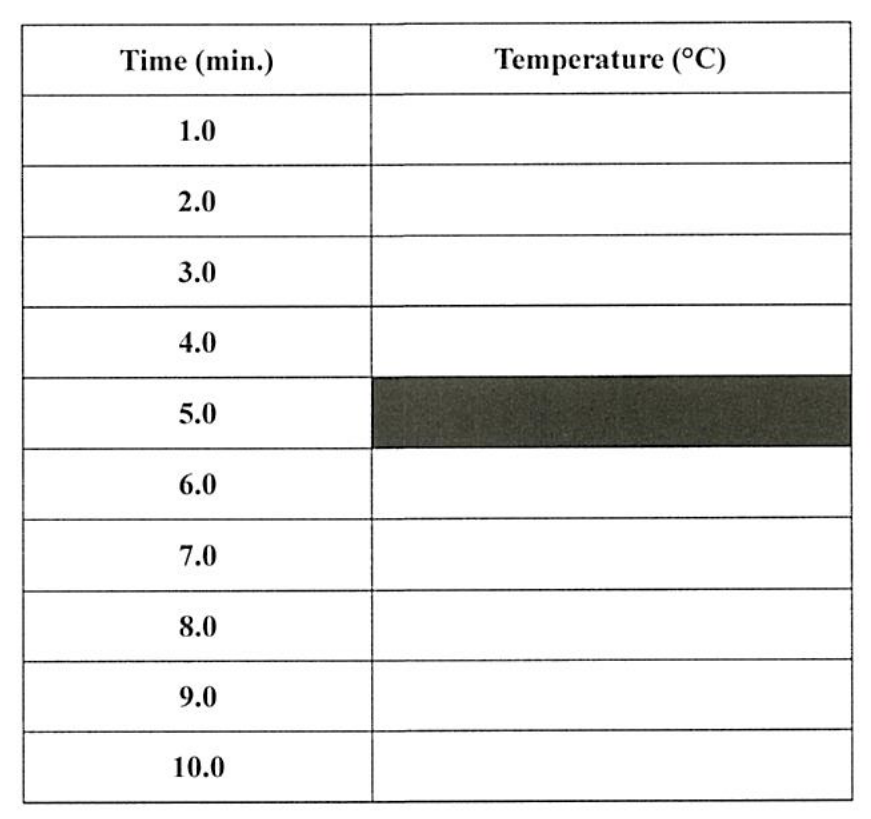
TABLE 1: TIME–TEMPERATURE DATA
| Time (min.) | Temperature () |
|---|---|
| 1.0 | |
| 2.0 | |
| 3.0 | |
| 4.0 | |
| 5.0 | |
| 6.0 | |
| 7.0 | |
| 8.0 | |
| 9.0 | |
| 10.0 |
[5 marks]
Free CXC Chemistry Paper 3 January 2021 past paper from 2021. Includes a worked answer key. Open the PDF, take a timed test, and study with AI on Caribbean AI.
Answer keys are free on Caribbean AI. View the answers to every past-paper question at no cost - no payment needed - with step-by-step worked solutions and instant AI marking available on Premium.
CSEC Chemistry Paper 3 January 2021 - Free CXC Past Paper with Answers
Free CXC Chemistry Paper 3 January 2021 past paper from 2021. Includes a worked answer key. Open the PDF, take a timed test, and study with AI on Caribbean AI.
Opening the interactive papers…
Every question from this paper as text. See the answers and worked solutions. Questions are the property of the Caribbean Examinations Council; Caribbean AI is not affiliated with CXC.
Chemical reactions are always accompanied by energy changes. When the energy change is in the form of heat, reactions can be investigated by using temperature measurements. You are required to determine the value of the enthalpy change that accompanies a neutralization reaction.
You are provided with the following chemicals and apparatus:
Procedure (i) Measure of the sodium hydroxide solution and pour it into the calorimeter. (ii) Place the lid on the calorimeter; insert the thermometer through the lid and stir. Start the stop-watch. (iii) Record the temperature for the first 4 one-minute intervals in Table 1, on page 6. (iv) Rinse the measuring cylinder and measure of the sulfuric acid. (v) On the fifth minute, remove the lid and the thermometer, and add the of sulfuric acid solution to the calorimeter. (vi) Replace the lid on the calorimeter; insert the thermometer through the lid and stir. (vii) Record the temperature at the sixth minute and at every one-minute interval up to ten minutes, in Table 1.
[13 marks]
| Time (min.) | Temperature () |
|---|---|
| 1.0 | |
| 2.0 | |
| 3.0 | |
| 4.0 | |
| 5.0 | |
| 6.0 | |
| 7.0 | |
| 8.0 | |
| 9.0 | |
| 10.0 |
[5 marks]
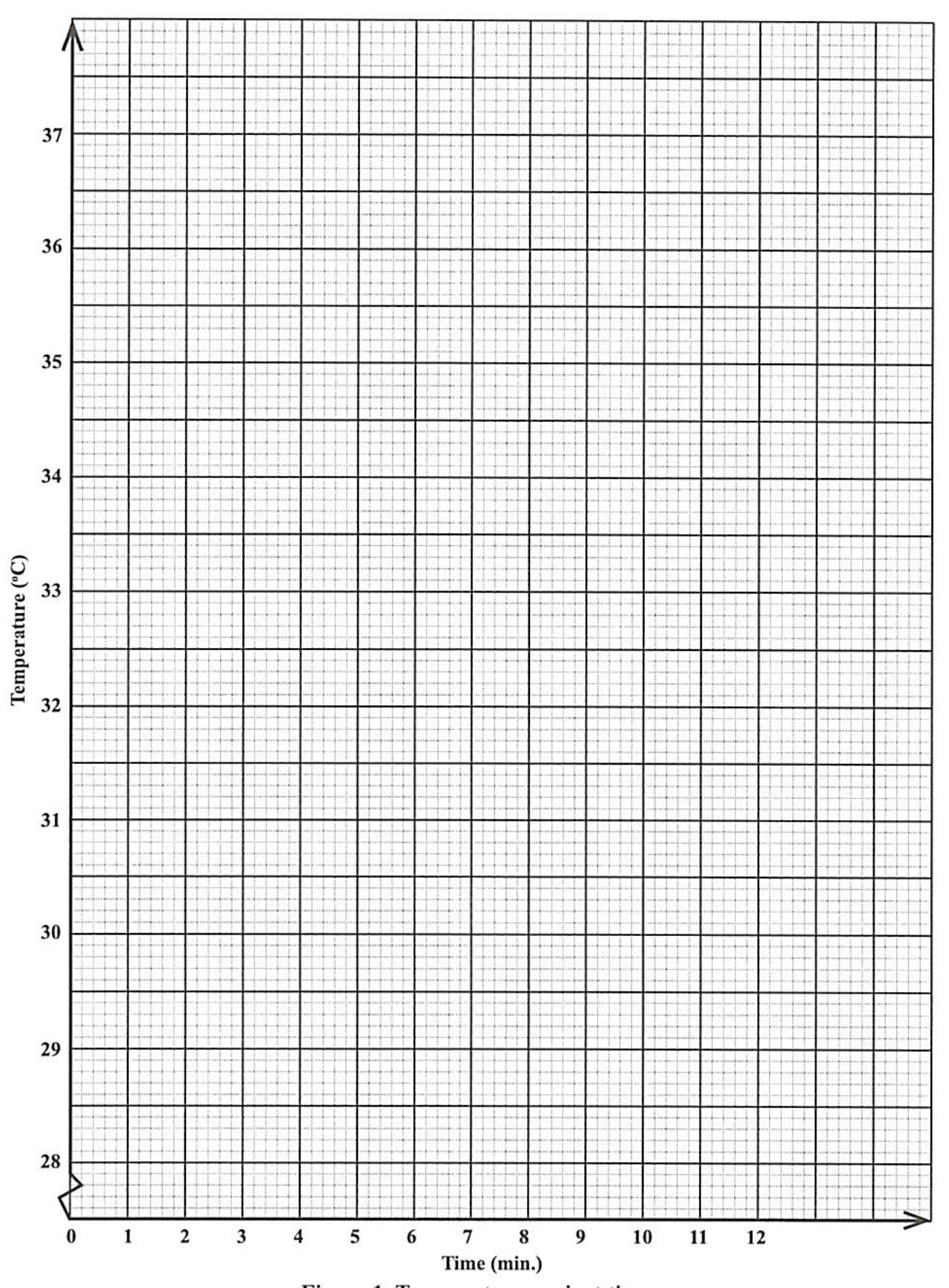
Using the axes provided in Figure 1, on page 7, plot a graph of temperature against time using the data in Table 1. Draw a smooth curve through the points on the graph.
[6 marks]
From your graph, calculate the change in temperature (), for the reaction taking place in the experiment.
[1 mark]
State whether the reaction is exothermic or endothermic.
[1 mark]
Write a balanced equation for the reaction occurring in the experiment.
[2 marks]
Calculate the number of moles of sulfuric acid in the of sulfuric acid solution that was used in the reaction.
[2 marks]
Determine the number of moles of water that was produced in the reaction.
[2 marks]
The final solution has a mass () of and a specific heat capacity () of . Using your answer in (b) (ii), calculate the heat change () for the reaction, given that .
[2 marks]
Calculate the enthalpy change for the reaction.
[2 marks]
Suggest TWO ways in which the experiment could have been affected if it was carried out using an uncovered glass beaker instead of a calorimeter.
[2 marks]
State ONE precaution that should be taken when stirring the reaction mixture.
[1 mark]
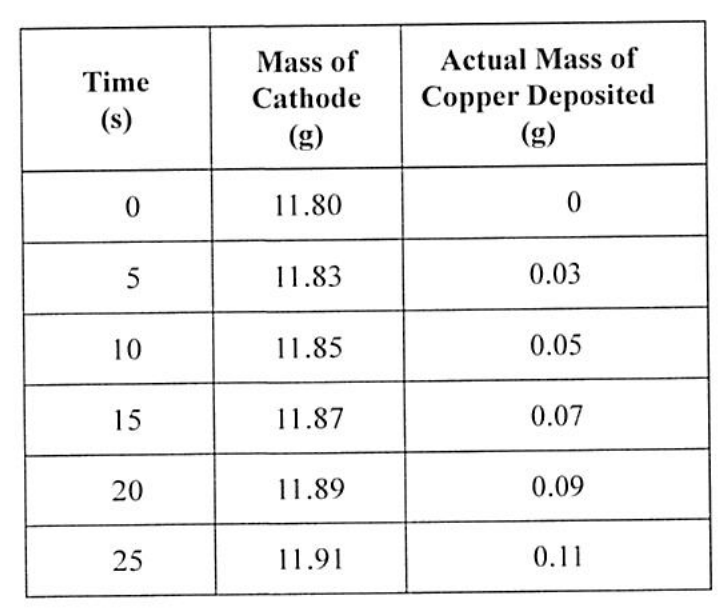
Remi and Rohanna conducted an investigation involving the electrolysis of copper(II) sulfate using copper electrodes. The mass of the cathode was recorded at various time intervals and the actual mass of the copper deposited was calculated. Table 2 shows the experimental results.
| Time (s) | Mass of Cathode (g) | Actual Mass of Copper Deposited (g) |
|---|---|---|
| 0 | 11.80 | 0 |
| 5 | 11.83 | 0.03 |
| 10 | 11.85 | 0.05 |
| 15 | 11.87 | 0.07 |
| 20 | 11.89 | 0.09 |
| 25 | 11.91 | 0.11 |
[10 marks]

Using the data in Table 2, plot a graph of actual mass of copper deposited against time on the grid provided in Figure 2, on page 11. Use appropriate scales on the grid and plot a line of best fit.
[6 marks]
Draw a labelled diagram to show the electrolytic cell that would be used for carrying out this investigation.
[4 marks]
A man was suspected of defacing a wall at his workplace with water-soluble paint. After searching his office, a can of water-soluble paint was discovered in his desk. However, one of the investigators thought that the paint on the wall looked somewhat different when compared to the paint in the can.
Plan and design an experiment that could assist the investigators in determining if the paints are indeed different.
In your response include the following:
[8 marks]
Hypothesis
[1 mark]
Procedure
[3 marks]
Apparatus and materials
[2 marks]
Variables to be controlled
[2 marks]
Data to be collected
[2 marks]
Discussion
[2 marks]