Free CXC Chemistry Paper 3 May/June 2014 past paper from 2014. Includes a worked answer key. Open the PDF, take a timed test, and study with AI on Caribbean AI.
Answer keys are free on Caribbean AI. View the answers to every past-paper question at no cost - no payment needed - with step-by-step worked solutions and instant AI marking available on Premium.
CSEC Chemistry Paper 3 May/June 2014 - Free CXC Past Paper with Answers
Free CXC Chemistry Paper 3 May/June 2014 past paper from 2014. Includes a worked answer key. Open the PDF, take a timed test, and study with AI on Caribbean AI.
Opening the interactive papers…
Every question from this paper as text. See the answers and worked solutions. Questions are the property of the Caribbean Examinations Council; Caribbean AI is not affiliated with CXC.
Energy changes always accompany chemical reactions. When the energy change is in the form of heat, reactions can be investigated by using temperature measurements. John and Mary were asked to determine a value for the enthalpy change that accompanies a neutralization reaction. They were provided with chemicals and apparatus as listed below:
The following procedure was followed: (i) Allow the solutions of acid and base to equilibrate at room temperature. (ii) Measure 100 of the sodium hydroxide solution, pour it into the Styrofoam cup, cover with the lid, and record the temperature for four one-minute intervals. (iii) On the fifth minute, add 50 of the sulfuric acid solution to the Styrofoam cup. (iv) Put on the Styrofoam lid, insert the thermometer and stir the solution. (v) Record the temperature at 5.5 minutes, and at every 0.5-minute interval up to 10 minutes.
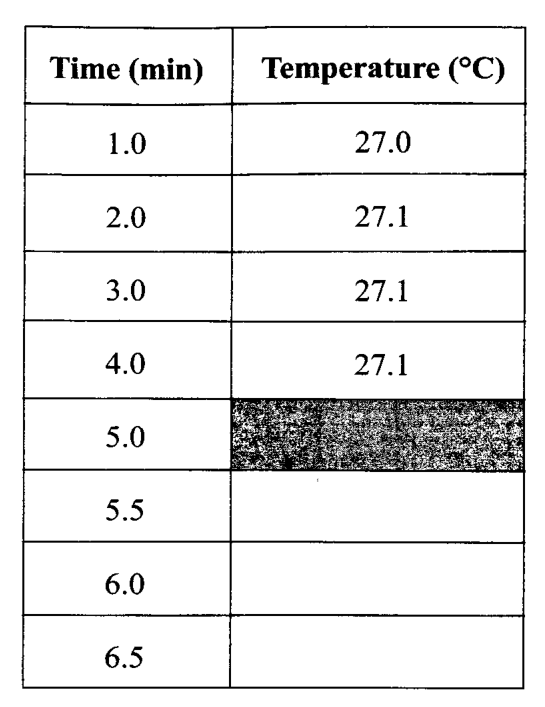
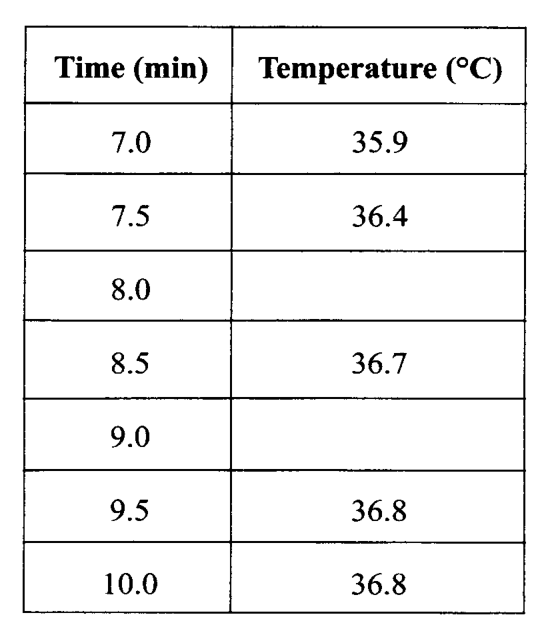
Some of the temperature readings are shown in Table 1.
| Time (min) | Temperature () | Time (min) | Temperature () |
|---|---|---|---|
| 1.0 | 27.0 | 7.0 | 35.9 |
| 2.0 | 27.1 | 7.5 | 36.4 |
| 3.0 | 27.1 | 8.0 | 36.7 |
| 4.0 | 27.1 | 8.5 | 36.7 |
| 5.0 | 9.0 | ||
| 5.5 | 9.5 | 36.8 | |
| 6.0 | 10.0 | 36.8 | |
| 6.5 |
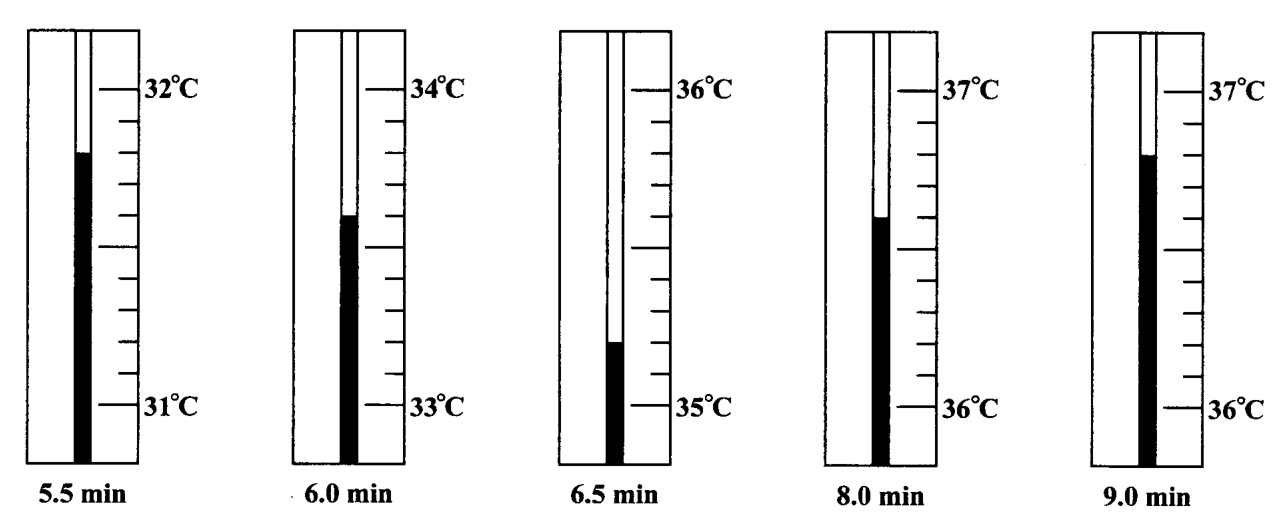
From the diagrams in Figure 1, read the temperature at the times shown and insert the readings in Table 1.
[5 marks]
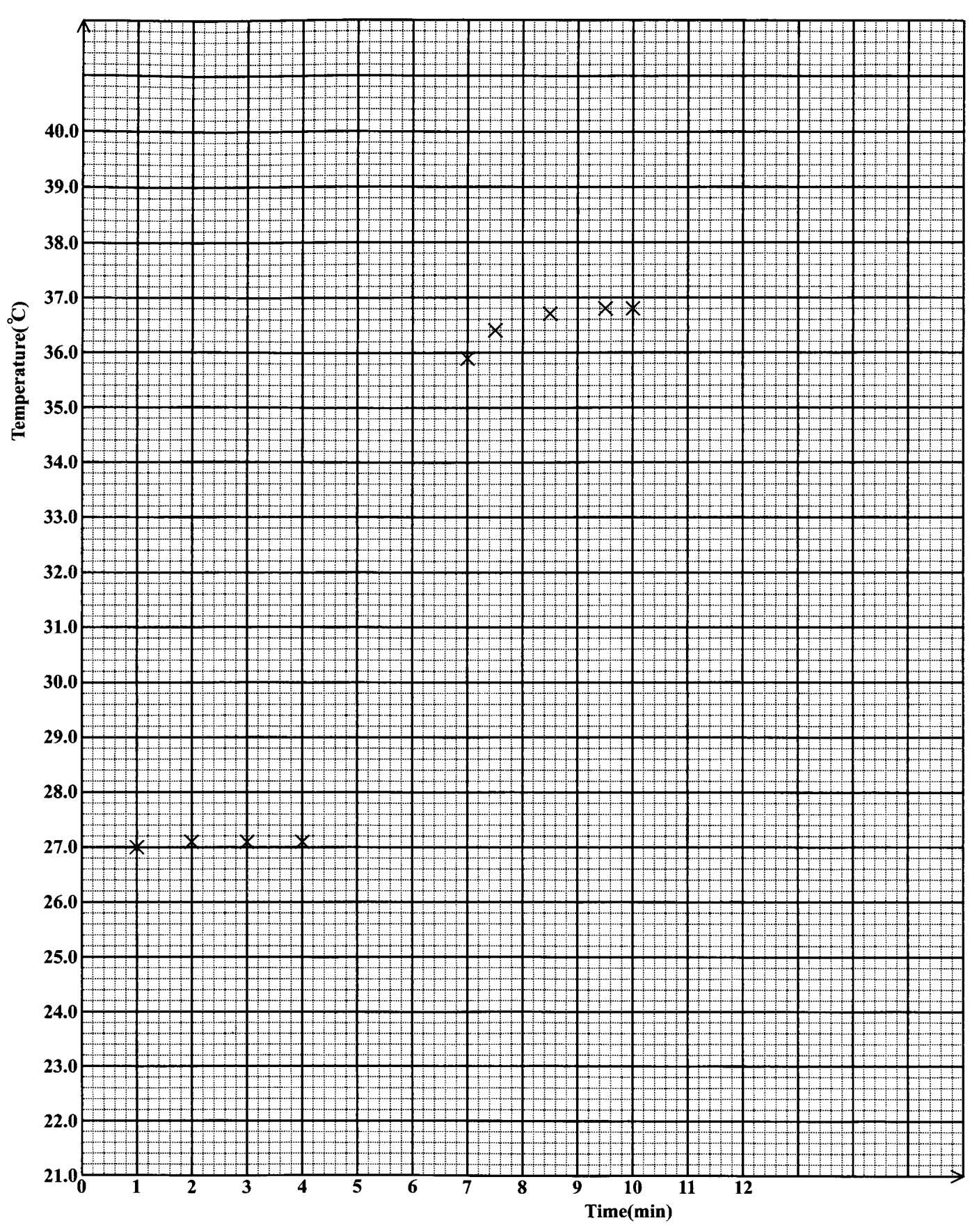
Using the axes provided on page 5, plot a graph of temperature against time using the data in Table 1. Some of the points have been plotted for you.
Using the axes provided on page 5, plot a graph of temperature against time using the data in Table 1. Some of the points have been plotted for you.
[3 marks]
Draw a smooth curve through the points on the graph in (b) (i).
[1 mark]
From the graph, calculate the change in temperature for the reaction taking place in the Styrofoam cup.
[1 mark]
State whether the reaction is exothermic or endothermic.
[1 mark]
Write a balanced equation for the reaction in the Styrofoam cup.
[2 marks]
Calculate the number of moles of sulfuric acid in the 50 of 1.0 mol that were used in the reaction.
[2 marks]
Determine the number of moles of water that were produced in the reaction.
[1 mark]
The density of the final solution is 1.02 g . Calculate the mass of the solution.
[1 mark]
The specific heat capacity of the final solution is 3.82 J . Calculate the heat change for the reaction in the Styrofoam cup.
[2 marks]
Calculate the heat change for the formation of ONE mole of water.
[2 marks]
State ONE assumption that can be made when carrying out the experiment.
[1 mark]
If the reaction was carried out in a glass beaker instead of a Styrofoam cup, how would this have affected the observed heat change?
[2 marks]
Assuming that the reaction is carried out in a glass beaker, what precaution should be taken when stirring the reaction mixture?
[2 marks]
How should the procedure in (iii) above be modified?
[2 marks]
Bill conducted a number of tests on a solid mixture, W. The inferences made are recorded in Table 2. Complete Table 2 by inserting the observations based on the inferences made.
[10 marks]
Distilled water was added to a portion of W and the resulting mixture stirred and filtered. The filtrate was divided into three tests and tests (b) to (d) done on separate portions.
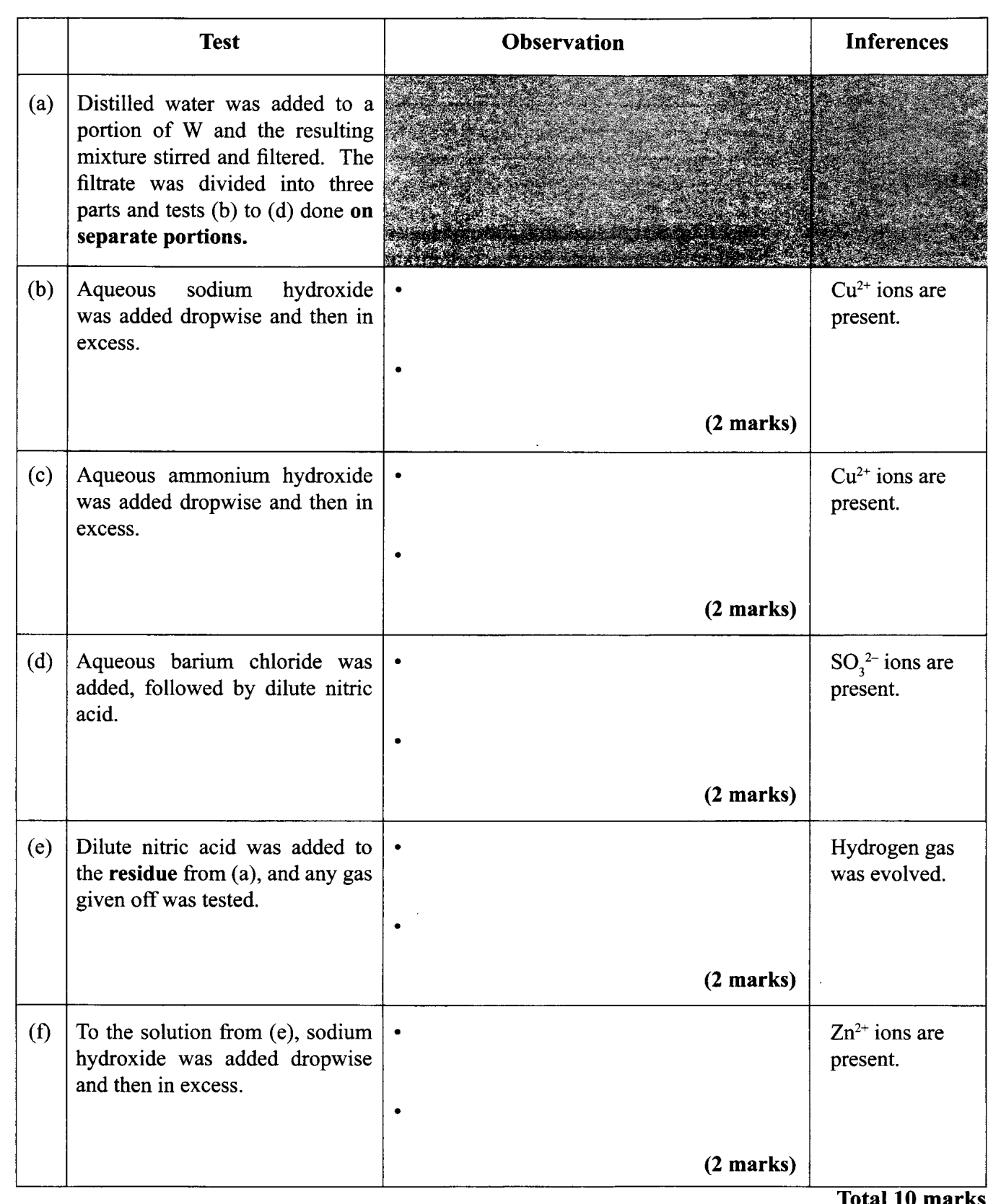
[2 marks]
Aqueous sodium hydroxide was added dropwise and then in excess. Inference: ions are present.
[2 marks]
Aqueous ammonium hydroxide was added dropwise and then in excess. Inference: ions are present.
[2 marks]
Aqueous barium chloride was added, followed by dilute nitric acid. Inference: ions are present.
[2 marks]
Dilute nitric acid was added to the residue from (a), and any gas given off was tested. Inference: Hydrogen gas was evolved.
[2 marks]
To the solution from (e), sodium hydroxide was added dropwise and then in excess. Inference: ions are present.
[2 marks]
A sample of sea water which was contaminated by petroleum was taken to the school chemistry laboratory for use in an experiment. Plan and design a suitable experiment to obtain pure water from the sample of sea water.
In your response you should include the following:
[6 marks]
Aim
[1 mark]
Materials
[2 marks]
Procedure
[3 marks]
A fully labelled diagram of the apparatus required to obtain the pure water in this experiment
[4 marks]
TWO possible sources of error OR precautions taken in your experiment
[2 marks]