Free CXC Chemistry Paper 3 May/June 2006 past paper from 2006. Includes a worked answer key. Open the PDF, take a timed test, and study with AI on Caribbean AI.
Answer keys are free on Caribbean AI. View the answers to every past-paper question at no cost - no payment needed - with step-by-step worked solutions and instant AI marking available on Premium.
CSEC Chemistry Paper 3 May/June 2006 - Free CXC Past Paper with Answers
Free CXC Chemistry Paper 3 May/June 2006 past paper from 2006. Includes a worked answer key. Open the PDF, take a timed test, and study with AI on Caribbean AI.
Opening the interactive papers…
Every question from this paper as text. See the answers and worked solutions. Questions are the property of the Caribbean Examinations Council; Caribbean AI is not affiliated with CXC.
Outline the steps in preparing a dry sample of calcium nitrate crystals starting from calcium carbonate and dilute nitric acid.
[6 marks]
Describe a test to determine whether the sample of calcium nitrate crystals prepared in (a)(i) above is free of calcium carbonate.
[2 marks]
Write chemical equations to show the differences in products obtained when sodium nitrate and calcium nitrate are heated.
[4 marks]
With the aid of a fully labelled diagram, show how an iron rod can be electroplated with chromium, using aqueous chromium (III) nitrate as the electrolyte. Write ionic equations to represent the reactions taking place at the electrodes.
[4 marks]
Assume that the iron rod to be electroplated in (b)(i) above originally weighed 25.00 g. Calculate the mass of the iron rod AFTER electroplating, if a current of 10 A was passed through the electrolyte for 30 minutes.
[Relative Atomic Mass: Cr = 52; Faraday's constant = 96 500 C ]
[4 marks]
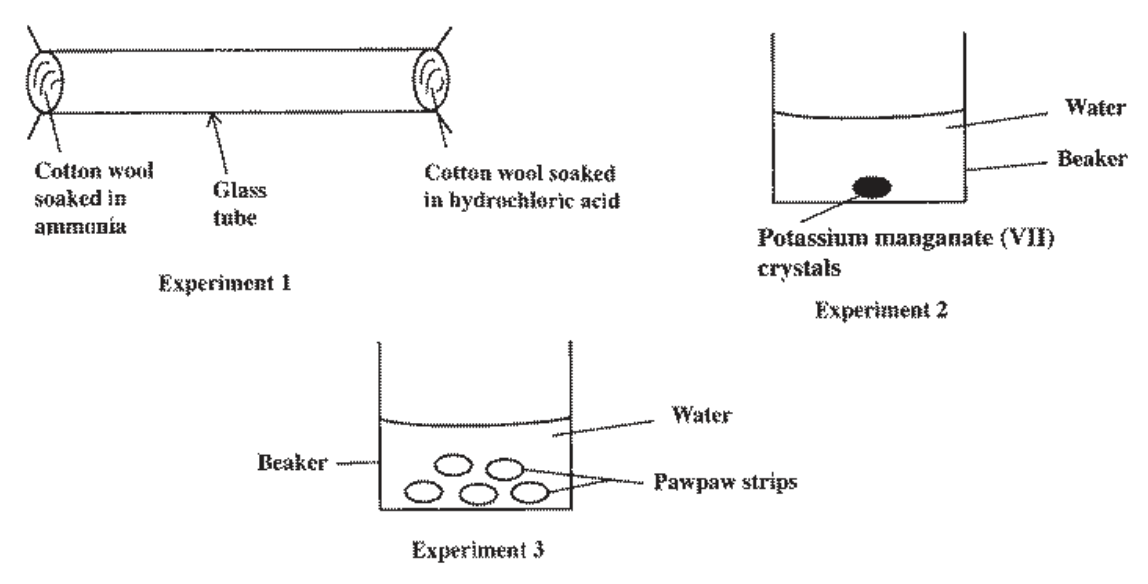
A student sets up three experiments to investigate the particulate nature of matter. Figure 1 shows the apparatus used in these three experiments.
(a) (i) Describe what would be observed in Experiments 1, 2 and 3 as the experiments proceed.
[6 marks]
Account for the observations you described in (a)(i). You should include in your answer
[7 marks]
Suggest how the rate of change of the observations made in Experiment 2 could be increased. Explain your answer.
[2 marks]
Chromatography is widely used in the pharmaceutical industry to check the purity of substances.
Suggest ONE advantage of using chromatography as a means of separating the components of a mixture.
[1 mark]
Using two fully labelled chromatograms, illustrate how chromatography can be used to indicate whether or not a compound is a pure substance.
[4 marks]
Hexanoic acid, , belongs to the same homologous series as ethanoic acid. Based on this fact, write equations to represent the reaction between hexanoic acid and EACH of the following:
Sodium
[2 marks]
Ethanol in the presence of a trace of acid as a catalyst
[2 marks]
Hexane is an alkane of formula . A mixture of hexane and bromine is placed in a reaction flask in bright sunlight. After a while, bubbles of gas are seen to escape from the reaction mixture. The escaping gas forms dense fumes in contact with ammonia gas.
Explain the above observations.
[4 marks]
Write an equation to represent the reaction taking place between hexane and bromine.
[2 marks]
What difference, if any, would be observed if hexene () is used in place of hexane in the flask? Explain your answer.
[2 marks]
The gas, , is unsaturated and is used in the manufacture of polymers. It can also be readily converted into the alcohol, .
Write an equation to show the partial structure of the polymer that is formed when three molecules of are linked together. State the type of polymerisation which occurs.
[3 marks]
Write an equation for the conversion of into the alcohol, . Include the reaction conditions.
Show by means of a fully labelled diagram ONLY, how a pure sample of the alcohol from the reaction mixture in (c) (ii) above can be obtained.
[3 marks]
Most metals exist as their ores in nature in combination with other elements. The extraction of metals from their ores is a reduction process. The choice of the reduction method depends upon the position of the metal in the reactivity series.
Explain the above statements using TWO appropriate examples of metal oxides to illustrate your answer.
[5 marks]
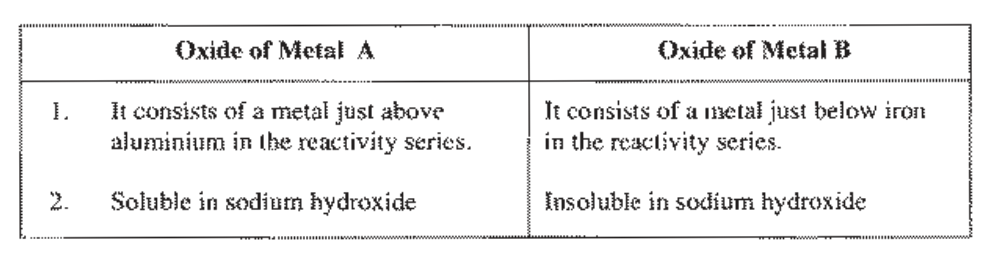
A newly discovered ore is found to consist of a mixture of the oxides of two metals, A and B. Some properties of the metal oxides of A and B are given in Table 1.
| Oxide of Metal A | Oxide of Metal B | |
|---|---|---|
| 1. | It consists of a metal just above aluminium in the reactivity series. | It consists of a metal just below iron in the reactivity series. |
| 2. | Soluble in sodium hydroxide | Insoluble in sodium hydroxide |
Based on the data in Table 1 outline a possible extraction procedure for metals A and B from their ore.
Metal X is a Group 1 metal. It is extracted by the electrolysis of its molten halide. Explain why the molten salt and not the aqueous halide is used.
[3 marks]
Calcium oxide, CaO, is used to remove sulphur dioxide gas from the exhaust gases from factories, by precipitating the sulphur dioxide in the form of calcium sulphite.
Suggest why this is possible. Illustrate your answer by means of appropriate equations.
[4 marks]
Water possesses a number of unique physical properties which makes it an ideal transport medium as well as a medium for the various chemical processes occurring in organisms. Some of these unique properties of water are as follows:
Discuss any TWO of the above properties of water as they relate to processes occurring in living systems.
[4 marks]
The presence of certain ions in water can cause temporary and permanent hardness. Hard water is of serious concern in the laundry industry.
What is meant by the term 'hard water'?
[1 mark]
Write the formula for EACH of the following: a) A compound which causes temporary hardness b) An ion which causes permanent hardness
Sodium carbonate is widely used to remove both temporary and permanent hardness, while temporary hardness may also be removed by boiling.
Write an equation to illustrate the removal of EACH of the following: a) Permanent hardness using sodium carbonate b) Temporary hardness by boiling
Compare the effect of soaps and soapless detergents on hard water.
[3 marks]
We use water, together with detergents, to do most of our washing. However, sometimes we send our clothes to be dry-cleaned instead of being washed at home.
What is meant by the term 'dry-cleaning'?
[1 mark]
Discuss TWO advantages and ONE disadvantage of using dry-cleaning when compared to using water.
[3 marks]
Vinita is returning home in her car with the clothes she has just collected from the dry-cleaners. The car windows are closed and she soon begins to feel nauseous. Suggest a possible reason for Vinita's ill feeling.
[2 marks]
Regular brushing of teeth and periodic visits to the dentist are highly recommended since they lead to healthy teeth.
List THREE important components of toothpaste.
[3 marks]
The enamel of teeth is composed of a calcium phosphate compound, . Describe, with the aid of a balanced equation, how ONE of the components of toothpaste, listed in (a)(i), can strengthen the enamel of teeth.
[4 marks]
A sticky film of bacteria and food can remain on teeth long after eating. These bacteria act on carbohydrates and convert them to substances which promote tooth decay.
Explain how teeth can decay in the presence of these bacteria. Support your answer with a balanced equation.
[5 marks]
Since the earliest days of recorded human history, people have been plagued by insect pests. Now, chemical and biological control may be the only forms of pest control that stand between us and some of the insect-borne plagues.
Discuss TWO advantages and TWO disadvantages of
chemical control of pests
[4 marks]
biological control of pests.
[4 marks]
[2 marks]