Free CXC Chemistry Paper 3 January 2019 past paper from 2019. Includes a worked answer key. Open the PDF, take a timed test, and study with AI on Caribbean AI.
Answer keys are free on Caribbean AI. View the answers to every past-paper question at no cost - no payment needed - with step-by-step worked solutions and instant AI marking available on Premium.
CSEC Chemistry Paper 3 January 2019 - Free CXC Past Paper with Answers
Free CXC Chemistry Paper 3 January 2019 past paper from 2019. Includes a worked answer key. Open the PDF, take a timed test, and study with AI on Caribbean AI.
Opening the interactive papers…
Every question from this paper as text. See the answers and worked solutions. Questions are the property of the Caribbean Examinations Council; Caribbean AI is not affiliated with CXC.
< ![CDATA[The heat of neutralization can be determined by measuring the temperature change when various volumes of acid are reacted with an alkali. In this experiment, you are to determine the heat of neutralization between potassium hydroxide and dilute hydrochloric acid.
You are provided with the following reagents:
Procedure:
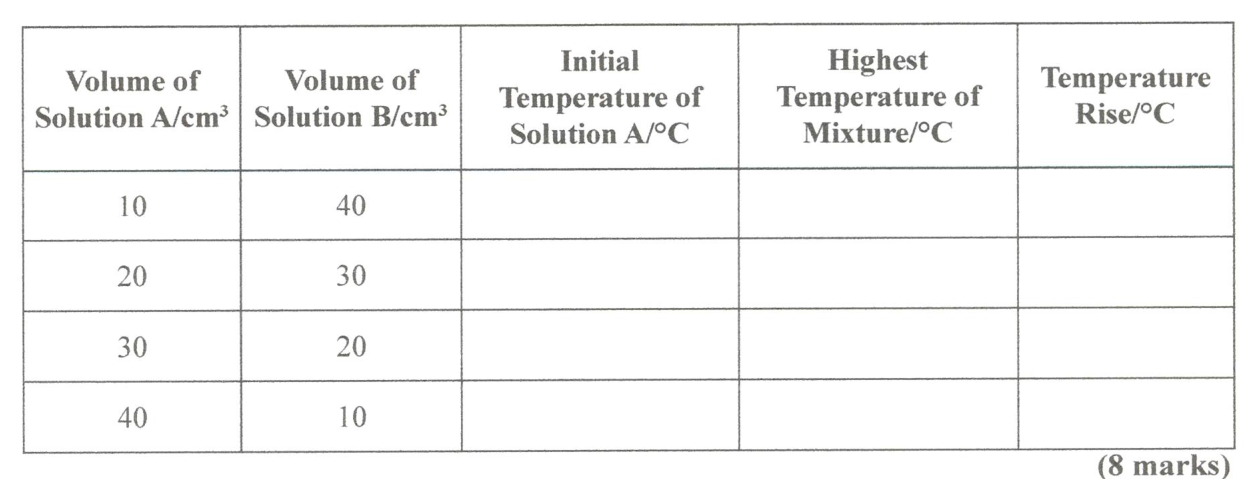
< ![CDATA[TABLE 1: HEAT OF NEUTRALIZATION EXPERIMENT BETWEEN POTASSIUM HYDROXIDE AND DILUTE HYDROCHLORIC ACID
[9 marks]
Complete Table 1.
[8 marks]
Write a balanced chemical equation for the reaction.
[1 mark]
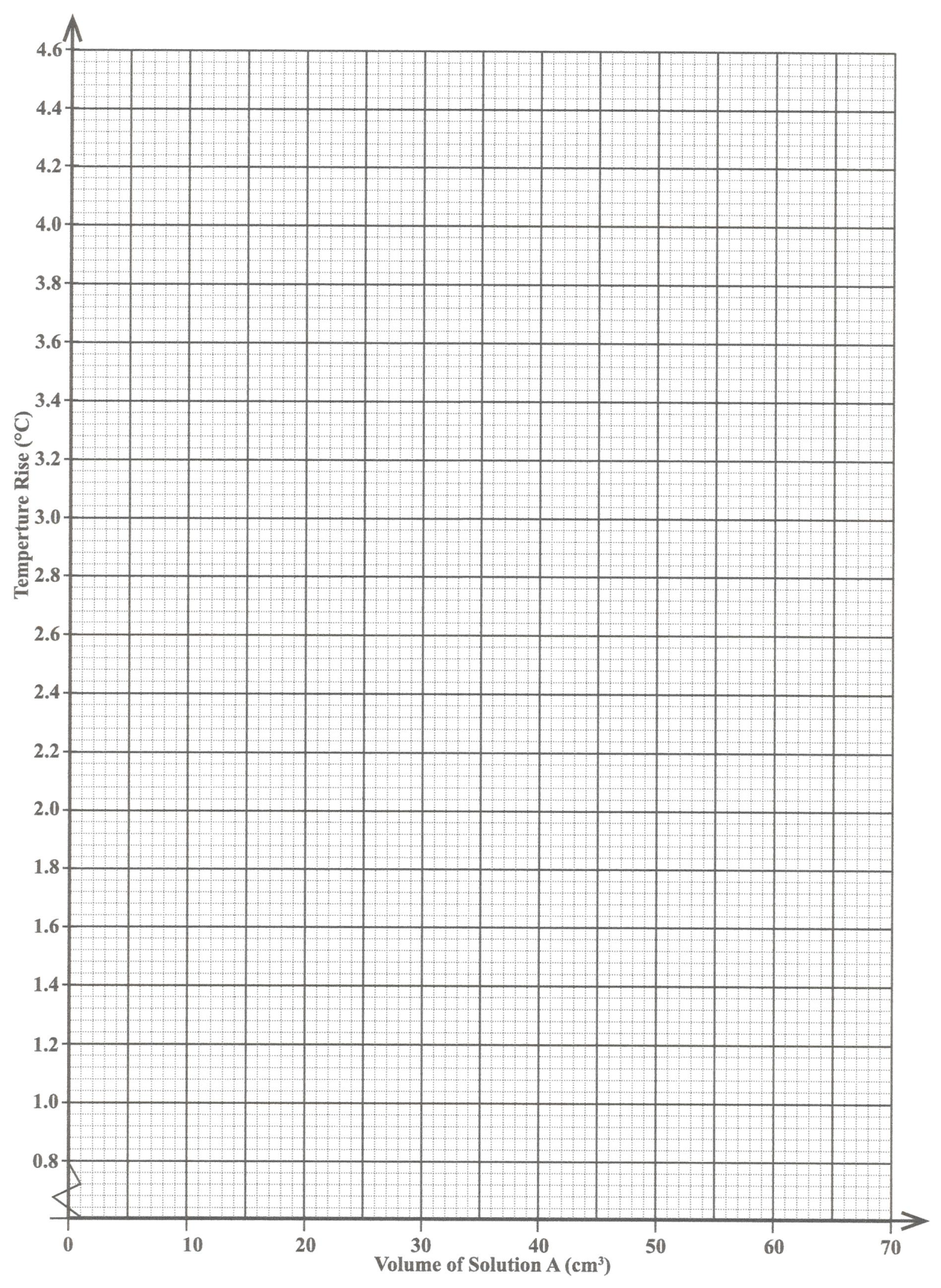
Use the data from Table 1 to plot a graph of temperature rise against the volume of Solution A using the axes provided in Figure 1 on page 7. Draw two best fit intersecting straight lines.
[6 marks]
From the graph drawn in (b) , determine the largest temperature rise, T, and the corresponding volume of Solution A needed to cause this rise.
< ![CDATA[T = ................................................................................................................................. °C
[1 mark]
Volume of Solution A = ................................................................................................................. cm³
[1 mark]
Calculate the heat change at the point of neutralization for the reaction between potassium hydroxide and hydrochloric acid.
[Use ΔH = m × c × ΔT. Note: The specific heat capacity of solution is 4.2 J/g°C. Assume that the density of the solution is 1 g/cm³.]
[3 marks]
Calculate the number of moles of hydrochloric acid used in the experiment.
[2 marks]
Calculate the enthalpy change (ΔH) for the reaction between potassium hydroxide and hydrochloric acid. Include an appropriate sign for ΔH.
[2 marks]
< ![CDATA[List ONE source of error that should be taken in the experiment.
[1 mark]
List ONE precaution that should be taken in the experiment.
[1 mark]
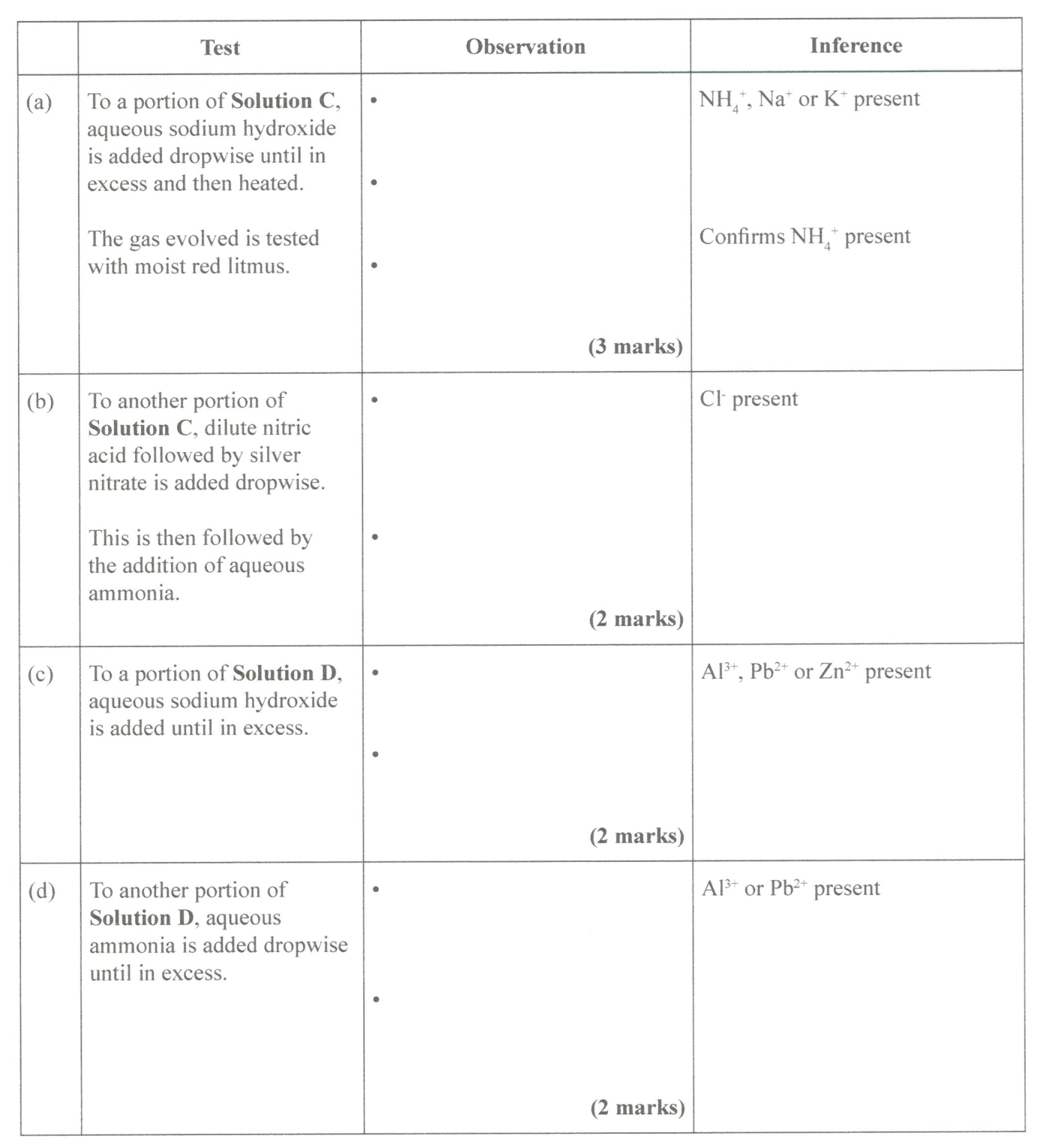
A student conducts the following tests on Solution C and Solution D. The inferences made are recorded in Table 2. Complete Table 2 to show all possible observations.
TABLE 2: RESULTS OF TESTS CONDUCTED ON SOLUTION C AND SOLUTION D
[10 marks]
Test To a portion of Solution C, aqueous sodium hydroxide is added dropwise until in excess and then heated.
The gas evolved is tested with moist red litmus.
Inference
[3 marks]
Test To another portion of Solution C, dilute nitric acid followed by silver nitrate is added dropwise.
This is then followed by the addition of aqueous ammonia.
Inference present
[2 marks]
Test To a portion of Solution D, aqueous sodium hydroxide is added until in excess.
Inference , or present
Test To another portion of Solution D, aqueous ammonia is added dropwise until in excess.
Inference or present
[2 marks]
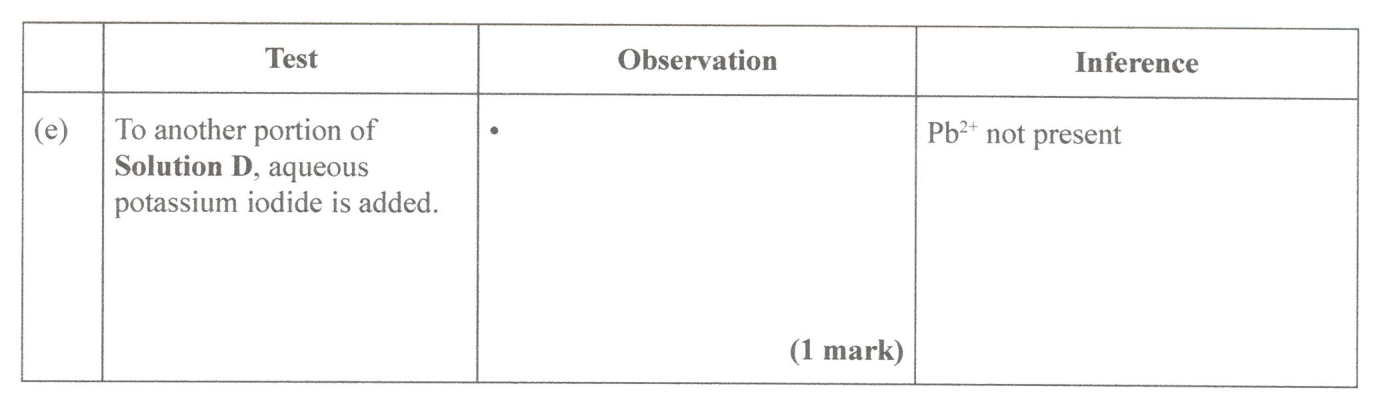
Test To another portion of Solution D, aqueous potassium iodide is added.
Inference not present
[1 mark]
You are provided with two unknown organic compounds, Liquid E and Liquid F, of which one is an alkane and the other an alkene. You are also provided with a solution of acidified potassium manganate (VII) .
Plan and design an experiment to determine which liquid is the alkene and which liquid is the alkane.
In your response include the following:
< ![CDATA[Aim
[1 mark]
Hypothesis
[1 mark]
Procedure
[3 marks]
Apparatus and reagents
[2 marks]
One precaution to be taken during the experiment
[1 mark]
Data to be collected
[2 marks]
Discussion of results as they relate to the hypothesis
[2 marks]
[2 marks]