Free CXC Chemistry Paper 3 May/June 2013 past paper from 2013. Includes a worked answer key. Open the PDF, take a timed test, and study with AI on Caribbean AI.
Answer keys are free on Caribbean AI. View the answers to every past-paper question at no cost - no payment needed - with step-by-step worked solutions and instant AI marking available on Premium.
CSEC Chemistry Paper 3 May/June 2013 - Free CXC Past Paper with Answers
Free CXC Chemistry Paper 3 May/June 2013 past paper from 2013. Includes a worked answer key. Open the PDF, take a timed test, and study with AI on Caribbean AI.
Opening the interactive papers…
Every question from this paper as text. See the answers and worked solutions. Questions are the property of the Caribbean Examinations Council; Caribbean AI is not affiliated with CXC.
Some students conducted two experiments, Experiments 1 and 2, to investigate the rate of reaction of magnesium with dilute hydrochloric acid. The procedure for Experiment 1 is given below and Table 1 presents the data collected.
(Table with Length of Magnesium (cm) and Time (s) values is present on page 2)
[25 marks]
Some students conducted two experiments, Experiments 1 and 2, to investigate the rate of reaction of magnesium with dilute hydrochloric acid. The procedure for Experiment 1 is given below and Table 1 presents the data collected.
(Table with Length of Magnesium (cm) and Time (s) values is present on page 2)
[25 marks]
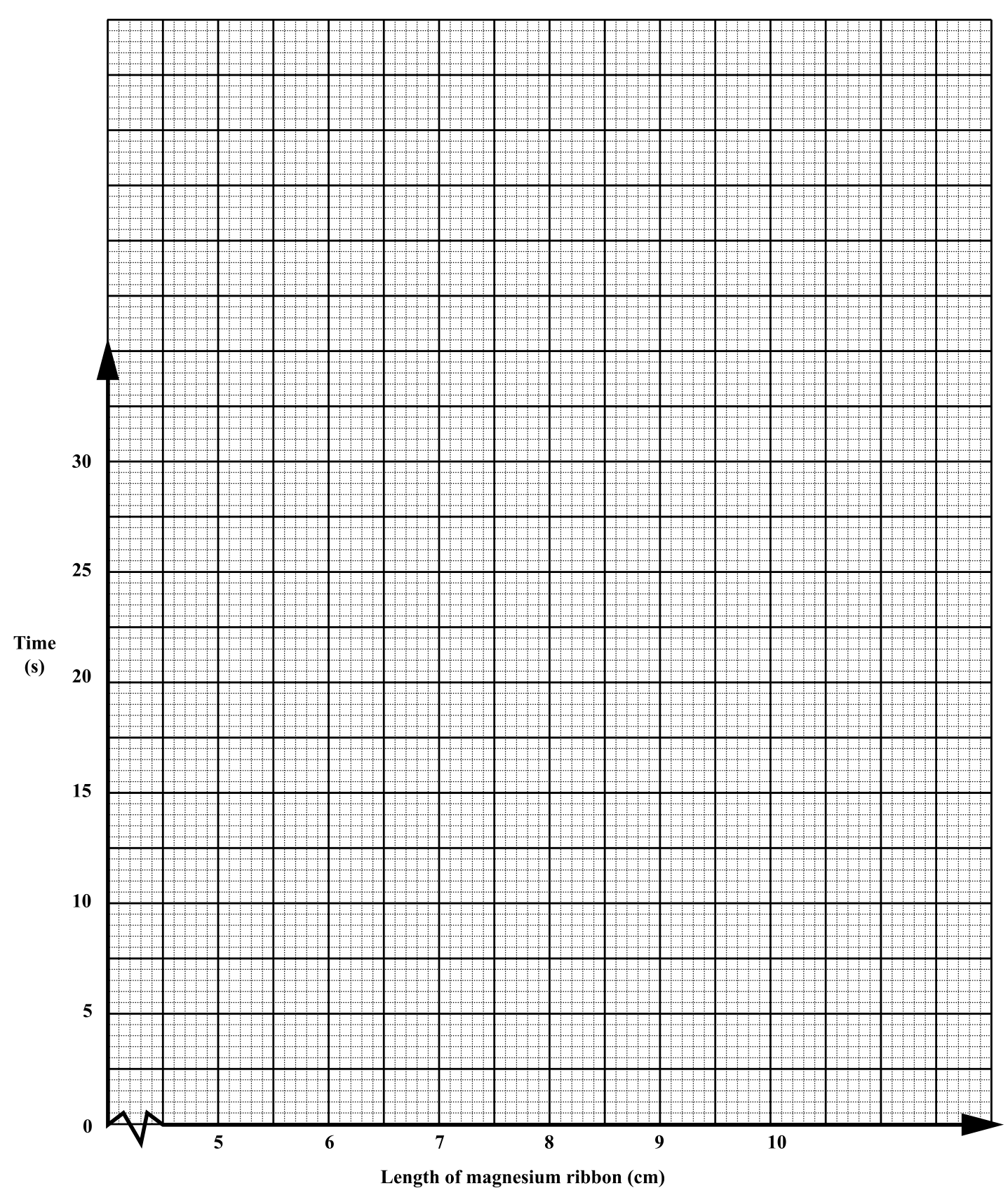
Using the axes in Figure 1 on page 3, plot a graph to show how the time taken for the reaction varies with the different lengths of magnesium ribbon.
[4 marks]
Write a balanced chemical equation for the reaction in Experiment 1.
[2 marks]
Describe the general shape of the graph.
[1 mark]
Provide a reason for the general shape of the graph.
[2 marks]
Given that a 3-cm length of magnesium weighs approximately 0.04 g, calculate the number of moles of acid that reacted with the 9-cm piece of magnesium ribbon.
(RAM Mg = 24)
[3 marks]
Determine the volume of gas that would be produced when 9 cm of magnesium ribbon reacts with the acid at RTP. (1 mole of gas occupies 24 dm at RTP.)
[2 marks]
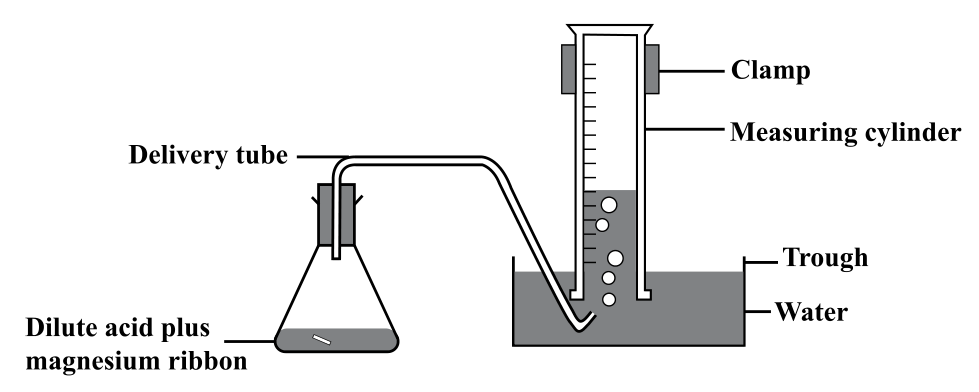
In Experiment 2, 4 g of magnesium reacted with 100 cm of 1 mol dm hydrochloric acid and the time taken for the reaction to be completed was recorded. Figure 2 is a diagram of the arrangement of the apparatus used in Experiment 2.
(Diagram of apparatus for Experiment 2 is present on page 4)
[11 marks]
State a possible aim of Experiment 2.
[2 marks]
Identify ONE variable that should be controlled in Experiment 2.
[1 mark]
Identify the variable being measured in Experiment 2.
[1 mark]
Describe how the students would identify the gas produced in Experiment 2.
[2 marks]
State ONE physical property of the gas produced that can be deduced from this experiment.
[1 mark]
State ONE change that the students would observe if 2 mol dm hydrochloric acid was used instead of 1 mol dm in Experiment 2.
[1 mark]
When the reaction in Experiment 2 had ceased, a small piece of magnesium ribbon remained in the liquid in the conical flask. a) Provide a suitable explanation for this observation. b) Describe what the students would observe if the liquid remaining in the conical flask was tested with red and blue litmus paper.
[3 marks]
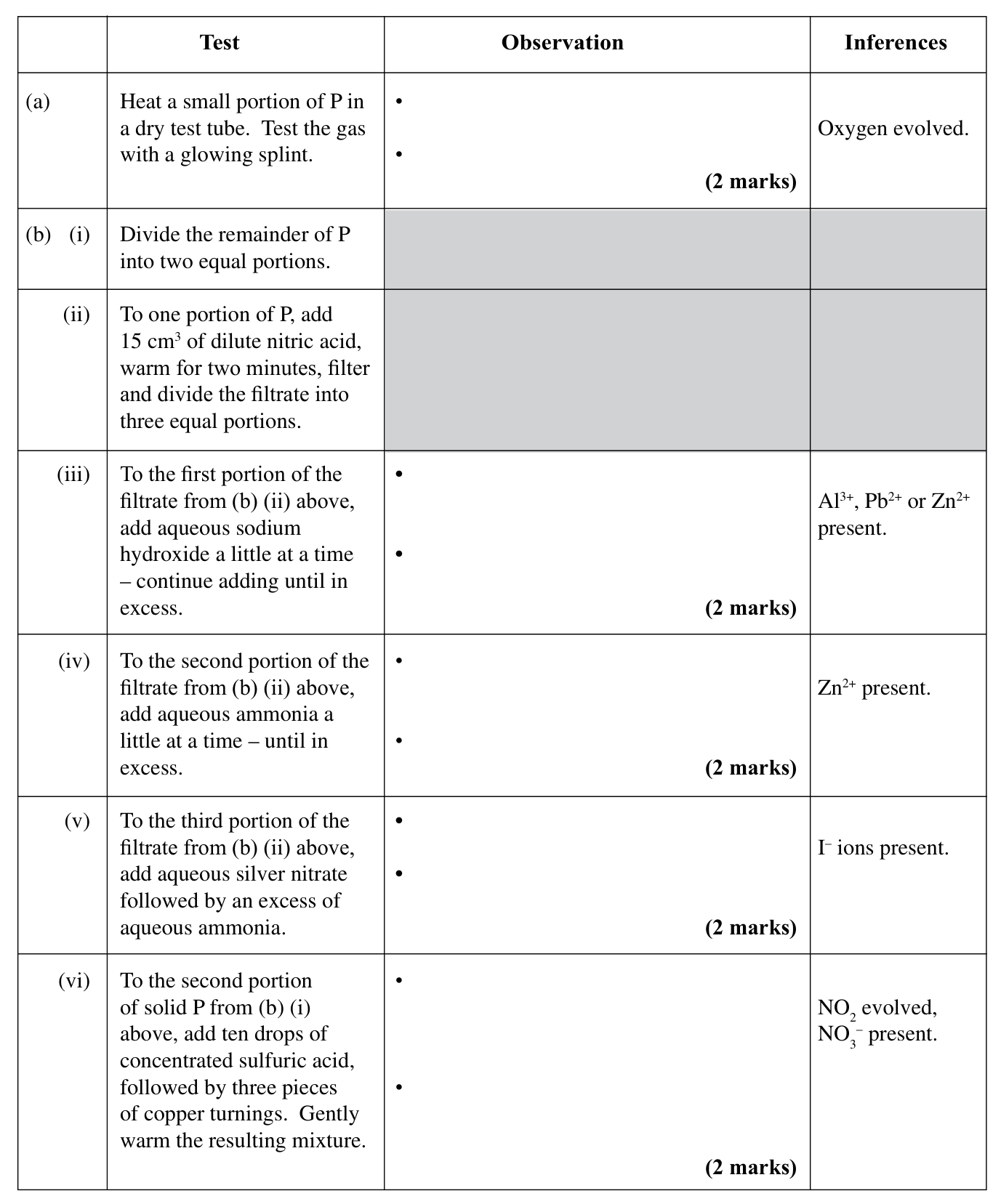
A student conducted a number of tests on Compound P. The inferences made are recorded in the table below. You are required to fill in the observations based on the inferences observed.
(Table with Test, Observation, and Inferences columns is present on page 6)
[10 marks]
Heat a small portion of P in a dry test tube. Test the gas with a glowing splint. Inference: Oxygen evolved.
[2 marks]
Divide the remainder of P into two equal portions.
To one portion of P, add 15 cm of dilute nitric acid, warm for two minutes, filter and divide the filtrate into three equal portions. Inference: Al, Pb or Zn present.
[2 marks]
To the first portion of the filtrate from (b) (ii) above, add aqueous sodium hydroxide a little at a time – continue adding until in excess. Inference: Al, Pb or Zn present.
To the second portion of the filtrate from (b) (ii) above, add aqueous ammonia a little at a time – until in excess. Inference: Zn present.
[2 marks]
To the third portion of the filtrate from (b) (ii) above, add aqueous silver nitrate followed by an excess of aqueous ammonia. Inference: I ions present.
[2 marks]
To the second portion of solid P from (b) (i) above, add ten drops of concentrated sulfuric acid, followed by three pieces of copper turnings. Gently warm the resulting mixture. Inference: NO evolved, NO present.
[2 marks]
When an aqueous solution of copper(II) sulfate is electrolyzed using copper electrodes, the mass of each electrode changes. You are provided with a 2.0 mol dm solution of aqueous copper(II) sulfate.
Hypothesis: The change in the mass of the copper cathode, for a fixed time period, is dependent on the concentration of the copper(II) sulfate solution.
Plan and design an experiment to investigate this hypothesis.
Your answer should include the following:
[13 marks]
Aim
[1 mark]
Apparatus and materials
[2 marks]
Procedure
[3 marks]
TWO variables to be controlled
[2 marks]
Data to be collected
[2 marks]
Discussion of the results (whether the hypothesis will be accepted or rejected)
[2 marks]
ONE possible source of error
[1 mark]
[2 marks]