CSEC Chemistry Paper 3 May/June 2011 - Free CXC Past Paper with Answers
Free CXC Chemistry Paper 3 May/June 2011 past paper from 2011. Includes a worked answer key. Open the PDF, take a timed test, and study with AI on Caribbean AI.
Answer keys are free on Caribbean AI. View the answers to every past-paper question at no cost - no payment needed - with step-by-step worked solutions and instant AI marking available on Premium.
- All CSEC Past Papers
- CSEC Chemistry Past Papers
- CSEC Chemistry Paper 3 May/June 2025
- CSEC Chemistry Paper 3 January 2021
- CSEC Chemistry Paper 3 January 2019
- CSEC Chemistry Paper 3 May/June 2017
- CSEC Chemistry Paper 3 May/June 2015
- CSEC Chemistry Paper 3 May/June 2014
- CSEC Chemistry Paper 3 May/June 2013
- CSEC Chemistry Paper 3 May/June 2012
- CSEC Chemistry Paper 3 May/June 2010
- CSEC Chemistry Paper 3 May/June 2007
- CSEC Chemistry Paper 3 May/June 2006
- CSEC Chemistry Paper 3 May/June 2005
CSEC Chemistry Paper 3 May/June 2011 - Free CXC Past Paper with Answers
Free CXC Chemistry Paper 3 May/June 2011 past paper from 2011. Includes a worked answer key. Open the PDF, take a timed test, and study with AI on Caribbean AI.
Opening the interactive papers…
- All CSEC Past Papers
- CSEC Chemistry Past Papers
- CSEC Chemistry Paper 3 May/June 2025
- CSEC Chemistry Paper 3 January 2021
- CSEC Chemistry Paper 3 January 2019
- CSEC Chemistry Paper 3 May/June 2017
- CSEC Chemistry Paper 3 May/June 2015
- CSEC Chemistry Paper 3 May/June 2014
- CSEC Chemistry Paper 3 May/June 2013
- CSEC Chemistry Paper 3 May/June 2012
- CSEC Chemistry Paper 3 May/June 2010
- CSEC Chemistry Paper 3 May/June 2007
- CSEC Chemistry Paper 3 May/June 2006
- CSEC Chemistry Paper 3 May/June 2005
CSEC Chemistry Paper 3 May/June 2011 Questions
Every question from this paper as text. See the answers and worked solutions. Questions are the property of the Caribbean Examinations Council; Caribbean AI is not affiliated with CXC.
Question 1 (14 marks)
Chemical reactions are accompanied by heat changes. Heat may be absorbed from (or given out to) the surroundings. Such heat changes can be measured experimentally. In this experiment, you are required to determine the heat change which occurs when solid potassium nitrate is dissolved in water.
The procedure for the experiment is outlined below.
PROCEDURE
- 50 cm³ of distilled water were measured into a polystyrene cup.
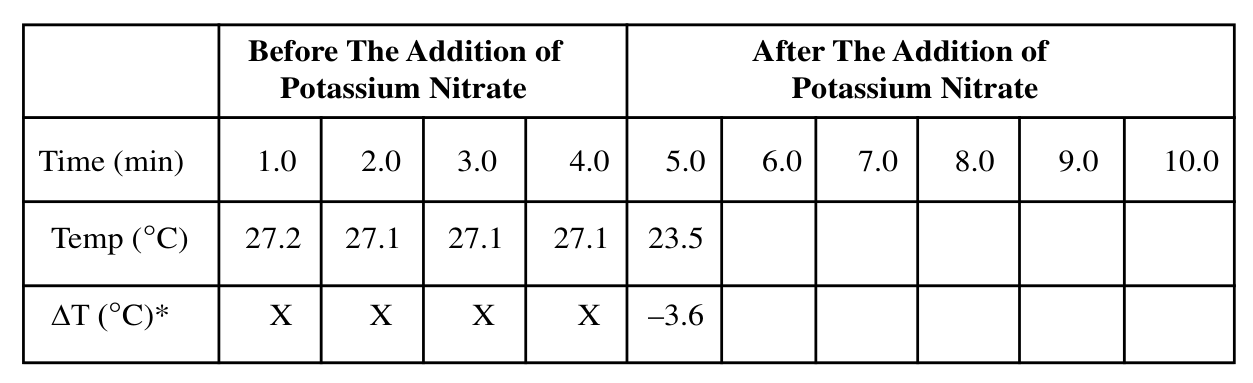
- The temperature of the water in the cup was measured at one-minute intervals for four minutes, and the data were recorded in Table 1.
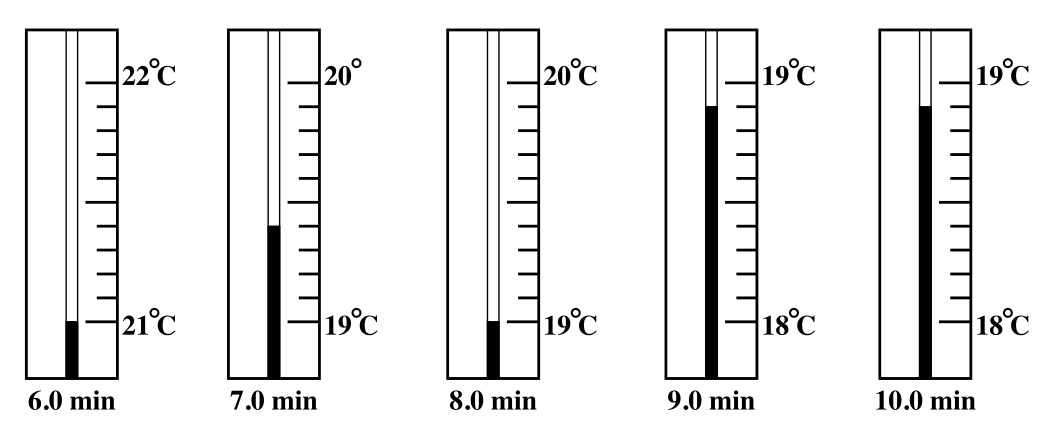
- Potassium nitrate (5.0 g) was poured into the cup. The contents were stirred with the thermometer and the temperature was recorded at one-minute intervals over a further period of 6 minutes. The temperature for minute 5 is also recorded in Table 1.
TABLE 1. TEMPERATURE CHANGES UPON DISSOLVING POTASSIUM NITRATE IN WATER
- (temperature reading at a particular time) – (temperature reading at 4 minutes)