Free CXC Chemistry Paper 3 May/June 2007 past paper from 2007. Includes a worked answer key. Open the PDF, take a timed test, and study with AI on Caribbean AI.
Answer keys are free on Caribbean AI. View the answers to every past-paper question at no cost - no payment needed - with step-by-step worked solutions and instant AI marking available on Premium.
CSEC Chemistry Paper 3 May/June 2007 - Free CXC Past Paper with Answers
Free CXC Chemistry Paper 3 May/June 2007 past paper from 2007. Includes a worked answer key. Open the PDF, take a timed test, and study with AI on Caribbean AI.
Opening the interactive papers…
Every question from this paper as text. See the answers and worked solutions. Questions are the property of the Caribbean Examinations Council; Caribbean AI is not affiliated with CXC.
Phosphoric acid (), which is used as an additive in soft drinks, can react with sodium hydroxide to form both normal and acidic salts.
[4 marks]
Define the terms 'acid salts' and 'normal salts'.
[2 marks]
Write ONE balanced equation EACH for the formation of a normal salt and an acid salt when phosphoric acid reacts with aqueous sodium hydroxide.
[4 marks]
Excess consumption of soft drinks may lead to excess stomach acid. a) How is this problem usually treated? b) Explain the chemical principles upon which the treatment you stated in (iii) a) above is based. c) Write an ionic equation for the reaction.
25.0 of 2.0 sodium hydroxide and 50.0 of 1.0 hydrochloric acid, both at 30.0°C, are mixed together in a styrofoam cup. On mixing, the temperature rises to 38.9°C. (i) Calculate the heat of neutralisation for the reaction in . Use the following information in your calculation:
[5 marks]
Draw a labelled energy profile diagram to illustrate the reaction in (b) (i) above.
[3 marks]
A solution of phosphoric acid has a pH of 4 and a solution of hydrochloric acid has a pH of 1. Which of the two is the stronger acid? Explain your answer.
[2 marks]
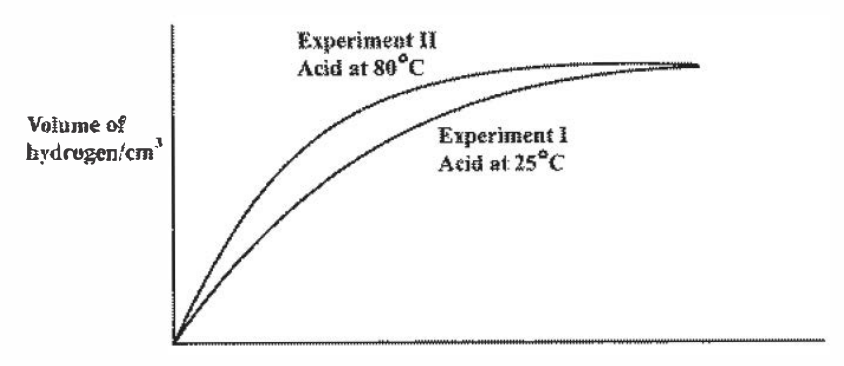
In Experiments I and II, 6.5 g of zinc granules are allowed to react with excess 1 sulphuric acid at 25°C and 80°C respectively. Figure 1 shows the rate of production of hydrogen gas for both experiments.
Write a balanced equation for the reaction between zinc and aqueous sulphuric acid.
[2 marks]
Based on the balanced equation you wrote in (a) (i) above, calculate the maximum volume of hydrogen gas at r.t.p. which can be generated from Experiment I using 6.5 g of zinc granules. (R.A.M: H = 1, Zn = 65, S = 32, O = 16. 1 mole of gas occupies 24 at r.t.p.)
[2 marks]
In a third experiment, Experiment III, 6.5 g of zinc reacts with excess 2 sulphuric acid at 80°C.
Make a sketch of the graph in Figure 1 in your answer booklet. On your sketch, draw the expected results for Experiment III.
[2 marks]
With reference to the slopes of the graphs for Experiments I, II and III, discuss the effects of EACH of the following on the rate of production of hydrogen: a) Temperature b) Concentration of the acid
[8 marks]
State TWO precautions that should be taken when conducting these experiments.
[2 marks]
Catalysts are used to alter the rates of chemical reactions.
Explain how a catalyst works to increase the rates of chemical reactions.
[2 marks]
Draw a labelled energy profile diagram to show how a catalyst would alter the rate of reaction between zinc and sulphuric acid.
[2 marks]
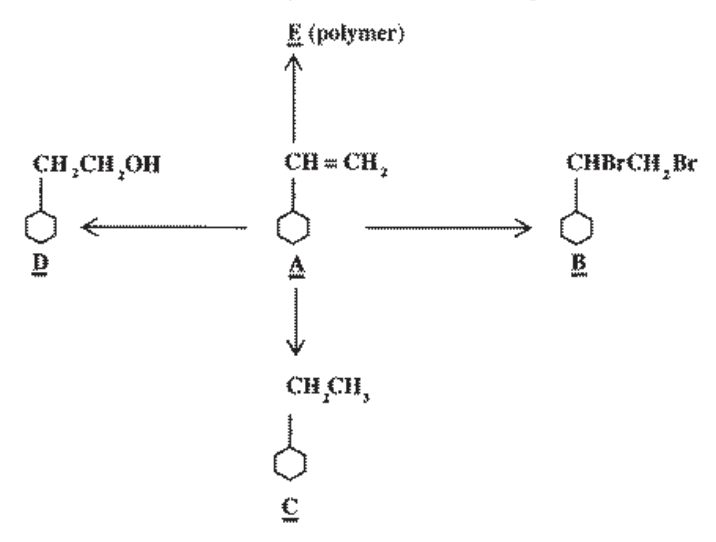
Carefully study the reaction scheme in Figure 2 and answer the questions which follow.
Identify suitable reagents and reaction conditions which can be used to convert (i) Compound A into Compound B (ii) Compound A into Compound C.
[4 marks]
Describe what may be OBSERVED when Compound D reacts with EACH of the following: (i) Acidified potassium chromate (VI) Give a reason for your answer. (ii) Sodium metal Include a balanced chemical equation in your answer.
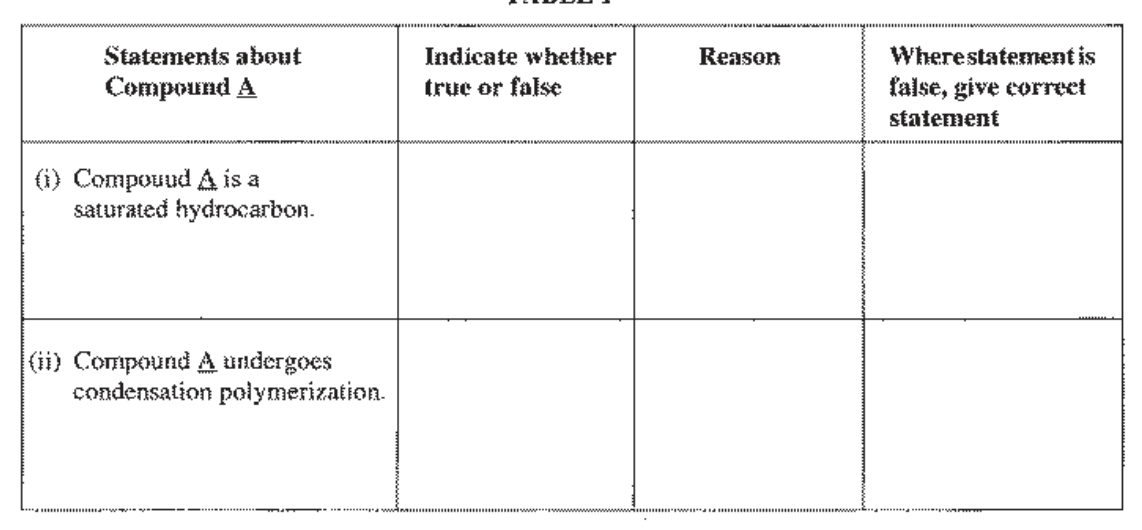
Table 1 below gives TWO statements about Compound A. These statements may be true or false. Copy this table in your answer booklet and fill in the information required in the blank spaces. In answering this question you should refer to the information about Compound A given in Figure 2 on page 4.
[6 marks]
Draw the partial structure of the polymer, E, that is formed when Compound A is polymerized.
[2 marks]
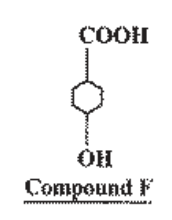
State how the structure of the polymer you have drawn in (d) (i) above differs from that formed from the polymerization of Compound F shown below. Illustrate your answer by means of an appropriate partial structure.
[2 marks]
Show by means of chemical equations, the main steps involved in the manufacture of sulphuric acid by the Contact process, starting with sulphur. You should state the reaction conditions required.
[6 marks]
The manufacture of sulphuric acid is a highly exothermic process. Suggest how this helps to make the whole process more economical.
[1 mark]
Suggest why in the manufacture of sulphuric acid, the sulphur trioxide is dissolved in sulphuric acid (98%) rather than directly in water.
[1 mark]
Name TWO factors that should be taken into consideration in the siting of a sulphuric acid plant.
[2 marks]
Account for the following observation: Sulphur burns in air to form an oxide which is gaseous, whereas sodium forms an oxide which is a solid, although both elements belong to the same period of the periodic table.
[4 marks]
Natural rubber is very soft and pliable. It can be strengthened by the process of vulcanization. Illustrate by means of a labelled diagram the role of sulphur in the vulcanization process.
[2 marks]
Consider the following equations and determine whether sulphuric acid and sulphur dioxide are acting as reducing or oxidizing agents. You should indicate how you arrived at your answer. (i) (ii)
[4 marks]
(a) Briefly outline how greenhouse gases can contribute to an increase of the earth's atmospheric temperature. Include in your answer: (i) The name of the main greenhouse gas (ii) TWO main causes of the increase in concentration of the named greenhouse gas (iii) An explanation of how EACH of the causes named in (ii) above can lead to the increase of this gas in the atmosphere You should include ONE chemical equation in your answer. (iv) A brief explanation of how the greenhouse effect works. Use a labelled diagram to illustrate your answer. (b) There is a claim that the use of electrical cars can completely eliminate the greenhouse gas effect. Do you support this statement? Suggest TWO reasons for your answer. (c) Over the years, studies have shown that there has been a significant decrease in the levels of the ozone layer. This has been linked to the extensive use of chlorofluorocarbons (CFCs) for many years.
Discuss the significance of the above statement, making reference to:
- The function of the ozone layer
- The action of CFCs on the ozone layer
- TWO health or environmental effects of the reduction of the ozone layer
- The possible long-term implications for the Caribbean's tourism industry
- ONE measure that has been put in place to reduce the amount of CFCs in the atmosphere
[20 marks]
Briefly outline how greenhouse gases can contribute to an increase of the earth's atmospheric temperature. Include in your answer: (i) The name of the main greenhouse gas (ii) TWO main causes of the increase in concentration of the named greenhouse gas (iii) An explanation of how EACH of the causes named in (ii) above can lead to the increase of this gas in the atmosphere You should include ONE chemical equation in your answer. (iv) A brief explanation of how the greenhouse effect works. Use a labelled diagram to illustrate your answer.
[11 marks]
The name of the main greenhouse gas
[1 mark]
TWO main causes of the increase in concentration of the named greenhouse gas
[2 marks]
An explanation of how EACH of the causes named in (ii) above can lead to the increase of this gas in the atmosphere You should include ONE chemical equation in your answer.
[3 marks]
A brief explanation of how the greenhouse effect works. Use a labelled diagram to illustrate your answer.
[5 marks]
There is a claim that the use of electrical cars can completely eliminate the greenhouse gas effect. Do you support this statement? Suggest TWO reasons for your answer.
[2 marks]
Over the years, studies have shown that there has been a significant decrease in the levels of the ozone layer. This has been linked to the extensive use of chlorofluorocarbons (CFCs) for many years.
Discuss the significance of the above statement, making reference to:
[7 marks]
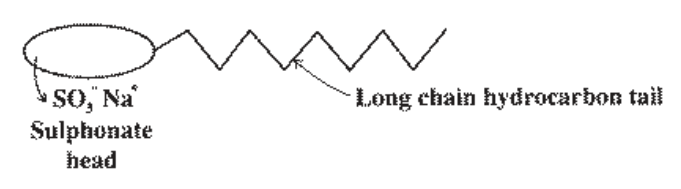
(a) Using the information given in Figure 3 above, suggest how detergents remove dirt from a piece of clothing during washing. (b) In those areas that use hard water, when soaps are used for bathing, bathrooms must be cleaned very often. However, when detergents such as bath gels are used this frequent cleaning is not found to be necessary.
Suggest a reason for this.
(c) One major function of laundering clothes is stain removal.
Stacy-Ann has two similar pieces of cloth. On one piece there is a tea stain and on the other a rust stain.
(i) Suggest an appropriate reagent to effectively remove EACH stain.
(ii) Give ONE reason for the selection of EACH stain remover and explain how EACH of them works.
(d) Fabric softeners are usually added to the final rinse when laundering. (i) What type of compounds are fabric softeners? (ii) State THREE reasons why fabric softeners are used. (iii) For ONE of the reasons identified in (d) (ii) above, explain how fabric softeners help to carry out this function.
[20 marks]
Using the information given in Figure 3 above, suggest how detergents remove dirt from a piece of clothing during washing.
[4 marks]
In those areas that use hard water, when soaps are used for bathing, bathrooms must be cleaned very often. However, when detergents such as bath gels are used this frequent cleaning is not found to be necessary.
Suggest a reason for this.
[4 marks]
One major function of laundering clothes is stain removal.
Stacy-Ann has two similar pieces of cloth. On one piece there is a tea stain and on the other a rust stain. (i) Suggest an appropriate reagent to effectively remove EACH stain. (ii) Give ONE reason for the selection of EACH stain remover and explain how EACH of them works.
[8 marks]
Suggest an appropriate reagent to effectively remove EACH stain.
[2 marks]
Give ONE reason for the selection of EACH stain remover and explain how EACH of them works.
[4 marks]
Fabric softeners are usually added to the final rinse when laundering. (i) What type of compounds are fabric softeners? (ii) State THREE reasons why fabric softeners are used. (iii) For ONE of the reasons identified in (d) (ii) above, explain how fabric softeners help to carry out this function.
[4 marks]
What type of compounds are fabric softeners?
[1 mark]
State THREE reasons why fabric softeners are used.
[1 mark]
For ONE of the reasons identified in (d) (ii) above, explain how fabric softeners help to carry out this function.
[2 marks]