Free CXC Human and Social Biology Paper 2 January 2008 past paper from 2008. Includes a worked answer key. Open the PDF, take a timed test, and study with AI on Caribbean AI.
Answer keys are free on Caribbean AI. View the answers to every past-paper question at no cost - no payment needed - with step-by-step worked solutions and instant AI marking available on Premium.
CSEC Human and Social Biology Paper 2 January 2008 - Free CXC Past Paper with Answers
Free CXC Human and Social Biology Paper 2 January 2008 past paper from 2008. Includes a worked answer key. Open the PDF, take a timed test, and study with AI on Caribbean AI.
Opening the interactive papers…
Every question from this paper as text. See the answers and worked solutions. Questions are the property of the Caribbean Examinations Council; Caribbean AI is not affiliated with CXC.
Name THREE characteristics of living organisms.
[3 marks]
A rose plant accidentally sticks Mary in her arm and she pulls away her arm.
Does the muscle in Mary's arm contract or relax?
[1 mark]
Suggest TWO features of the muscle in Mary's arm which allow her to respond by pulling away her arm.
[2 marks]
Mary's muscle needs energy for movement of the arm. Describe the process which produces this energy.
[3 marks]
Is the process described in (iii) above aerobic or anaerobic respiration?
[1 mark]
Explain what is meant by 'fertilisation' as it relates to reproduction.
[2 marks]
Does fertilisation occur during asexual reproduction or sexual reproduction?
[1 mark]
Mrs. Khan is pregnant. Describe how the foetus she is carrying obtains food and oxygen through the placenta.
[4 marks]
Give TWO reasons why it is essential that the foetal circulatory system is never directly connected to the mother's blood vessels.
[2 marks]
Give ONE example of parental care following birth.
[1 mark]
What is the liquid part of blood called?
[1 mark]
Name the oxygen-carrying pigment of human blood.
[1 mark]
Name the type of blood cells which assists the body in fighting infections.
[1 mark]
Thomas is involved in a vehicular accident and one of his blood vessels is cut open.
Explain how his body functions to prevent him bleeding to death.
[4 marks]
Explain how his body prevents his wounds from becoming infected.
[3 marks]
Ms. Moneyless makes sure her children are never hungry by feeding them a lot of boiled white rice and sugar water. When they become constipated she takes them to the Health Centre, where she learns that her children are malnourished, they have rickets and are suffering from night blindness.
What is meant by the term 'malnutrition'?
[1 mark]
Why would the children be constipated?
[1 mark]
Name ONE food which the children can eat to prevent constipation.
[1 mark]
Which vitamin is deficient in the children's diet to cause EACH of the following diseases: a) Rickets b) Night blindness
[2 marks]
For EACH of the diseases in (c) (i), name ONE food which Ms. Moneyless should have given to her children to prevent the disease. a) Rickets b) Night blindness
[2 marks]
Suggest THREE nutrients, OTHER THAN carbohydrates and vitamins, required to balance the children's diet.
[3 marks]
The World Health Organization has suggested that it is possible to eradicate mosquito-borne diseases if all communities follow strict guidelines.
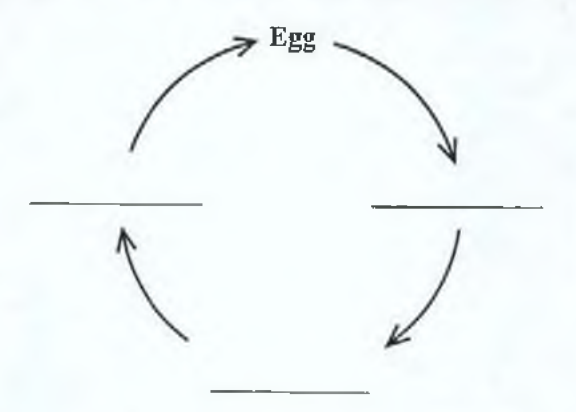
Complete Figure 1 to show the correct stages in the life cycle of the mosquito.
Figure 1. Incomplete life cycle of the mosquito
[3 marks]
You have to inform your community about the Aedes aegypti mosquito.
Describe how the mosquito transmits the dengue fever virus to human beings.
[2 marks]
Outline TWO activities which the community can carry out on the environment, to prevent the spread of mosquito-borne diseases, and explain how these activities will be effective in preventing the diseases.
Activity: Explanation:
[4 marks]
Suggest ONE activity, OTHER THAN the two in (b) (ii), which your mother can carry out in the home to prevent the spread of dengue fever.
[1 mark]
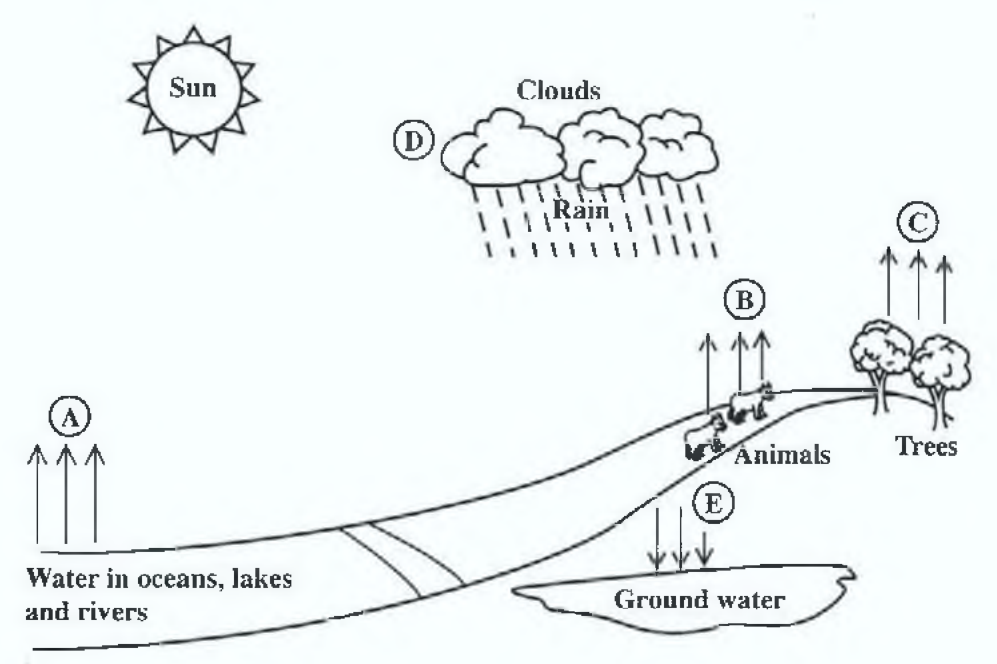
Nisha tells her brother, Niall, that the amount of water on earth remains constant, with the assistance of plants, and that the water cycle illustrates how this is so. Figure 2 represents the water cycle.
Figure 2. The water cycle
Identify the processes labelled A, B, C, D and E in Figure 2.
A: B: C: D: E:
[5 marks]
Ground water must be purified before it is safe for drinking.
Name TWO methods used in the home for purifying water.
[2 marks]
What is the function of screening in water treatment plants?
[1 mark]
Niall has a sample of water which he thinks has bacteria. How can he demonstrate the presence of bacteria in the water?
[2 marks]
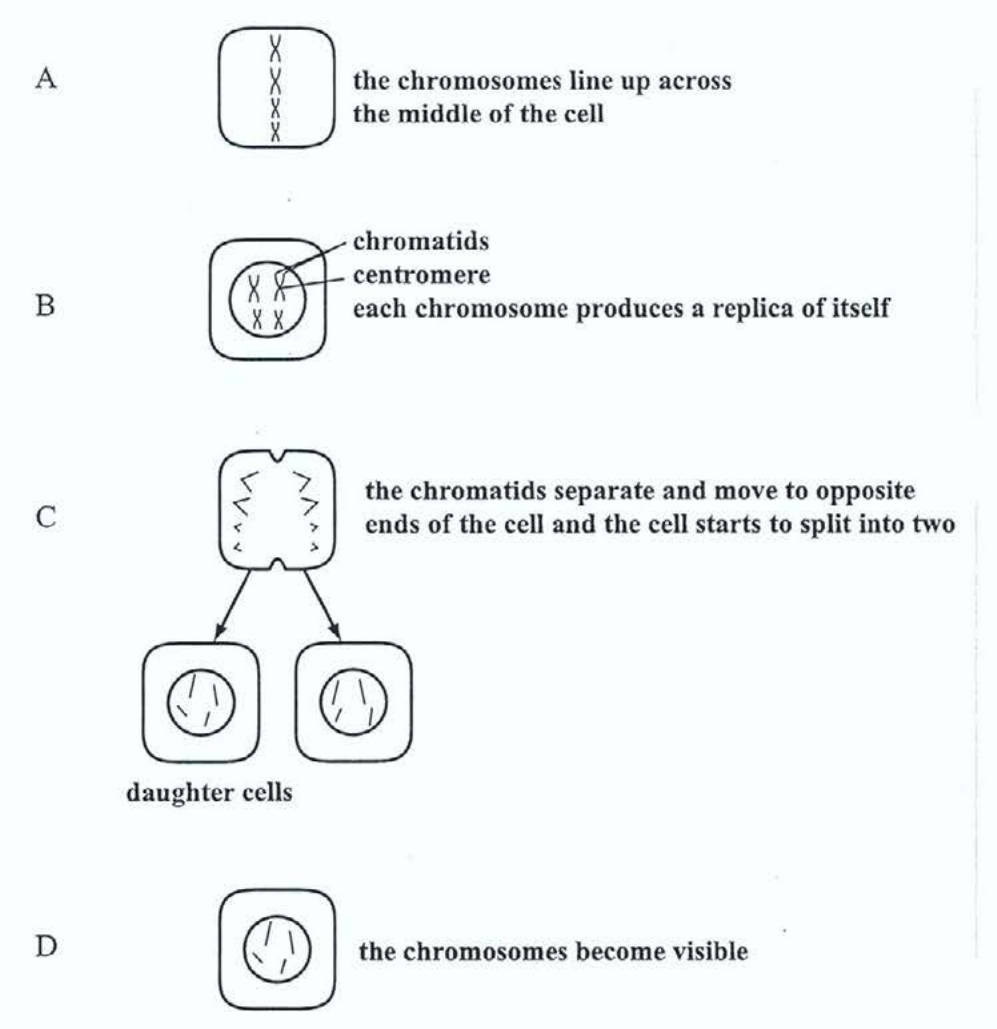
Figure 3 shows four steps in the process of mitosis. These steps are NOT in the correct order.
[10 marks]
Define EACH of the following terms:
[3 marks]
Mitosis
[1 mark]
Meiosis
[1 mark]
Genetic inheritance
[1 mark]
Figure 3 shows four steps in the process of mitosis. These steps are NOT in the correct order.
Figure 3. Steps in the process of mitosis
Complete the sequence of the steps in the process of mitosis by writing the correct letter in the boxes below.
D [ ] [ ] [ ] [ ]
[2 marks]
Suggest TWO reasons why it is important to have cells subdivide by mitosis.
[2 marks]
Give TWO examples of the process of mitosis in the human body.
[2 marks]
Suggest ONE way in which the process of mitosis could be used in the medical field.
[1 mark]
State TWO functions of bones in the human body.
[2 marks]
What is the function of cartilage in the human body?
[1 mark]
The lungs are the organs responsible for gaseous exchange.
Complete the statement below by writing the correct answer from the list in brackets.
Oxygen from the air moves into our lungs by the process of ____________________. (diffusion, osmosis, active transport)
[1 mark]
Oxygen enters the blood by the same process as in (b) (i) above. Describe how this process causes oxygen to move into the blood.
[2 marks]
Plants also need oxygen to function.
Explain the process by which oxygen is produced by green plants.
[4 marks]
What is meant by the term 'pollutant'?
[1 mark]
State TWO causes of water pollution.
[2 marks]
Carbon monoxide is an atmospheric pollutant produced by the incomplete combustion of fuel in motor vehicles.
[5 marks]
Name ONE OTHER process or activity which produces carbon monoxide.
[1 mark]
The driver of an old car has fumes (carbon monoxide) entering the vehicle. Explain the effect of carbon monoxide on the human system.
[2 marks]
Suggest TWO ways in which a community can reduce the risk of carbon monoxide poisoning.
[2 marks]
Until recently, carbon dioxide levels remained constant in the atmosphere.
Suggest TWO human activities which cause an increase of carbon dioxide in the atmosphere.
[2 marks]
Name the organism which causes AIDS.
[1 mark]
State TWO ways by which the disease is spread.
[2 marks]
Suggest TWO ways in which a person diagnosed with AIDS can treat or manage the disease.
[2 marks]
People suffering from AIDS are at greater risk of contracting infectious diseases like tuberculosis.
Suggest why this is so.
[1 mark]
Caribbean governments are concerned about the impact of AIDS on society.
Outline TWO social and TWO economic impacts of AIDS.
Social: (i) (ii)
Economic: (i) (ii)
[4 marks]
Write your answers on the pages provided at the end of this booklet.
[20 marks]
Define the term 'homeostasis' and state why homeostasis is important for human beings.
[2 marks]
What is meant by 'homeothermy' and which organ is mainly responsible for it?
[3 marks]
Suggest FIVE problems associated with a lack of control of blood glucose in the human body.
[5 marks]
Once a day Mr. Stephens eats a meal rich in carbohydrates. Explain how his body regulates his blood sugar levels.
[10 marks]
At which point of a food chain, the beginning, middle or end, is there the MOST energy?
[1 mark]
At which point of a food chain does photosynthesis occur?
[1 mark]
Arrange the following components of a food chain in correct sequence:
Big fish, water weed, small fish, tadpole
[3 marks]
In an effort to make it easier for tourists to view coral reefs and exotic fish, one Caribbean island decided to get rid of the seaweed from the sea bed. At first, small levels of weedicide were injected into the seaweeds but some people in the population suffered from weedicide poisoning.
[12 marks]
Explain what might have caused the appearance of the weedicide in some people in the population by discussing the concentration levels of weedicide in EACH element of the food chain.
[6 marks]
It was then decided to have divers pull up the seaweeds. Gradually, all the sea life around the island disappeared and the coral reefs died.
Explain how the removal of the seaweeds led to the disappearance of the sea life and the death of the coral reefs around the island.
[6 marks]
Rivers provide recreation for us, and for tourists also.
Explain how growing crops near a river can cause the 'death' of the river.
[3 marks]
Define the term 'sterilization' as it relates to preventing diseases.
[1 mark]
Explain how heat is used in the canning of tuna to ensure that it stays for long periods without spoilage.
[3 marks]
Name ONE method, OTHER THAN canning, which employs high temperature for food preservation.
[1 mark]
Mrs. Grazette has been taking antibiotics for the common cold, without her doctor's knowledge. (i) Define the term 'antibiotic' as used in the pharmaceutical industry. (ii) Give ONE example of an antibiotic. (iii) Explain how antibiotic treatments can adversely affect the microorganism population in the intestine. (iv) Why should antibiotic treatment be regulated by a physician (doctor)?
[10 marks]
Define the term 'antibiotic' as used in the pharmaceutical industry.
[2 marks]
Give ONE example of an antibiotic.
[1 mark]
Explain how antibiotic treatments can adversely affect the microorganism population in the intestine.
[4 marks]
Why should antibiotic treatment be regulated by a physician (doctor)?
[4 marks]
Another common disease in the Caribbean is leptospirosis. You have to create a poster to inform your community about the disease.
What information should be written on the poster about EACH of the following? (i) The causative organism (ii) The vector (iii) Transmission of the disease
[4 marks]
The causative organism
[1 mark]
The vector
[1 mark]
Transmission of the disease
[2 marks]
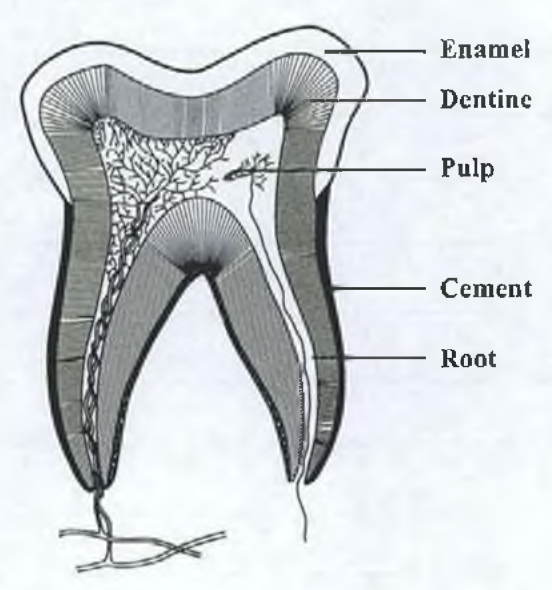
Figure 4 shows a labelled diagram of a molar tooth.
(i) State the function of EACH of the labelled parts. (ii) Your friend, Peter, says that he has a toothache caused by a 'cavity' in one of his teeth.
Explain to Peter how bacteria may have caused his tooth to develop a cavity. (iii) Suggest TWO practices which Peter should follow to prevent cavities in his other teeth, and explain why these practices would be effective.
[16 marks]
State the function of EACH of the labelled parts.
[5 marks]
Your friend, Peter, says that he has a toothache caused by a 'cavity' in one of his teeth.
Explain to Peter how bacteria may have caused his tooth to develop a cavity.
[7 marks]
Suggest TWO practices which Peter should follow to prevent cavities in his other teeth, and explain why these practices would be effective.
[4 marks]
Granny is missing her canine and molar teeth. Explain how this affects her ability to eat food.
[4 marks]