Free CXC Human and Social Biology Paper 2 January 2011 past paper from 2011. Includes a worked answer key. Open the PDF, take a timed test, and study with AI on Caribbean AI.
Answer keys are free on Caribbean AI. View the answers to every past-paper question at no cost - no payment needed - with step-by-step worked solutions and instant AI marking available on Premium.
CSEC Human and Social Biology Paper 2 January 2011 - Free CXC Past Paper with Answers
Free CXC Human and Social Biology Paper 2 January 2011 past paper from 2011. Includes a worked answer key. Open the PDF, take a timed test, and study with AI on Caribbean AI.
Opening the interactive papers…
Every question from this paper as text. See the answers and worked solutions. Questions are the property of the Caribbean Examinations Council; Caribbean AI is not affiliated with CXC.
Infectious diseases are caused by pathogens. Name the type of organism that causes EACH of the following diseases:
[3 marks]
Typhoid
[1 mark]
Dengue
[1 mark]
Tuberculosis
[1 mark]
Identify TWO differences between bacteria and viruses.
[2 marks]
Suggest ONE reason why a bacterium may be considered a plant cell.
[1 mark]
A river has overflowed its banks and the drinking water supply in the area outlining the signs/symptoms of cholera, and measures to control its spread. Suggest TWO signs/symptoms, and TWO control measures which may be on the poster.
Signs/symptoms:
Control:
[4 marks]
Complete the statement below by choosing the correct word from the list provided in brackets.
(motor, sensory, central, spinal, peripheral)
The nervous system, consisting of the brain and spinal cord, is known as the _________________________________ nervous system, while the _________________________________ nerves system is made up of the paired cranial nerves and the _________________________________ nerves.
[3 marks]
Melissa and her parents are involved in a vehicular accident. Upon recovery, Melissa is having difficulty remembering things, while her father is unable to maintain his balance. Suggest the region of the brain that may have been damaged for: (i) Melissa (ii) Melissa's father
[2 marks]
Melissa
[1 mark]
Melissa's father
[1 mark]
The doctor suspects that Melissa's hypothalamus may also have been affected. Figure 1 shows a drawing of the human brain.
Write X on Figure 1 to show the hypothalamus. Suggest ONE way Melissa's bodily functions may be affected by a malfunctioning hypothalamus.
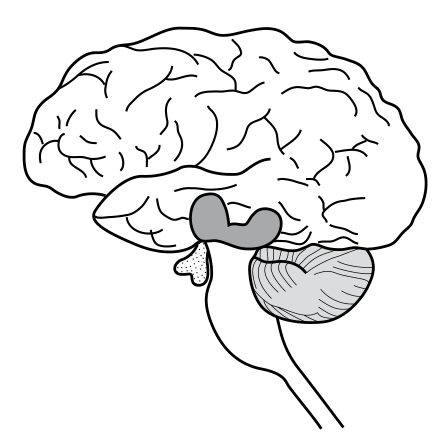
[2 marks]
Write X on Figure 1 to show the hypothalamus.
[1 mark]
Suggest ONE way Melissa's bodily functions may be affected by a malfunctioning hypothalamus.
[1 mark]
Paul and Paula are eight-year-old twins. Paul's thyroid gland is not producing sufficient thyroxine.
Suggest how Paul's thyroid gland would make his physical and mental development different from Paula's. Identify ONE effect of an overactive thyroid gland on a human adult.
[3 marks]
Suggest how Paul's thyroid gland would make his physical and mental development different from Paula's.
Mental: Physical:
[2 marks]
Identify ONE effect of an overactive thyroid gland on a human adult.
[1 mark]
State TWO functions of blood in the human body.
[2 marks]
Name the pigment that gives red blood cells their colour.
[1 mark]
On a site visit to a hospital, Dana views some blood slides under a microscope and observes some differences in the blood cells.
Suggest TWO differences Dana may have observed between the red blood cells and white blood cells. Identify ONE feature of the platelets which may have assisted her in identifying the platelets. What role do the platelets play in the human body?
[4 marks]
Suggest TWO differences Dana may have observed between the red blood cells and white blood cells.
[2 marks]
Identify ONE feature of the platelets which may have assisted her in identifying the platelets.
[1 mark]
What role do the platelets play in the human body?
[1 mark]
Explain what is meant by 'atherosclerosis'. Suggest ONE way an individual may prevent atherosclerosis.
[3 marks]
Explain what is meant by 'atherosclerosis'.
[2 marks]
Suggest ONE way an individual may prevent atherosclerosis.
[1 mark]
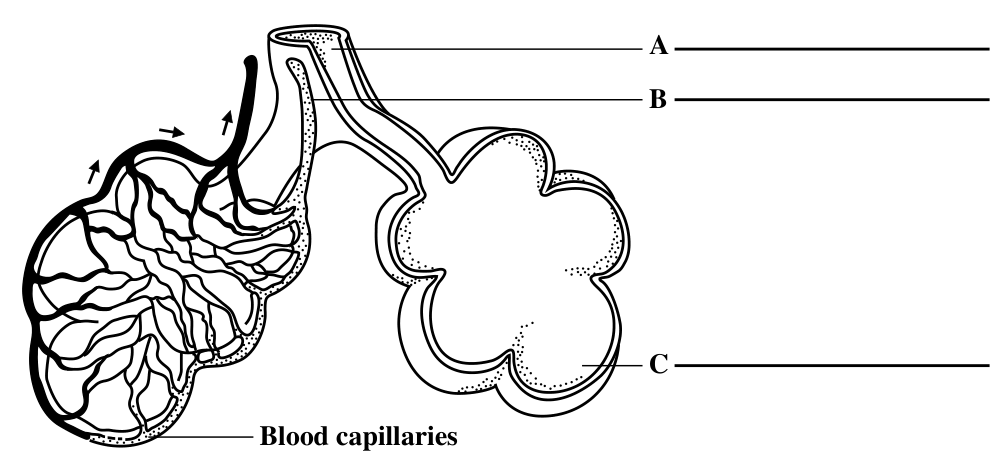
Breathing is the movement of air in and out of the lungs.
Identify the structures labelled A, B and C in Figure 2. Write your answers in the spaces provided in Figure 2.
[3 marks]
Ian got into difficulties while sea-bathing, causing the lifeguard to employ mouth-to-mouth resuscitation to revive him.
Explain why the lifeguard performed EACH of the following actions during mouth-to-mouth resuscitation: The air blown into Ian's lungs contains 4% - 6% carbon dioxide. Suggest which part of the brain the carbon dioxide stimulates to cause breathing to restart.
[3 marks]
Explain why the lifeguard performed EACH of the following actions during mouth-to-mouth resuscitation: a) Pressed Ian's head back, and his lower jaw upward b) Pressed down on Ian's chest
[2 marks]
The air blown into Ian's lungs contains 4% - 6% carbon dioxide. Suggest which part of the brain the carbon dioxide stimulates to cause breathing to restart.
[1 mark]
Some acute respiratory infections, like influenza, occur when we breathe in pathogens.
Name the type of organism that causes influenza. Suggest how the organism named in (c)(i) is spread. Identify TWO signs/symptoms of the flu.
[4 marks]
Name the type of organism that causes influenza.
[1 mark]
Suggest how the organism named in (c)(i) is spread.
[1 mark]
Identify TWO signs/symptoms of the flu.
[2 marks]
The bulk of our food consists of the nutrients, carbohydrates, fats and proteins. We require vitamins and minerals in very small quantities.
[10 marks]
State ONE function of EACH of the following nutrients in the human body.
[3 marks]
Carbohydrates
[1 mark]
Fats
[1 mark]
Proteins
[1 mark]
Stella's lunch consists of chicken, baked potato, lettuce, milk and a slice of mango. David eats a chicken leg and two slices of bread, with a soda and a slice of cake.
[5 marks]
Explain what is meant by a 'balanced diet'.
[2 marks]
Which of the two lunches, Stella's or David's, is balanced? Explain your answer.
[3 marks]
The teeth of your six-month-old baby sister are now beginning to grow.
[2 marks]
Which mineral is particularly important for the growth of her teeth?
[1 mark]
Suggest ONE vegetable which may be a source of the mineral named in (c) (i) above.
[1 mark]
Name the organ that produces oestrogen.
[1 mark]
State TWO functions of oestrogen in the human female.
[2 marks]
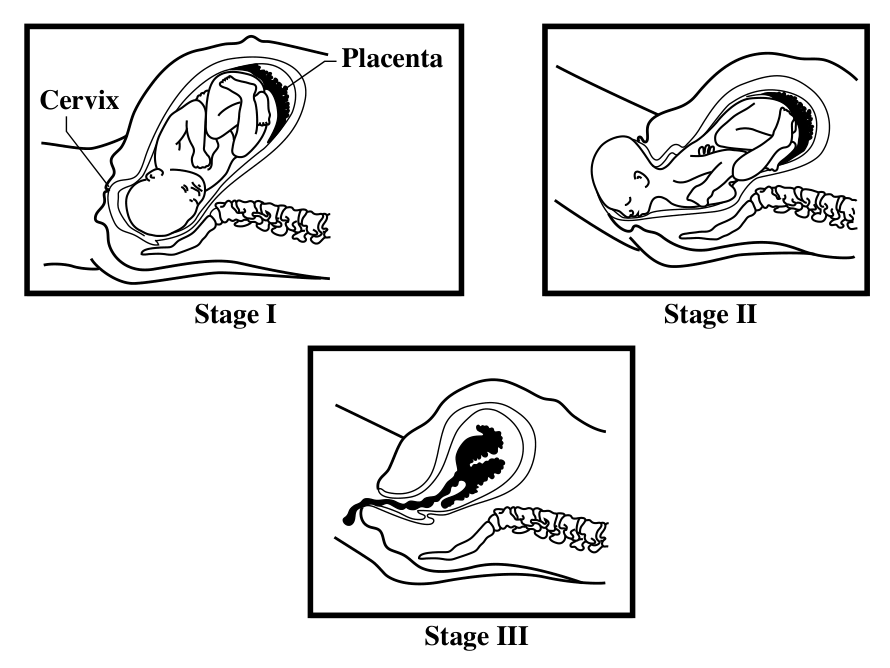
The birth process involves three stages, illustrated in Figure 3.
Outline what occurs in EACH of the three stages in Figure 3. Stage I: Stage II: Stage III:
[5 marks]
A newborn baby shows severe growth deficiencies, believed to be caused by the mother's alcohol consumption during pregnancy.
[2 marks]
Suggest the name of the disease with which the baby is born.
[1 mark]
Name ONE other drug that could cause babies to be underweight at birth.
[1 mark]
What is meant by EACH of the following terms?
[2 marks]
Chromosome
[1 mark]
Heterozygous
[1 mark]
State the number of chromosomes that are found in muscle cells of humans.
[1 mark]
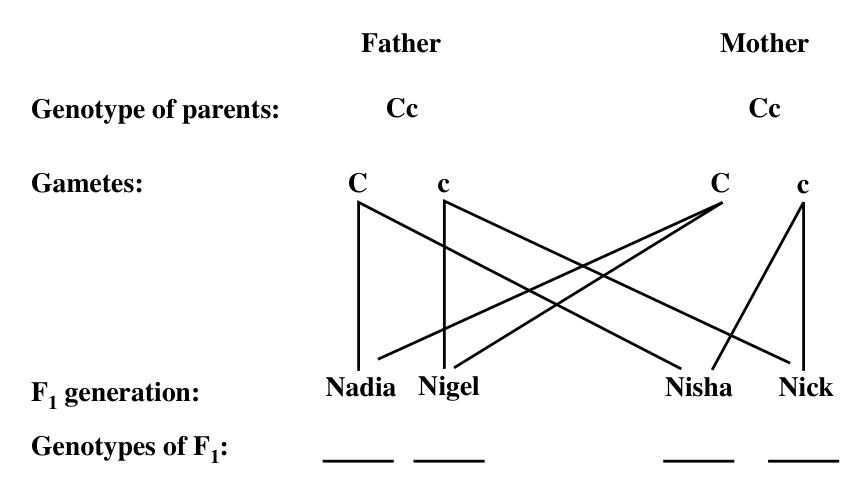
Figure 4 shows the inheritance of height in humans. C represents the gene for tallness; c represents the gene for dwarfism.
[7 marks]
On Figure 4, write the genotypes for the generation.
[4 marks]
Name the child who is homozygous dominant.
[1 mark]
Name ONE child who is short and ONE child who is tall.
Short: Tall:
[2 marks]
What is meant by the term 'vector'?
[3 marks]
Name ONE vector found in the Caribbean region.
[1 mark]
An outbreak of leptospirosis has occurred in your community.
[3 marks]
Outline TWO measures which the community can undertake to control the further spread of the disease.
[2 marks]
Suggest ONE method of treatment for a person infected with leptospirosis.
[1 mark]
A major disease affecting Caribbean populations is AIDS.
[4 marks]
Gregory discovers that he is losing weight rapidly. How can he confirm whether or not he has AIDS?
[1 mark]
Identify ONE OTHER sign/symptom of AIDS.
[1 mark]
Suggest TWO means by which the virus that causes AIDS is spread.
[2 marks]
Instruments in a hospital must be sterilized before use.
[3 marks]
What is meant by the term 'sterilization'?
[1 mark]
Name TWO methods of sterilizing food or other materials.
[2 marks]
After Hurricane Dean, the citizens of Jamaica were advised to add a small amount of chlorine bleach to their drinking water.
[3 marks]
Suggest the effect of chlorine bleach on the drinking water.
[1 mark]
Explain the function of chlorination in large-scale water purification.
[2 marks]
When Johnny steps on a rusty nail, the nurse gives him a tetanus injection, which provides him with artificial passive immunity.
[4 marks]
Explain how artificial passive immunity protects Johnny.
[2 marks]
Outline TWO differences between artificial passive immunity and artificial active immunity.
[2 marks]
List THREE structures common to plant and animal cells.
[3 marks]
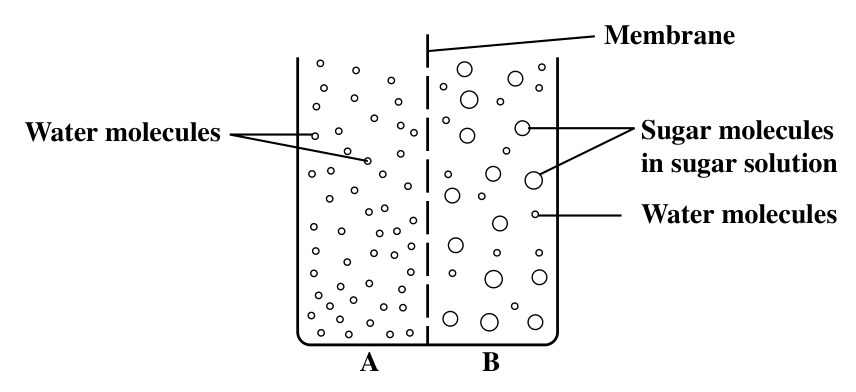
Figure 5 is a simplified illustration of osmosis.
[5 marks]
Using ONE arrow, show on Figure 5 the movement of molecules.
[1 mark]
Which part of the container, A or B, has the greater concentration of water molecules?
[1 mark]
Explain the process of osmosis, using the illustration in Figure 5.
[3 marks]
During breathing, oxygen and carbon dioxide pass across the alveoli.
[2 marks]
Name the process by which oxygen and carbon dioxide move across the alveoli.
[1 mark]
Identify ONE way in which osmosis differs from the process named in (c) (i) above.
[1 mark]
SECTION B Answer ANY TWO questions.
[20 marks]
Explain what is 'diabetes mellitus'.
[1 mark]
Name the TWO types of diabetes mellitus.
[1 mark]
Name the hormone which, when deficient, causes diabetes mellitus.
[3 marks]
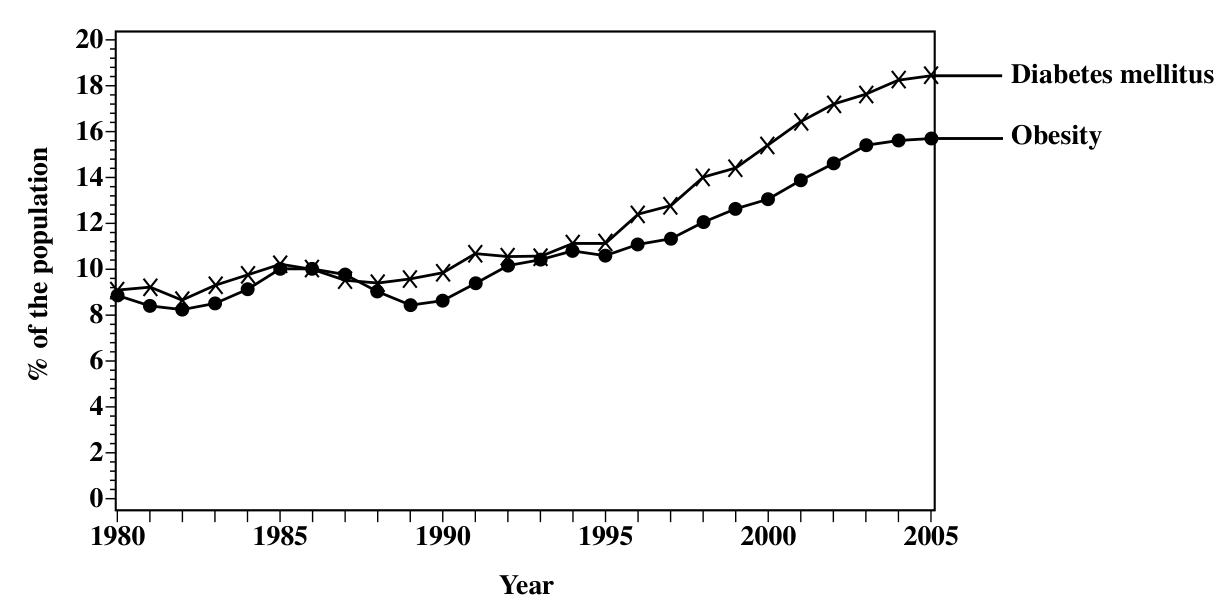
Figure 6 shows the relationship between obesity and diabetes mellitus in Caribbean people from 1980 to 2005.
[6 marks]
Approximately what percentage of the population was diagnosed with diabetes mellitus in 2005?
[1 mark]
Approximately what percentage of the population was considered obese in 2005?
[1 mark]
By approximately how much had diabetes mellitus increased from 1980 to 2005?
[1 mark]
Compare the trends in diabetes mellitus and obesity between 1980 and 2005.
[3 marks]
Suggest FOUR factors which may have contributed to obesity becoming a problem in the Caribbean.
[3 marks]
Recommend TWO lifestyle changes in managing obesity.
[3 marks]
Explain how obesity may affect blood pressure.
[3 marks]
Describe how a landfill is made.
[2 marks]
Sorting is one activity that is performed in treating with solid waste at a landfill. Name TWO other activities.
[3 marks]
Community Y has an effective solid waste management programme. Labelled bins are provided for the collection of household refuse, glass, wood and metal products. Community Y also uses methods of incineration, recycling, and composting to manage its solid waste.
[9 marks]
Explain the processes of incineration, recycling and composting.
[5 marks]
Suggest ONE advantage of using EACH of the processes in (b)(i) above.
[4 marks]
Community Y is concerned about pollution. Explain how Community Y can prevent water pollution. Your answer should include THREE methods.
[6 marks]
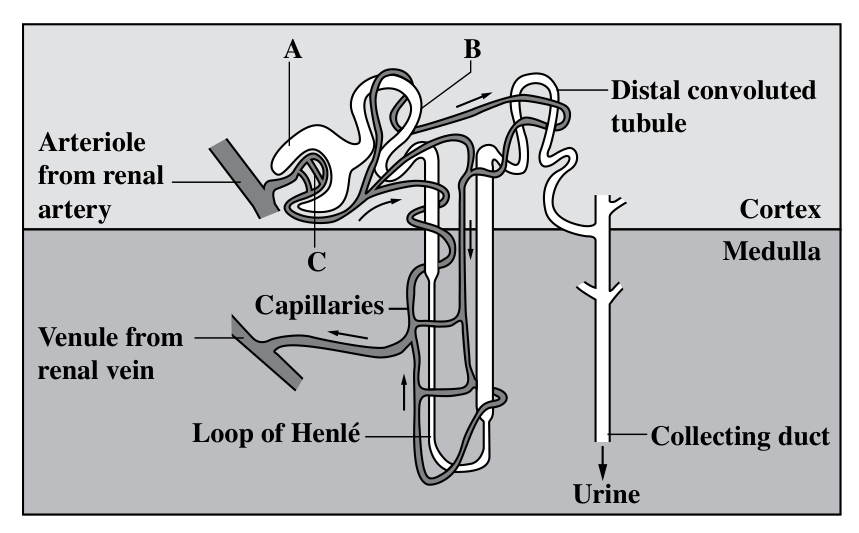
The kidney plays an important role in excretion.
Figure 7 shows the structure of a nephron in the kidney.
[5 marks]
Identify the parts labelled A, B and C in Figure 7.
[2 marks]
State the function of EACH of the parts labelled A and B in Figure 7.
[3 marks]
Explain how urine is formed. In your answer, explain how the processes of ultrafiltration and selective reabsorption are utilized.
[8 marks]
Roger is an excessive consumer of alcohol and this has affected his liver.
[7 marks]
Suggest TWO functions of the liver that would be impaired as a result of this disease.
[2 marks]
Roger has begun to experience some tremors. Identify THREE OTHER physiological effects of alcoholism that Roger might experience.
[3 marks]
Suggest TWO social effects that could arise as a result of alcoholism.
[2 marks]
State what is meant by the term 'hormones'.
[1 mark]
State ONE function of EACH of the following hormones: a) Adrenaline b) Glucagon
[2 marks]
Name the gland that produces adrenaline.
[2 marks]
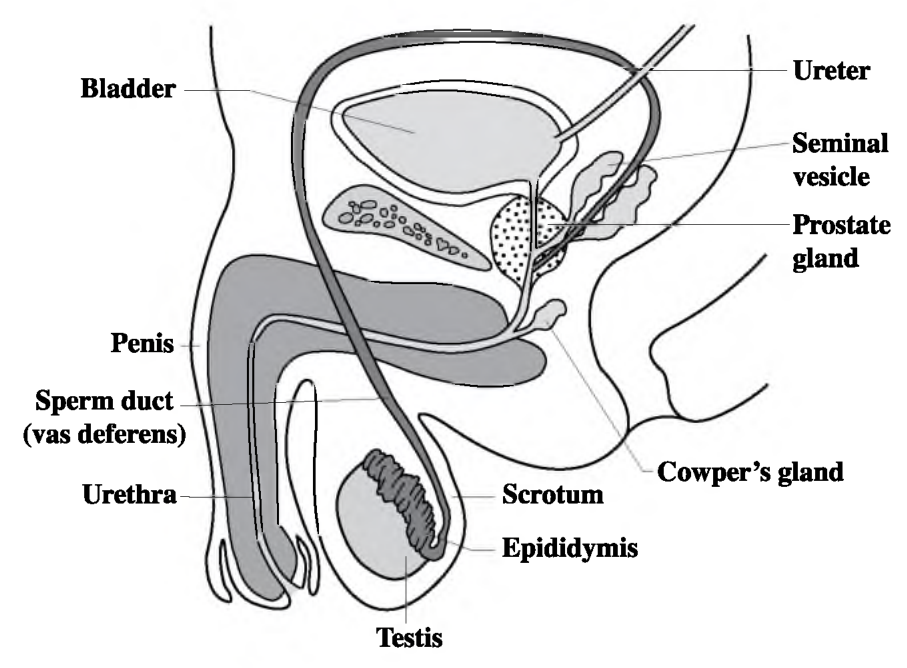
Humans reproduce sexually while some organisms like the amoeba reproduce asexually.
[9 marks]
Your friend, Reeza, believes that the major disadvantage of sexual reproduction in humans is the time and energy it takes to find a mate.
Convince Reeza of the advantages of sexual reproduction over asexual reproduction. Your answer should include a definition and TWO advantages of sexual reproduction.
[5 marks]
With the aid of the diagram in Figure 8, describe how semen is produced.
[4 marks]
Pregnancy among teenage girls is on the increase.
[6 marks]
Explain TWO disadvantages of very young teenage girls becoming pregnant.
[3 marks]
Sometimes spontaneous abortion occurs during pregnancy. Explain what is meant by 'spontaneous abortion'.
[3 marks]