Free CXC Human and Social Biology Paper 2 May/June 2009 past paper from 2009. Includes a worked answer key. Open the PDF, take a timed test, and study with AI on Caribbean AI.
Answer keys are free on Caribbean AI. View the answers to every past-paper question at no cost - no payment needed - with step-by-step worked solutions and instant AI marking available on Premium.
CSEC Human and Social Biology Paper 2 May/June 2009 - Free CXC Past Paper with Answers
Free CXC Human and Social Biology Paper 2 May/June 2009 past paper from 2009. Includes a worked answer key. Open the PDF, take a timed test, and study with AI on Caribbean AI.
Opening the interactive papers…
Every question from this paper as text. See the answers and worked solutions. Questions are the property of the Caribbean Examinations Council; Caribbean AI is not affiliated with CXC.
Living things use materials from the environment. Some of these materials are cycled in nature and returned to the environment.
[10 marks]
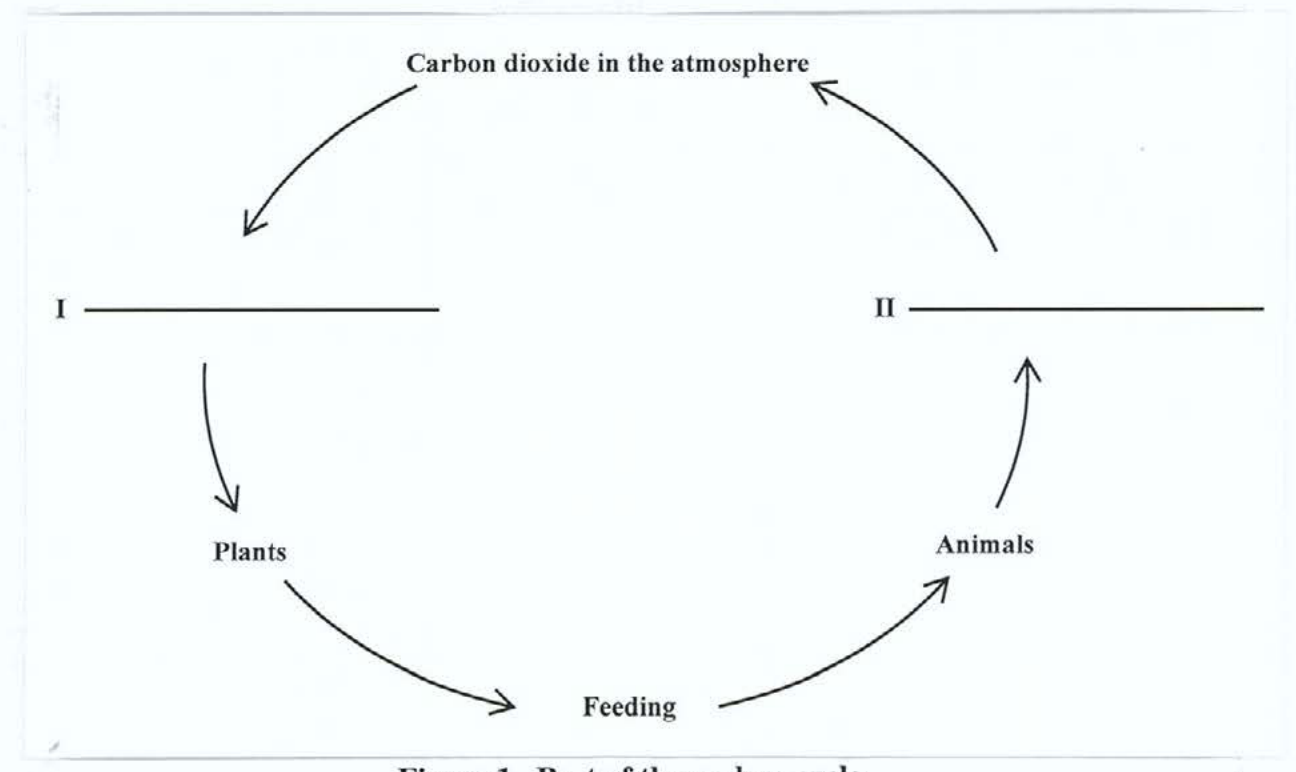
Carbon is one element which is cycled in nature. Figure 1 shows a part of the carbon cycle.
[3 marks]
From the list given in brackets below, identify the processes at I and II in Figure 1. Write your answers in the spaces provided in Figure 1.
(respiration, digestion, osmosis, photosynthesis).
[2 marks]
The lungs are responsible for removing carbon dioxide from the body. Which structure in the lungs is responsible for gaseous exchange?
[1 mark]
Nitrogen is another element which is cycled in nature. Plants use nitrogen in the form of nitrates.
[5 marks]
Explain the role of nitrifying bacteria in making nitrates available to plants.
[3 marks]
Explain how nitrates in the soil are returned to the atmosphere as nitrogen gas.
[2 marks]
Decomposers, like bacteria and fungi, feed on dead organisms and waste droppings from animals, and release nutrients into the soil.
One way human beings can utilize decomposers is in the production of biogas.
Suggest TWO OTHER ways in which human beings can utilize decomposers to benefit their daily lives.
[2 marks]
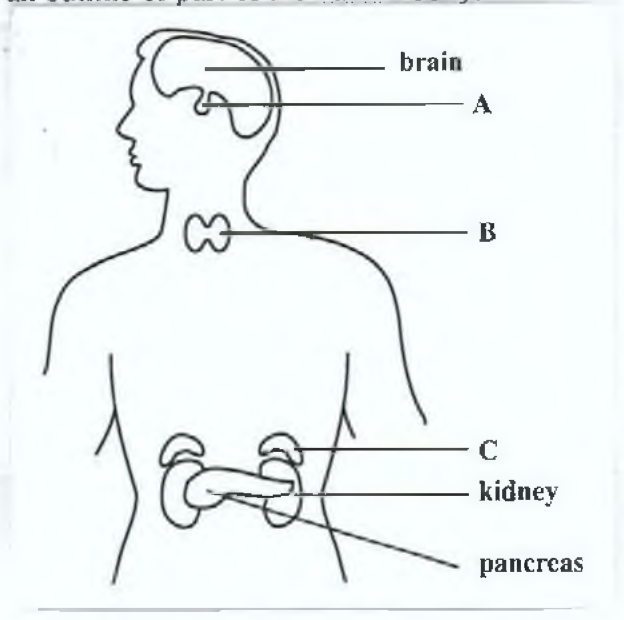
Figure 2 shows an outline of part of the human body.
[6 marks]
Name the endocrine glands labelled A, B and C in Figure 2.
A: B: C:
[3 marks]
Why is the pancreas considered as BOTH an endocrine gland and an exocrine gland?
Endocrine: Exocrine:
[3 marks]
Diabetes mellitus is a common disease among Caribbean people.
[4 marks]
Which hormone, produced by the pancreas, is likely to be deficient in people suffering from diabetes mellitus?
[1 mark]
Explain how the hormone named in 2 (b) (i) above functions to lower blood glucose levels.
[3 marks]
Human beings need a variety of foods for healthy living.
[10 marks]
Define the term 'malnutrition'.
[2 marks]
Fashion models tend to view slimming as very important for their profession. When taken to the extreme, slimming can lead to a mental illness called anorexia nervosa.
Describe THREE effects of anorexia nervosa on an individual.
[3 marks]
Your friend, Ancill, thinks that human beings should not have fibre in their diet.
[2 marks]
Name ONE food which is high in fibre.
[1 mark]
Advise Ancill of ONE reason why fibre is important to his diet.
[1 mark]
Ancill drinks water with all his meals. Suggest THREE functions of water in the human body.
[3 marks]
Many countries in the Caribbean use family planning as a means of controlling population. This is achieved by the use of natural or artificial methods.
[10 marks]
Name ONE natural method of birth control.
Natural method:
[1 mark]
Name TWO artificial methods of birth control, OTHER THAN the contraceptive pill.
Artificial methods:
[2 marks]
Complete the following sentences by writing the correct word from the list given in brackets below.
(medical, natural, genetic, abuse, rape)
Spontaneous abortion is nature's way of controlling population. Sometimes, spontaneous abortion occurs when the foetus has a _________________________________ problem.
In some countries, a _________________________________ abortion may be performed in cases of _________________________________ , or if the foetus is deformed in some way.
[3 marks]
Mrs. Wise believes that the most reliable method of birth control is the contraceptive pill. Explain how the contraceptive pill functions to prevent pregnancy.
[2 marks]
Suggest TWO benefits to a family of having a small number of children.
[2 marks]
Gastroenteritis is caused by typhoid, cholera and amoebic dysentery.
[10 marks]
Complete the following sentences by writing the correct word from the list given in brackets below.
(damage, pain, lungs, intestines, bacterium, virus)
Gastroenteritis results from _________________________________ to the walls of the stomach and _________________________________ by inflammation.
Typhoid is caused by a _________________________________ .
[3 marks]
Suggest ONE method of treating someone who has typhoid.
[1 mark]
Your friend, Indar, has dengue fever, which is caused by a pathogen, and the doctor says that he needs a lot of fluids and rest.
[6 marks]
A pathogen is a disease-causing organism, for example, a virus or bacterium. How is a vector different from a pathogen?
Vector:
[2 marks]
Identify the pathogen and the vector for Indar's disease (dengue fever).
Pathogen: Vector:
[2 marks]
Suggest TWO symptoms of the dengue fever which Indar may be experiencing.
[2 marks]
What is meant by the term 'drug abuse'?
[1 mark]
Name TWO commonly abused legal (social) drugs in the Caribbean.
[2 marks]
A woman who smokes gives birth to a small baby, who dies within one week of its birth.
[5 marks]
Suggest how smoking causes babies to be smaller than normal.
[2 marks]
Nicotine passes across the placental barrier to the foetus. Describe the effect of nicotine on infants.
[1 mark]
Name ONE OTHER way in which nicotine may be passed to an infant from the mother.
[1 mark]
Suggest TWO effects of alcohol consumption on the foetus.
[2 marks]
Breast feeding is the recommended form of nutrition for babies.
What form of immunity is passed from the mother to the baby by breast milk?
[1 mark]
Human beings in early civilization did not pollute their environment. They maintained the balance of nature.
[10 marks]
Define the term 'pollution'.
[2 marks]
ONE type of pollution is air pollution. Name ONE OTHER type of pollution.
[1 mark]
Vehicular transport causes pollution by the pollutant, carbon dioxide, . Suggest TWO OTHER pollutants resulting from vehicles.
[2 marks]
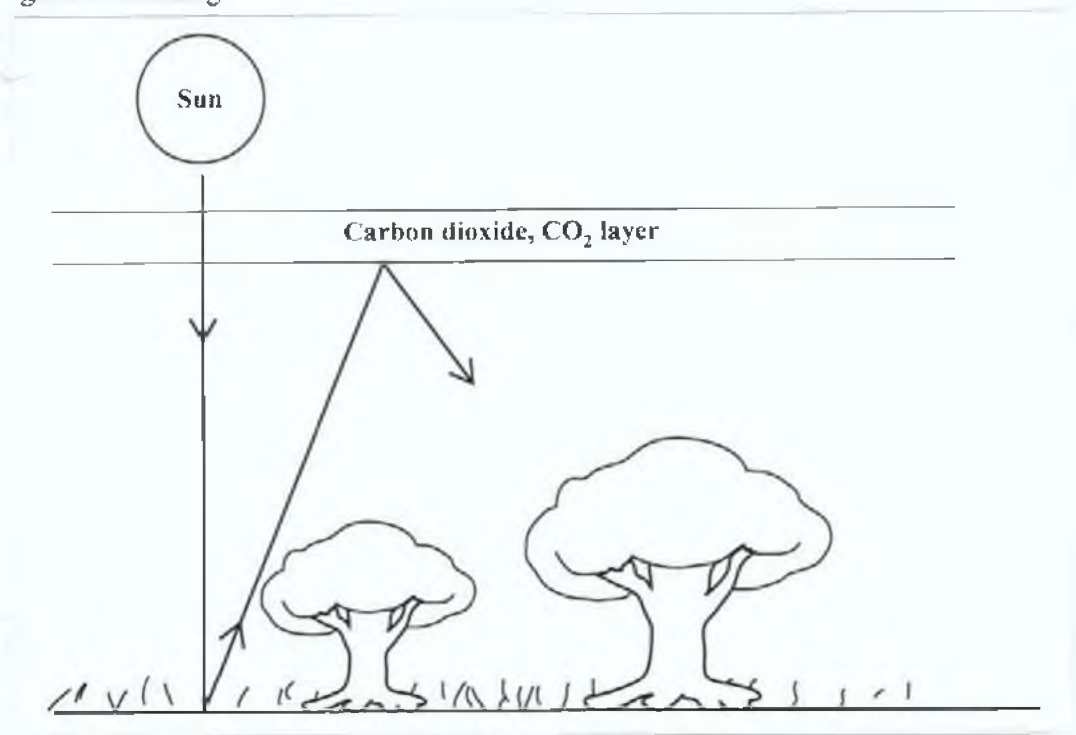
A vast amount of carbon dioxide, , is produced by human activities. This forms a blanket over the earth, leading to what is described as the greenhouse effect. Figure 3 is a diagrammatic representation of how the greenhouse effect may be responsible for global warming.
Complete the following sentences by writing the correct word from the list given in brackets below. (heat, light, , radiation)
The sun radiates ________________________________ energy which passes through the layer. This is converted to ________________________________ energy which cannot pass through the layer. This ________________________________ becomes trapped in the atmosphere over the earth's surface, causing global warming.
Suggest TWO possible effects of global warming.
[2 marks]
In the Caribbean, waste disposal is becoming increasingly important to maintaining a healthy society.
[10 marks]
Solid waste may be categorized as biodegradable or non-biodegradable.
What is meant by 'non-biodegradable'?
[1 mark]
Give ONE example of a biodegradable waste material and ONE example of a non-biodegradable waste material.
Biodegradable: Non-biodegradable:
[2 marks]
It is possible to reuse, reduce or recycle household waste. Write ONE word from the list in brackets, which BEST applies to EACH of the following situations. EACH word must be used ONCE. (reuse, reduce, recycle)
Mrs. Karing puts all her empty bottles in a green bin, and all old newspapers and magazines in a blue bin, for the garbage collector.
[1 mark]
Mr. Atkin takes his water bottle to the supermarket to have it refilled.
[1 mark]
Mrs. Ram takes her basket to the market. She does not buy vegetables from Mr. Daniel because he packages his vegetables in plastic bags. She buys from Mr. Peter, who does not use plastic bags. She puts all the vegetables which she buys in her basket.
[1 mark]
Dumps and landfills are used to dispose of solid waste. A dump is a hole in the ground where garbage is thrown. Suggest TWO negative effects of a dump.
[2 marks]
Suggest TWO benefits of proper disposal of household and industrial waste.
[2 marks]
Viruses and bacteria are pathogens, causing diseases like the common cold, AIDS and cholera.
[10 marks]
Determine whether EACH of the following statements is true or false. Write TRUE next to the true statements and FALSE next to the false statements.
[3 marks]
All bacteria are parasites.
[1 mark]
There are harmful and useful bacteria.
[1 mark]
A virus is a non-cellular organism.
[1 mark]
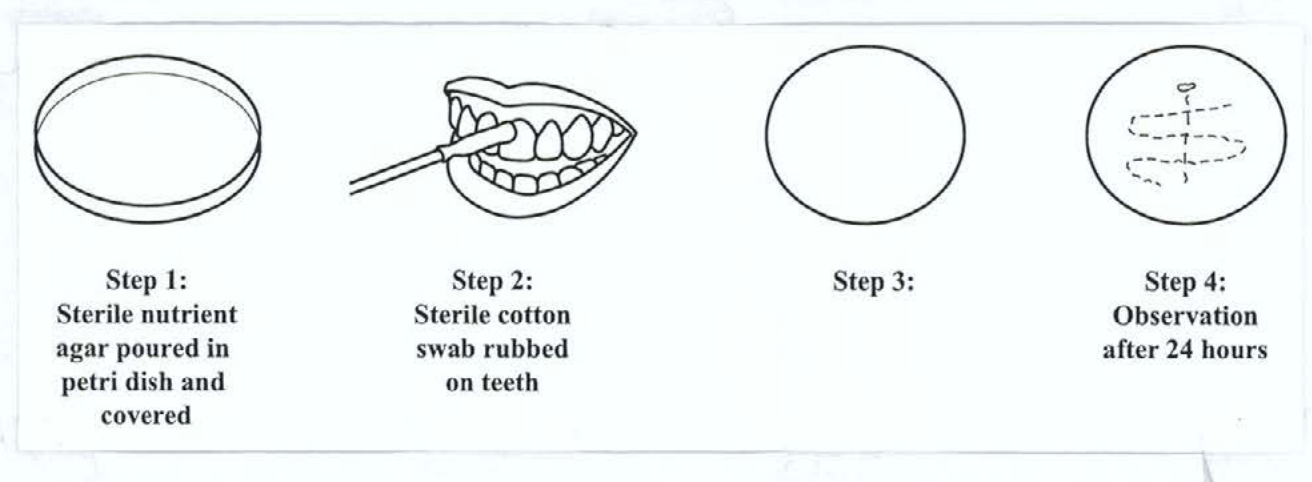
Zara's class tests a sample of water for bacteria. Zara explains that a similar test can be used to test for the presence of bacteria in the mouth.
She sets up an experiment to demonstrate to her classmates that bacteria are present in the mouth. Figure 4 shows the steps which Zara followed.
[2 marks]
What does Zara do in Step 3?
[1 mark]
Zara asks her classmates to set up a control for this experiment by changing Step 2. What should her classmates do at Step 2?
[1 mark]
After severe flooding, some villagers complain of having diarrhoea. This results from an outbreak of cholera.
[3 marks]
Suggest ONE OTHER sign or symptom of cholera.
[1 mark]
Explain how the villagers may have contracted cholera from the flood waters.
[2 marks]
AIDS is caused by the human immunodeficiency virus (HIV), which affects the T lymphocytes. How does this affect the immune system of a human being?
[2 marks]
AIDS is caused by the human immunodeficiency virus (HIV), which affects the T lymphocytes. How does this affect the immune system of a human being?
[1 mark]
Suggest ONE method of preventing the spread of HIV.
[1 mark]
The skeleton in human beings has many functions. One function is locomotion.
[10 marks]
What is meant by 'locomotion'?
[1 mark]
State TWO OTHER functions of the skeleton.
[2 marks]
Suggest TWO reasons why locomotion is important to human beings.
[2 marks]
George is involved in a vehicular accident, which caused injury to the tendons and ligaments in his legs. What is the function of EACH of the following in the leg?
[2 marks]
Tendons
[1 mark]
Ligaments
[1 mark]
Osteoarthritis is a degenerative disease caused by wear and tear on the joints. The cartilage in your grandfather's knee has become worn and thin.
[3 marks]
What is the function of cartilage in the knee?
[1 mark]
Suggest TWO effects that the worn, thin cartilage will have on your grandfather when he walks.
[2 marks]
SECTION B
Answer ANY TWO questions.
Write your answers on the pages provided at the end of the booklet. Cell division occurs by mitosis and by meiosis.
[13 marks]
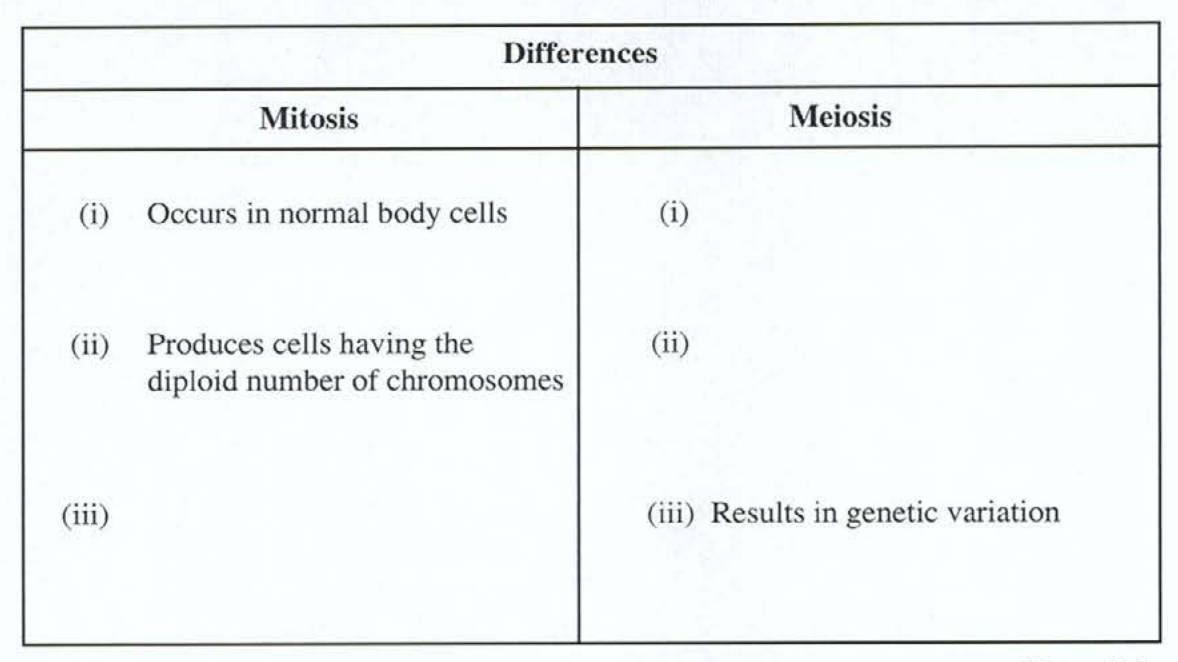
Copy Table 1 on your answer page. Complete Table 1 to show THREE differences between mitosis and meiosis.
[3 marks]
Meiosis results in genetic variation.
[2 marks]
In continuous variation there are small differences among individuals. Give ONE example of continuous variation in human beings.
[1 mark]
Discontinuous variation shows distinct differences among individuals. Give ONE example of discontinuous variation in human beings.
[1 mark]
The genotype of Mr. Henry is and the genotype of Mrs. Henry is . X and Y represent the sex chromosomes. H represents the dominant normal allele, and h represents the recessive allele for haemophilia. One of their two children, John and Jenny, inherited the sex-linked disorder, haemophilia.
[10 marks]
Using a clearly labelled diagram, show how the haemophilia disorder is passed from the parents to one of the children.
Your diagram must include the genotype and phenotype of Mr. and Mrs. Henry, and the children. The beginning of the diagram has been done for you, as follows:
| Carrier female | Normal male | |
|---|---|---|
| Parents: |
Which of the children, John or Jenny, inherited haemophilia? Give a reason for your answer.
[2 marks]
Haemophilia is a disease in which the blood does not clot. One of your classmates, who suffers from haemophilia gets a cut on his hand. Suggest ONE sign of the disease, and how can it be treated.
[2 marks]
Your friend, Rita, is an albino.
[3 marks]
What kind of alleles, dominant or recessive, causes albinism?
[1 mark]
Suggest ONE characteristic that distinguishes Rita as an albino, and ONE precaution which Rita must take in her daily life.
[2 marks]
Human beings are surrounded by both beneficial and harmful microorganisms. Care must be taken to prevent harmful microorganisms from affecting us.
[20 marks]
(i) What is meant by 'sterilization' as it relates to microorganisms? (ii) Name TWO processes which use heat to preserve milk. (iii) State ONE method of sterilizing instruments used in a hospital. (iv) What is an 'antibiotic'?
[5 marks]
A new student, Marsha, has joined your class. She has difficulty finding friends because of her poor hygiene. Advise Marsha on how she can maintain good personal hygiene. Your answer must include:
[10 marks]
Vectors, like the housefly, cause diseases in human beings.
After feeding on faeces containing bacteria, the housefly can transmit bacteria to us when it feeds, walks or defecates on our food. Explain how the bacteria are transmitted to our food when the housefly a) feeds b) walks c) defecates.
Suggest TWO ways of controlling houseflies.
[5 marks]
Many diseases are caused by the activities of human beings.
[15 marks]
Some infectious diseases are caused by drinking water which has been contaminated by human beings. To prevent this, large-scale water purification is undertaken to supply households with clean drinking water. (i) The final stage in the water purification process is chlorination. List the first THREE steps in the water purification process. (ii) What is the function of chlorination? (iii) Why is fluoride sometimes added to drinking water?
[5 marks]
Lifestyle diseases occur as a result of the way we live. Sometimes our choices lead to obesity, alcoholism and sexually transmitted diseases.
One effect of obesity, caused by eating too much animal fat, is an increase in coronary heart disease. Suggest TWO OTHER effects of obesity.
Identify TWO school activities which you can undertake to prevent obesity.
Write a report on the effects of alcoholism. Your report must include:
Gonorrhoea and syphilis are two sexually transmitted diseases. Identify TWO signs or symptoms of gonorrhoea and TWO signs or symptoms of syphilis.
Suggest ONE method of treatment for gonorrhoea and ONE for syphilis.
[5 marks]
The human body has developed a very efficient transport system, with the heart functioning as a double pump.
[15 marks]
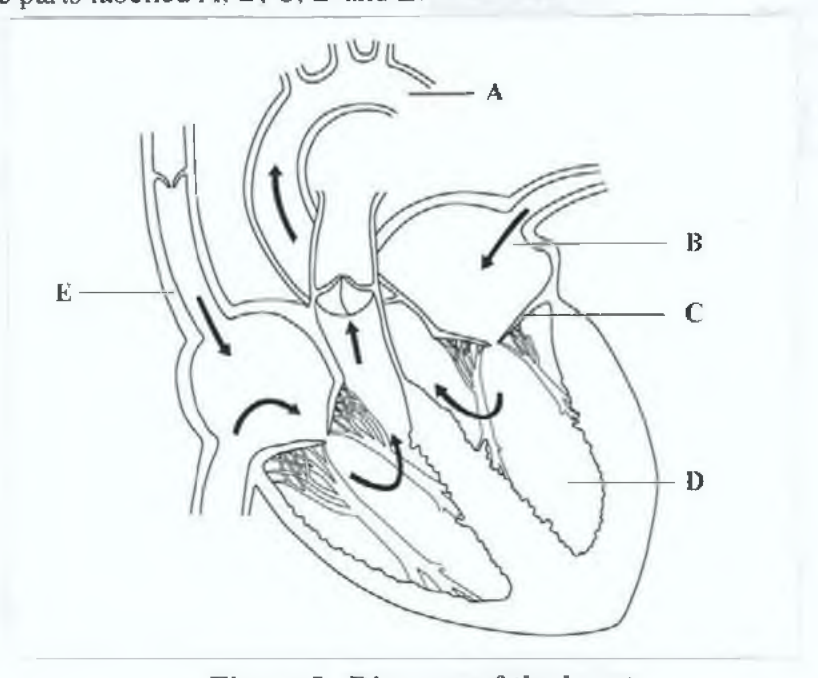
Figure 5 is a diagrammatic representation of the heart and major blood vessels. Identify the parts labelled A, B, C, D and E.
[5 marks]
Explain how the heart functions as a double pump.
[4 marks]
During one beat of the heart, a series of events occurs in the cardiac cycle.
What is the function of the special tissue in the heart, called the "pacemaker"?
The pulse rate of your friend, Kimran, during a Human and Social Biology class is 72. How many times does his heart beat in one minute?
After lunch, Kimran's pulse rate is 82. Suggest TWO reasons why his pulse rate may have increased.
[4 marks]
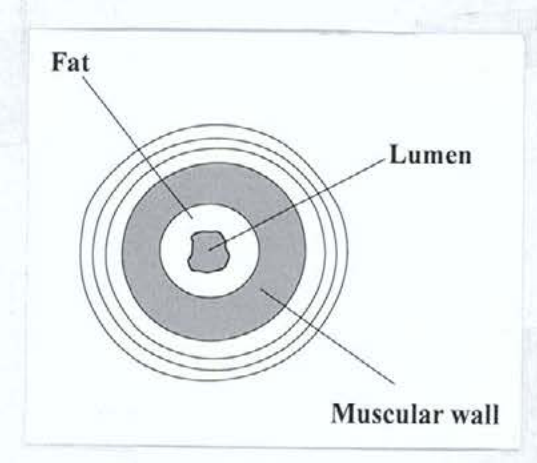
Figure 6 represents a transverse section of an artery showing atherosclerosis.
[7 marks]
Suggest ONE possible cause of atherosclerosis.
[1 mark]
What effect do arteries, like the one in Figure 6, have on blood pressure?
[1 mark]
One difference in structure between an artery and a vein is the thicker muscular wall of the artery.
Identify ONE OTHER difference in structure.
[5 marks]
Blood vessels in the skin (capillaries) assist the body in regulating its temperature.
Explain how vasodilation and vasoconstriction regulate body temperature.
[4 marks]
[3 marks]
[8 marks]