Free CXC Human and Social Biology Paper 2 January 2009 past paper from 2009. Includes a worked answer key. Open the PDF, take a timed test, and study with AI on Caribbean AI.
Answer keys are free on Caribbean AI. View the answers to every past-paper question at no cost - no payment needed - with step-by-step worked solutions and instant AI marking available on Premium.
CSEC Human and Social Biology Paper 2 January 2009 - Free CXC Past Paper with Answers
Free CXC Human and Social Biology Paper 2 January 2009 past paper from 2009. Includes a worked answer key. Open the PDF, take a timed test, and study with AI on Caribbean AI.
Opening the interactive papers…
Every question from this paper as text. See the answers and worked solutions. Questions are the property of the Caribbean Examinations Council; Caribbean AI is not affiliated with CXC.
Develop a food chain of FOUR organisms, ONE of which MUST include the dolphin OR shark.
[3 marks]
Use your knowledge of food chains to explain how a permanent ban on the fishing of whales, dolphins and sharks would affect the ecosystem.
[4 marks]
Define EACH of the following terms:
[3 marks]
Carnivore
[1 mark]
Herbivore
[1 mark]
Omnivore
[1 mark]
A student sets up an experiment, as shown in Figure 1, to demonstrate the process of osmosis.
Complete the statement below by writing the correct word or words chosen from the list provided in brackets.
(solute, sugar molecules, water molecules, sugar solution)
Osmosis involves the movement of ________________________________________________ from a region of high concentration to a region of low concentration of ________________________________________________.
[2 marks]
Give ONE example of the process of osmosis occurring in the human body.
[1 mark]
During his visit to the medical doctor, Mr Douglas learns that he has sugar in his urine.
Is it normal for a healthy person to have sugar in his or her urine?
[1 mark]
Ultrafiltration forces water, salts and glucose into the Bowman's capsule. Describe the process of ultrafiltration in the tubules of the kidneys.
[2 marks]
Name the process by which glucose is reabsorbed into the blood in the tubules of the kidneys.
[1 mark]
Name ONE common disease which Mr Douglas may have, based on his urine test.
[1 mark]
Suggest TWO measures which the doctor may recommend to Mr Douglas to treat the disease named in (iv) above.
[2 marks]
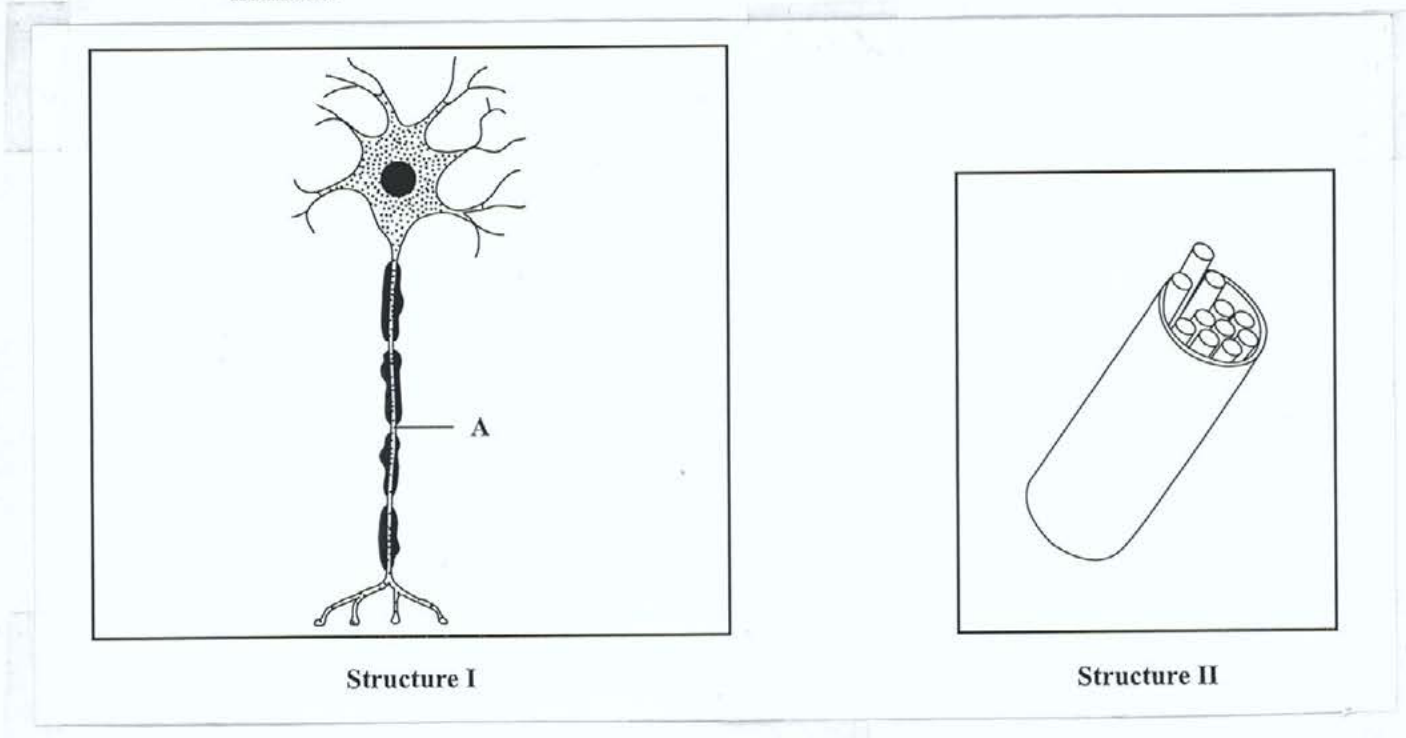
Figure 2 shows drawings of a nerve and a neurone found in the nervous system of humans.
Identify Structure I and Structure II in Figure 2. I: II:
What is the name of the part labelled A in Structure I in Figure 2? A:
[3 marks]
A new sweetener is found to interfere with the neurotransmitters (chemicals) released at synapses in the nervous system.
What feature of a synapse makes neurotransmitters (chemicals) necessary?
How do neurotransmitters function at synapses?
[2 marks]
Why would persons taking the new sweetener experience difficulty responding to stimuli?
[2 marks]
What may be the effect if the sweetener causes spontaneous release of neurotransmitters at synapses?
[1 mark]
Complete the following sentences by writing the correct word or words chosen from the list provided in brackets.
(blood, glucose, fats, oxygen, lymphocytes, waste products)
Food molecules, such as, _________________________________ and substances such as, _________________________________ are carried to the cells where they are needed.
The blood also collects and carries away _________________________________ from the cells.
[3 marks]
Mrs Eaton's blood vessels, supplying blood to the heart muscle itself, have become clogged with fatty substances. Use your knowledge of the heart and circulatory system to answer the following questions.
Identify a medical condition that Mrs Eaton is LIKELY to suffer and ONE symptom of this condition.
Condition: Symptom:
[2 marks]
Explain how the clogged blood vessels will affect the heart and hence the body.
Effect on the heart: Effect on the body:
[5 marks]
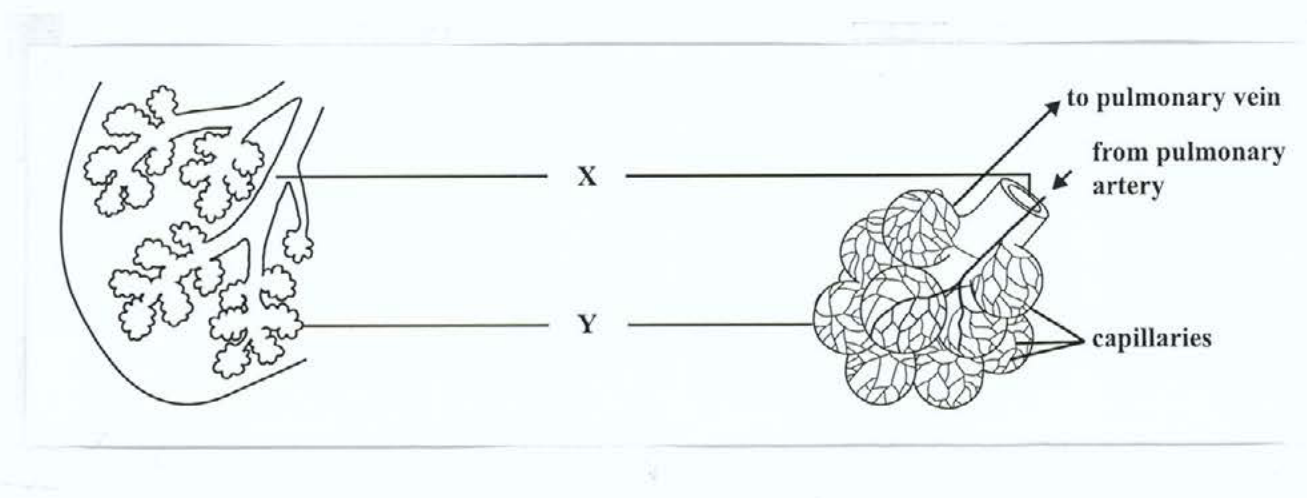
Figure 3 shows the detailed structure of part of a lung and its blood supply.
[10 marks]
Name the parts labelled X and Y in Figure 3.
[2 marks]
X:
[1 mark]
Y:
[1 mark]
Define the term 'vital capacity'.
[1 mark]
During a sprint race both aerobic and anaerobic respiration occur in an athlete’s body.
[7 marks]
Explain the processes of aerobic and anaerobic respiration taking place during the sprint race.
Aerobic respiration:
Anaerobic respiration:
[5 marks]
Explain why anaerobic respiration occurs after aerobic respiration in the athlete’s body.
[2 marks]
Name ONE water-soluble vitamin and ONE fat-soluble vitamin.
Water-soluble:
Fat-soluble:
[2 marks]
Which vitamin, when deficient, causes night blindness?
[1 mark]
For years Mr Henry has been having too much carbohydrate in his diet, and no physical exercise. This has affected his health.
[4 marks]
What is the end-product of carbohydrate digestion?
[1 mark]
Excess carbohydrate leads to excess end-product for Mr Henry. State what happens to the excess end-product of carbohydrate digestion.
[2 marks]
Suggest ONE possible disease which may have resulted from Mr Henry’s diet of excess carbohydrate, and no physical exercise.
[1 mark]
Explain how too little calcium in the diet over a prolonged period of time affects the body.
[3 marks]
Define the term 'homoeostasis', giving ONE example relating to the human body.
Homoeostasis:
Example:
[3 marks]
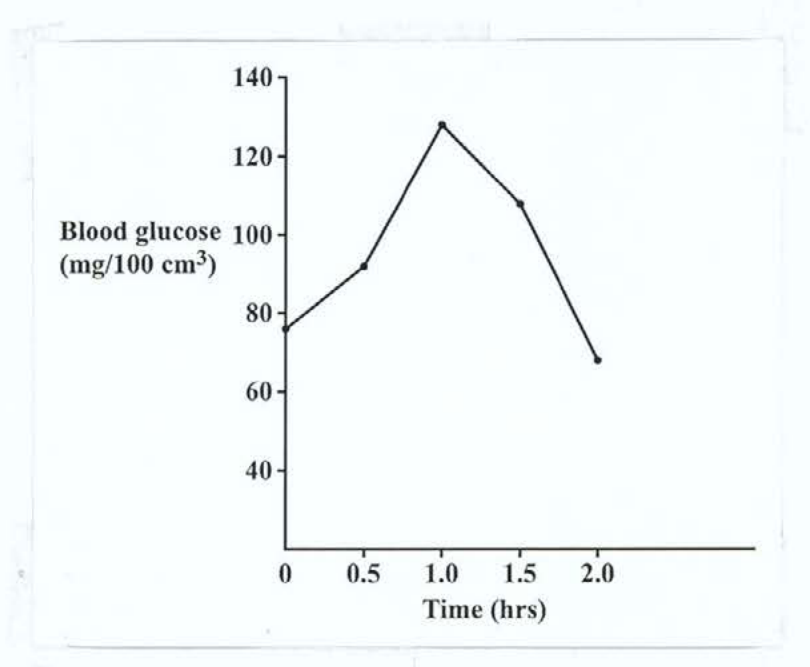
Figure 4 shows blood glucose levels over a two-hour period after breakfast.
[7 marks]
Describe the shape of the graph in Figure 4, in terms of blood glucose levels and time after breakfast.
[3 marks]
Name the hormone responsible for the fall in glucose levels in Figure 4, and explain how this hormone causes the fall in blood glucose levels.
Hormone:
Explanation:
[4 marks]
Complete the statement below by writing the correct word chosen from the list provided in brackets.
(ribosome, DNA, RNA, chromosome, cytoplasm, nucleus)
A gene consists of part of a ________________________________ molecule arranged on a ________________________________ in the ________________________________.
[3 marks]
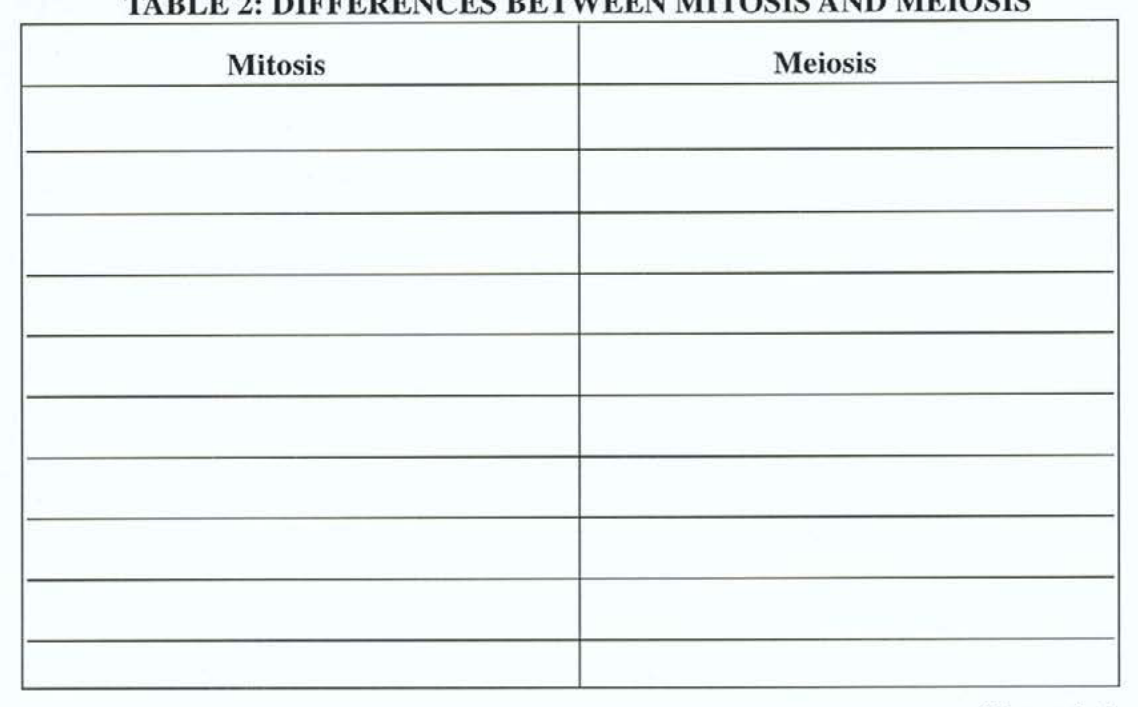
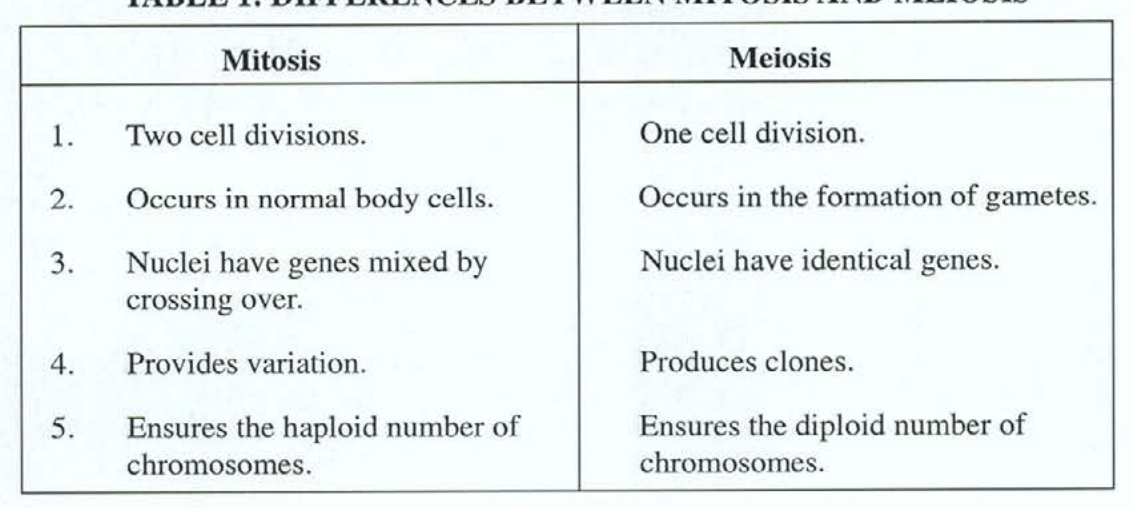
Your friend, Marc, completed Table 1 below to show the differences between mitosis and meiosis. Some of his information is incorrect.
Complete Table 2 below to show FIVE CORRECT differences between mitosis and meiosis.
[5 marks]
Brown eyes are dominant to blue eyes. Mr and Mrs Browne have three children with brown eyes and one child with blue eyes. Both Mr and Mrs Browne have brown eyes. What is the genotype for eye colour for Mr and Mrs Browne, and the genotype of their children? Show your working.
[2 marks]
Define the term 'vector'.
[3 marks]
Which vector is responsible for the spread of dengue fever in the Caribbean?
[1 mark]
You are preparing a poster for dengue fever awareness in your community. Using your knowledge of the disease, what information would you include with respect to EACH of the following?
[7 marks]
The organism which causes the disease
[1 mark]
The form of the disease in which there is bleeding
[1 mark]
Transmission of the disease by the vector
[5 marks]
What are the TWO MAIN constituents of sewage?
[2 marks]
On a visit to a sewage treatment plant you observe that at the end of the treatment, dirty waste water is collected but clear water is discharged into a nearby river.
Explain the processes which transform the dirty water into clean water.
[5 marks]
Smoke and high concentrations of sulphur dioxide cause a reducing smog. Photochemical smogs are caused by sunlight reacting with pollutants from car exhausts.
[3 marks]
Name ONE source of the sulphur dioxide.
[1 mark]
Suggest ONE way in which EACH of the following affects human beings.
Reducing smog:
Photochemical smog:
[2 marks]
SECTION B Answer ANY TWO questions.
Write your answers on the pages provided at the end of this booklet.
[20 marks]
State ONE function of EACH of the following parts of the reproductive system: (i) Testis (ii) Urethra (iii) Oviduct (iv) Ovary (v) Vas deferens
[5 marks]
Birth control methods are being promoted in underdeveloped countries as a means of controlling population growth. Discuss FOUR advantages and FOUR disadvantages of controlling population growth.
[8 marks]
Use your knowledge of the menstrual cycle and fertilisation to explain EACH of the following: (i) Menstruating females can become pregnant during only a few days each month. (ii) Females taking the pill do NOT normally become pregnant. (iii) Very young females and very old females CANNOT normally become pregnant.
[7 marks]
Total 20 marks
[20 marks]
State TWO functions of bones and ONE function of cartilage.
[3 marks]
Name the type of joints found at the a) shoulder b) knee.
In a degenerative disease which affects elderly people, the cartilage in the knee is lost. Predict how the loss of knee cartilage would affect the function of the knee.
[5 marks]
A cricketer, who injured his biceps, cannot bend his arm.
Use your knowledge of bones, tendons and muscles to explain why he cannot bend his arm.
[9 marks]
Explain why a broken shoulder bone would affect movement of the lower arm.
[3 marks]
Total 20 marks
[20 marks]
Name the organism which causes leptospirosis.
[1 mark]
Identify the animal vector which commonly carries leptospirosis in the Caribbean.
[1 mark]
Give THREE mild symptoms of leptospirosis.
[3 marks]
Hurricane Gilbert caused floods in Jamaica, resulting in an increase in leptospirosis. (i) Suggest how the floods may have caused an increase in the incidence of leptospirosis. (ii) What treatment is given to a person with leptospirosis? (iii) Advise your community on FOUR ways to reduce the incidence of leptospirosis.
[15 marks]
Total 20 marks
[20 marks]
Explain what is meant by EACH of the following terms as it applies to solid waste:
[5 marks]
In some countries, garbage is dumped in an area set aside for solid waste. A lot of smoke and bad smells arise from this area or 'dump'. (i) What is the cause of the bad smell? (ii) Suggest FIVE kinds of materials that make up the garbage in such an area. (iii) Explain how this garbage area can be harmful to health. (iv) Why is a landfill safer than a dump?
[15 marks]