
Free CXC Human and Social Biology Paper 2 May/June 2024 past paper from 2024. Includes a worked answer key. Open the PDF, take a timed test, and study with AI on Caribbean AI.
Answer keys are free on Caribbean AI. View the answers to every past-paper question at no cost - no payment needed - with step-by-step worked solutions and instant AI marking available on Premium.
CSEC Human and Social Biology Paper 2 May/June 2024 - Free CXC Past Paper with Answers
Free CXC Human and Social Biology Paper 2 May/June 2024 past paper from 2024. Includes a worked answer key. Open the PDF, take a timed test, and study with AI on Caribbean AI.
Opening the interactive papers…
Every question from this paper as text. See the answers and worked solutions. Questions are the property of the Caribbean Examinations Council; Caribbean AI is not affiliated with CXC.
Justin is an amateur boxer. His trainer advises him that in order to increase his energy levels he should consume a diet that contains more complex carbohydrates such as sweet potato and cassava, which are rich in starch.
Name the test that Justin could use to determine the presence of starch in his diet and state the colour of the precipitate formed if starch is present.
[2 marks]
Identify TWO foods that are rich in starch, other than sweet potato and cassava.
[2 marks]
State TWO of the following foods Justin should consume for growth and repair of his muscle tissue: chicken, plantain, tomato, lentil peas.
[2 marks]
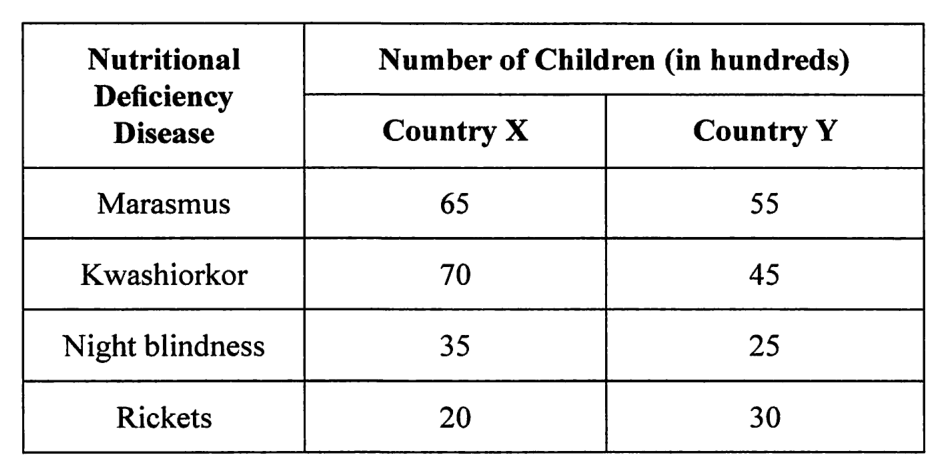
Table 1 shows the number of children (in hundreds) who suffer from nutritional deficiency diseases in two countries, Country X and Country Y.
| Nutritional Deficiency Disease | Number of Children (in hundreds) |
|---|---|
| Country X | |
| Marasmus | 65 |
| Kwashiorkor | 70 |
| Night blindness | 35 |
| Rickets | 20 |
[15 marks]
On the grid provided in Figure 1 on page 7, draw a bar graph to represent the data shown in Table 1.
[4 marks]
From your graph, identify the country which had the HIGHER incidence of BOTH marasmus and kwashiorkor.
[1 mark]
From your graph, identify the country which had the LOWER incidence of diseases overall.
[1 mark]
State the major micronutrient that is lacking in the diets of the children in Country X and the major micronutrient that is lacking in the diets of the children in Country Y.
Country X _________________________________________________________________
Country Y _________________________________________________________________
[2 marks]
Suggest ONE disease that could develop as a result of overeating.
[1 mark]
All living organisms share common characteristics.
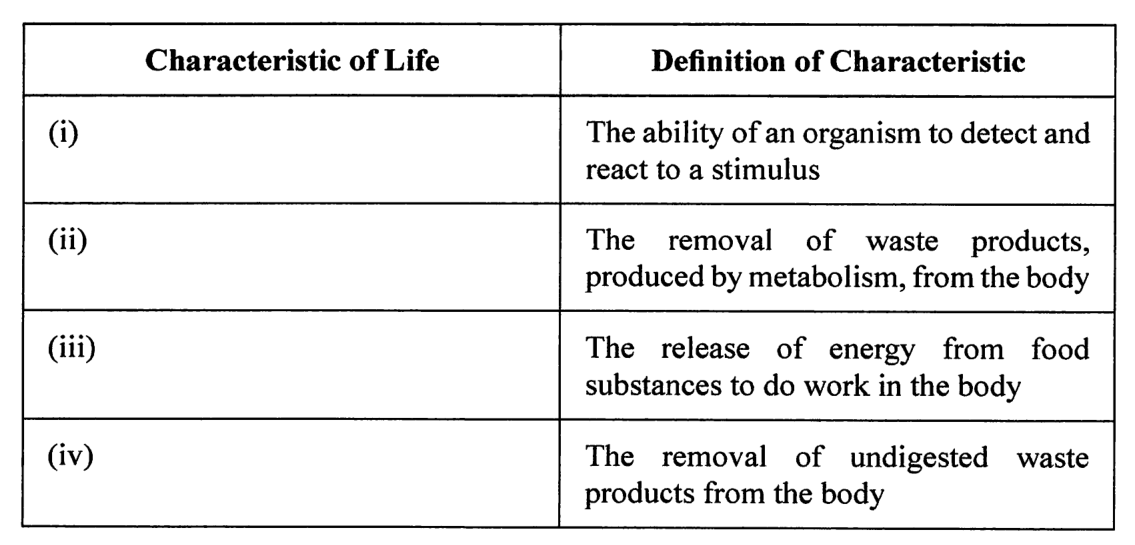
Complete Table 2 by inserting the characteristic of life that corresponds with EACH definition.
TABLE 2: CHARACTERISTICS OF LIVING THINGS
| Characteristic of Life | Definition of Characteristic |
|---|---|
| (i) | The ability of an organism to detect and react to a stimulus |
| (ii) | The removal of waste products, produced by metabolism, from the body |
| (iii) | The release of energy from food substances to do work in the body |
| (iv) | The removal of undigested waste products from the body |
[4 marks]
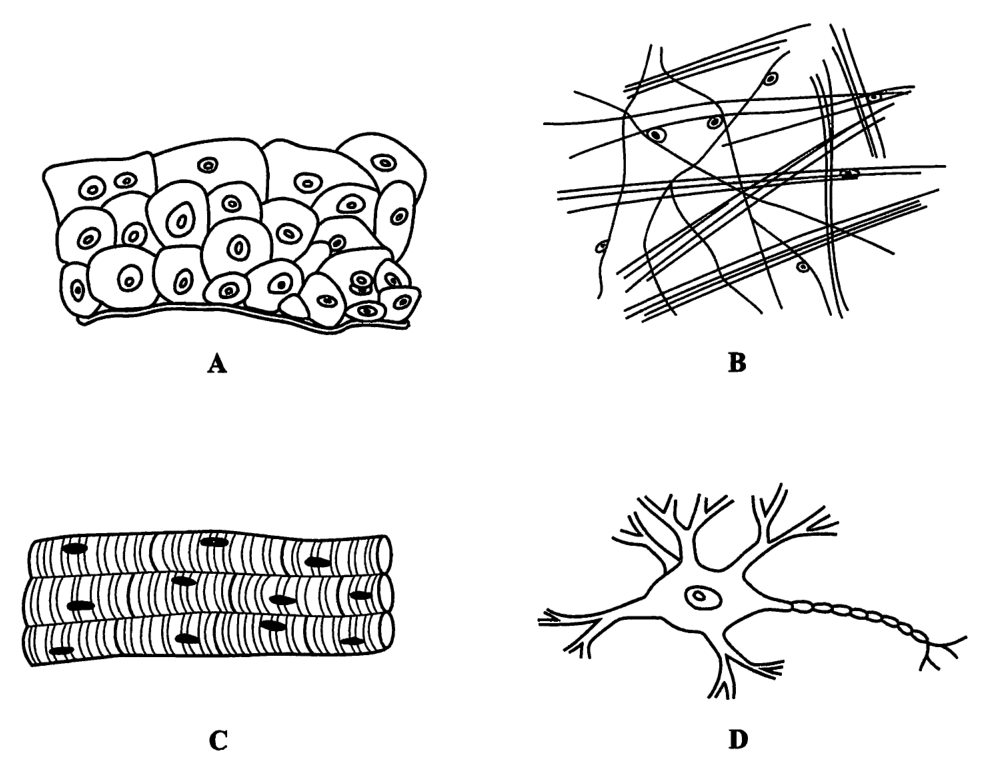
Figure 2 shows the four main types of tissue found in the human body, labelled A–D.
Using letter labels only, identify the type of tissue that is responsible for movement and the type of tissue that is responsible for the protection of body surfaces.
Movement Protection
[2 marks]
Seema is a footballer who notices that she tires easily even after very short practice sessions. She researches possible causes of her fatigue and discovers some interesting facts about certain cell organelles.
Identify the cell organelle in Seema’s body which may not be working adequately and therefore causing her fatigue.
[1 mark]
State the process which occurs in the cell organelle identified in (c) (i) which would prevent Seema’s fatigue.
[1 mark]
Write, in words, an equation that describes the process stated in (c) (ii).
[2 marks]
Seema decides to visit the doctor to be tested to determine the cause of her fatigue. The doctor indicates that her fatigue is not caused by a malfunctioning cell organelle but is the result of a mineral deficiency in her diet.
Suggest the disease that Seema is likely suffering from and state what is occurring in her body as a result of the disease.
[2 marks]
The human body consists of several organs and organ systems.
Identify ONE organ in the body which belongs to two different organ systems and state the names of the TWO organ systems.
[3 marks]
Define the term ‘health’, according to the World Health Organization (WHO).
[2 marks]
Identify, by circling, the TWO diseases in the list below which are classified as non-communicable diseases.
Malaria Cervical cancer Chlamydia Influenza Hypertension
[2 marks]
There are concerns about the increasing global incidence of the viral disease monkey pox. Typically, infected persons will experience the following signs and symptoms.
From the list above, identify ONE sign and ONE symptom experienced by a person who is suffering from monkey pox.
(i) Sign (ii) Symptom
[2 marks]
Sign
[1 mark]
Symptom
[1 mark]
Explain TWO ways in which the COVID-19 pandemic has impacted societies and economies of the Caribbean.
[4 marks]
Human immunodeficiency virus (HIV) is transmitted primarily through sexual contact or body fluids.
Explain TWO ways in which individuals may reduce their risk of contracting HIV.
[4 marks]
State why antibiotics cannot be used to treat HIV infections.
[1 mark]
Figure 3 shows a diagram of a cross-section of the human heart.
[10 marks]
Figure 3 shows a diagram of a cross-section of the human heart.
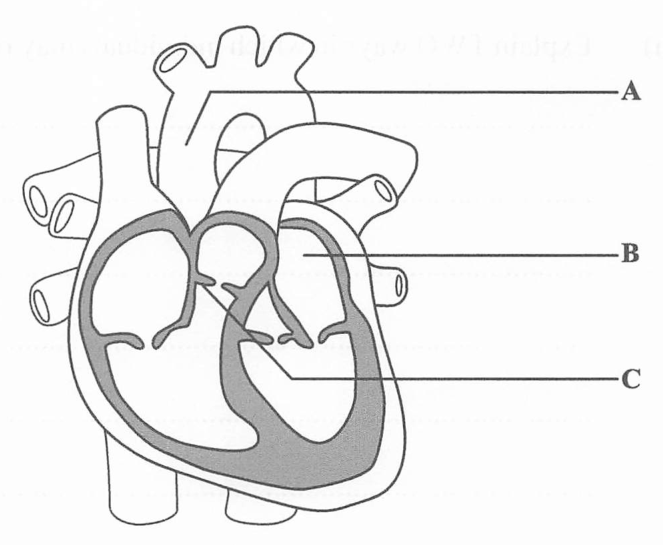
Identify the structure of the heart labelled A and the region of the heart labelled B.
Structure A Region B
[2 marks]
Describe the function of the structure of the heart labelled C.
[2 marks]
State the region of the heart in which the pacemaker is located.
[1 mark]
State the function of a pacemaker.
[1 mark]
Certain countries within the Caribbean have very high incidences of coronary heart disease (CHD).
Discuss how ONE named factor contributes to the development of coronary heart disease.
[4 marks]
Explain why the walls of the ventricles of the heart may become thicker as a result of coronary heart disease.
[2 marks]
Suggest THREE approaches that could be used by governments to reduce the incidence of coronary heart disease.
[3 marks]
SECTION B Answer ALL questions.
[10 marks]
State TWO sources of water pollution.
[2 marks]
Figure 4 shows a diagram of an aquatic ecosystem.
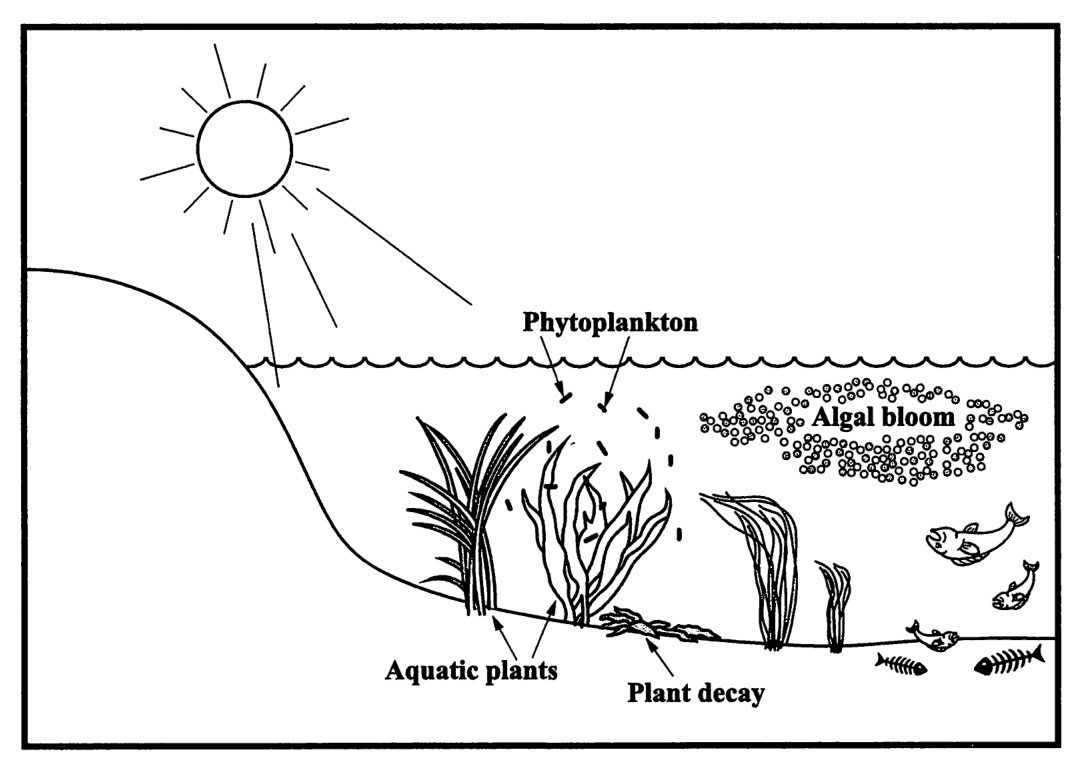
Identify the process that results in the algal bloom in Figure 4.
[1 mark]
Explain how the process identified in (b) (i) results in the death of the fish in Figure 4.
[3 marks]
Table 3 shows the percentage of pollutants in the air for a city and a rural region.
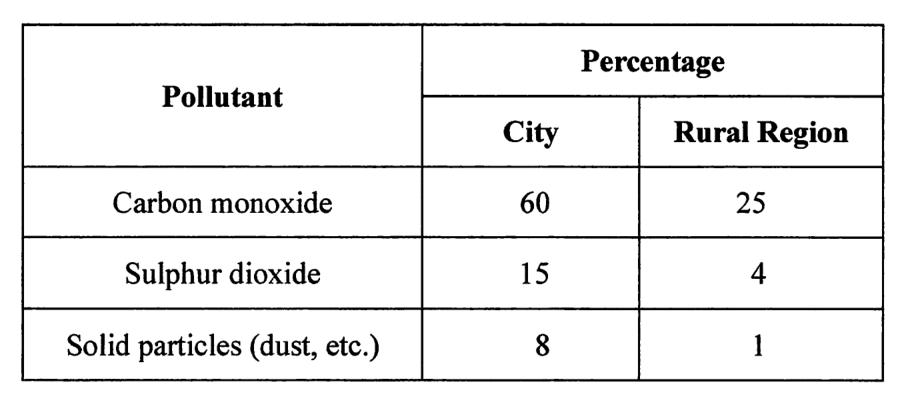
Outline TWO reasons why the percentage of carbon monoxide is so much higher in the city than in the rural region.
[4 marks]
Explain why the percentage of carbon monoxide is so much higher than the percentage of the other pollutants in the rural region.
[2 marks]
Recommend THREE ways in which the high levels of pollution in the city can be reduced.
[3 marks]
Name ONE excretory product of EACH of the following organs.
Lung
[1 mark]
Skin
[1 mark]
Kidney
[1 mark]
State which blood vessel carries blood to the kidney.
[1 mark]
Identify the structures in the kidney in which ultrafiltration and reabsorption take place. Ultrafiltration Reabsorption
[2 marks]
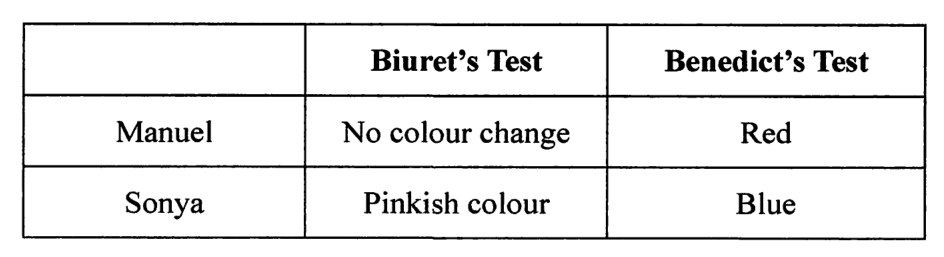
Manuel and Sonya want to investigate the components of their urine. Each of them collects a urine sample and performs a Biuret's test and Benedict's test on the individual samples. Table 4 shows Manuel's and Sonya's observations.
Using the data from Table 4, state the conclusions that can be drawn about Manuel's and Sonya's urine, and suggest the diseases for which Manuel and Sonya are at risk.
[6 marks]
Santo is badly injured at work and quickly experiences severe blood loss. He arrives at the emergency room with low blood pressure.
Explain how Santo's body will respond in order to increase his blood pressure.
[3 marks]