Free CXC Physics Paper 2 May/June 2006 past paper from 2006. Includes a worked answer key. Open the PDF, take a timed test, and study with AI on Caribbean AI.
Answer keys are free on Caribbean AI. View the answers to every past-paper question at no cost - no payment needed - with step-by-step worked solutions and instant AI marking available on Premium.
CSEC Physics Paper 2 May/June 2006 - Free CXC Past Paper with Answers
Free CXC Physics Paper 2 May/June 2006 past paper from 2006. Includes a worked answer key. Open the PDF, take a timed test, and study with AI on Caribbean AI.
Opening the interactive papers…
Every question from this paper as text. See the answers and worked solutions. Questions are the property of the Caribbean Examinations Council; Caribbean AI is not affiliated with CXC.
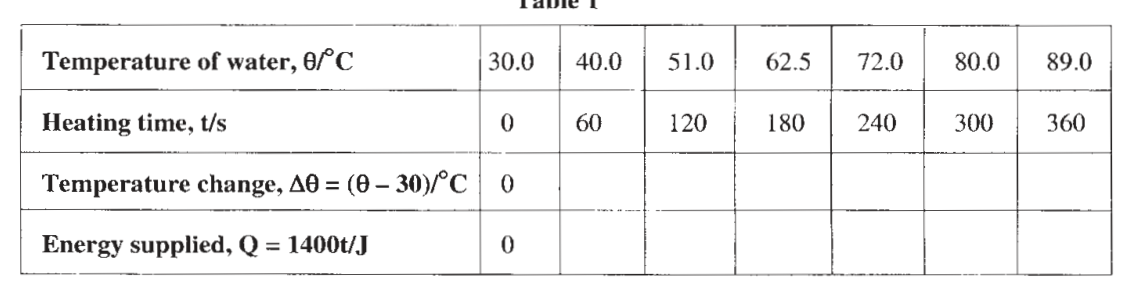
A student was asked to investigate the variation in temperature of 2 kg of water initially at , when heat energy was supplied to it by an electric heater rated at 1400 W. The following measurements were taken and recorded in Table 1.
Table 1 | Temperature of water, | 30.0 | 40.0 | 51.0 | 62.5 | 72.0 | 80.0 | 89.0 | | Heating time, t/s | 0 | 60 | 120 | 180 | 240 | 300 | 360 | | Temperature change, | 0 | | | | | | | | Energy supplied, Q = 1400t/J | 0 | | | | | | |
[30 marks]
Complete the table above.
[3 marks]
Plot on the graph page opposite a graph of energy supplied against temperature change.
[11 marks]
Calculate the gradient of the graph.
[6 marks]
Assuming that the energy loss to the container and the surroundings is negligible, what physical quantity does this gradient represent?
[1 mark]
Determine the value of this quantity if 1 kg of water were used and state the physical quantity this represents.
[2 marks]
Water boils at . Calculate the heat energy which must be supplied in order to completely convert the 2 kg of water to steam.
[3 marks]
Distinguish between boiling and evaporation.
[4 marks]
Explain what is meant by 'electrical resistance'.
[2 marks]
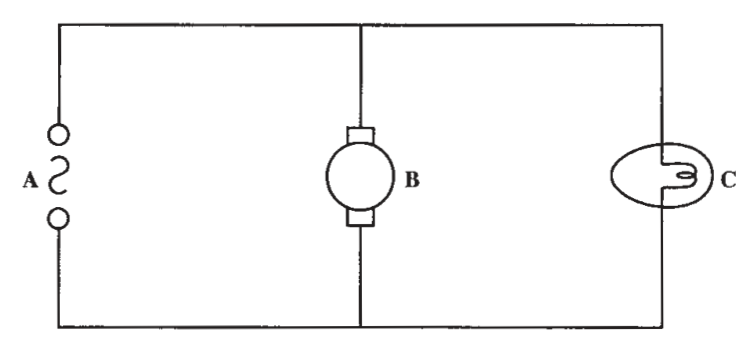
The circuit shown in Figure 1 shows the interconnection between electrical devices, B and C, and voltage source A.
Figure 1
[1 mark]
Identify the type of connection employed in this circuit.
[1 mark]
Give the meaning of the circuit symbols labelled: B C
[2 marks]
Name the type of voltage produced at A.
[1 mark]
A fluorescent lamp is rated at 15W, 120V. Calculate the current which the lamp draws from the main supply.
[3 marks]
Calculate the resistance of this lamp while it is lit.
[3 marks]
When the lamp is lit, 4 W of the energy supplied is lost as heat. Calculate the efficiency of the lamp.
[3 marks]
Figure 2 shows successive stages in the generation of a transverse wave on a stretched slinky spring.
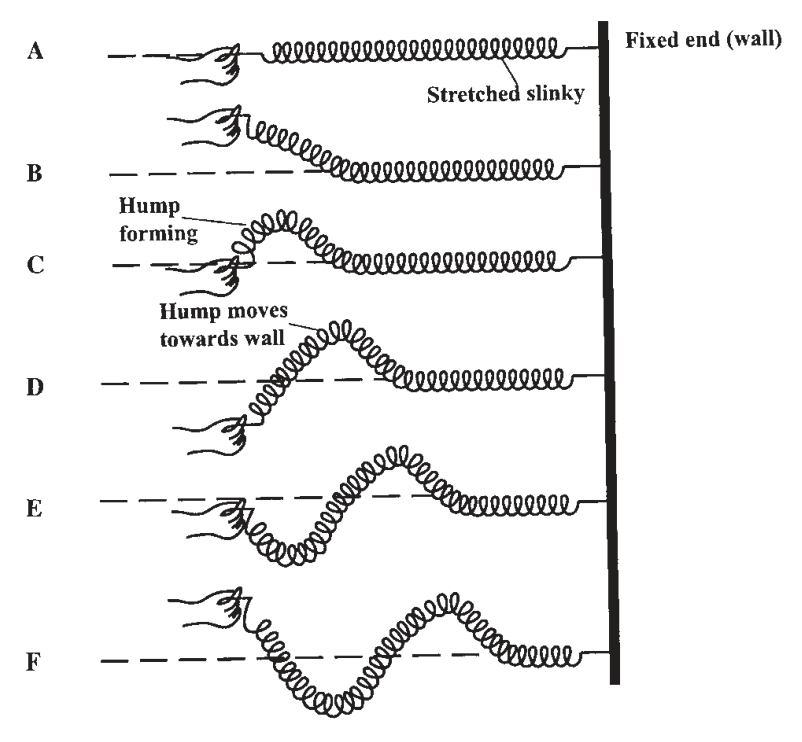
Indicate on Figure 2F by appropriately labelling a) the position of a crest b) the position of a trough.
[2 marks]
Draw labelled arrows on Figure 2E to show a) the direction of the wave b) the direction of hand movement needed to produce this wave.
[3 marks]
Indicate on Figure 2A the direction of hand movement needed to produce a longitudinal wave.
[1 mark]
In a classroom demonstration a student uses a slinky spring to generate waves of frequency 5 Hz with 0.65 metres separation between successive crests. Determine the speed of these waves.
[3 marks]
(i) Deduce whether the velocity of a sound wave will increase, decrease or remain constant when the wave travels from a denser to a less dense medium, given that the frequency remains constant and the wavelength decreases.
Compare the waves produced on the slinky spring in part (b) with a typical sound wave in terms of the motion of the particles. Transverse wave on slinky spring Sound wave
[2 marks]
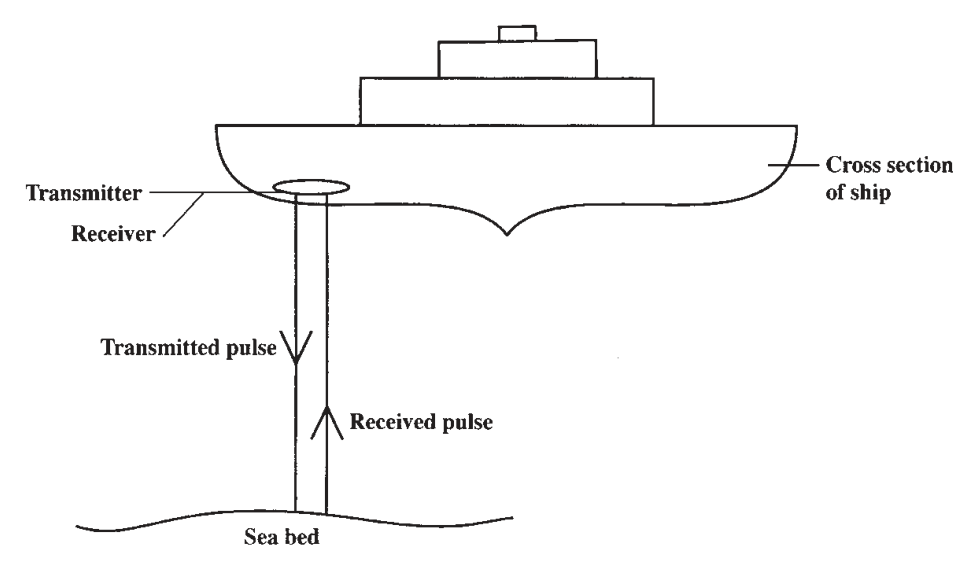
In Figure 3 below, a ship sends out pulses of high-frequency sound (ultrasound) which are reflected from the sea bed and received at the ship every seconds.
Calculate the depth of the sea bed below the transmitter.
(Speed of sound in sea water = )
Define 'the moment of a force'.
[3 marks]
State the principle of moments.
[3 marks]
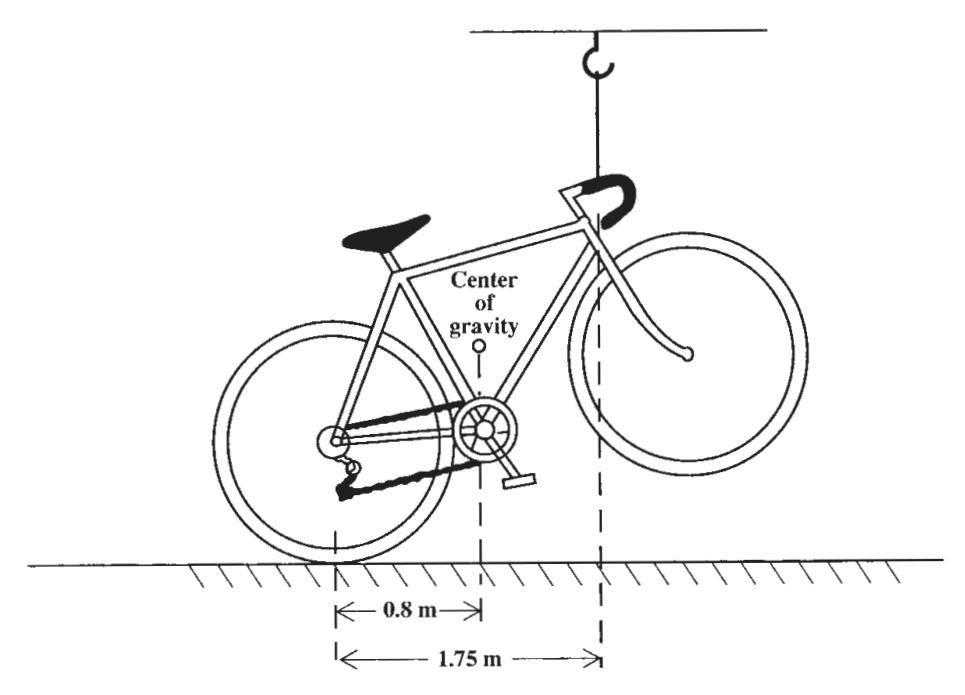
A cyclist hangs his bicycle with the rear wheel in contact with the ground and the handle attached to a light string as shown in Figure 4. The entire assembly is in equilibrium.
[9 marks]
Indicate by drawing arrows on Figure 4 the forces acting on the bicycle.
[3 marks]
Write TWO equations relating these forces.
[3 marks]
The bicycle has a mass of . Use the result you obtained in Part (c) (ii) to determine the tension in the string.
[Acceleration due to gravity, ]
[3 marks]
Complete Table 2 below showing the International Insulation Colour Code.
Table 2
| Code | Live Wire | Neutral Wire | Earth Wire |
|---|---|---|---|
| International Insulation Colour |

[3 marks]
Fuses are sometimes used to protect electrical equipment from excess current. Explain how a fuse works.
[3 marks]
A household has the following appliances
[8 marks]
Calculate the total power consumed by these devices.
[1 mark]
These devices are in use for 4 hours per day. Calculate the energy consumed in kilowatt-hours in a 30-day month.
[2 marks]
Calculate the bill for the month if each unit of electricity costs .
[2 marks]
Assuming that these devices are connected in parallel across the mains supply, and are switched ON, calculate the TOTAL current drawn from the mains.
[3 marks]
Fuses are available with the following current ratings: , , , . Select a suitable fuse for protecting these devices.
[1 mark]
[3 marks]