Free CXC Physics Paper 2 January 2014 past paper from 2014. Includes a worked answer key. Open the PDF, take a timed test, and study with AI on Caribbean AI.
Answer keys are free on Caribbean AI. View the answers to every past-paper question at no cost - no payment needed - with step-by-step worked solutions and instant AI marking available on Premium.
CSEC Physics Paper 2 January 2014 - Free CXC Past Paper with Answers
Free CXC Physics Paper 2 January 2014 past paper from 2014. Includes a worked answer key. Open the PDF, take a timed test, and study with AI on Caribbean AI.
Opening the interactive papers…
Every question from this paper as text. See the answers and worked solutions. Questions are the property of the Caribbean Examinations Council; Caribbean AI is not affiliated with CXC.
Keshom investigated the relationship between image size, I, and object size, O, while studying shadows.
His results are presented in Table 1.
| Image Size, I/cm | 2.5 | 5.0 | 7.6 | 10.0 | 12.6 | 15.0 |
|---|---|---|---|---|---|---|
| Object Size, O/cm | 0.5 | 1.0 | 1.5 | 2.0 | 2.5 | 3.0 |

[25 marks]
On page 3, plot a graph of image size, I, versus object size, O.
[7 marks]
Calculate the gradient, G, of the line obtained.
[5 marks]
State the physical quantity with which the gradient of the graph, G, is associated.
[1 mark]
During the investigation, Keshorn talked with his friend Atiba about the term 'focal length'. Define the term 'focal length'.
[3 marks]
With what piece of apparatus in physics is the term 'focal length' associated?
[1 mark]
A 10 cm tall tablet computer was placed vertically 20 cm from a plane mirror. Its image distance was found to be 20 cm.
Use the data given to calculate
the height of the image of the computer
[4 marks]
the magnification of this image.
[4 marks]
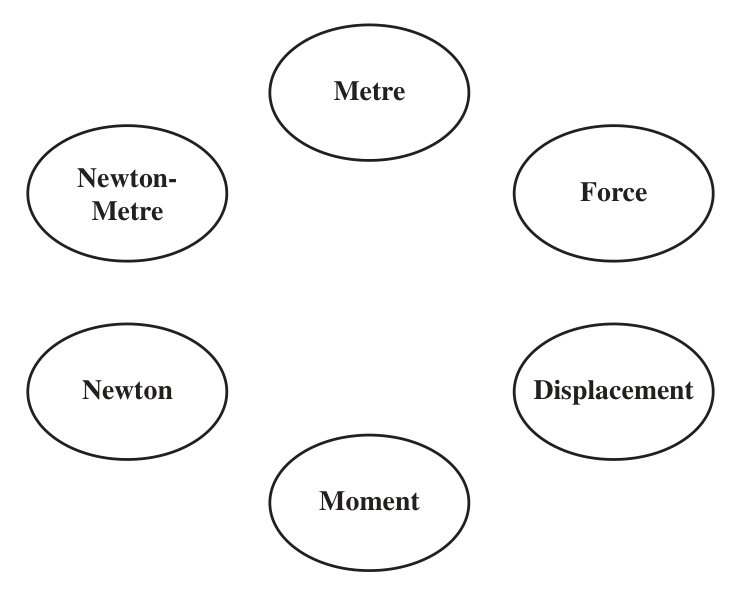
Figure 1 shows some physical quantities and their units. Draw an arrow from EACH quantity to its unit.
[3 marks]
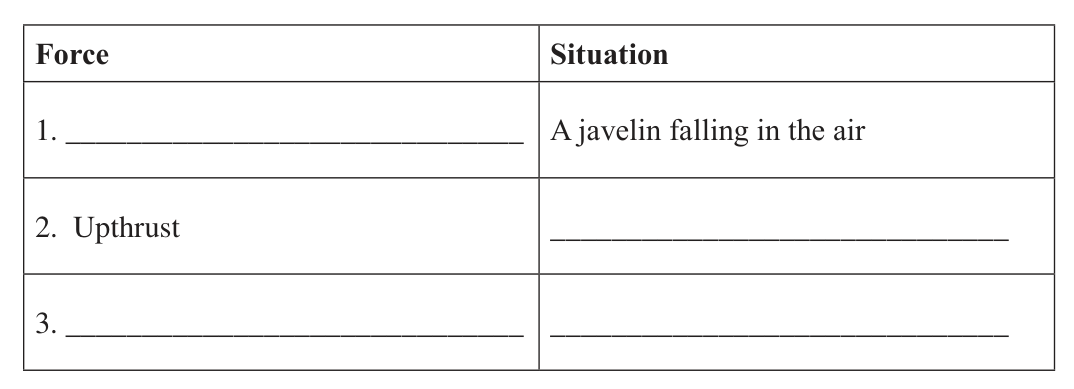
Complete Table 2 to show the names of three forces and a situation in which EACH force acts.
| Force | Situation |
|---|---|
| 1. | A javelin falling in the air |
| 2. Upthrust | |
| 3. |
[4 marks]
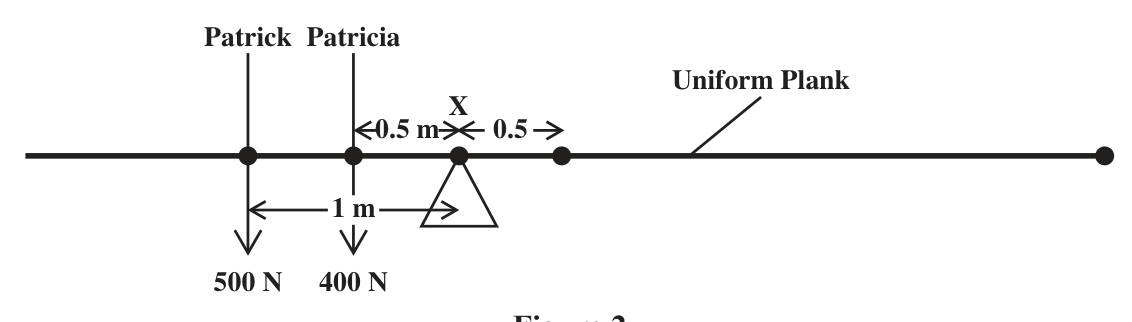
Patrick and Patricia showed their class a 'magical' balancing act. They both sat on one side of a uniform 6.0 m plank. Patrick sat 1.0 m from the pivot located 0.5 m from the centre of the plank. Patricia sat 0.5 m from the pivot, on the same side as Patrick.
Figure 2 shows the 'magical' balancing act. X represents the pivot point.
Label, as W, the point on Figure 2 where the weight of the plank acts.
[1 mark]
Calculate the weight of the plank, W.
[4 marks]
If Patrick sat alone on the plank, calculate where he would have to sit in order to maintain his 'magical' balancing act. The pivot remains as before.
[3 marks]
State the physical property that varies with temperature in each of the following thermometers.
A laboratory thermometer
[1 mark]
A thermocouple
[1 mark]
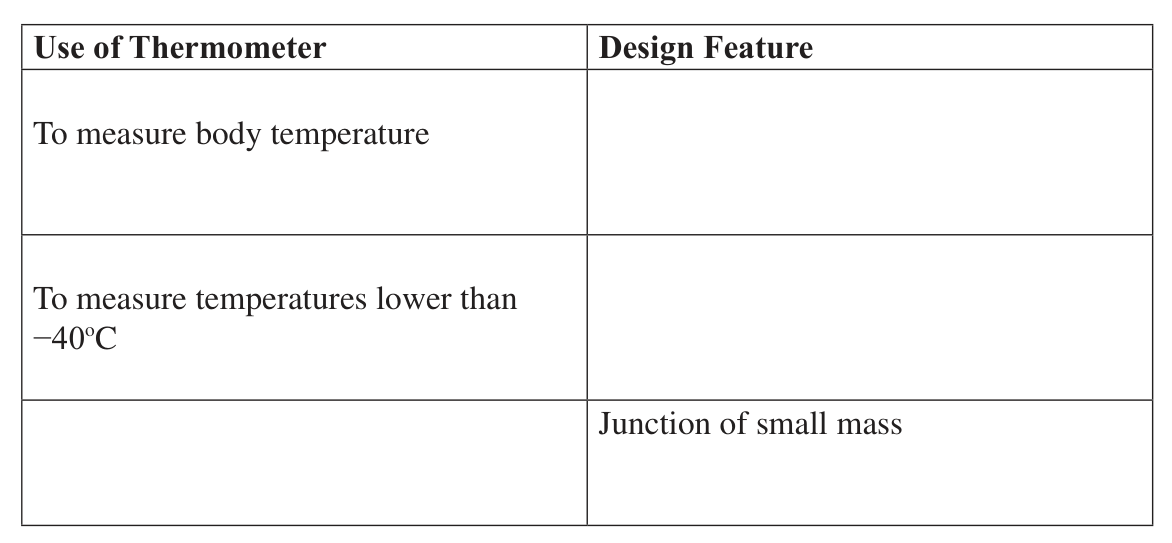
Complete Table 3 which relates the use of a thermometer to its design.
TABLE 3
| Use of Thermometer | Design Feature |
|---|---|
| To measure body temperature | |
| To measure temperatures lower than | |
| Junction of small mass |
[3 marks]
State Charles' Law.
[10 marks]
State Charles' Law.
[2 marks]
In a sealed cylinder, the volume of gas is recorded as with a temperature of .
What is the percentage increase in volume of the gas if the cylinder is heated until the gas temperature reaches ?
You MUST write your answers in the spaces provided after each question.
[15 marks]
State TWO properties of electromagnetic waves.
[2 marks]
Visible light is a type of electromagnetic wave. State TWO other types of electromagnetic waves indicating whether the wavelength of each is higher or lower than that of visible light.
[4 marks]
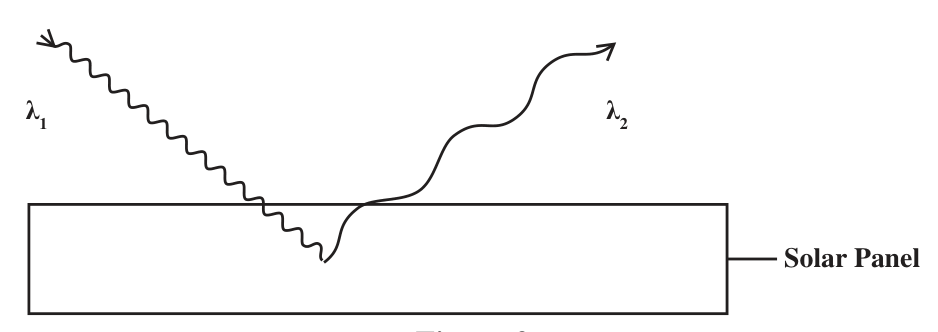
Electromagnetic waves of one wavelength are absorbed by a solar panel and waves of a longer wavelength are emitted. If electromagnetic waves of wavelength m are absorbed by a solar panel as shown in Figure 3 and waves of wavelength m are emitted, calculate (a) the frequency in each case (b) the decrease in frequency, .
We assume that the useful energy transferred to the solar panel is a constant, k, times the decrease in frequency of the e.m. waves. (). State the corresponding energy transferred, , in terms of k.
With a change of conditions, the wavelength of the wave now absorbed by the panel increased to m, but the emitted wavelength remains at m. What fraction of , the original energy transferred, is now transferred to the solar panel?
[Speed of light, m s]
[9 marks]
the frequency in each case
[3 marks]
the decrease in frequency, .
[1 mark]
We assume that the useful energy transferred to the solar panel is a constant, k, times the decrease in frequency of the e.m. waves. (). State the corresponding energy transferred, , in terms of k.
[1 mark]
With a change of conditions, the wavelength of the wave now absorbed by the panel increased to , but the emitted wavelength remains at . What fraction of , the original energy transferred, is now transferred to the solar panel?
With the aid of a diagram, describe an experiment that may be used to investigate the relationship between current, I, and potential difference, V, for a filament lamp. Sketch your expected result.
[6 marks]
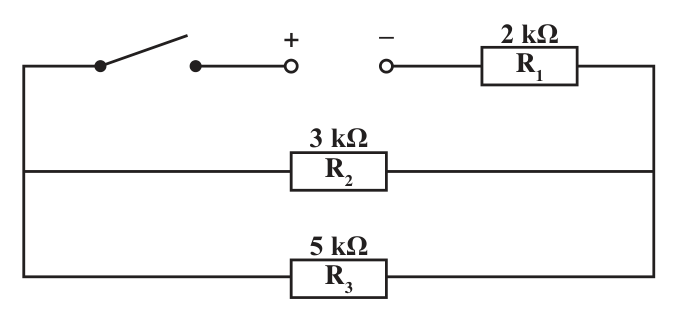
The power supply shown for the circuit in Figure 4 provides a current of 1 mA to the rest of the circuit. (Figure 4 shows a circuit diagram with a power supply, a switch, a resistor (), a resistor (), and a resistor (). and are in series, and is in parallel with .)
[8 marks]
Assuming negligible losses in the connecting wires, calculate the required potential difference of the supply.
[5 marks]
Calculate the current in the resistor.
[3 marks]
If the resistor burns out, what current now flows in the resistor?
[1 mark]
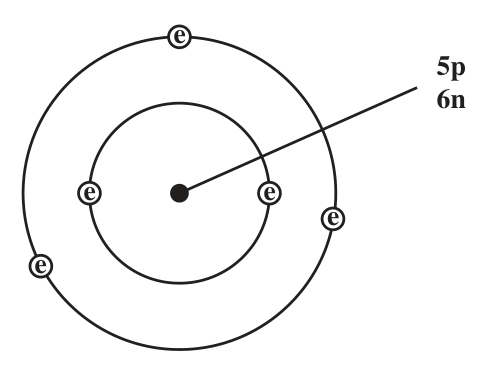
Figure 5 shows the structure of the atom of an element X:
n: neutrons p: protons e: electrons
(i) State the mass number, atomic number and the charge on the nucleus of this atom. (ii) Write the symbol for another possible isotope of X.
[15 marks]
A nucleus of a radioactive isotope radium emits an -particle (alpha-particle) when it decays to a nucleus of the element radon, Rn.
[5 marks]
Write the equation representing this decay process.
[3 marks]
How many neutrons are in the nucleus?
[2 marks]
Explain why an atom is normally neutral and stable.
[4 marks]
What are 'isotopes'?
[2 marks]
Figure 5 shows the structure of the atom of an element X: n: neutrons p: protons e: electrons (Figure 5 shows a Bohr model of an atom with a nucleus containing 5 protons and 6 neutrons, and 5 electrons orbiting the nucleus.)
[6 marks]
State the mass number, atomic number and the charge on the nucleus of this atom.
[4 marks]
Write the symbol for another possible isotope of X.
[2 marks]
[8 marks]
[Speed of light, ]
[4 marks]