Free CXC Physics Paper 2 May/June 2009 past paper from 2009. Includes a worked answer key. Open the PDF, take a timed test, and study with AI on Caribbean AI.
Answer keys are free on Caribbean AI. View the answers to every past-paper question at no cost - no payment needed - with step-by-step worked solutions and instant AI marking available on Premium.
CSEC Physics Paper 2 May/June 2009 - Free CXC Past Paper with Answers
Free CXC Physics Paper 2 May/June 2009 past paper from 2009. Includes a worked answer key. Open the PDF, take a timed test, and study with AI on Caribbean AI.
Opening the interactive papers…
Every question from this paper as text. See the answers and worked solutions. Questions are the property of the Caribbean Examinations Council; Caribbean AI is not affiliated with CXC.
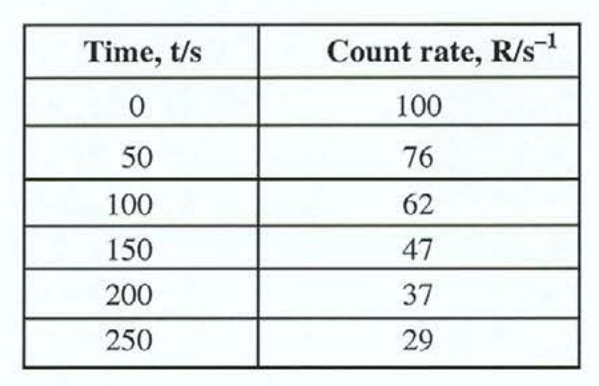
In determining the half-life of an alpha-emitting radioactive source, a student recorded the following data in Table 1.
TABLE 1
| Time, t/s | Count rate, R/s |
|---|---|
| 0 | 100 |
| 50 | 76 |
| 100 | 62 |
| 150 | 47 |
| 200 | 37 |
| 250 | 29 |
[25 marks]
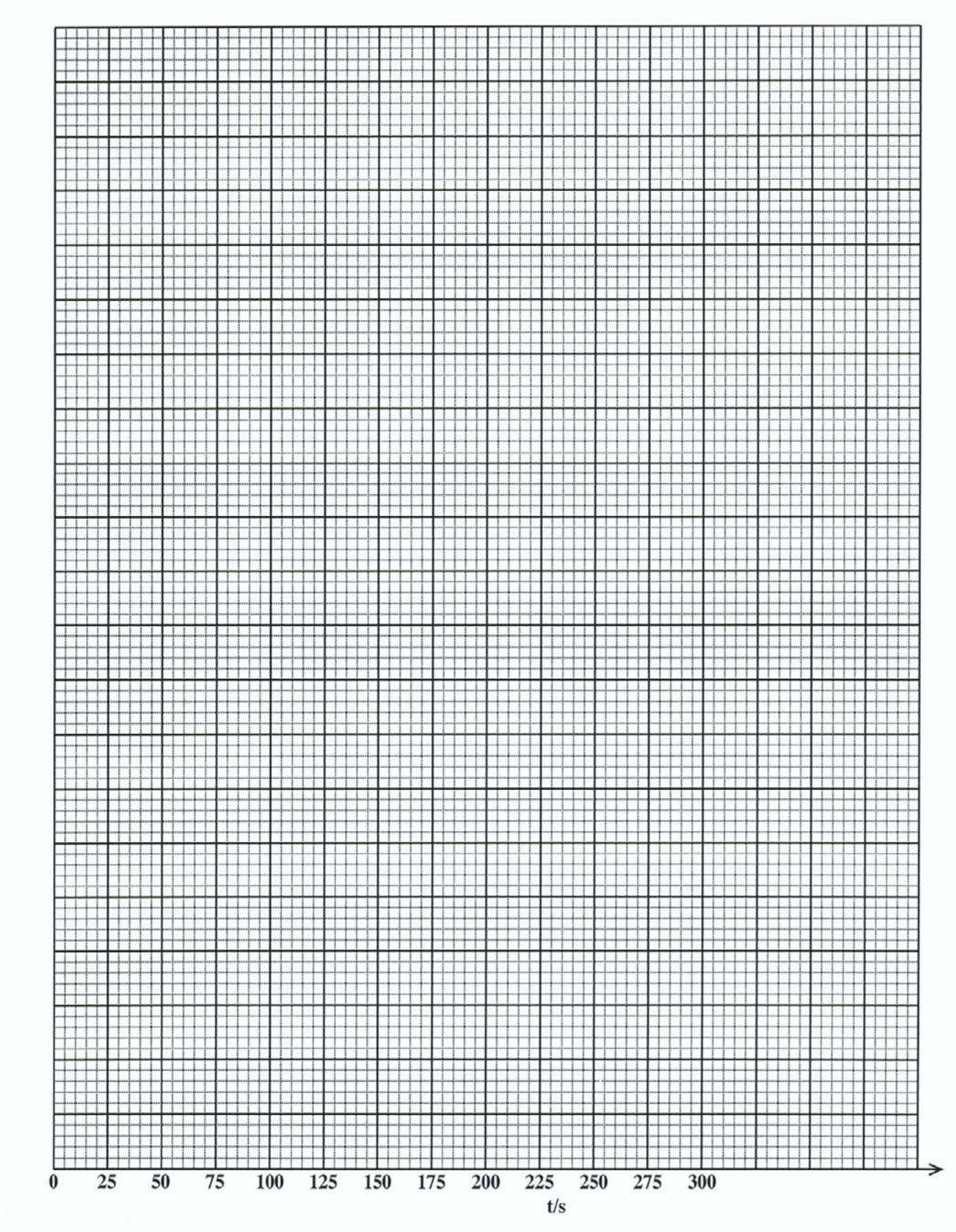
Plot on page 3, a graph of count rate (R) versus time (t).
[7 marks]
What is meant by the 'half-life' of a radioactive sample?
[1 mark]
Describe the procedure a student would use to obtain the results in Table 1. State ONE precaution.
[3 marks]
From the graph, make TWO calculations of the half-life of the sample.
[6 marks]
From your results in (d) (i), calculate the mean (average) half-life.
[2 marks]
Estimate the count rate of the sample after 425 s
[2 marks]
Estimate the count rate of the sample after 4 half-life periods.
[4 marks]
Give the difference between a 'vector quantity' and a 'scalar quantity'.
[1 mark]
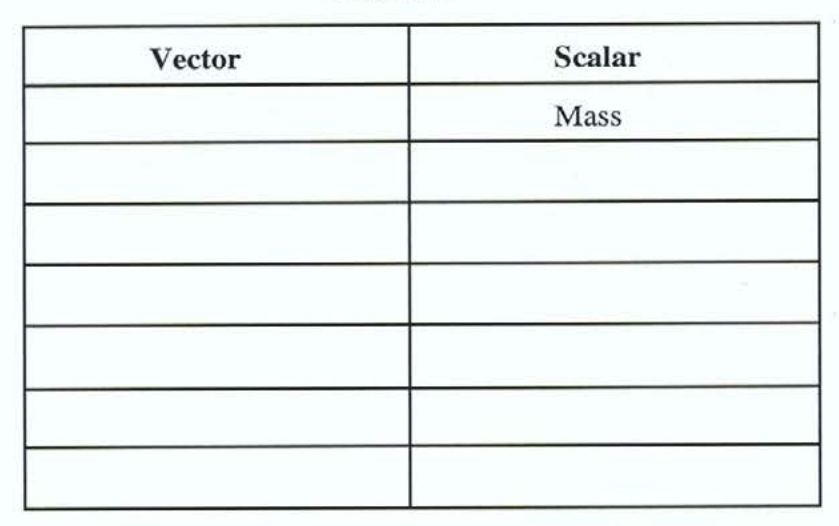
Complete Table 2 by writing EACH of the physical quantities from the list below in the appropriate column:
Mass, Momentum, Displacement, Heat Capacity, Temperature, Half-Life, Upthrust.
TABLE 2
| Vector | Scalar |
|---|---|
| Mass | |
[6 marks]
A taxi reaches a traffic police officer while travelling at on the highway. The officer immediately signals the taxi which decelerates uniformly and comes to a complete stop in 5 s. (Assume zero reaction time.)
[8 marks]
In the space below, draw a velocity-time graph to represent the motion of the taxi from the moment the officer signals, to when the taxi comes to a stop.
[2 marks]
Determine the distance travelled by the taxi from the time the police signals until the taxi stops.
[3 marks]
If the speed limit is , determine whether or not the driver should receive a speeding ticket.
[3 marks]
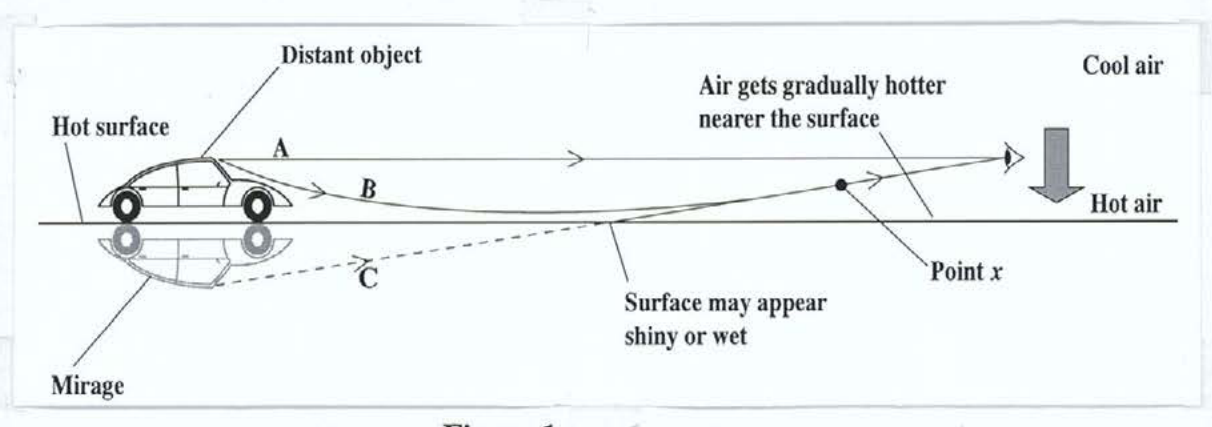
When travelling along a hot road on a hot day a traveller may see a distant object with its image directly below it as shown in Figure 1. The image is called a mirage. Three light rays on the diagram are labelled A, B and C.
<image> Figure 1[10 marks]
Why does Ray A travel in a straight line from the object to the observer?
[1 mark]
What is the name given to the bending of Ray B as it approaches the hot surface?
[1 mark]
With reference to the normal, the temperature and the density of the air, explain the direction of the bending of Ray B at Point x.
[2 marks]
The mirage is a virtual image. With reference to Rays B and C, explain how the mirage is formed and why it is described as a virtual image.
[2 marks]
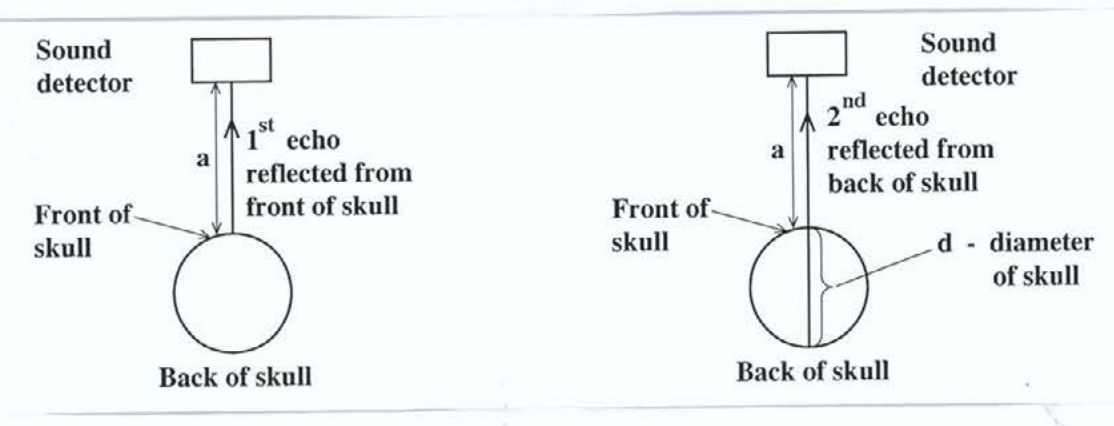
Ultrasounds may be used in determining the growth of a baby in its mother's womb. Sound pulses are directed towards the baby's skull and reflected pulses (echoes) from the front and back of the skull are detected and displayed on an oscilloscope screen, as shown in Figure 2.
<image> Figure 2[15 marks]
In terms of the distances a and d, write an expression for a) the distance travelled by the sound pulse after reflection from the front of the skull to the sound detector
[1 mark]
b) the distance travelled by the sound pulse after reflection from the back of the skull to the sound detector.
[1 mark]
The oscilloscope screen shows that the time between the first and the second echo is . The speed of the sound pulses is .
Determine a) the difference in distance travelled between the first and the second echo
[3 marks]
b) the diameter, d, of the baby's skull.
[1 mark]
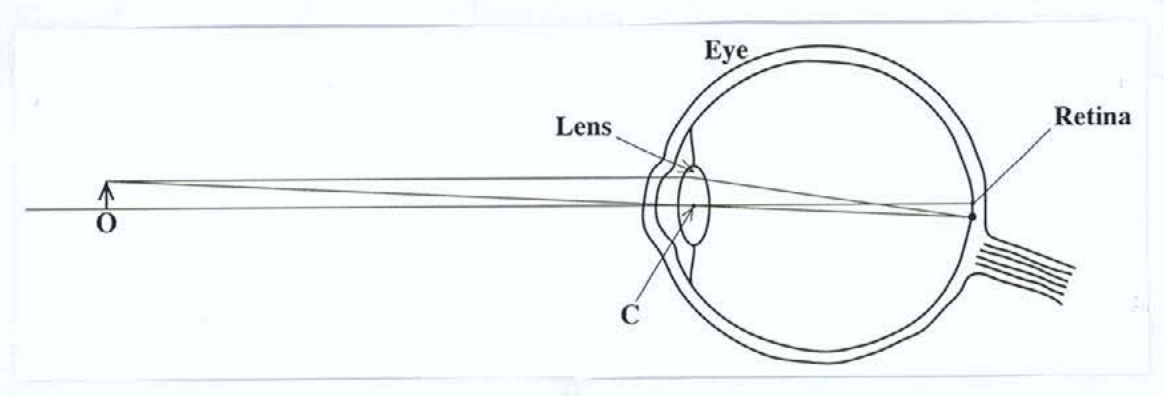
Figure 3 shows how a human eye focuses to see an object O. C represents the optical centre of the lens in the eye.
<image> Figure 3[3 marks]
The object O is from the centre of the eye lens and the magnification of the eye lens is 0.005.
Determine the distance of the retina from the centre of the eye lens.
[3 marks]
Write a formula for calculating the magnification of the eye lens using the object height and the image height
[1 mark]
SECTION B
Answer ALL questions in this space.
You MUST write your answers in the space provided after each question.
[15 marks]
(i) State the law of the conservation of energy. (ii) What is the difference between 'potential energy' and 'kinetic energy'? (iii) Does the fact that heat is lost when work is done against friction violate the law of conservation of energy? Justify your answer.
[6 marks]
State the law of the conservation of energy.
What is the difference between 'potential energy' and 'kinetic energy'?
Does the fact that heat is lost when work is done against friction violate the law of conservation of energy? Justify your answer.
The three-week-long cycling race, the Tour de France, is said to be one of the most gruelling sporting events in the world.
(i) If a cyclist of mass kg uses a bicycle of mass kg, how much work must the cyclist do against gravity in order to ascend to m from sea level ( m)? (ii) One particular descent goes from m to m. Assuming the work done against friction is $90%$ of the potential energy change of the cyclist and the cycle, what INCREASE in speed in km/h can a rider attain by the end of the descent? (iii) What is the average rate of energy conversion of the cyclist and cycle if the descent in part (ii) takes minute at constant speed?
(Acceleration due to gravity, m s)
[9 marks]
If a cyclist of mass kg uses a bicycle of mass kg, how much work must the cyclist do against gravity in order to ascend to m from sea level ( m)?
One particular descent goes from m to m. Assuming the work done against friction is $90%$ of the potential energy change of the cyclist and the cycle, what INCREASE in speed in km/h can a rider attain by the end of the descent?
What is the average rate of energy conversion of the cyclist and cycle if the descent in part (ii) takes minute at constant speed?
(Acceleration due to gravity, m s)
A similar device includes a transformer so that an MP3 player can also be charged. The primary coil has turns.
[6 marks]
How many turns are needed in the secondary winding if the voltage is stepped up from to ?
[3 marks]
Given that the current in the primary winding is , what power is transmitted to the secondary windings if the transformer is $77%$ efficient?
[3 marks]
You are given a container of negligible heat capacity and a thermometer.
Describe how the specific latent heat of fusion of ice can be determined using the method of mixtures.
[6 marks]
A physics student was provided with 25 g of ice to convert to steam. How much heat is needed to change this 25 g of ice at to steam at ? (Specific heat capacity of ice = ) (Specific heat capacity of water = ) (Specific latent heat of vaporisation of water = ) (Specific latent heat of fusion of ice = )
[9 marks]