Free CXC Physics Paper 2 May/June 2026 past paper from 2026. Includes a worked answer key. Open the PDF, take a timed test, and study with AI on Caribbean AI.
Answer keys are free on Caribbean AI. View the answers to every past-paper question at no cost - no payment needed - with step-by-step worked solutions and instant AI marking available on Premium.
CSEC Physics Paper 2 May/June 2026 - Free CXC Past Paper with Answers
Free CXC Physics Paper 2 May/June 2026 past paper from 2026. Includes a worked answer key. Open the PDF, take a timed test, and study with AI on Caribbean AI.
Opening the interactive papers…
Every question from this paper as text. See the answers and worked solutions. Questions are the property of the Caribbean Examinations Council; Caribbean AI is not affiliated with CXC.
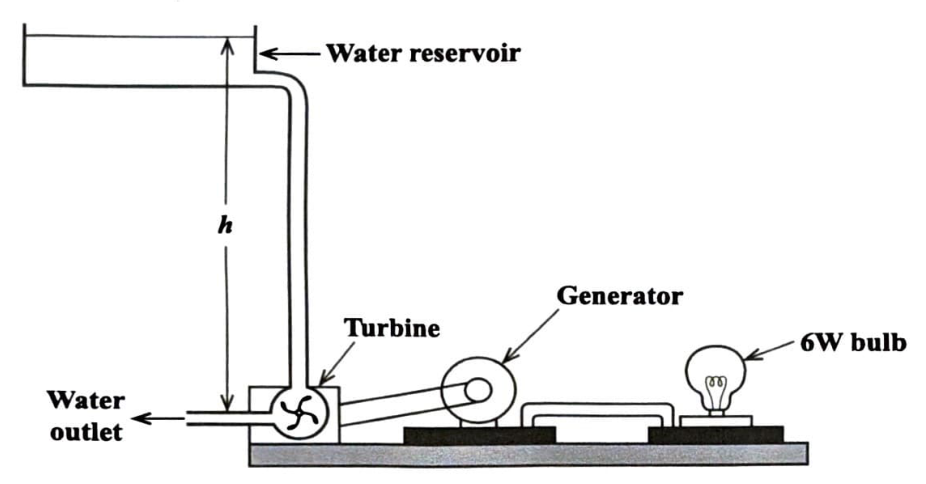
Figure 1 shows a model of a hydroelectric power station. Water from the reservoir flows down and turns the turbine, which is connected to the generator, to produce electrical energy.
[25 marks]
The chart in Figure 2 shows the energy changes that take place during the operation of the turbine in the generation of electricity to light the bulb. Complete the chart by filling in the missing energy types.

[3 marks]
One 6 W bulb is connected as shown in Figure 1. Determine the amount of electrical energy supplied to the bulb in one second.
[1 mark]
Calculate the efficiency of the system if the total power input is 10 W, given that the lamp is at its normal brightness.
[3 marks]
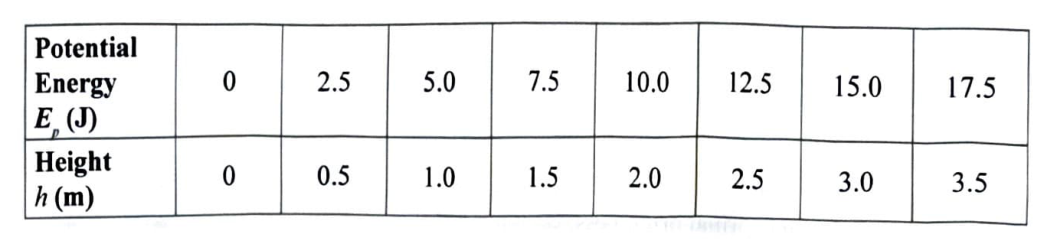
There is a relationship between the brightness of the bulb and the height of the water reservoir. To investigate the most appropriate height for the model, the following results were observed.
TABLE 1: RESULTS FOR POTENTIAL ENERGY OF THE WATER VS HEIGHT OF THE WATER RESERVOIR
| Potential Energy (J) | 0 | 2.5 | 5.0 | 7.5 | 10.0 | 12.5 | 15.0 | 17.5 |
|---|---|---|---|---|---|---|---|---|
| Height (m) | 0 | 0.5 | 1.0 | 1.5 | 2.0 | 2.5 | 3.0 | 3.5 |
There is a relationship between the brightness of the bulb and the height of the water reservoir. To investigate the most appropriate height for the model, the following results were observed.
TABLE 1: RESULTS FOR POTENTIAL ENERGY OF THE WATER VS HEIGHT OF THE WATER RESERVOIR
| Potential Energy | 0 | 2.5 | 5.0 | 7.5 | 10.0 | 12.5 | 15.0 | 17.5 |
|---|---|---|---|---|---|---|---|---|
| Height $h (m)$ | 0 | 0.5 | 1.0 | 1.5 | 2.0 | 2.5 | 3.0 | 3.5 |
Plot a graph of potential energy of the water, , against height, , on the grid in Figure 3 on page 7.
[8 marks]
Using your graph in (d) (i), calculate the slope, , of the line.
[5 marks]
State the conclusion that can be drawn from the graph with respect to the brightness of the lamp and the potential energy of the water in the reservoir. Explain your answer.
Conclusion Explanation
[2 marks]
Calculate the mass of the water in the reservoir given that the slope, , is equal to $mg$, where is the mass of the water and is the acceleration due to gravity. Take to be .
[3 marks]
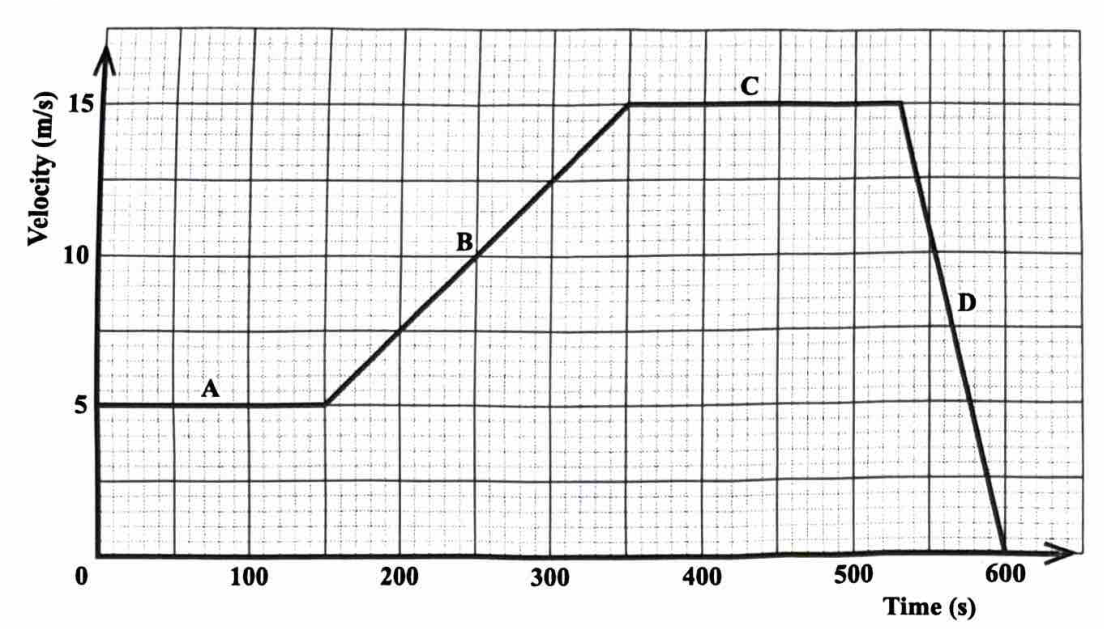
Figure 4 shows the motion (velocity-time graph) of a cyclist's journey during a short ride which is part of his exercise routine.
[15 marks]
Define EACH of the following terms as it relates to motion.
[4 marks]
Displacement
[2 marks]
Acceleration
[2 marks]
The letters A, B, C and D on the graph in Figure 4 represent the various stages of the cyclist’s motion during his journey.
Describe the motion of the cyclist at EACH of the stages labelled A, B and D.
Stage A Stage B Stage D
[3 marks]
Calculate the TOTAL distance travelled by the cyclist during the ten-minute journey, as shown in Figure 4 on page 9.
[4 marks]
Calculate the average speed of the cyclist during the ten-minute journey.
[2 marks]
Determine the deceleration of the cyclist.
[2 marks]
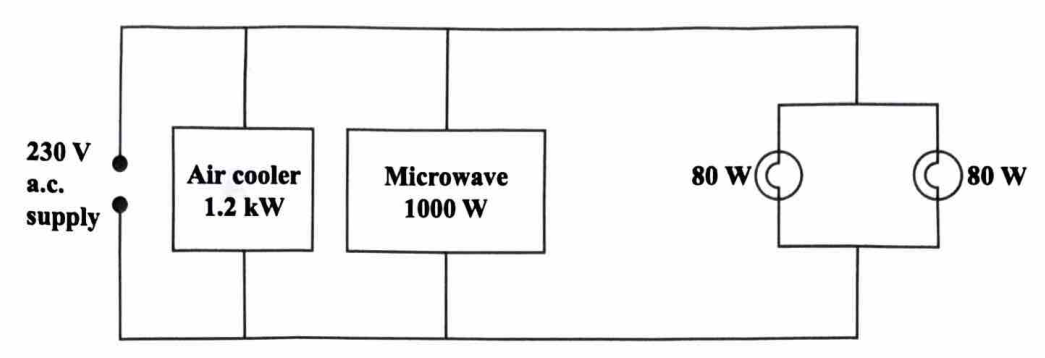
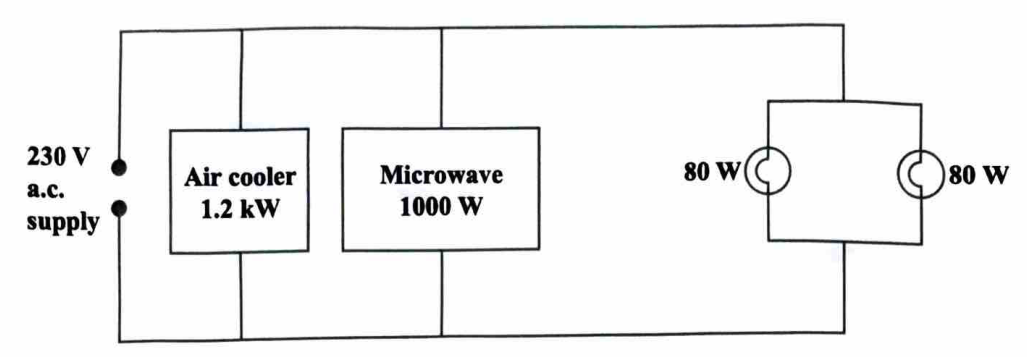
Figure 5 shows a 230 V a.c. mains circuit to which a number of appliances are connected.
Define the term 'power' as an electrical quantity and state the standard unit (SI unit) in which it is measured.
[2 marks]
Calculate the total power which is supplied to the circuit.
[2 marks]
Fill in the blank spaces in the statements below which relate to the manner in which the appliances are connected.
The appliances are connected in ____________________________________________________. As a result, the voltage across each appliance is ____________________________________.
[2 marks]
Suggest ONE advantage of connecting the appliances as shown in Figure 5 on page 10.
[1 mark]
Calculate the current in the microwave.
[2 marks]
A fuse must be used with the microwave. Briefly explain the purpose of the fuse in the electrical circuit.
[2 marks]
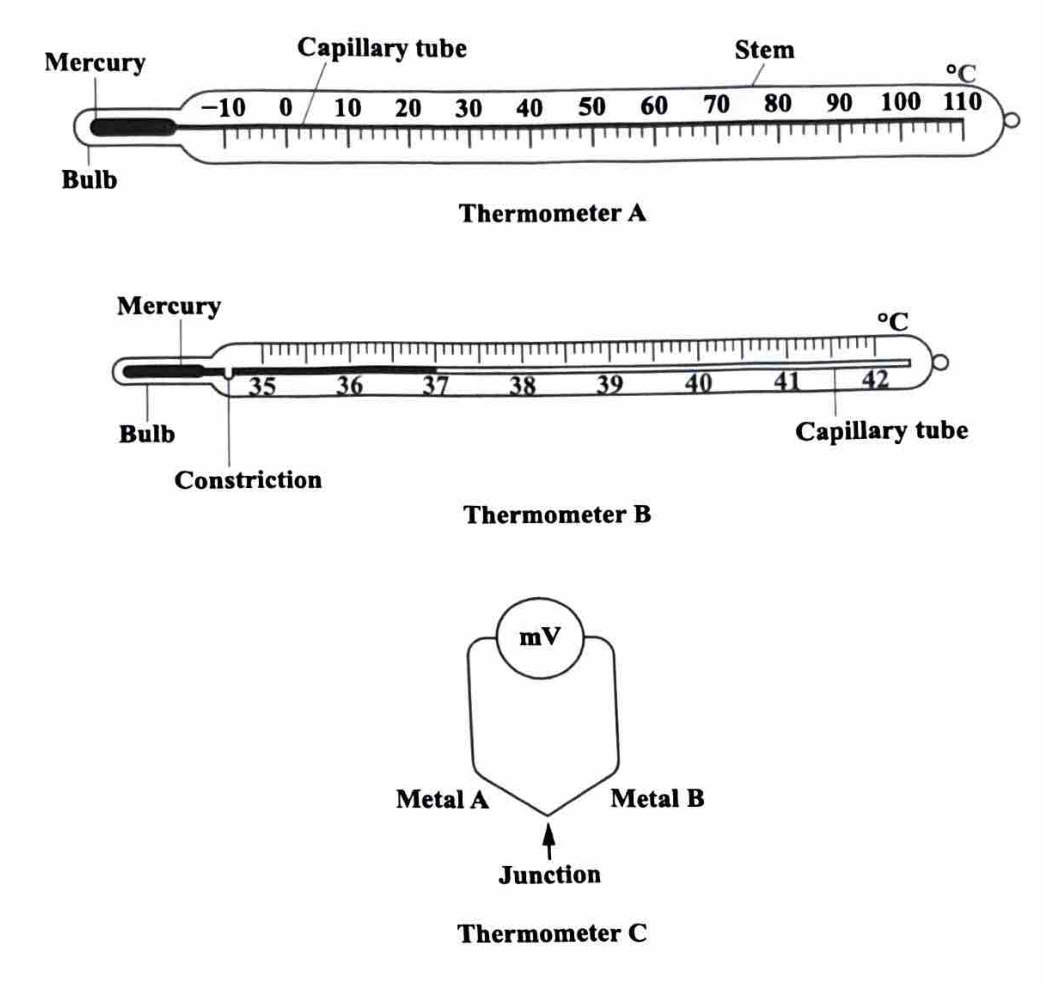
Figure 6 shows the diagrams of three thermometers, A, B and C.
[15 marks]
Identify the three types of thermometers shown in Figure 6. A B C
[3 marks]
State TWO features of Thermometer A which determine the time taken for the thermometer to respond to changes in temperature.
[2 marks]
Determine the physical property employed by Thermometer B, that varies with temperature.
[1 mark]
Using the kinetic theory, explain why the (i) rate of evaporation of water increases with temperature (ii) pressure exerted by a given mass of gas increases when its temperature is raised and its volume is kept constant.
[5 marks]
rate of evaporation of water increases with temperature
[2 marks]
pressure exerted by a given mass of gas increases when its temperature is raised and its volume is kept constant.
[3 marks]
A metal cylinder containing gas is taken out of a refrigerated store maintained at . The pressure in the cylinder was before it was removed.
Calculate the pressure in the cylinder when the surrounding temperature rises to , assuming that the cylinder itself does not expand.
[4 marks]
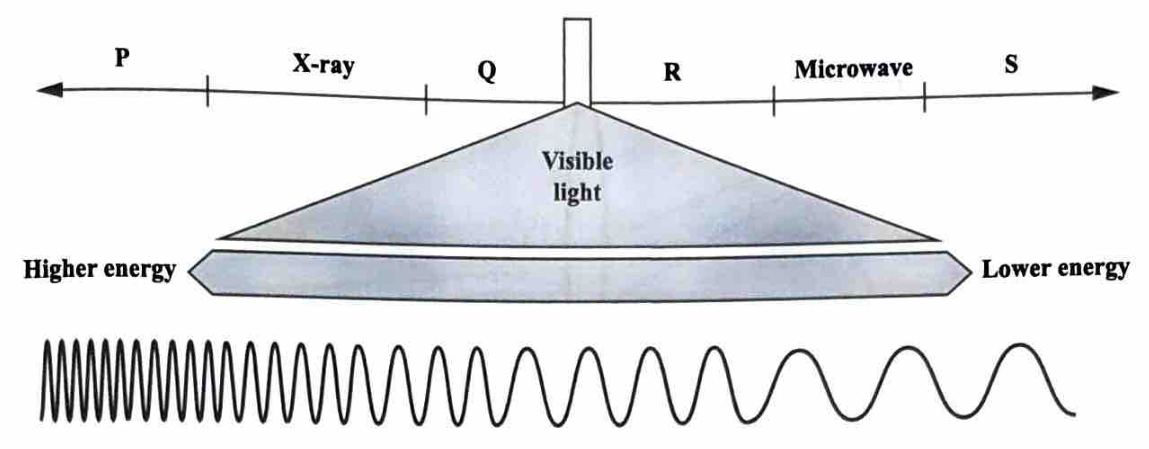
Figure 7 shows a representation of the electromagnetic spectrum.
[6 marks]
Identify the type of radiation in EACH of the regions represented by P, Q, R and S in Figure 7. P Q R S
[4 marks]
X-rays and ultrasound can both be used for scanning internal organs. Explain why ultrasound can be used to scan unborn babies whereas X-rays are NOT used.
[2 marks]
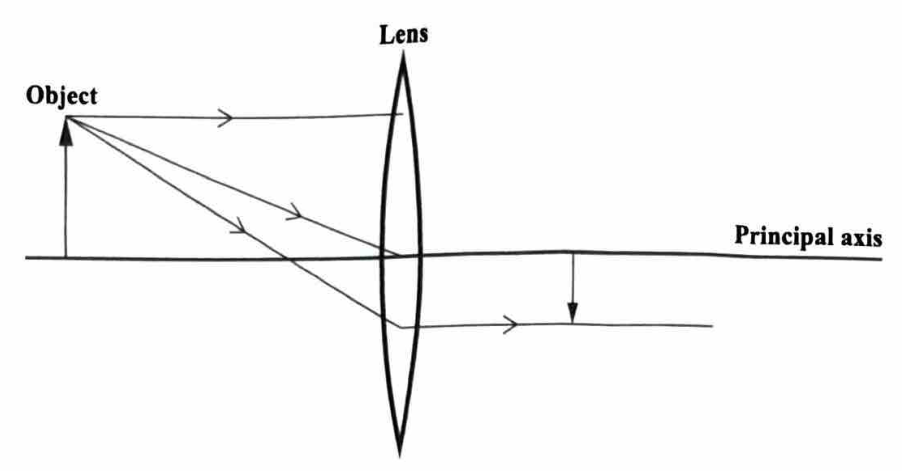
Figure 8 is a diagram (not drawn to scale) which shows three rays emerging from the top of an object. The path of one ray through the lens has been completed on the diagram.
[4 marks]
Define the term 'focal length' with respect to a converging lens.
[2 marks]
On the diagram in Figure 8, complete the paths of the other two rays.
[2 marks]
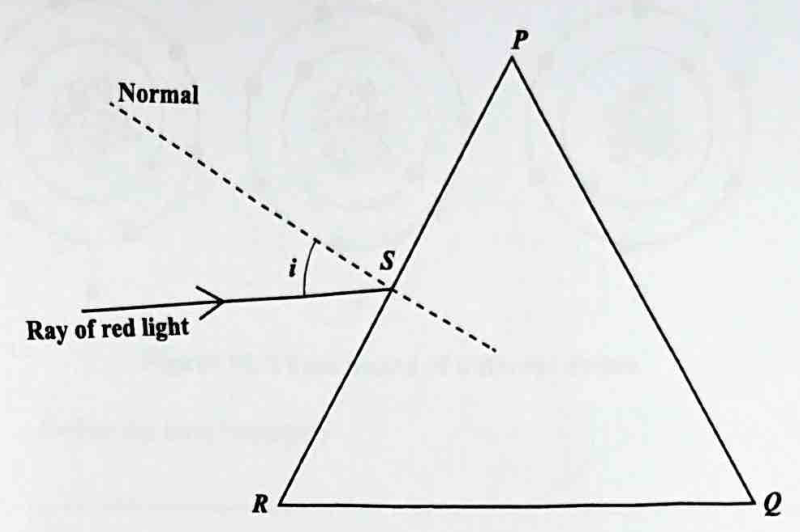
Figure 9 shows a ray of red light from a source incident on the face of a glass prism at point . The source emits visible light.
The angle of incidence, , of the ray is . The refractive index of the glass for red light is .
Calculate, to 3 significant figures, the angle of refraction in the glass at .
[3 marks]
On Figure 9, draw the refracted ray at face and the ray emerging from face of the prism. Label this ray .
[2 marks]
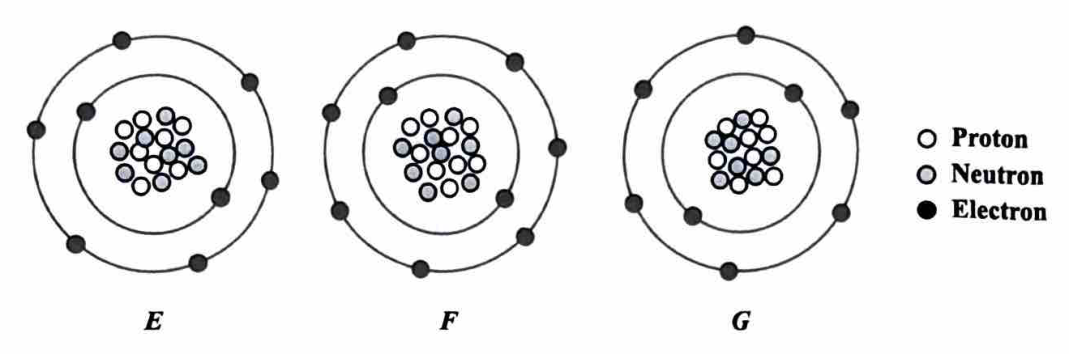
Figure 10 shows three nuclei, , and , of different atoms, two of which are isotopes.
[6 marks]
Define the term 'isotope'.
[2 marks]
Assuming that the chemical element symbol of the three nuclei are , and , as shown in Figure 10, write the nuclide notation of each in the form .
[3 marks]
From Figure 10, identify which atoms are isotopes.
[1 mark]
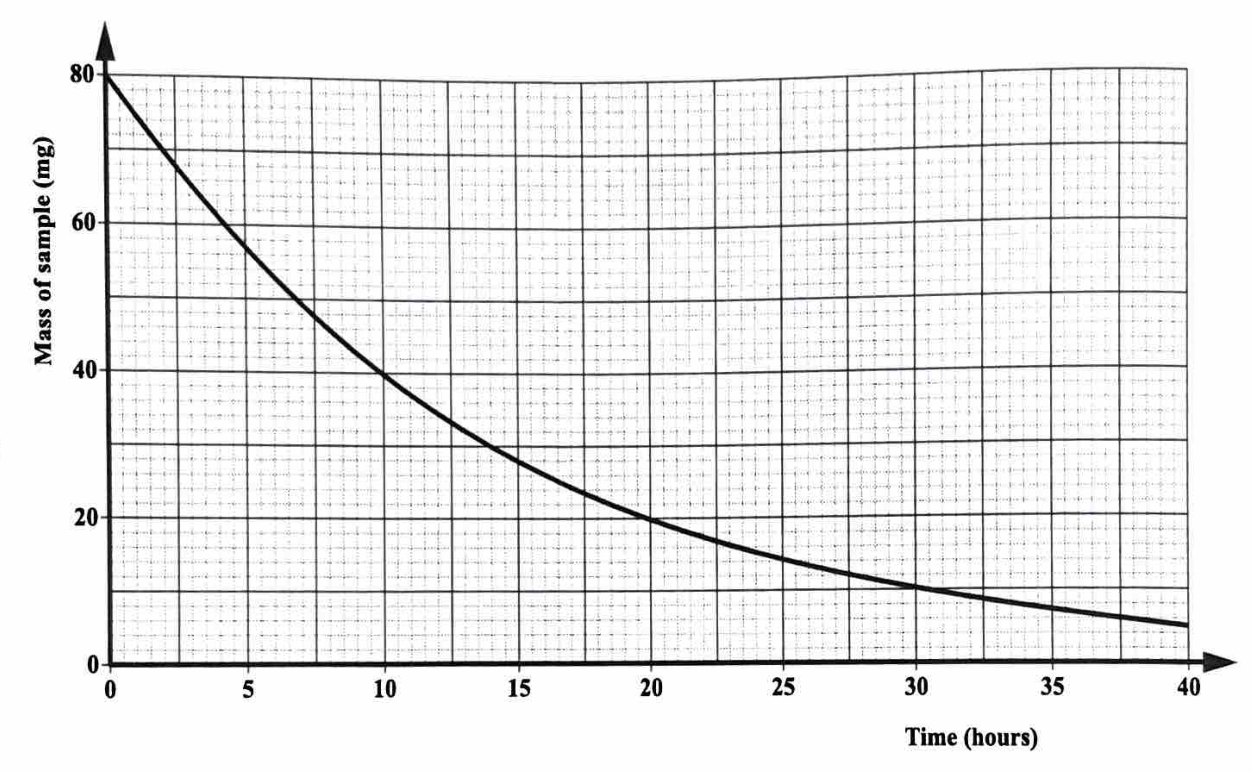
A certain radioisotope is administered just prior to a severe medical procedure. The graph in Figure 11 shows the activity of the sample of the radioisotope given to the patient over a few hours.
[9 marks]
Define the term 'half-life' of a radioactive nuclide.
[2 marks]
Using the graph in Figure 11, and assuming that all the radioactive substance stays in the patient's body, state the original mass of the sample.
[1 mark]
Determine the average half-life of the radioactive substance. Draw lines on the graph, or otherwise, to illustrate your answer.
[4 marks]
Estimate the mass of the radioactive substance that remains after four half-life periods. Show your working.
[2 marks]
[5 marks]