Free CXC Physics Paper 2 May/June 2021 past paper from 2021. Includes a worked answer key. Open the PDF, take a timed test, and study with AI on Caribbean AI.
Answer keys are free on Caribbean AI. View the answers to every past-paper question at no cost - no payment needed - with step-by-step worked solutions and instant AI marking available on Premium.
CSEC Physics Paper 2 May/June 2021 - Free CXC Past Paper with Answers
Free CXC Physics Paper 2 May/June 2021 past paper from 2021. Includes a worked answer key. Open the PDF, take a timed test, and study with AI on Caribbean AI.
Opening the interactive papers…
Every question from this paper as text. See the answers and worked solutions. Questions are the property of the Caribbean Examinations Council; Caribbean AI is not affiliated with CXC.
State Hooke's law.
[3 marks]
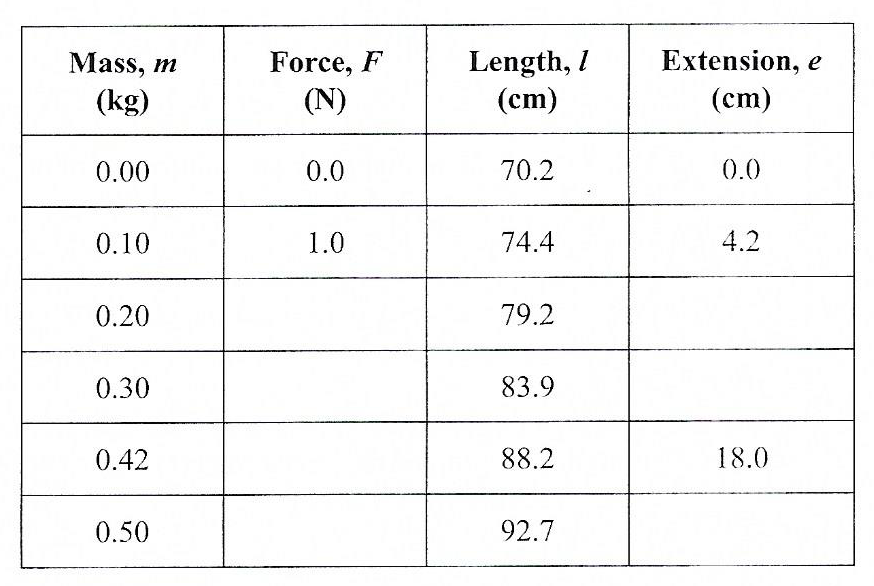
To determine the spring constant (or stiffness) of a spring, a student placed different masses, , on a hanger that was attached to a spring and recorded the length, , of the spring. Table 1 shows the mass and corresponding values of length.
Complete Table 1 by inserting the missing force and extension values in Columns 2 and 4 respectively.
[4 marks]
Using the grid provided in Figure 1 on page 5, plot a graph of extension, , versus force, .
[8 marks]
Calculate the gradient, , of the graph on page 5.
[4 marks]
Given the gradient, , calculate the spring constant, .
[3 marks]
Given that , calculate the length, , when a force of is applied. Assume that the spring obeys Hooke's law.
[3 marks]
Define EACH of the following terms.
Moment of a force
[3 marks]
Centre of gravity
[2 marks]
State the TWO conditions necessary for a body to be in equilibrium.
[2 marks]
Figure 2 shown below is a diagram of a non-uniform wooden plank, , which is long and weighs . The plank is supported from a ceiling by two vertical springs, and . The plank is attached at a distance of from each end. is the centre of gravity as shown in Figure 2.
When the plank is horizontal, the tension in Spring is .
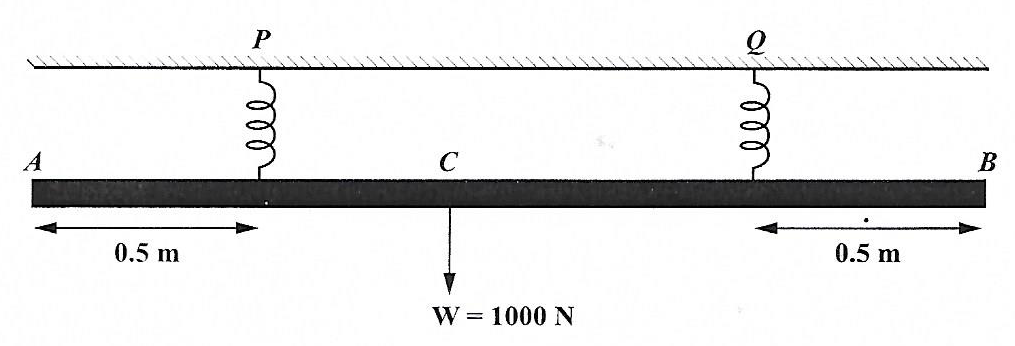
Calculate the tension in Spring . Show ALL working.
[2 marks]
By taking moments about , determine the horizontal distance from to .
[5 marks]
State why the centre of gravity is located closer to the point than the point .
[1 mark]
Waves can be described as transverse or longitudinal.
[4 marks]
Explain what is meant by a 'transverse wave'.
[3 marks]
Give ONE example of a 'transverse wave'.
[1 mark]
Define the term 'ultrasound'.
[2 marks]
State ONE example of the application of ultrasound.
[1 mark]
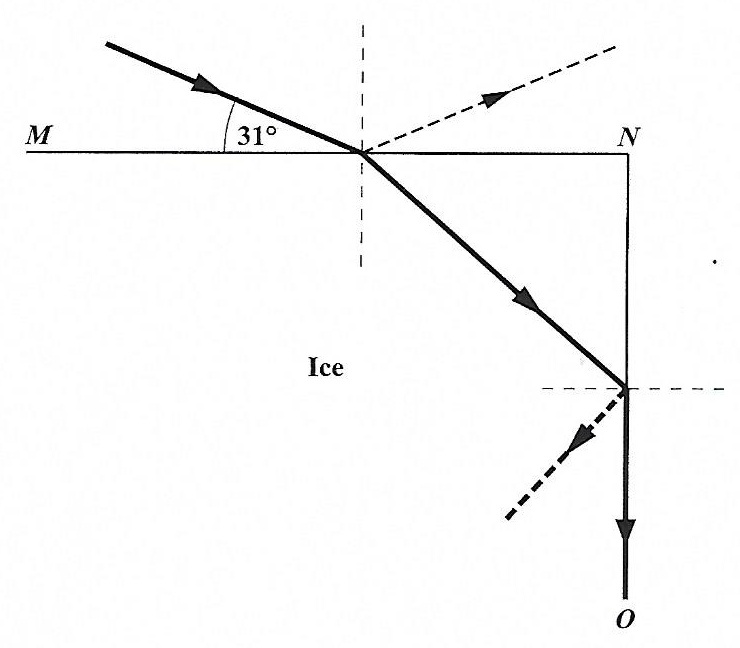
Figure 3 shows the path of a light ray from air through a cube of ice, along with two rays showing partial reflection.
Determine
[2 marks]
the angle of incidence on the face .
[2 marks]
the angle of reflection on the face .
[1 mark]
the angle of refraction at the face , given that the refractive index of ice is 1.31.
[4 marks]
On the diagram in Figure 3 on page 11, label the critical angle, , for ice.
[1 mark]
Answer ALL questions.
On Figure 4 below, sketch the graph of pressure versus temperature (in degrees Celsius) for an ideal gas.
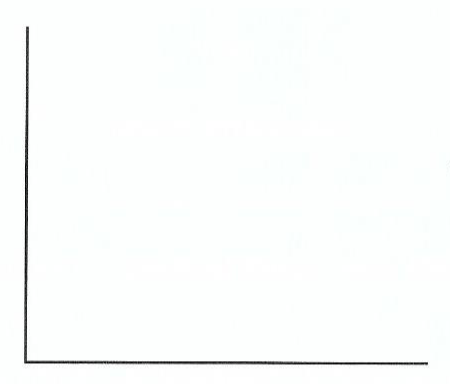
[2 marks]
Explain how the graph could be used to derive the Kelvin scale.
[2 marks]
Using to represent the Kelvin temperature and to represent the Celsius temperature, state the mathematical relationship between the Kelvin and Celsius temperature scales.
[2 marks]
A container stores of gas at a pressure of 13 atmospheres and a temperature of . Calculate the volume that the same gas would occupy at a temperature of and atmospheric pressure of 1 atmosphere.
[5 marks]
Blocks X and Y in Figure 5 are identical except for their temperatures.
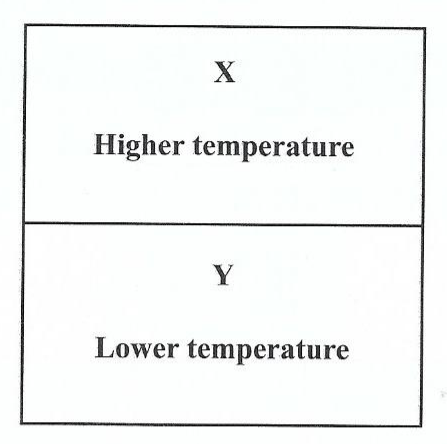
[4 marks]
Explain the difference in the motion of the particles in Block X compared with the motion of the particles in Block Y.
[2 marks]
In which direction would thermal energy be transferred?
[1 mark]
State the condition under which the transfer of thermal energy would cease.
[1 mark]
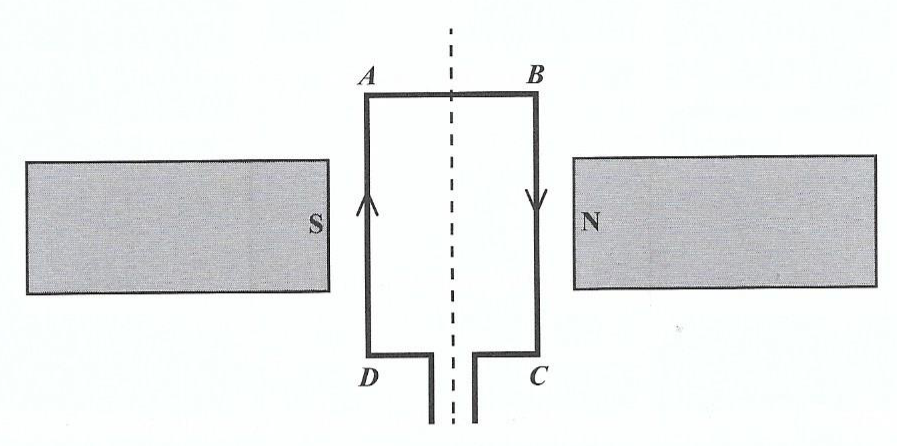
Figure 6 shows a simple d.c. motor which consists of a coil of wire, , between the poles of a magnet. The dotted line represents an axle about which the coil can turn. A current flows through the coil in the direction shown by the arrows.
[10 marks]
Draw the magnetic field between the poles of the magnet on Figure 6.
[2 marks]
State the direction in which side of the coil will move as the current starts flowing through the circuit.
[1 mark]
Name the rule used to determine the direction in which side of the coil moves.
[1 mark]
Explain why a split-ring (commutator) is used in a d.c. motor.
[2 marks]
Figure 7 shows a graph of the variation of voltage with time across the output terminals of an a.c. generator.
[4 marks]
Calculate the value of the frequency for the generator.
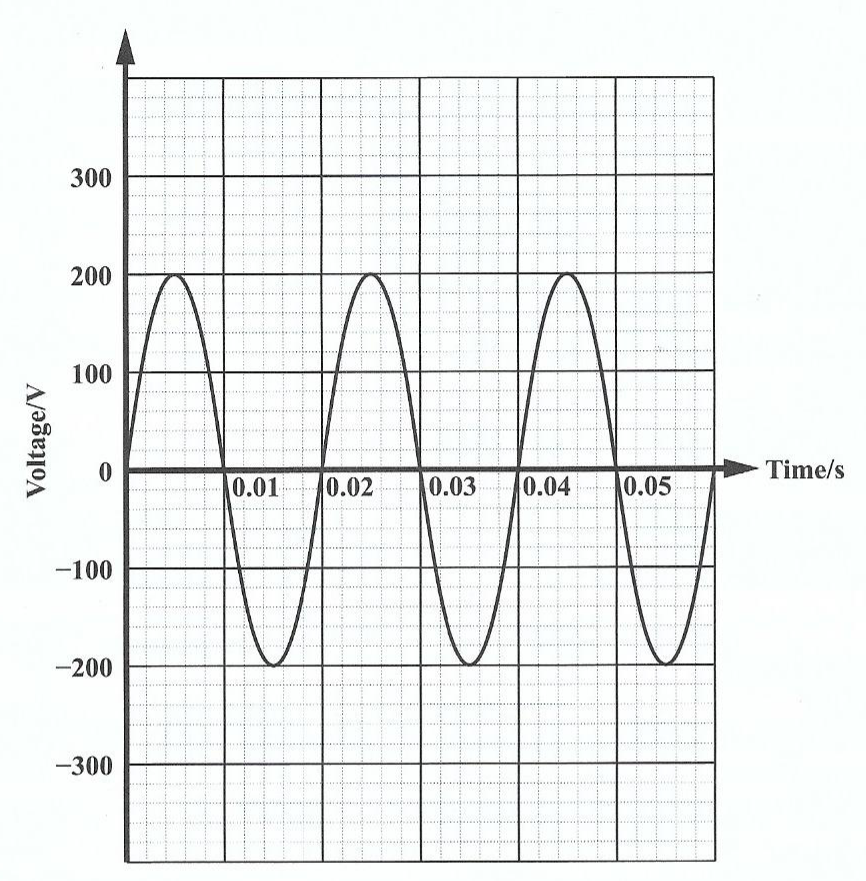
[3 marks]
The peak voltage is applied by the generator across a resistor. Calculate the peak value of the current in the resistor.
[3 marks]
The generator is subsequently rotated at twice the frequency in (b) (i). State the effect this will have on
[3 marks]
the period of the output
[2 marks]
the value of the output voltage.
[1 mark]
Radium-226 is radioactive and is represented by the nuclide .
[15 marks]
For a neutral atom of Radium-226, state
[3 marks]
the number of protons
[1 mark]
the number of neutrons
[1 mark]
the number of electrons.
[1 mark]
A Radium-226 nucleus decays by -particle emission to Radon (Rn) nucleus.
[5 marks]
Explain what is meant by the term 'radioactivity'.
[3 marks]
Complete the equation for the decay of Radium-226.
[2 marks]
Radium-226 has a half-life of 1600 years.
[7 marks]
Define the term 'half-life'.
[2 marks]
At a certain time, a sample contains Radium nuclei. Calculate the number of -particles emitted by the Radium nuclei in the next 4800 years.
[4 marks]
How much more time will elapse before the number of Radium nuclei remaining falls to ?
[1 mark]